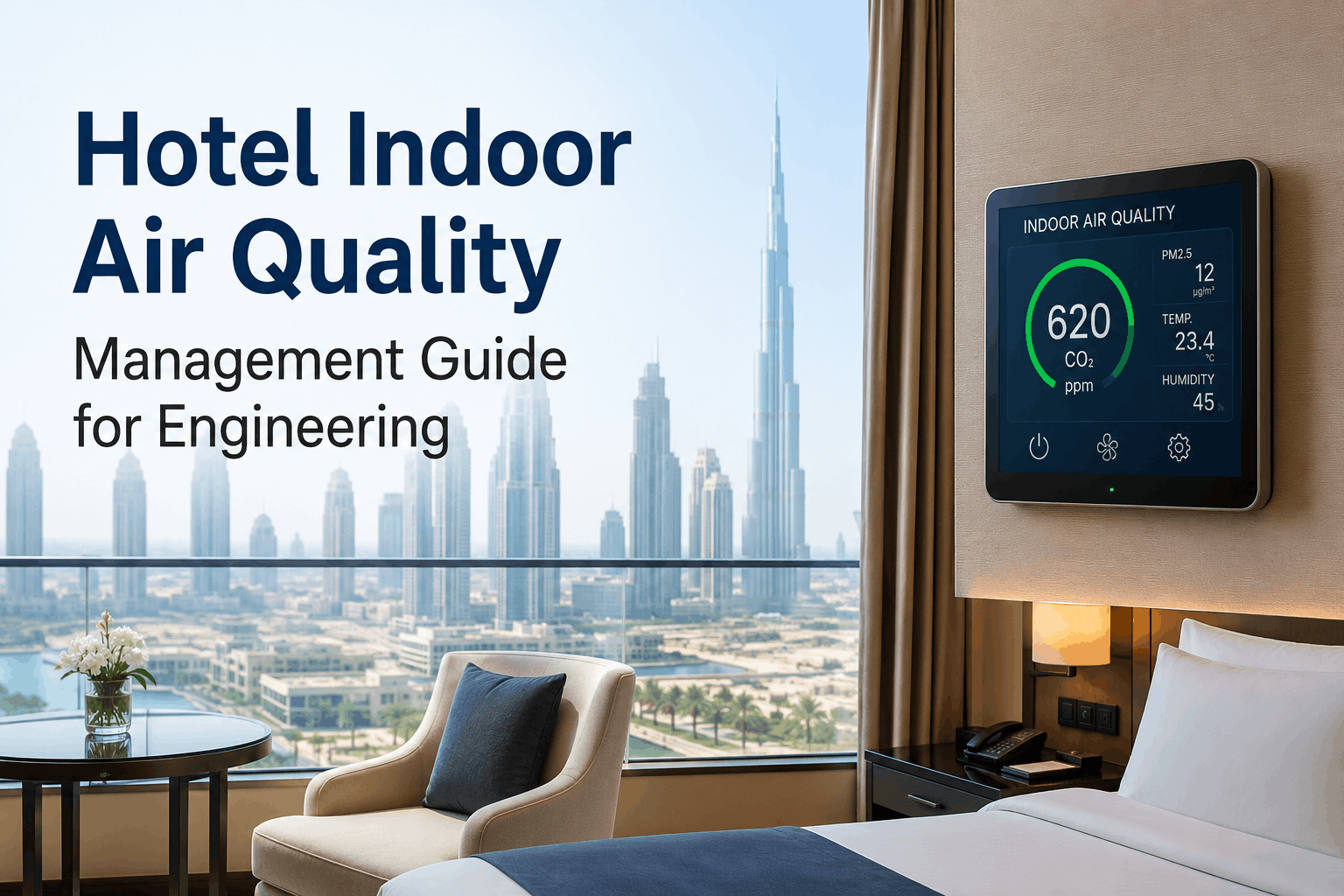
Hotel guests do not complain about the air — they just leave bad reviews, request room changes, and never come back. Poor indoor air quality is one of the most underdiagnosed drivers of guest dissatisfaction in hospitality, yet most hotels manage their HVAC systems reactively, replacing filters on a calendar schedule and responding to complaints rather than monitoring conditions proactively. This guide breaks down the maintenance strategies, filtration standards, ventilation protocols, and humidity controls that keep hotel air genuinely clean — and shows how an IAQ monitoring dashboard catches problems before guests ever notice them. Start your free trial on Oxmaint or book a live demo to see how leading hotels are managing air quality proactively across every zone.
62%
of hotel guest air quality complaints traced to unmaintained HVAC filters and coils
30%
energy savings achievable with properly maintained HVAC filtration and airflow systems
48hr
average time for Legionella and mold to establish in untreated stagnant HVAC condensate
3x
higher guest satisfaction scores in hotels with documented proactive IAQ programs
Why Hotel Indoor Air Quality Is a Maintenance Problem — Not a Hardware Problem
Most hotels that struggle with IAQ already have adequate HVAC equipment. The problem is maintenance — filters replaced on fixed calendars rather than actual pressure drop readings, coils cleaned annually instead of when fouling is detected, and humidity drift that goes unmonitored for weeks before anyone notices. IAQ is not something you install. It is something you maintain.
01
Clogged Filters Restricting Airflow
A filter past its service life reduces supply air volume by 25 to 40 percent — dropping zone ventilation below the ASHRAE 62.1 minimum required for guest occupancy and triggering stale air complaints before any measurement is taken.
02
Fouled Coils Degrading Air Quality
Biofilm and particulate buildup on cooling coils reduces heat transfer efficiency and becomes a breeding surface for mold and bacteria. Contaminated coil air passes directly into guest rooms — invisible on a maintenance calendar.
03
Uncontrolled Humidity Drift
Relative humidity above 60 percent creates conditions for mold growth within 24 to 48 hours. Humidity below 30 percent causes respiratory irritation in guests. Both extremes appear in hotels with no humidity monitoring in place.
04
Inadequate Fresh Air Delivery
Outside air dampers that drift closed — from failed actuators, dirty linkages, or incorrect setpoints — silently remove the fresh air dilution that ASHRAE 62.1 requires. CO2 rises, guests feel tired and complain of headaches, and no alert fires.
Stop managing hotel air quality by complaint
Oxmaint's IAQ monitoring dashboard tracks filtration status, humidity levels, CO2 readings, and ventilation compliance across every zone — with automatic alerts before conditions affect guests.
The IAQ Stack: Five Layers That Must All Work Together
Hotel air quality is not a single system — it is a stack of five interdependent maintenance layers. A failure in any one layer degrades the entire outcome. Proactive IAQ management means tracking and maintaining all five simultaneously, not addressing them in isolation when a complaint surfaces.
L1
Filtration — The Primary Barrier
MERV-rated filters capture particulates, allergens, and biological contaminants before they enter occupied zones. Filter condition must be tracked by pressure differential — not by calendar date — to reflect actual loading conditions and occupancy patterns.
MERV 13 minimum for guest areas
Pressure differential monitoring
Pre-filter and final filter tracking
L2
Ventilation — Fresh Air Delivery
Outside air dampers, economizer controls, and minimum ventilation setpoints must be verified at regular intervals against ASHRAE 62.1 requirements. CO2 monitoring by zone provides continuous proof of adequate fresh air delivery.
Damper actuator inspection
CO2 monitoring by zone
ASHRAE 62.1 compliance
L3
Humidity Control — The Mold Boundary
Maintaining relative humidity between 40 and 60 percent year-round prevents mold growth and respiratory irritation simultaneously. Chilled water valve condition, drain pan maintenance, and dehumidifier calibration are all critical maintenance inputs to this layer.
40 to 60% RH target range
Drain pan and condensate management
Dehumidifier calibration
L4
Coil and Duct Cleanliness
Contaminated cooling coils and supply ducts distribute biological particles and VOCs directly into occupied spaces. Coil cleaning frequency should be driven by leaving-air temperature deviation and pressure drop data — not solely by annual service schedules.
Coil leaving-air temp monitoring
Duct inspection cycle
Biological growth prevention
L5
IAQ Monitoring and Alert System
Continuous monitoring of CO2, particulates, humidity, and temperature — with automatic alerts when any parameter drifts outside the acceptable range — is the layer that makes the other four proactive rather than reactive. Without monitoring, every IAQ failure is discovered by a guest first.
CO2, PM2.5, humidity, VOC sensors
Zone-level alerting
Maintenance trigger automation
IAQ Parameter Benchmarks: What Good Hotel Air Actually Looks Like
These are the measurable standards that define acceptable hotel indoor air quality. A reading outside any of these ranges is an active guest comfort and compliance risk — and a signal that a specific maintenance action is required.
CO2 Concentration
Below 1,000 ppm
Good: Under 800 ppm
Action: Above 1,000 ppm
Elevated CO2 above 1,000 ppm signals inadequate fresh air delivery. Root cause is typically a failed outside air damper or incorrect minimum ventilation setpoint.
Relative Humidity
40% to 60% RH
Good: 45 to 55% RH
Action: Above 60% or below 30%
Humidity above 60% for more than 24 hours creates mold growth conditions. Below 30% causes respiratory irritation. Both trigger guest complaints.
PM2.5 Particulates
Below 12 ug/m3
Good: Under 8 ug/m3
Action: Above 12 ug/m3
Fine particulate above 12 ug/m3 indicates filter bypass, clogged pre-filters, or duct contamination. Maintenance trigger should fire automatically at this threshold.
Filter Pressure Differential
Within 0.1 to 0.5 in. w.g.
Clean: 0.1 in. w.g. baseline
Replace: Above 0.5 in. w.g.
Pressure drop above 0.5 in. w.g. over clean baseline means the filter is loaded — regardless of calendar date. Tracking by differential ensures replacement when needed, not when scheduled.
Supply Air Temperature
52 to 58 F in cooling
Design: 55 F at full load
Investigate: Above 58 F at load
Supply air above 58 F during cooling demand signals coil fouling, low chilled water flow, or a valve not opening fully — all of which reduce zone conditioning and humidity control.
Outside Air Percentage
15% to 30% of supply
ASHRAE minimum met
Action: Below ASHRAE 62.1 minimum
Outside air below the ASHRAE 62.1 ventilation minimum for the zone's occupancy creates a compliance violation and CO2 accumulation. Verify damper position and actuator stroke monthly.
See every IAQ parameter across every hotel zone in one dashboard
Oxmaint's IAQ monitoring dashboard tracks CO2, humidity, particulates, filter status, and ventilation compliance in real time — with automatic maintenance alerts before any parameter affects guests.
Book a Demo
HVAC Filtration Tracking: Why Calendar Replacement Fails Hotel IAQ
A filter that is changed every 90 days regardless of actual loading condition is either changed too early — wasting cost — or changed too late — after airflow and air quality have already degraded. Occupancy events, renovation dust, and seasonal pollen loads mean the same filter can be fully loaded in 3 weeks or still adequate at 16 weeks depending on conditions. Pressure differential tracking is the only reliable signal.
Calendar-Based Replacement
Fixed 90-day schedule regardless of actual filter loading or occupancy level
Filters replaced early during low-occupancy periods — unnecessary cost
Filters run past service life during high-occupancy events — degraded IAQ
No record of actual pressure differential at replacement — no trend data
MERV rating not verified on replacement — wrong filter installed goes undetected
IAQ drift is invisible until a guest complains or an inspector visits
Pressure Differential Tracking with Oxmaint
Replacement triggered by actual pressure drop reading — not calendar date
Filter change work order auto-generated when differential exceeds 0.5 in. w.g.
Every replacement logged with MERV rating, size, date, and technician sign-off
Trend data by unit shows which zones have higher loading — informing procurement
Filter history per asset stored in CMMS — available for insurer and auditor review
IAQ dashboard confirms improved particulate readings after each filter change
Zone-by-Zone IAQ Priorities: Not All Hotel Areas Are Equal
IAQ maintenance is not one-size-fits-all across a hotel. Each zone has different occupancy density, different contaminant sources, and different ventilation requirements. Treating the fitness centre the same as the guest corridor — or the kitchen the same as the boardroom — guarantees that at least one zone is always under-maintained.
MERV 13
Minimum Filter Grade
800 ppm
CO2 Alert Threshold
45-55%
Target Humidity Range
Guest rooms are the highest-sensitivity IAQ zone — occupants are stationary for 6 to 8 hours and any odor, stuffiness, or humidity issue generates a direct complaint. FCU filter condition and drain pan maintenance are the top maintenance priorities.
MERV 11
Minimum Filter Grade
900 ppm
CO2 Alert Threshold
Weekly
Filter Check Frequency
High footfall zones carry heavy particulate loads from foot traffic, outdoor air ingress, and event activity. Filter loading rates are highly variable — pressure differential monitoring is essential. Entrance matting and door seal condition directly affect AHU loading.
MERV 13
Minimum Filter Grade
1,000 ppm
CO2 Alert Threshold
55% max
Humidity Hard Limit
Fitness centres generate high CO2, moisture, and odor loads relative to their floor area. Spa and pool areas require dedicated humidity management systems. Drain pan and condensate line maintenance is critical to prevent Legionella risk in these zones.
MERV 13
Minimum Filter Grade
900 ppm
CO2 Alert Threshold
Demand
Ventilation Control
Meeting rooms swing from unoccupied to maximum density within hours. Demand-controlled ventilation linked to occupancy sensors prevents CO2 buildup during events. Pre-event IAQ confirmation is a critical quality step for high-occupancy bookings.
Before vs. After: What Proactive IAQ Management Delivers
Reactive IAQ Management
Filter replacement on fixed calendar — loading condition unknown between changes
CO2 and humidity drift undiscovered until guest complaints surface
Coil cleaning annual regardless of fouling level or leaving-air temperature trend
Damper positions unverified — outside air delivery unknown between inspections
No zone-level IAQ data — every complaint is investigated from scratch
Negative reviews citing stuffiness, odors, and air quality with no proactive response
Proactive IAQ with Oxmaint
Filter replacement triggered by pressure differential — every change logged with MERV and date
CO2 and humidity monitored continuously — alerts fire before guest threshold is reached
Coil cleaning triggered by leaving-air temperature deviation from design — condition-based
Damper position and outside air percentage verified monthly — compliance documented
Zone IAQ dashboard shows live parameter status — maintenance dispatched before complaints
Guest satisfaction scores 3x higher — air quality issues resolved before check-in
How Oxmaint Powers Hotel IAQ Management
Hotels managing indoor air quality through disconnected spreadsheets, fixed-calendar schedules, and reactive complaint handling are leaving guest satisfaction on the table and running up energy costs that proper filtration tracking would prevent. Oxmaint connects IAQ monitoring, HVAC filtration tracking, and air quality alert management in one platform designed for hotel building systems teams. Start for free and build your first IAQ monitoring dashboard today.
IAQ Monitoring Dashboard
Live zone-level view of CO2, humidity, PM2.5, filter status, and ventilation compliance across every hotel area — with automatic alerts when any parameter drifts outside the acceptable range before guest impact occurs.
HVAC Filtration Tracking
Filter pressure differential logged per unit. Replacement work orders auto-generated when differential exceeds threshold. Every filter change recorded with MERV rating, date, technician, and post-change pressure baseline.
Air Quality Alerts
Automatic notifications when CO2 rises above zone thresholds, humidity exceeds limits, particulate loading triggers filter replacement, or supply air temperature deviates from design — all linked to the correct maintenance work order.
Ventilation Compliance Tracking
Damper position checks, outside air percentage verification, and ASHRAE 62.1 minimum ventilation confirmation — scheduled automatically and documented digitally for each air handling unit and fan coil unit across the property.
Humidity and Condensate Management
Humidity reading trends stored per zone. Drain pan inspection and condensate flush tasks auto-scheduled. High-humidity alerts link directly to chilled water valve and dehumidifier inspection work orders — closing the loop automatically.
Condition-Based Coil Maintenance
Coil leaving-air temperature and pressure drop tracked per AHU. Cleaning work orders generated when performance deviates from design baseline — not on a fixed annual schedule — reducing both over-maintenance costs and IAQ failures.
Build a Hotel IAQ Program That Works Before Guests Complain
Oxmaint gives hotel building systems teams the IAQ monitoring dashboard, HVAC filtration tracking, and air quality alert tools needed to maintain genuinely clean air across every zone — not just pass the next inspection. Real-time visibility, condition-based maintenance triggers, and complete documentation — built for hospitality operations that take guest experience seriously.
Frequently Asked Questions
What MERV rating should hotel HVAC filters be?
Guest rooms and meeting spaces should use a minimum of MERV 13 filtration to capture fine particulates, allergens, and biological particles at the level required for occupied sleeping areas. Lobbies and back-of-house areas typically use MERV 11 as a baseline. MERV 8 pre-filters are used upstream of final filters to extend final filter life — both stages require separate pressure differential monitoring.
How often should hotel HVAC filters be replaced?
Calendar-based replacement — every 30, 60, or 90 days — is an unreliable proxy for actual filter loading. The only accurate trigger is pressure differential: replace the pre-filter when differential exceeds 0.5 in. w.g. above the clean baseline, and the final filter when it reaches its rated pressure drop. High-occupancy events, renovation activity, and seasonal pollen all accelerate loading — making differential tracking essential for consistent IAQ and cost control.
What causes musty odors in hotel guest rooms?
Musty odors in guest rooms are almost always caused by one of three maintenance failures: standing water in the FCU drain pan allowing mold to establish, humidity above 60 percent in the room creating surface condensation, or biological growth on the FCU cooling coil fins. All three are preventable through monthly drain pan inspection and flush, humidity monitoring with alerts at 60 percent, and quarterly coil cleaning driven by temperature performance data.
What is demand-controlled ventilation and should hotels use it?
Demand-controlled ventilation adjusts outside air delivery based on actual occupancy — typically using CO2 sensors as the proxy for occupant density. It is highly recommended for hotel meeting rooms and banquet spaces that swing from empty to fully occupied within hours. DCV prevents CO2 buildup during high-occupancy events and eliminates the energy waste of delivering maximum outside air to empty spaces. ASHRAE 62.1 now recognizes DCV as an approved compliance pathway for variable-occupancy spaces.
How does Oxmaint's IAQ monitoring dashboard work for hotels?
Oxmaint's IAQ monitoring dashboard aggregates CO2 readings, humidity levels, filter pressure differential data, and HVAC performance metrics from across the property into a single zone-level view. When any parameter exceeds its alert threshold — a humidity spike in a guest floor, a CO2 rise in a meeting room, or a filter differential triggering replacement — the system automatically creates a maintenance work order assigned to the correct technician, with the asset history and acceptance criteria attached. Every reading and every action is logged for compliance documentation.