Guest room inspection compliance export is the dividing line between hotels that breeze through brand audits and those that scramble for three days assembling PDFs from six disconnected systems. A purpose-built CMMS turns every room check, timestamp, and deficiency photo into a structured, auditable record that can be exported on demand in minutes — not patched together the night before a QA visit. For properties managing 200+ keys across multiple brands, the cost of failed or conditional audit scores compounds quickly in rev-par penalties, franchise non-compliance fees, and reputational drag on OTA rankings. This guide walks through the CMMS architecture, verification standards, and export workflows that make audit-ready records the default state rather than a quarterly fire drill. You can Start Free Trial to see the compliance export module configured for your portfolio.
Can your team produce a complete, photo-verified inspection record for any guest room in under five minutes?
Brand auditors arrive with a 240-point checklist and 48 hours. Most hotels spend 3–4 days compiling records from paper logs, email threads, and shared drives — and still lose 8–12 points on documentation gaps. A CMMS-built compliance export closes that gap permanently by making the audit record a byproduct of daily operations, not a separate project.
Every room check becomes a permanent, queryable compliance record
A CMMS inspection archive stores each guest room check as a structured object — room number, inspector ID, checklist version, line-item results, deficiency codes, attached photos with EXIF timestamps, resolution status, and supervisor sign-off — indexed for instant retrieval during any audit window.
Structured capture at the door
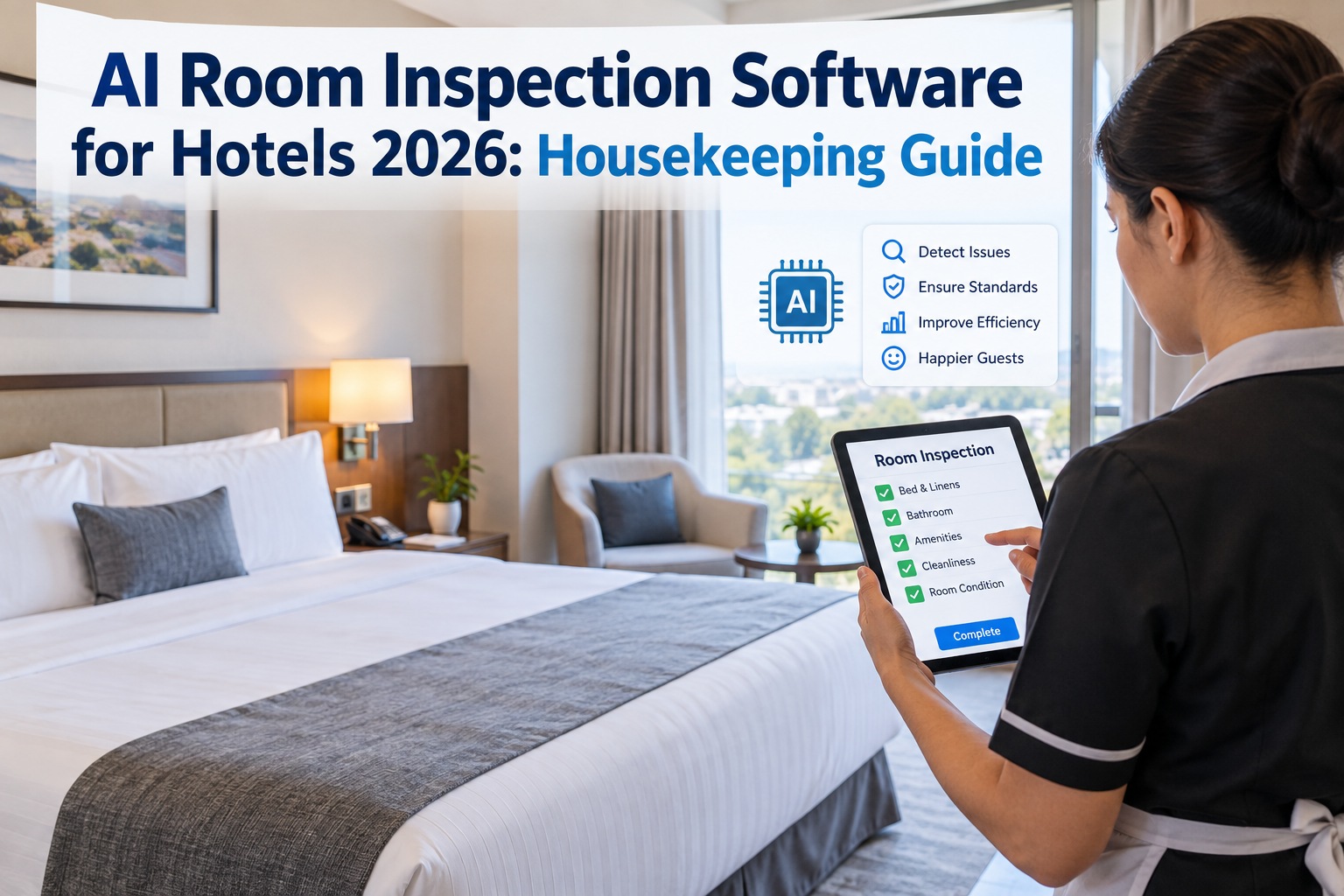
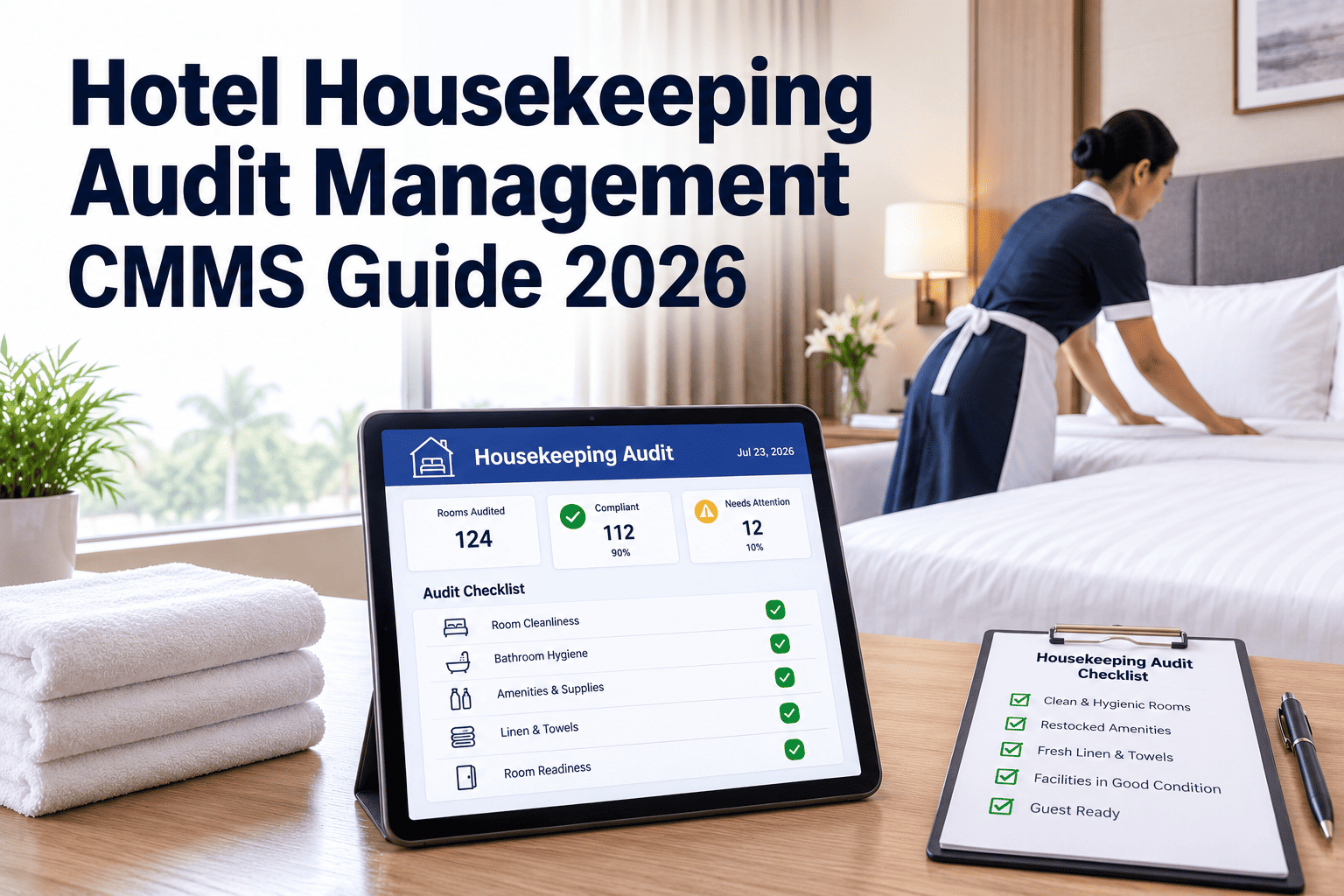
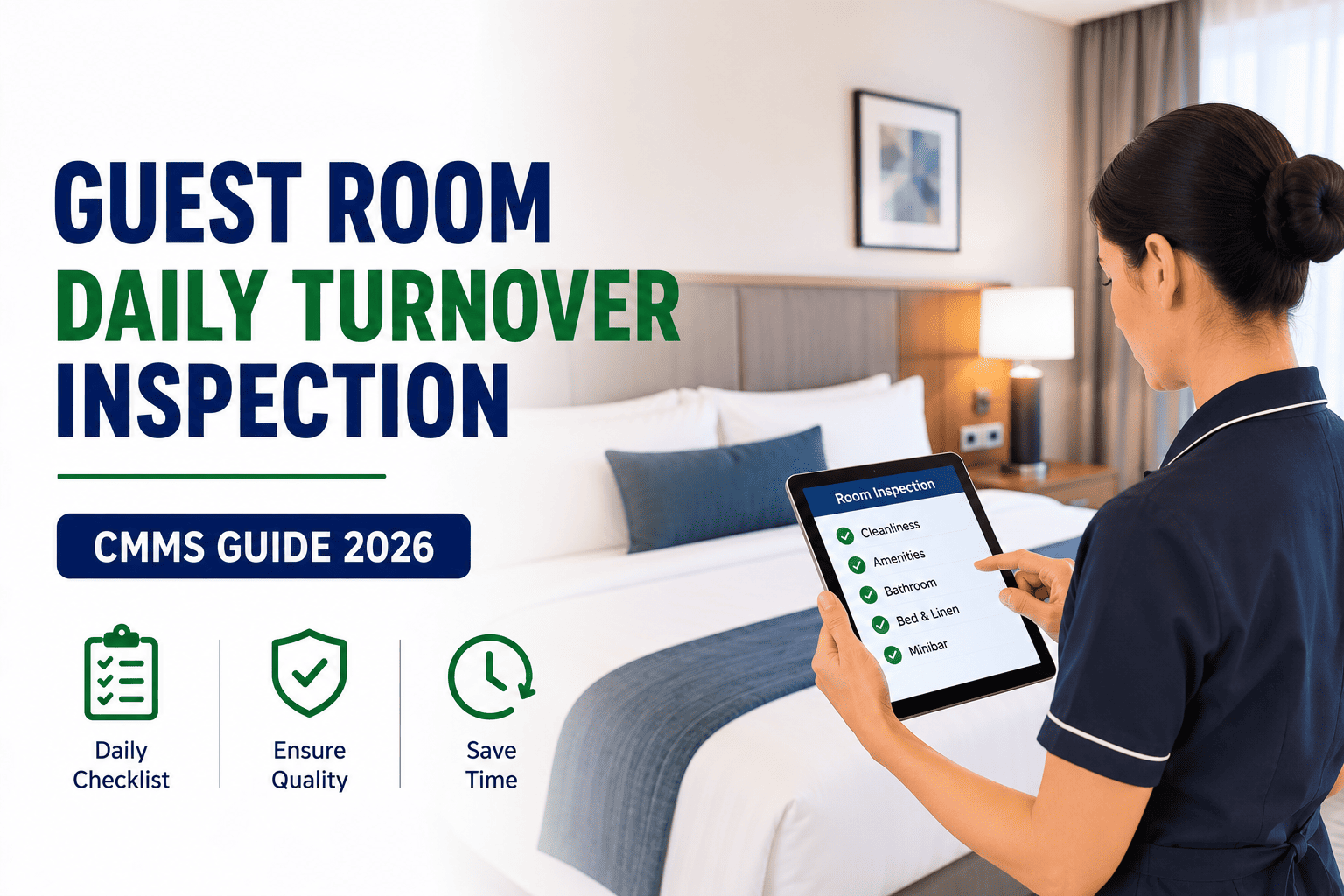
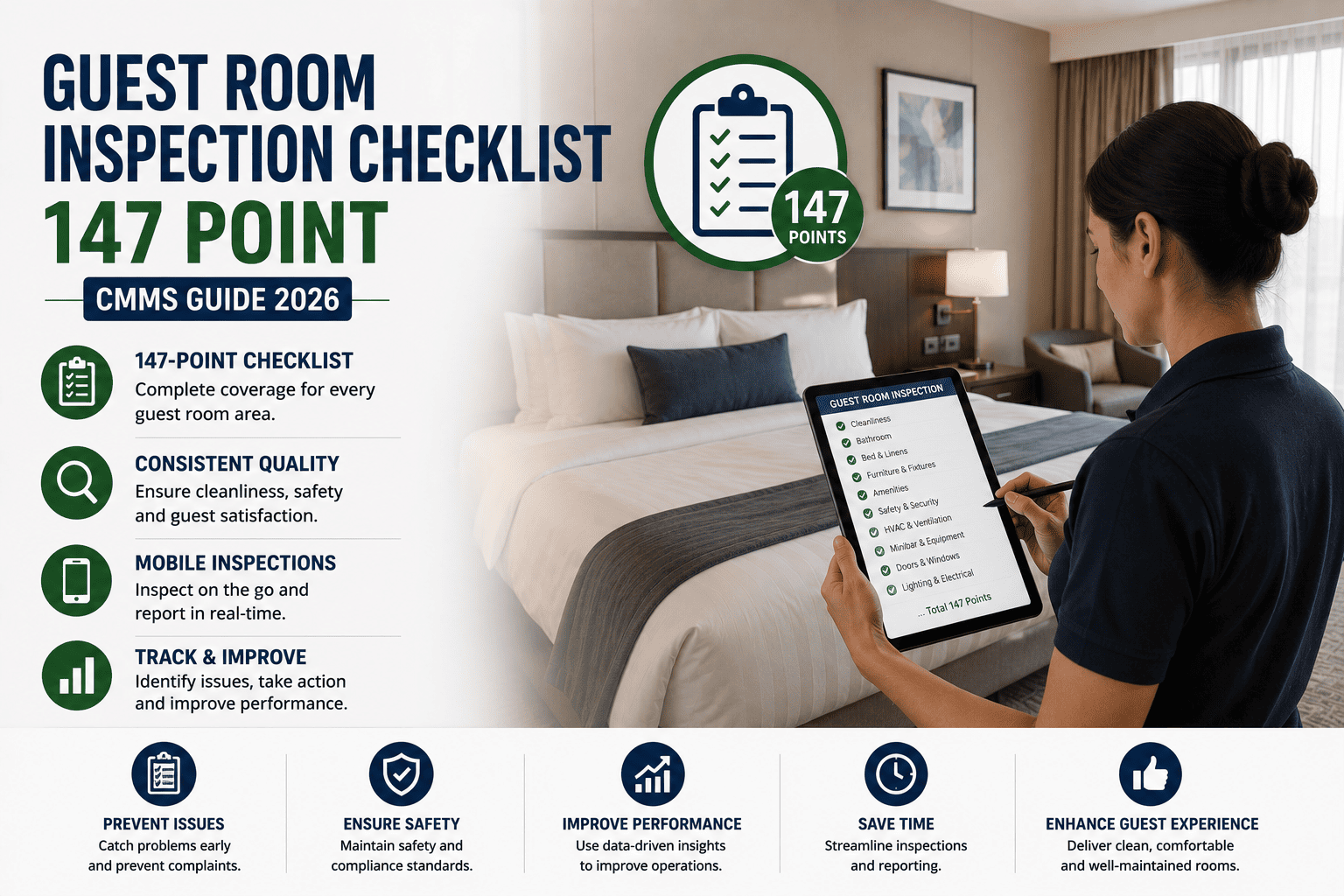
Inspectors complete brand-specific checklists on a mobile device. Each line item — bedding, bathroom, HVAC, minibar, safety — is scored pass/fail/deficiency with a required photo for any fail flag. The CMMS locks the record with a server-side timestamp the moment it syncs, preventing backdating.
Deficiency-to-work-order linkage
Every flagged deficiency auto-generates a work order tied to the originating inspection record. When the work order closes, the resolution — parts used, labor minutes, closure photo — writes back to the same inspection object, creating a closed-loop audit trail auditors can follow end to end.
Immutable version history
Checklist templates evolve with brand standard updates. The CMMS retains every version, so an inspection conducted under the Q2 2025 brand template can be exported with that template's exact criteria — not the current one — preserving audit fidelity across reporting periods.
A 240-room flagged property cut audit prep from 4 days to 90 minutes
Consider a 240-room dual-branded property running 14,600 room inspections per year across housekeeping, engineering, and brand QA walks. Before CMMS adoption, the Director of Rooms spent roughly 32 labor-hours per quarterly brand audit pulling records from three systems, cross-referencing photos on a shared drive, and manually building the compliance binder.
The property now runs a CMMS workflow where every housekeeping and engineering inspection auto-archives with brand-aligned checklist mapping. When the brand auditor requests room-by-room records for a specific date range, the Director of Rooms selects the date window, brand template version, and floor scope — then exports a single bundled PDF with linked work orders. The same export that took 32 hours now takes under 90 minutes and contains zero manual compilation.
Timestamp and photo verification that satisfies franchise auditors
Brand auditors reject records that lack verifiable timestamps, geotagged evidence, or a clear chain of custody between inspection and resolution. The CMMS enforces these standards at the point of capture rather than relying on inspectors to remember documentation rules.
Server-locked timestamps
Inspection start, line-item completion, and submission times are stamped by the CMMS server — not the device clock. Auditors see UTC-normalized times with timezone conversion, eliminating disputes over when a room was actually inspected.
Photo integrity checks
Every deficiency photo carries EXIF metadata — capture time, device ID, and optional geolocation. The CMMS flags photos missing required metadata before the inspection can be submitted, so incomplete evidence never enters the archive.
Supervisor sign-off chain
Each inspection passes through a configurable approval workflow — inspector submit, housekeeping supervisor review, engineering verification for maintenance-related items — with each approver's name, role, and timestamp embedded in the final export record.
Brand template alignment
Checklist templates map directly to current brand audit standards — Marriott's RMS, Hilton's RIC, IHG's IHG Way of Clean — so exported records present in the exact line-item structure auditors expect, with no cross-walking or reinterpretation needed.
Build audit-ready reports with the fields auditors actually require
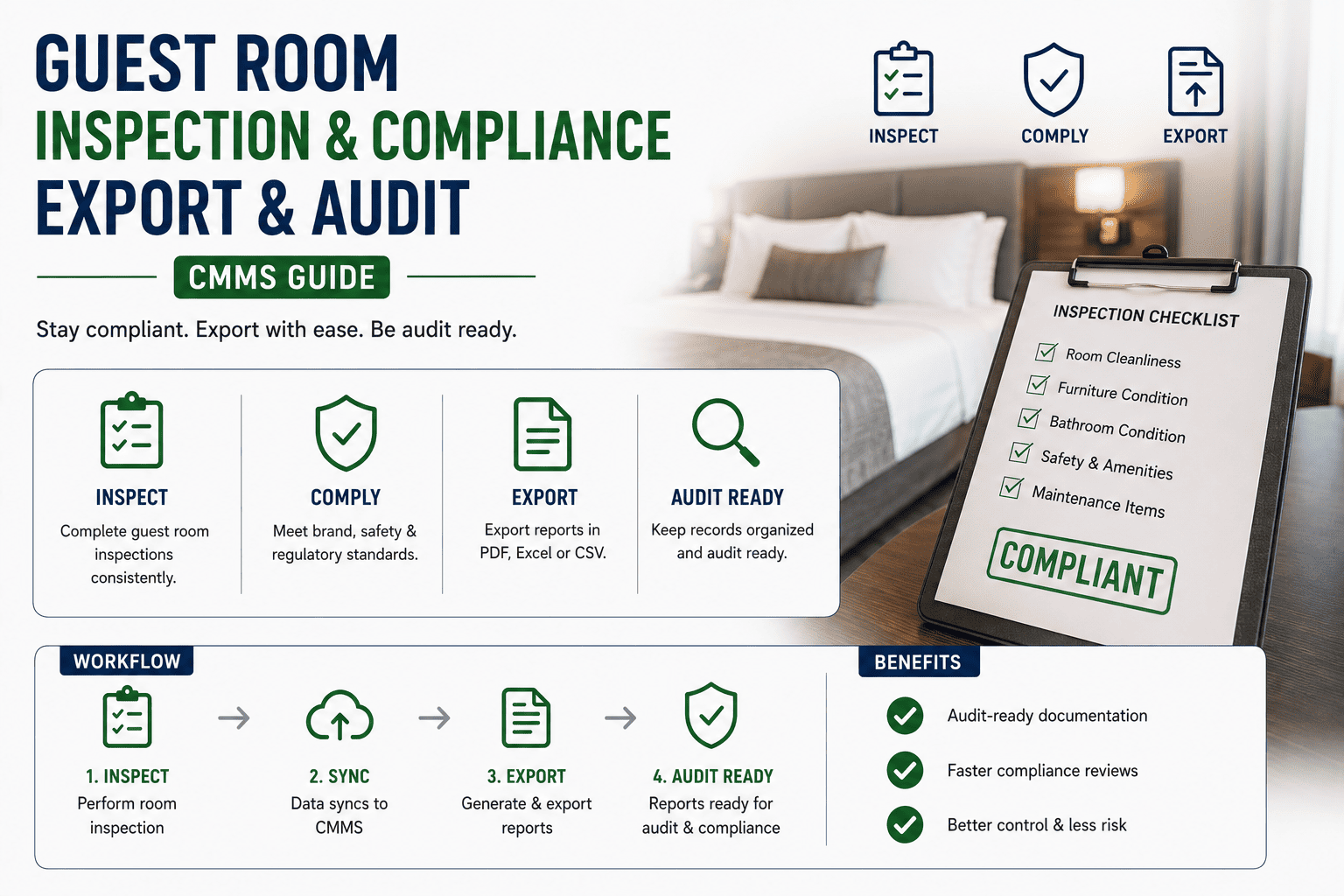
The compliance export builder lets properties configure exactly what lands in the audit packet — date range, floor or room scope, checklist version, deficiency status, photo inclusion, and work-order linkage — then save that configuration as a reusable template for recurring audits.
| Export Field | What Auditors Verify | CMMS Source | Format in Export |
|---|---|---|---|
| Inspection date & time | Room checked within required cycle window | Server-locked submission timestamp | UTC + local timezone |
| Inspector identity | Certified, brand-trained personnel | SSO user ID + training record link | Name, role, cert date |
| Checklist version | Current brand standard applied | Template ID with version tag | Version number + effective date |
| Line-item results | Every standard point scored | Structured pass/fail/deficiency data | Grid with color-coded status |
| Deficiency photos | Visual evidence of condition | EXIF-verified image attachments | Embedded with timestamp caption |
| Resolution record | Closed-loop correction documented | Linked work order closure data | WO number, parts, labor, close photo |
| Supervisor approval | Management review completed | Workflow approval log | Approver name, role, timestamp |
| Compliance score | Overall room readiness percentage | Auto-calculated from line items | Numeric + trend vs. prior period |
Map CMMS records to the audit frameworks that govern your portfolio
Whether your property answers to a global brand standard, a local health authority, or a corporate ESG mandate, the CMMS export engine maps inspection data to the specific framework citations auditors cross-reference during scoring.
Franchise audit standards
Marriott RMS, Hilton RIC, IHG Brand Standard, Hyatt Fit, Accor Key — checklist templates mirror each brand's current published criteria, with automatic re-mapping when brands publish annual updates. Properties running multiple brands maintain separate template libraries within one CMMS instance.
Public health compliance
Local health department inspections, FDA Food Code for minibar and in-room dining, CDC guidance for infection prevention, and pool/spa code requirements — all mapable to CMMS inspection line items for consolidated export during health authority visits.
Sustainability and governance reporting
Energy and water consumption per room, green cleaning product verification, waste diversion logs, and accessibility compliance — the CMMS tags these data points during routine inspections so corporate ESG reports pull from the same audited source as brand QA exports.
Stop assembling audit binders the night before a brand visit
Configure your property's brand templates, inspection cycles, and export profiles once — then generate audit-ready compliance packets on demand for any date range, floor, or framework.
Guest room inspection compliance export — answered
The five questions hotel operations leaders ask most often when evaluating a CMMS for audit-ready inspection records and brand compliance export.
How does the CMMS handle inspections conducted under older brand checklist versions?
The CMMS retains every checklist template version with its effective date range. When you export inspections from Q2 2025, the system applies the Q2 2025 template criteria — not the current version — so auditors see records scored against the standards that were active at inspection time. This eliminates a common audit dispute where properties present records under updated criteria that did not apply during the inspection period. You can Start Free Trial to test version-mapped exports on your historical data.
Can the compliance export include photos without making the file unmanageably large?
Yes. The export builder lets you choose photo resolution — full, compressed, or thumbnail index — and bundles everything into a single navigable PDF with hyperlinked room numbers. A 240-room export with compressed deficiency photos typically lands between 15–40 MB, well within brand auditor portal upload limits. Photos can also be exported as a structured ZIP with CSV index for auditors who prefer spreadsheet-based review.
What happens if an inspector submits a record with missing required photos or fields?
The CMMS enforces mandatory field and photo rules at the mobile capture point — an inspection with a flagged deficiency cannot be submitted without the required photo evidence, and server-side validation rejects incomplete records before they enter the archive. This means every record in your compliance export already meets minimum documentation standards, so auditors never encounter a gap that costs you points during review.
Does the system support properties operating under multiple brand standards simultaneously?
Absolutely. The CMMS maintains separate template libraries for each brand within a single property instance. A dual-branded property running Marriott and Hilton standards assigns the correct template per floor or wing, and exports filter by brand template so each franchise auditor receives only the records relevant to their standard. Schedule a walkthrough via Book a Demo to see multi-brand configuration in action.
How long does the CMMS retain inspection records for audit and legal purposes?
Retention is configurable per property, with a default of seven years to cover most franchise agreement cycles and general liability statute windows. Records are stored in encrypted cloud archives with full audit logging — every access, export, and modification is tracked. Properties can set automated retention policies that archive or purge records on schedule, ensuring compliance with both franchise data requirements and regional privacy regulations like GDPR.
Your next brand audit should take 90 minutes, not 4 days
Deploy the CMMS compliance export module, configure your brand templates, and generate your first audit-ready inspection packet before your next QA window opens.
Free 14-day trial · No credit card