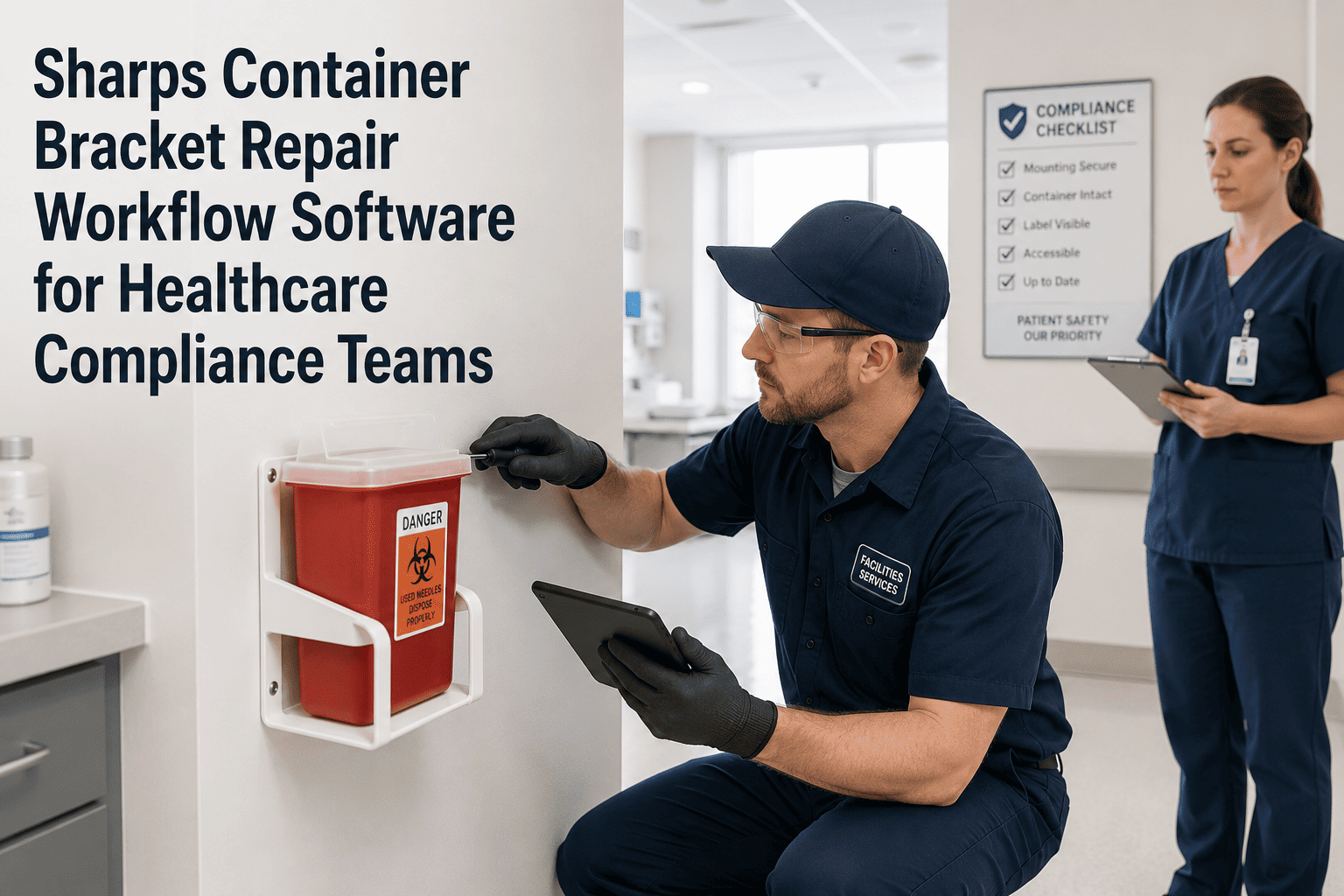
A broken sharps container bracket is more than a maintenance ticket — it's a documented OSHA violation risk, a Joint Commission Environment of Care finding, and a potential needlestick injury waiting to happen. When a sharps container falls due to a failed bracket mount, the consequences range from staff exposure to an uncontrolled biohazardous waste event requiring full regulatory reporting. Despite this, most hospitals manage bracket repair reactively and without closed-loop documentation: someone calls the work order desk, a technician comes when available, and no evidence of the repair survives past the technician's memory. OxMaint's healthcare work order system changes this entirely — sharps bracket defects are reported via mobile with photo evidence, routed to the right technician immediately, escalated if unresolved within the SLA window, and closed with before-and-after documentation that becomes part of a permanent asset history log. Compliance teams using OxMaint's CMMS for sharps safety eliminate documentation gaps, reduce average repair time from hours to under 30 minutes, and generate the complete evidence record OSHA and TJC inspectors need to see during any audit. Book a demo and see how sharps bracket repair workflows run in OxMaint.
OSHA Compliance · Sharps Safety · Healthcare Work Order Automation
Sharps Container Bracket Repair Workflow Software for Healthcare Compliance Teams
Mobile report to verified repair in under 30 minutes — with photo evidence, escalation rules, asset history, and compliance reports built in from day one.
Risk Context
What's at Stake with Every Broken Bracket
OSHA
Bloodborne Pathogens Standard Violation
OSHA 29 CFR 1910.1030 requires that sharps containers be maintained upright and accessible. A failed bracket that allows a container to tip or fall is a citable violation — fines up to $15,625 per instance.
TJC
Environment of Care Finding
Joint Commission EC.02.02.01 requires that the hospital manage safety risks in the environment. Unsecured sharps containers are a direct citation category in virtually every EOC survey type.
Safety
Needlestick Injury Liability
When a dropped container causes staff exposure, the hospital faces workers' compensation, OSHA recordable injury reporting, post-exposure protocol costs, and potential litigation — all traceable to a deferred maintenance event.
Waste
Biohazardous Waste Event
A spilled sharps container triggers an immediate biohazardous waste containment response, staff exposure protocol activation, state regulatory reporting, and a mandatory incident investigation — all avoidable with timely bracket repair.
OxMaint Workflow
Sharps Bracket Repair — From Defect to Documented Closure
Staff Reports Defect (Mobile)
Clinician or housekeeper scans room QR, selects "sharps bracket" defect type, attaches photo. Work order created in under 60 seconds with location and defect pre-populated.
Auto-Classification as Safety-Critical
Sharps bracket defects are classified as safety-critical by default in OxMaint — triggering a 30-minute SLA window and immediate supervisor notification rather than standard queue routing.
Technician Dispatched with Full Context
Assigned tech receives room number, photo of defect, container type, and any prior repair history for that bracket location — no second trip, no call back for missing information.
Escalation if SLA Breached
If the work order is not acknowledged in 30 minutes, OxMaint escalates automatically to the maintenance supervisor and safety officer — with a second escalation at 60 minutes if still unresolved.
Repair with Materials Log
Tech documents bracket type installed, hardware used, and whether interim containment was needed during the repair window — building a complete materials history for the location asset.
Photo Closure + Permanent Record
After-repair photo attached, technician closes with digital signature. The entire incident record — report time, dispatch, repair, closure — is stored in the asset history for OSHA or TJC retrieval.
Every Broken Bracket Should Generate a Compliance Record — Not Just a Phone Call
OxMaint converts every sharps bracket report into a documented, escalated, and closed compliance record. See how it works in 30 minutes.
Evidence & Reporting
What OxMaint Generates for Every Sharps Bracket Work Order
| Evidence Element |
Captured Automatically |
Regulatory Use |
| Initial Report Timestamp |
Date, time, reporter identity, location, defect photo |
OSHA incident timeline, TJC EOC documentation |
| Priority Classification Record |
Safety-critical flag, SLA window assigned, supervisor notified |
Demonstrates structured safety response process |
| Dispatch & Acknowledgment Log |
Technician ID, acknowledgment timestamp, ETA if logged |
Response time evidence for OSHA/TJC review |
| Materials Documentation |
Bracket type, hardware specs, installation date |
Asset maintenance record, liability documentation |
| Before & After Photos |
Timestamped images attached to work order |
Visual verification of corrective action |
| Closure Record |
Technician signature, completion timestamp, total elapsed time |
Survey-ready compliance evidence package |
| Asset History Log |
All prior repairs for this bracket location accumulated automatically |
Chronic defect identification, capital replacement planning |
Expert Review
Why Sharps Safety Documentation Is the OSHA Finding Most Facilities Underestimate
OSHA inspectors reviewing bloodborne pathogen compliance don't just check whether sharps containers are present — they check whether the facility has a documented system for maintaining the infrastructure that keeps them secure. A facility with 400 sharps container locations across three buildings needs to show not just that brackets are repaired when broken, but that there's a process for identifying breaks quickly, responding within a defined timeframe, and generating a documented record of corrective action. Without a CMMS-driven workflow, this documentation almost never exists in any retrievable form. The result is that facilities that actually fix brackets quickly get cited anyway because they can't prove they did it — a completely avoidable outcome.
Common Questions
Frequently Asked Questions
Can OxMaint track different bracket types across a large hospital campus with hundreds of locations?
Yes. OxMaint's asset management module supports custom fields at the asset level, so each sharps bracket location can store its bracket type, mounting configuration, container size compatibility, and installation date. When a repair is needed, the technician already knows what hardware to bring before arriving on site. For campuses with 300–1,000+ bracket locations, OxMaint supports bulk asset import via CSV to get the full inventory into the system quickly.
Sign up and start your bracket asset import today.
How does OxMaint handle sharps bracket defects reported during routine rounding versus ad-hoc staff reports?
OxMaint handles both channels identically from a workflow perspective — whether the defect is found during a scheduled PM round or reported ad-hoc by a nurse, it creates the same structured work order with the same escalation rules and documentation requirements. This matters for compliance: OSHA doesn't differentiate between proactive and reactive discovery when evaluating your response process. What it looks for is a consistent, documented response regardless of how the defect was found.
See the unified rounding and ad-hoc reporting workflow in a demo.
What interim controls should be documented when a bracket is broken but repair is delayed?
When a sharps bracket repair cannot be completed within the initial SLA window, OxMaint supports documenting interim controls directly on the work order — for example, placing the container on a stable surface, restricting access to the area, or posting a notification to staff. This interim action log is timestamped and stored alongside the repair record, demonstrating to OSHA or TJC reviewers that the facility actively managed the risk during the repair delay rather than leaving it unaddressed.
Configure your interim control documentation fields in OxMaint.
Can OxMaint identify locations with recurring bracket failures for capital replacement planning?
Absolutely. OxMaint's asset history and reporting module makes it straightforward to identify brackets that have had two or more repair events within a rolling 12-month period — the standard threshold for flagging for replacement rather than continued repair. Facilities managers can export this chronic failure report and use it to build a capital request for bracket replacement, with the repair history data serving as the business case for the investment.
Talk to our team about building a bracket lifecycle report.
Does OxMaint generate reports formatted for OSHA recordkeeping or TJC EOC survey responses?
OxMaint's report builder allows compliance teams to generate sharps bracket work order history reports filtered by date range, location, defect type, and resolution time — exportable as PDF or CSV. While OxMaint doesn't pre-format output to specific OSHA form templates, the data it captures covers all fields required for OSHA 300 log supplementary documentation and TJC Environment of Care corrective action evidence. Most compliance teams use OxMaint exports directly in survey response packages without additional reformatting.
Explore the OxMaint report builder with a free account.
Sharps Safety · OSHA Compliance · Healthcare CMMS
Don't Let a Broken Bracket Become Your Next OSHA Citation
OxMaint gives your safety and facilities team a complete, documented sharps bracket repair workflow — with mobile reporting, automatic escalation, asset history, and audit-ready compliance evidence on every work order.

.jpg)
