Behavioral health inpatient units place extraordinary demands on physical infrastructure — doors, walls, fixtures, and furnishings in these environments are subject to rates of wear, damage, and safety-critical deterioration that far exceed what standard hospital facilities teams plan for. When a room goes out of service in a behavioral health unit, the downstream impact is immediate: patient placement delays, increased length of stay in ED psychiatric holds, staff safety exposure, and regulatory risk if the environment does not meet Joint Commission EC.02.06.01 or CMS Conditions of Participation standards. OxMaint's Work Order and Analytics platform gives behavioral health facilities teams a clinical-priority-aware repair queue — where room repairs are ranked by patient safety risk, unit census impact, and compliance obligation rather than simple request order. The result is a maintenance operation that aligns with clinical priorities, accelerates room return to service, and creates the audit trail that compliance teams need for every inspection. Book a demo to see how behavioral health facilities teams use OxMaint to manage repair priority across inpatient psychiatric units.
4.2 hrs
Average room-out-of-service time with reactive maintenance in behavioral health
38%
of behavioral health JC citations relate to physical environment repair documentation gaps
$2,800
Daily cost per unavailable behavioral health bed in urban hospital markets (AHA, 2023)
72%
of room repairs in BH units involve safety-critical fixtures — not cosmetic maintenance
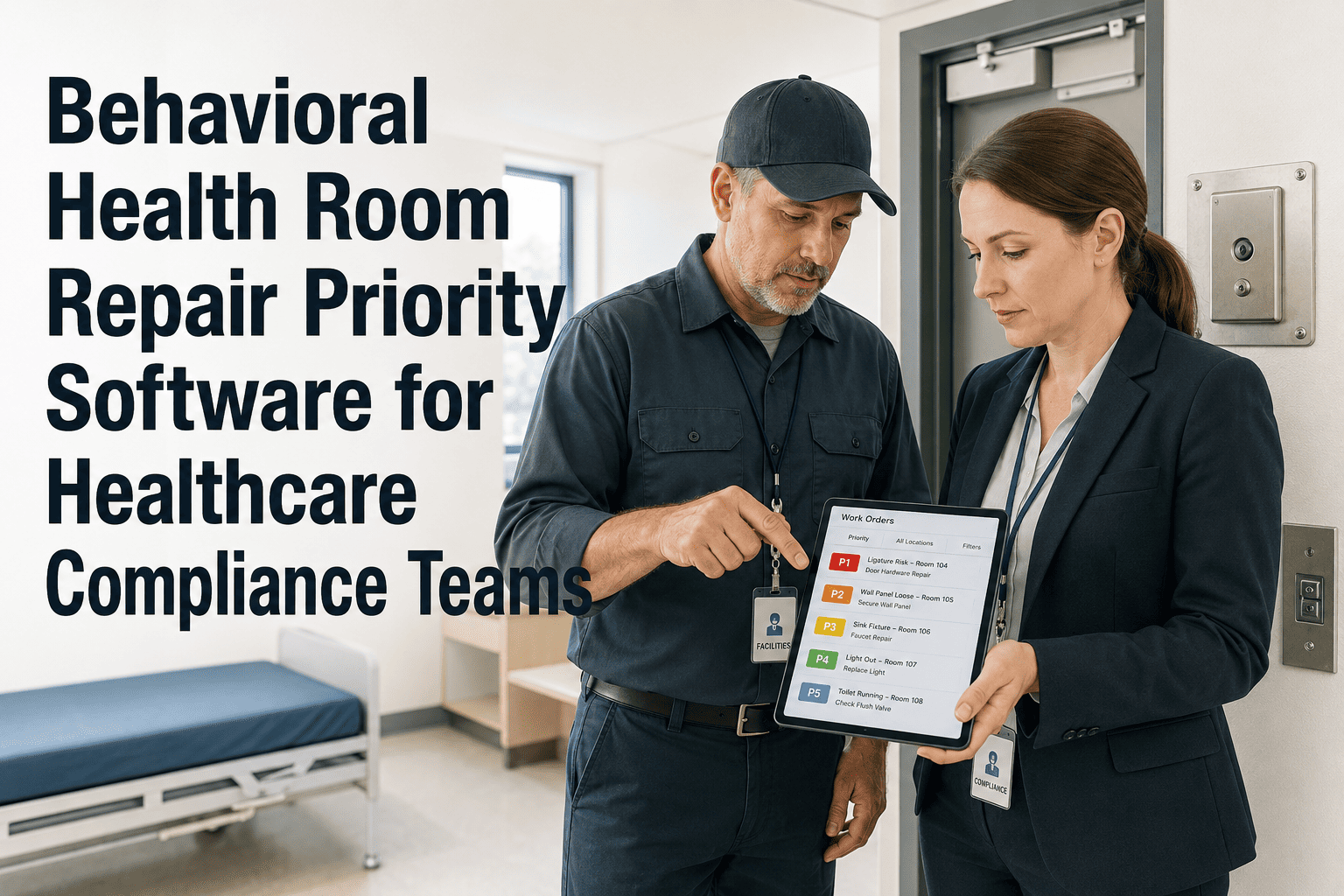
P1 — Immediate Safety
Response: Same shift
Ligature points · Broken door hardware · Missing window guards · Exposed electrical
Room placed out-of-service · Interim life safety measure documented · Same-shift work order mandatory
P2 — Elevated Risk
Response: 24–48 hours
Non-ligature-specific door damage · Plumbing leaks · Floor hazards · Broken call system
Room may remain occupied with enhanced observation · Work order escalates if unresolved at 24 hrs
P3 — Operational Impact
Response: 72 hours
HVAC malfunction · Lighting faults · Television/entertainment · Furniture damage (non-ligature)
Room available · Repair scheduled in next available technician slot · Patient notified if applicable
P4 — Planned Maintenance
Response: 7–14 days
Paint and cosmetic repairs · Non-urgent plumbing · Signage · Scheduled deep clean
Batched into weekly PM schedule · No immediate action required · Tracked to completion
Your behavioral health unit can't afford a repair backlog. OxMaint keeps every room on a defined return-to-service timeline.
M
Mobile Proof of Repair
Technicians capture before and after photos within the OxMaint mobile app — attached to the work order permanently. Every repair has visual evidence that is retrievable within seconds for any survey request.
Q
QR Room Reporting
QR codes posted in each behavioral health room allow nursing staff to report maintenance issues directly — bypassing email chains and phone calls, with issues entering the priority queue immediately upon submission.
K
Hospital KPI Dashboard
Unit-level dashboards show open work orders by priority, average time-to-repair by room type, repeat issue frequency, and SLA breach rate — giving nurse managers and compliance officers real-time visibility without a CMMS login.
A
Audit Trail Generation
One-click PDF export of every repair action, evidence photo, sign-off, and completion timestamp for any selected unit and date range — structured for Joint Commission, CMS, and state department of health reviewers.
E
Escalation Automation
OxMaint automatically escalates work orders that breach SLA — notifying supervisors and compliance officers without requiring manual follow-up. No repair falls through the queue silently after its deadline passes.
T
Trend Analysis by Room
Repair history per room surfaces recurring failures — identifying whether a room's repeat issues indicate a product specification problem, structural issue, or patient population-specific wear pattern requiring a capital response.
OxMaint vs. Spreadsheet / Email-Based Repair Tracking
| Capability |
Spreadsheet / Email |
OxMaint |
| Priority assignment on submission |
Manual — depends on person receiving email |
Automatic — risk matrix applied at submission |
| Photo evidence capture |
Separate email attachment — often lost |
Attached to work order permanently in-app |
| SLA clock and escalation |
None — entirely manual follow-up |
Automatic timer with supervisor alert at breach |
| Survey-ready export |
2–4 hours of manual compilation |
One-click PDF in under 2 minutes |
| Repeat issue detection |
Impossible without manual spreadsheet analysis |
Automated trend surface per room in dashboard |
| Room return-to-service tracking |
Not tracked — rooms stay closed past repair |
Real-time room status visible to nurse manager |
Expert Review
James Okoro, M.Eng., CHFM — Healthcare Facilities Director, 19 years, formerly Cleveland Clinic Health System
Behavioral health units are not like any other inpatient environment I have managed. The damage rates are higher. The safety stakes for every unresolved repair are higher. And the compliance scrutiny from Joint Commission surveyors on physical environment is more intense than in any other unit type. What I needed was a system that let my team operate with clinical awareness — where a broken door handle in a high-acuity psychiatric room gets a fundamentally different response from a broken door handle in an outpatient corridor. OxMaint gives us that clinical prioritisation. But equally important, it gives the compliance officer the documentation trail to prove that every P1 item was closed on time, with evidence — without having to compile it manually the night before a survey.
Frequently Asked Questions
How does OxMaint determine repair priority in behavioral health — is the system configurable to our own clinical risk criteria?
Yes. OxMaint's priority matrix is fully configurable by your facilities and compliance team. You define which repair categories map to P1 through P4, set the SLA for each tier, and configure escalation rules — including who receives alerts and at what threshold. Many behavioral health teams align their OxMaint configuration to their Joint Commission Environment of Care risk matrix, so the CMMS and compliance documentation are consistent without manual mapping.
Book a demo to walk through the configuration workflow with an OxMaint implementation specialist.
Can nursing staff and charge nurses submit repair requests without a full OxMaint account?
Yes. OxMaint's Requester role allows clinical staff to submit repair requests via the mobile app or a QR code scan — without needing full platform access or training. Requests are routed directly to the facilities priority queue with the room number, issue type, and submitter identity captured automatically. This removes the phone-call-and-email loop that delays many behavioral health repair requests by hours.
Start a free trial and set up your first QR room in under 10 minutes.
How does OxMaint handle room out-of-service status and communicate it to nurse managers?
When a P1 work order is opened for a behavioral health room, OxMaint allows the facilities team to mark the room as out-of-service — with a visible status change in the OxMaint room dashboard that is accessible to nurse managers and bed coordinators. When the repair is completed and verified, the room status returns to available automatically, with the return-to-service time stamped and logged. This eliminates the manual calls between housekeeping, maintenance, and nursing that typically delay room return.
Book a demo to see the room status dashboard in the context of a live behavioral health unit scenario.
What does OxMaint's audit trail export contain for a Joint Commission EOC survey review?
The export includes every work order for the selected unit and date range — with repair category, priority level, date reported, assigned technician, completion date, SLA status (met or breached), photo evidence thumbnails, and digital sign-off. The format is structured for EOC review, with each room's repair history presented as a distinct section. Compliance teams report that OxMaint export preparation reduces survey prep time from several hours to under 15 minutes.
Sign in to OxMaint to view a sample behavioral health unit export report.
Does OxMaint track preventive maintenance schedules for behavioral health room fixtures in addition to reactive repairs?
Yes. OxMaint supports full PM scheduling for behavioral health room assets — including scheduled safety hardware inspections, door closer checks, and ligature-resistant fixture audits — on configurable frequencies. PM work orders are automatically generated on schedule, assigned to technicians, and tracked for completion in the same platform as reactive repairs. This unified view means your EOC documentation covers both planned and reactive maintenance in a single auditable record.
Book a demo to see how PM scheduling and reactive repair management work together in OxMaint's behavioral health configuration.
OxMaint · Healthcare · Behavioral Health Facilities
Every hour a behavioral health room is out of service costs your unit. OxMaint gets it back — faster, documented, and compliant.
Priority Work Orders · Mobile Evidence · Room Status Tracking · KPI Dashboard · JC Audit Export · PM Scheduling


.jpg)
