Contaminated or displaced ceiling tiles in healthcare environments are not a cosmetic inconvenience — they are a documented infection risk, a fire barrier integrity concern, and a recurring Joint Commission citation category that affects hospitals of every size and age. A single stained tile above a patient bed in a med-surg unit represents a potential Aspergillus exposure pathway; a missing tile in an airborne infection isolation room can compromise negative pressure containment. Yet across most hospitals, ceiling tile defects are still tracked on paper rounds, reported verbally to the work order desk, and resolved without any photographic closure evidence. OxMaint's healthcare work order automation converts ceiling tile contamination reports into structured, traceable tasks: the defect is photographed at report, routed to the right technician with infection control context, and closed with before-and-after documentation that becomes part of your Environment of Care audit record. Healthcare compliance teams using OxMaint's mobile CMMS report 89% faster ceiling defect resolution and eliminate the gap between rounding findings and verified repair. Book a demo to see how ceiling tile work orders are created, tracked, and closed in OxMaint.
Healthcare Compliance · Infection Control · Work Order Automation
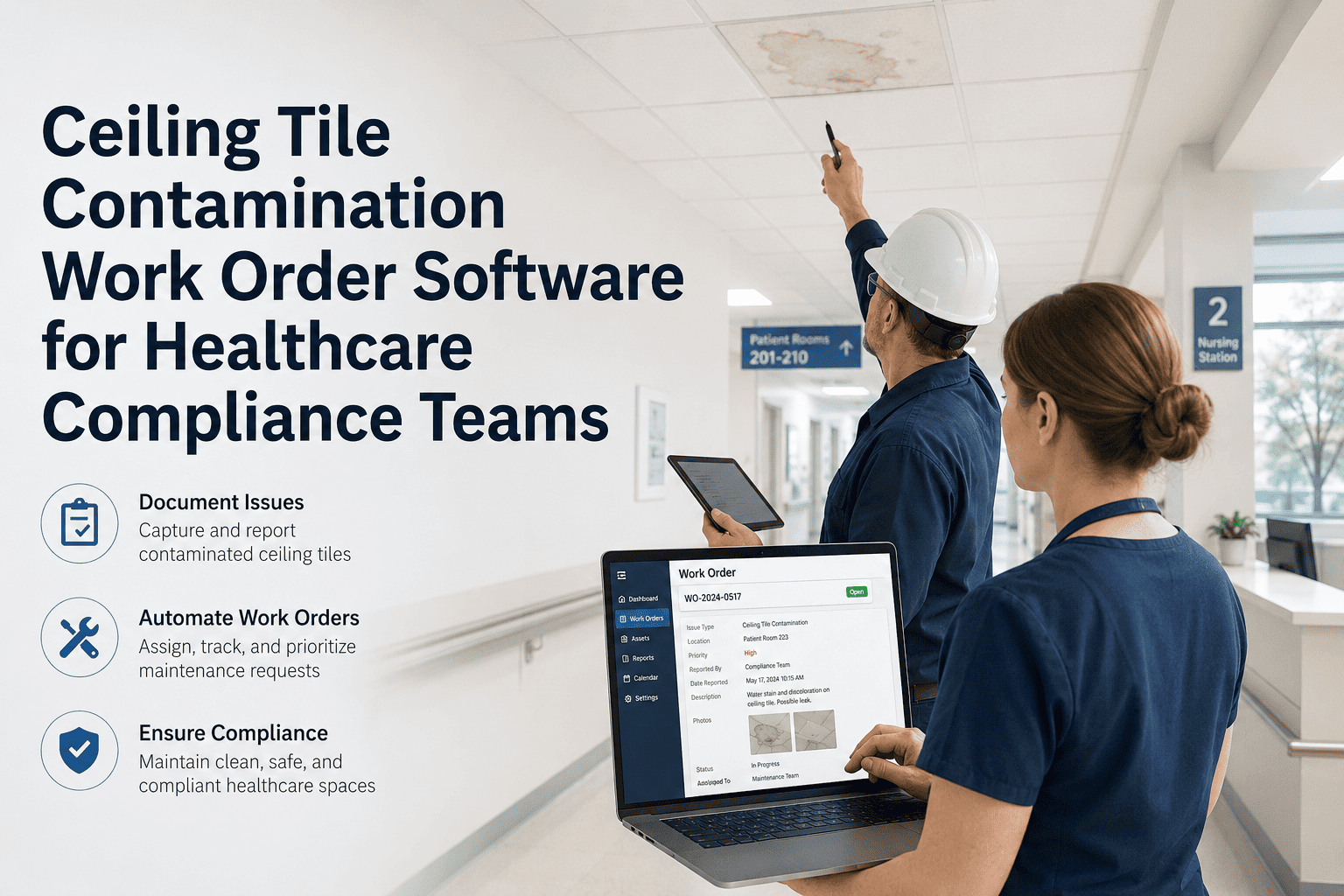
Ceiling Tile Contamination Work Order Software for Healthcare Compliance Teams
Convert every ceiling defect from a rounding finding to a closed, evidence-backed work order — with routing, escalation, and compliance records built in.
89%
Faster ceiling defect resolution with OxMaint vs. paper process
#3
Ceiling tile defects rank as the 3rd most cited EOC finding in TJC surveys
72 hr
Maximum safe window to remediate moisture-contaminated tiles before mold risk
Defect Classification
Types of Ceiling Tile Defects OxMaint Tracks
Critical
Water-Stained / Mold Visible
Active moisture contamination or visible mold — immediate infection control escalation required. OxMaint routes to tech and IC simultaneously.
High Priority
Missing or Displaced Tile
Open plenum exposure in patient care areas. Compromises fire barrier and airborne precaution integrity. Same-shift resolution target.
High Priority
Cracked / Damaged Tile
Structural damage allowing particulate fall. Common near HVAC diffusers and in aging facilities. Documents replacement with tile type and lot number.
Moderate
Sagging or Bowing
Indicates moisture saturation above the tile plane. May not be visibly contaminated but requires investigation of source before replacement.
Moderate
Grid Damage / Misalignment
Compromised grid system reduces fire barrier effectiveness. Tracked separately with fire barrier restoration documentation in OxMaint.
Routine
Cosmetic Discoloration
No active moisture, no infection risk — but still generates a work order with 5-day resolution target and rounding evidence for EOC documentation.
OxMaint Workflow
From Defect Spotted to Compliance Record Closed
1
Report with Photo
Staff scan QR, select defect type, attach photo — work order created instantly with room ID and priority auto-set by defect classification
2
Smart Routing
Moisture or mold defects auto-notify infection control team alongside the maintenance tech — non-moisture defects route to maintenance only
3
Repair Logged
Tech documents tile type replaced, materials used, moisture source if identified, and any follow-up corrective work orders created
4
Photo Closure
After photo attached, IC clearance recorded if applicable, work order closed with signature — complete evidence package stored automatically
Ready to Close the Loop on Every Ceiling Defect?
OxMaint turns every rounding finding into a tracked, documented, and evidence-closed work order. See it in action in a 30-minute demo with our healthcare team.
Compliance Standards
Regulatory Requirements OxMaint Supports for Ceiling Tile Compliance
| Standard |
Relevant Requirement |
OxMaint Evidence Generated |
Risk if Non-Compliant |
| TJC EC.02.06.01 |
Facility must identify and correct environment of care deficiencies |
Timestamped defect-to-closure work order with photo evidence |
Requirement for Evidence of Standards Compliance |
| CMS §482.41 |
Physical environment must be maintained to protect patient health and safety |
Repair history per room, infection control notification log |
Condition of Participation deficiency |
| NFPA 101 Life Safety |
Ceiling assemblies must maintain fire barrier integrity |
Tile replacement log with fire-rated tile documentation |
Life safety citation, possible patient transfer requirement |
| ASHRAE 170 |
Ventilation integrity in patient care areas must be maintained |
Ceiling defect work orders linked to HVAC inspection records |
Airborne infection control compromise |
| ICRA Guidelines |
Ceiling work in Class III/IV areas requires barrier controls |
ICRA checklist linked to ceiling work orders |
Construction-related infection outbreak risk |
Expert Review
Why Ceiling Tile Findings Recur on Joint Commission Surveys
Ceiling tile defects are among the most preventable repeat EOC findings — and yet they appear on consecutive surveys at the same facilities year after year. The reason is almost never a lack of awareness or resources; it's a lack of closed-loop documentation. Facilities teams fix the tile, but there's no record of when it was reported, what priority it received, how long it took to repair, or who confirmed it was complete. When a surveyor sees a clean tile and asks for the work order history, and the team can't produce it, the finding stands regardless of current condition. OxMaint solves the documentation gap — not by adding bureaucracy, but by making evidence capture the natural byproduct of the repair workflow itself.
Common Questions
Frequently Asked Questions
Can OxMaint differentiate between moisture-contaminated tiles and cosmetic defects for routing purposes?
Yes. OxMaint's work order templates include defect classification fields that determine routing behavior automatically. When a reporter selects "water stain" or "visible mold," the work order is flagged as infection control relevant and the IC team receives simultaneous notification alongside the maintenance technician. Cosmetic defects follow a standard maintenance-only routing path without triggering IC alerts.
Sign up and configure your ceiling defect work order templates.
How does OxMaint handle ceiling tile work in ICRA-controlled construction zones?
OxMaint supports ICRA checklists linked directly to ceiling work orders in designated construction or renovation zones. Before a technician can close a ceiling tile work order in a Class III or IV ICRA area, the checklist requires confirmation of barrier controls, negative pressure verification, and debris containment. This creates an ICRA-compliant evidence record for each intervention that satisfies infection preventionist review requirements.
See ICRA workflow configuration in a live demo.
What repair history does OxMaint maintain per room or ceiling location?
Every ceiling tile work order in OxMaint is linked to the specific room or location asset record, building a complete service history for that space. This means leadership and compliance teams can instantly see how many ceiling defects a specific room or corridor has had over any time period, what types they were, how quickly they were resolved, and whether a chronic moisture source has been investigated and corrected.
Start free and explore the location asset history dashboard.
How does OxMaint support leadership visibility into open ceiling defect work orders?
The OxMaint leadership dashboard provides a real-time view of all open ceiling tile work orders by location, priority, age, and assigned technician — without leadership needing to request a report. Directors of Facilities and Infection Control officers can see overdue repairs, SLA breaches, and resolution trend data in a single view. This is particularly valuable in the 60–90 days before a scheduled TJC survey.
Book a demo to see the leadership dashboard in action.
Can OxMaint track the specific tile materials used in repairs for fire-rating documentation?
Yes. OxMaint work order closure forms support custom fields where technicians record the replacement tile manufacturer, model, fire-rating designation, and installation date. For facilities with NFPA 101 fire barrier compliance requirements, this creates a materials log that documents that every replaced tile meets the required fire-resistance classification — a detail frequently requested during life safety surveys.
Sign up and configure your materials tracking fields.
Ceiling Tile Compliance · Healthcare Work Orders · EOC Evidence
Turn Every Ceiling Defect into Closed, Defensible Compliance Evidence
OxMaint gives your healthcare compliance team a complete ceiling tile work order workflow — from mobile report to infection control notification to photo-evidenced closure — with zero paper.



.jpg)
