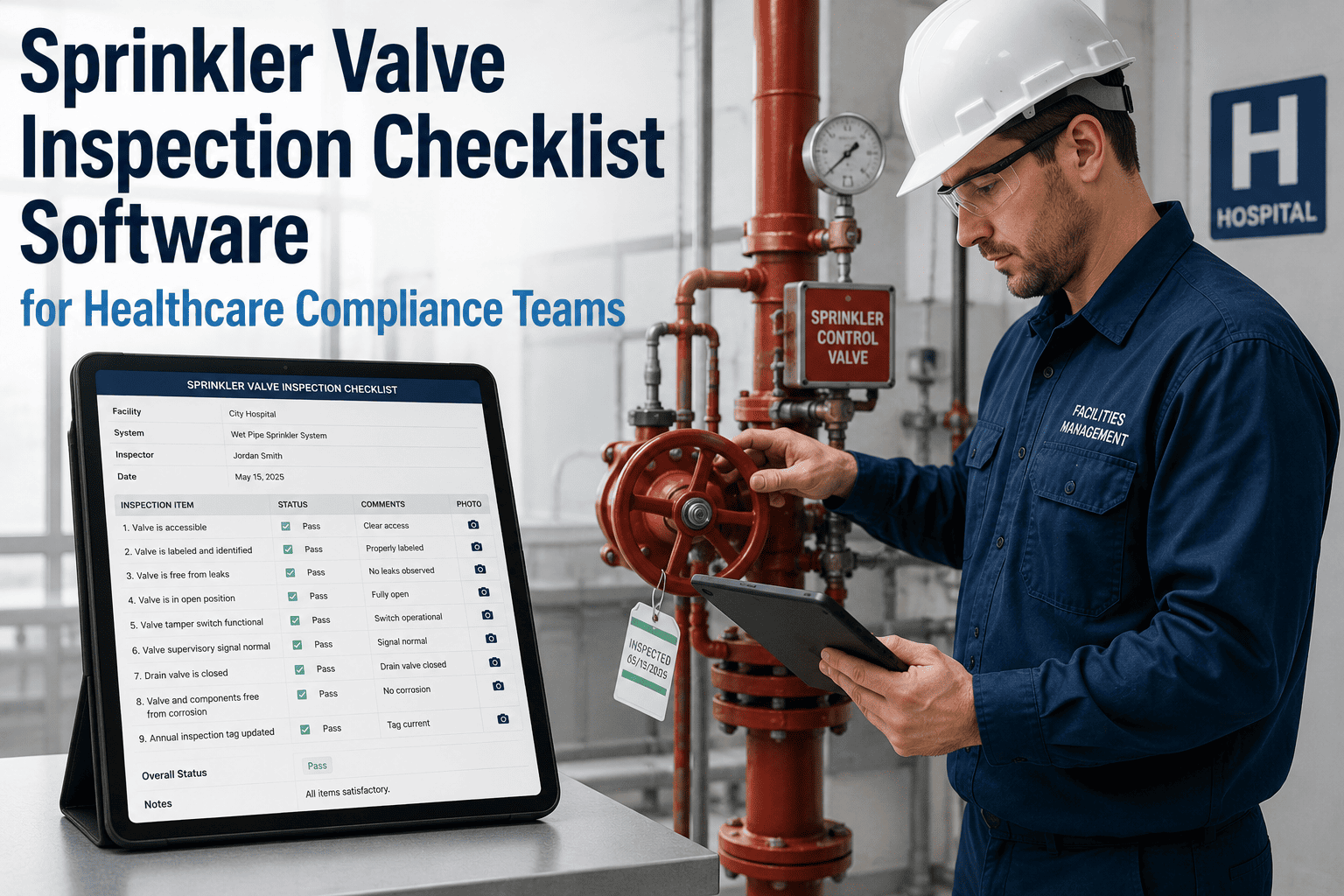
A single closed sprinkler control valve is responsible for 79% of sprinkler system failures during actual fire events. Yet the check that would have caught that closed valve — a 30-second visual verification of position, chain, seal, and handle presence — is one of the simplest inspection items in the entire NFPA 25 standard. The gap between "check that must be done weekly" and "check that was actually documented weekly" is where hospital fire life safety programs fail Joint Commission surveys. Under CMS's Life Safety Code (NFPA 101-2012 §9.7.5), every US healthcare occupancy participating in Medicare/Medicaid must maintain water-based fire protection systems in accordance with NFPA 25-2011. Under Joint Commission standard EC.02.03.05 (Fire Protection and Suppression Testing and Inspection), the surveyor expects to see the inspection record — not just the working valve. When either is missing, the citation is written. OxMaint's sprinkler inspection checklist platform generates the correct inspection work order at the correct frequency, routes it to the qualified technician, captures the pass/fail evidence at the point of inspection, and preserves the audit trail for the entire retention period required by NFPA 25 §4.4.
Sprinkler Valve Inspection Checklist Software for Healthcare Compliance Teams
The complete NFPA 25 inspection cycle — weekly, monthly, quarterly, annual, and 5-year — captured on mobile, routed to the qualified technician, and exportable to Joint Commission survey format in under 60 minutes.
The Regulatory Chain — Who Actually Enforces NFPA 25 in Hospitals
NFPA 25 is a technical standard published by a private organisation. It becomes legally enforceable in hospitals through a chain of federal, state, and accreditation authority. Understanding the chain matters because different authorities cite the same deficiency differently — and the correction pathway follows the citing authority. Life Safety Code compliance in hospital CMMS walks through each authority's evidence expectations.
Valve Type Reference — What You're Actually Inspecting
Every hospital sprinkler system contains multiple valve types, each with its own inspection frequency, failure mode, and criticality. A single 400-bed hospital typically has 40–120 water-based fire protection valves distributed across risers, zones, and specialised suppression areas. Sprinkler system preventive maintenance in CMMS tracks each valve by type, location, and its specific inspection cycle.
The Inspection Checklists — Organised by NFPA 25 Frequency
Below is the actual inspection cycle as it runs in a compliant hospital fire life safety programme. Each frequency band lists the tasks that a facilities or fire life safety technician must complete on that cycle, with the NFPA 25 section citation. Every task in OxMaint auto-generates a work order at the correct interval, routes to the qualified technician, and captures pass/fail evidence in the format Joint Commission surveyors expect.
One Missing Inspection Record Is One Citation Away.
OxMaint generates every NFPA 25 inspection work order at the correct frequency, routes it to the qualified technician, captures pass/fail evidence on mobile, and produces a Joint Commission-ready evidence package in under 60 minutes.
The Failure Escalation Cascade — When a Valve Fails Inspection
A closed control valve or failed inspection triggers a specific sequence of regulatory obligations. NFPA 25-2011 §15.5.2 defines the impairment procedure: at 4 hours of active impairment, fire watch is required; at 10 hours in any 24-hour period, fire department notification is required in addition. NFPA 101-2012 §9.6.1.6 and §9.7.6 reinforce these thresholds for CMS-covered occupancies.
The Paper Binder vs the Digital Checklist
Joint Commission surveyors report that the majority of EC.02.03.05 findings at US hospitals are not system malfunctions — they are documentation failures. The paper binder and the digital checklist produce the same technical inspection result. What differs is what happens between inspection and survey.
Joint Commission K-Tag & EC Element Mapping
When a Joint Commission surveyor writes a citation, it is tagged to a specific element of performance (EP) within EC.02.03.05 and — for hospitals surveyed under CMS deemed status — to a K-tag in the Life Safety Code Chapter. The table below maps the most common sprinkler valve inspection findings to their citation targets. Joint Commission K-tag tracking for fire safety configures OxMaint to raise the correct citation category on every deficiency.
The Economics of a Documented Fire Life Safety Programme
The value of a digital sprinkler inspection checklist is calculated across three axes: citation avoidance, CAPA closure velocity, and the compliance rate that keeps the hospital ahead of both TJC and CMS. Below is the scenario for a mid-size regional medical center switching from binder-based tracking to OxMaint.
Fire Life Safety KPIs a Hospital Compliance Director Tracks
Six KPIs — reviewed weekly by the Fire Life Safety Manager and monthly by the compliance director — that separate hospitals routinely finding-free at TJC survey from those receiving 2–4 EC.02.03.05 findings each cycle. NFPA 25 inspection frequency in hospital CMMS continuously monitors all six.
NFPA 25 Inspection Completion Rate
Percentage of scheduled inspections (weekly through 5-year) completed within their target window. Below 90% forecasts a TJC finding at the next survey; 95%+ is the operational floor for finding-free surveys.
Deficiency CAPA Closure Time
Average days from deficiency identified to corrective action closed and verified. Above 30 days indicates a broken escalation loop; under 14 days indicates a functioning FLS programme.
Impairment Record Completeness
Percentage of impairment events (planned or unplanned) with a complete record — declaration, fire watch documentation, fire department notification if applicable, and clearance. Any gap is a §15.5 citation risk.
Overdue Inspections
Count of NFPA 25 inspections past their target window with no completion record. Should be zero at any given moment; any non-zero value is a live citation exposure until closed.
Survey Evidence Package Time
Time from surveyor request to compliant evidence package delivered. Above 4 hours indicates the documentation is disorganised; under 60 minutes matches world-class digital deployments.
EC.02.03.05 Findings per Survey
The lagging indicator that everything else pointed at. Hospitals on binder tracking average 1.9 findings per cycle; hospitals on structured digital ITM regularly deliver 0. Every one avoided is a Plan of Correction avoided.
Expert Review — A Fire Life Safety Manager's Perspective
When you inspect sprinkler systems for a living, you learn very quickly that the technical work is the easy part. Walking a hospital campus every week and confirming that ninety control valves are open, no leaks, tags current — that is straightforward. What kills fire life safety programmes at survey time is not the technical inspection. It is the documentation. I have seen hospitals with pristine sprinkler systems get written up for missing records on inspections that were absolutely performed. The technician did the work. The paperwork got misfiled, or filed in a binder that no one could find during the survey window. The Joint Commission surveyor does not have time to hunt through binders — they need the evidence produced quickly, organised, and complete, or the finding goes in the report. The mobile checklist is what changes this. When the technician scans the valve tag, the record is time-stamped, GPS-verified, and linked to the exact citation the surveyor will look for. When a deficiency comes up, the corrective action work order is automatically raised with the NFPA 25 deadline attached, and the escalation triggers at day twenty-one so the deadline is not missed. When the surveyor asks to see the past twelve months of control valve inspections, one filter and one export produces the package. In three years of working with hospitals that made this transition, the finding count in the EC.02.03.05 category has gone to zero and stayed there. That is not a small change. That is the difference between a hospital that operates confidently and one that is always one survey away from a Condition of Participation problem.
Frequently Asked Questions
Which edition of NFPA 25 does OxMaint's checklist align with?
OxMaint's default configuration aligns with NFPA 25-2011 — the edition adopted by CMS through NFPA 101-2012 §9.7.5 and enforced by the Joint Commission through EC.02.03.05. This is the operative edition for the majority of US hospitals. Where a state or local AHJ has adopted a later edition (NFPA 25-2017, 2020, or 2023), OxMaint applies the edition-specific frequencies — for example, the 2023 waterflow alarm self-test provision, or the raised fast-response sample-test trigger from 20 to 25 years. Every inspection work order carries the applicable edition citation. Book a demo to see the edition selector for your state and AHJ.
Can non-technical facility staff run weekly and monthly checks, or do we need a licensed contractor?
NFPA 25 distinguishes three activity types under Chapter 4 — Inspection (visual), Testing (functional), and Maintenance (hands-on). Weekly and monthly visual inspections can be performed by trained hospital facility staff in most jurisdictions. Functional testing (annual fire pump, dry-pipe trip, main drain) and the 5-year internal obstruction investigation typically require a licensed fire protection contractor and NICET-certified personnel. OxMaint routes each inspection work order to a qualified technician role defined by your programme — internal or external — and the qualification is captured on every closed record for surveyor verification. Fire pump testing checklist for healthcare configures the qualification requirement per frequency.
How does OxMaint handle the impairment procedure required under NFPA 25 §15.5?
When an inspection finding creates an impairment, OxMaint automatically generates the impairment record with the correct timers running. The system tracks elapsed impairment time, triggers the 4-hour fire watch requirement, and triggers the 10-hour fire department notification requirement per §15.5.2. Fire watch logs, monitoring company notifications, and AHJ communications are captured within the impairment record. When the system is restored, the impairment is closed with a verification test result attached. Joint Commission surveyors reviewing impairment history under LS.02.01.35 see the complete lifecycle in one record. This eliminates the most common documentation gap in the impairment-record category. Start free to test the impairment workflow.
How do we transition from an existing paper binder or spreadsheet system without losing history?
OxMaint's onboarding process imports historical inspection records where available and establishes the baseline forward from Day 1. Weeks 1–2: valve and system asset registry loaded (typically 40–120 valves for a 400-bed hospital), frequency assignments applied per NFPA 25 supervision-method rules, technician qualifications configured. Weeks 3–4: mobile app deployed to inspectors, first cycle run in parallel with paper, gaps identified in the existing programme. Weeks 5–8: full digital cycle running, historical PDF binders scanned and attached to asset records for continuity. By day 60, compliance rate typically reaches 96% — up from the 61% paper baseline. The historical binder does not disappear; it becomes the pre-digital archive attached to each asset. Book a demo to see the transition plan for your facility.
What documentation does the Joint Commission surveyor actually ask to see under EC.02.03.05?
The surveyor typically requests the following, organised into a reviewable evidence package: (1) 12 months of inspection records per frequency (weekly, monthly, quarterly, annual), including inspector identity and pass/fail per item; (2) 12 months of test records for fire pump, main drain, waterflow alarm; (3) 12 months of impairment records with fire watch documentation and AHJ notifications where applicable; (4) 5-year test records for internal obstruction, standpipe flow, and backflow forward flow; (5) evidence of deficiency correction — showing that findings were closed within reasonable timeframes with verification. OxMaint produces this full package as a single export in under 60 minutes. The prior paper binder equivalent typically requires 2–3 weeks of manual assembly. Sign in to preview the survey export.
The Next Joint Commission Survey Decides Whether the Documentation Was There — Or Whether It Wasn't.
OxMaint captures every weekly, monthly, quarterly, annual, and 5-year NFPA 25 inspection on mobile — with automatic escalation on deficiencies and a 60-minute evidence pack for the surveyor.