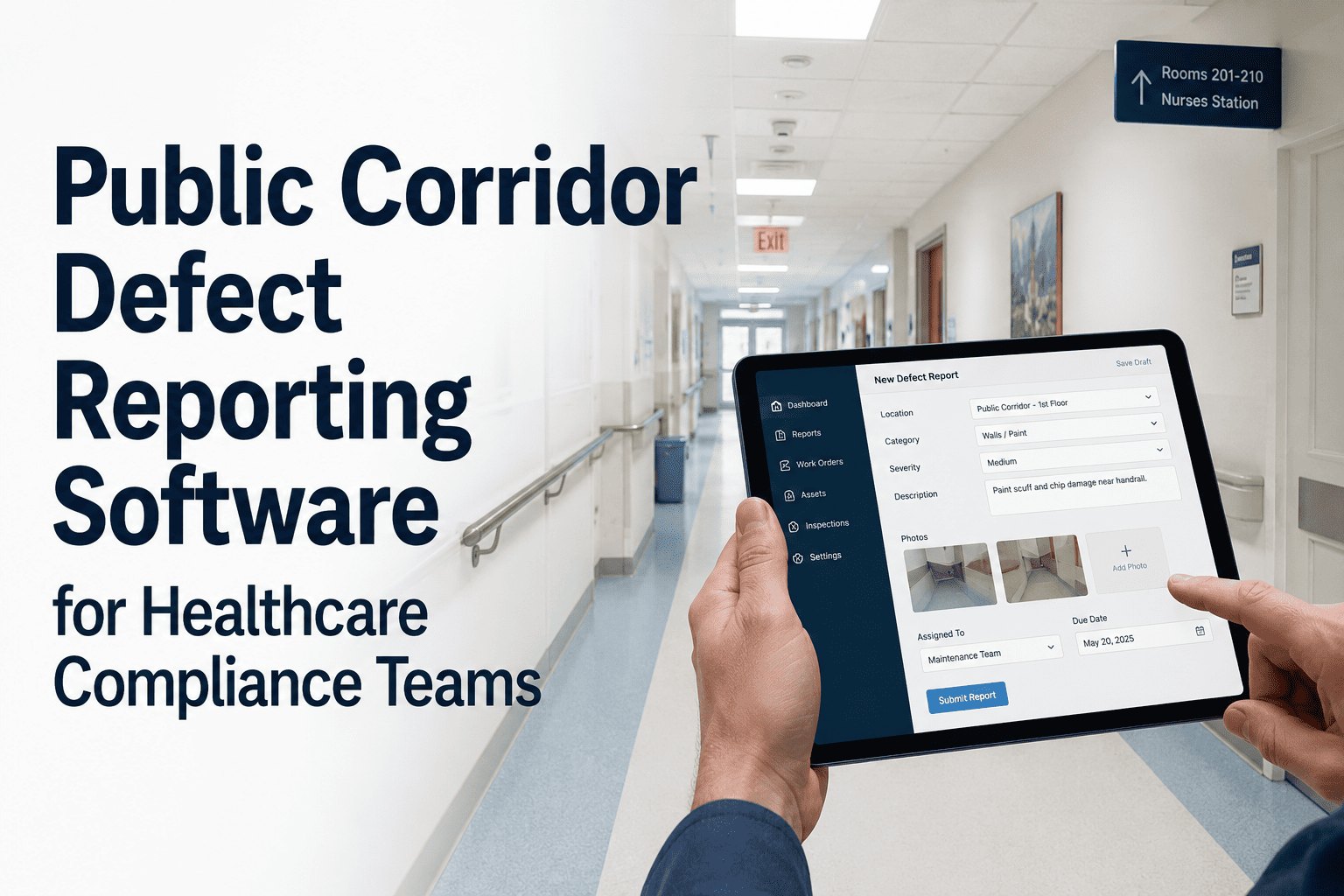
Joint Commission surveyors walk hospital corridors looking for exactly the kind of small defects that get noticed by staff every day but never make it into a tracked work order — a loose handrail, a blocked exit path, damaged flooring near a nursing station. Environment of Care deficiencies have ranked among the most frequently cited findings in recent surveys, and the gap usually isn't that maintenance wasn't done — it's that the defect was never logged, assigned, and closed in a system a surveyor can actually retrieve. Book a demo to see how OxMaint turns corridor rounds into audit-ready records, or start a free trial to digitize your first rounding checklist today.
Safety & Environment of Care · Healthcare Compliance · OxMaint
Corridor Defects Are Easy to Spot — and Easy to Lose Before They Reach a Work Order
OxMaint connects what your staff notices on rounds to a timestamped, assigned, auditable record — closing the exact gap that drives most Environment of Care survey findings.
Why Corridor Defects Keep Showing Up in Survey Findings
The maintenance usually happens. The record that proves it happened, on time, in the right format, often doesn't.
01
Verbal Reports Disappear
A nurse mentions a loose handrail to a passing engineer. It gets fixed eventually, but no work order, timestamp, or inspection record was ever created.
02
Paper Rounding Sheets
Environmental rounds get documented on paper checklists that sit in a binder, making it nearly impossible to retrieve a specific corridor's history during a survey.
03
No Closure Evidence
A defect is fixed, but there's no photo, no completion timestamp, and no link back to the original finding — so the corrective action can't be proven.
From Corridor Round to Closed, Audit-Ready Record
A defect spotted during a routine round follows the same digital trail every time, with no manual reconstruction needed later.
1
Defect Logged During Rounds
Staff or compliance teams log the corridor defect on a mobile device during environmental rounds, with a photo and exact location attached automatically.
2
Work Order Assigned Instantly
The finding becomes a work order routed to facilities or EVS with a priority level based on life-safety impact — no separate tracking spreadsheet.
3
Escalation if Overdue
Corridor and exit-path defects tied to life safety escalate automatically if not resolved within the configured window, so nothing sits silently for weeks.
4
Closure Proof Captured
Completion photo, technician name, and timestamp attach to the original finding — creating a closed-loop record a surveyor can retrieve in seconds.
See Your Corridor Rounds Become Survey-Ready Records
OxMaint digitizes the exact checklist your team already uses for environmental rounds — no new process to train staff on.
Common Corridor Defects and Where They Sit on Risk
| Defect Type |
Survey Relevance |
Typical Escalation |
| Blocked exit path or stairwell |
Life Safety, EC.02.06.01 |
Immediate |
| Damaged or loose handrail |
Patient/Staff Safety |
Same shift |
| Flooring damage or trip hazard |
Patient/Staff Safety |
24 hours |
| Missing or obscured signage |
Life Safety, Wayfinding |
48 hours |
| Improperly stored items in corridor |
Life Safety, EC.02.06.01 |
Immediate |
What Changes Once Rounds Are Digitized
13 days
Typical corrective action closure time once automated escalation replaces manual follow-up
Zero
Reconstruction needed before a survey — every finding is already retrievable
100%
Of corridor findings linked to a timestamped photo and closure record
Expert Review
Surveyors don't fail hospitals because maintenance wasn't done. They fail them because the connection between what happened in the corridor and what's recorded in the system was never made. A digital rounding workflow with automatic timestamps closes that exact gap, and it's the difference between a finding and a clean walkthrough.
Healthcare Facilities Compliance Advisor, Environment of Care Programs
Frequently Asked Questions
Which Joint Commission standards does corridor defect tracking support?
Corridor and exit-path findings primarily relate to EC.02.06.01 covering the physical environment and life safety requirements. OxMaint links each finding directly to the relevant standard for survey reference.
Book a demo to see the mapping.
Can staff log a defect without specialized facilities training?
Yes. Any staff member doing environmental rounds can log a finding on a mobile device in seconds, with the system handling routing, priority, and escalation automatically.
How quickly can we pull corridor history during an unannounced survey?
Findings, work orders, and closure evidence for any corridor or unit are retrievable instantly by location, eliminating the binder search that often happens under survey pressure.
Start a free trial to test retrieval speed yourself.
Does this replace our existing environmental rounds checklist?
No, it digitizes the checklist your team already uses, so the rounding process stays familiar while every finding becomes automatically tracked and auditable.
Close the Gap Between What Staff Notice and What Survey Records Show
Turn every environmental round into a retrievable, timestamped compliance record. See how OxMaint maps corridor defects to Joint Commission standards in a single walkthrough.



.jpg)
