Most multi-campus health systems don't have a maintenance problem — they have twenty-seven different versions of one. Site A uses a spreadsheet, Site B has a legacy CMMS from 2011, Site C runs a paper binder in the biomed office, and every audit cycle produces a different-looking submission from each. Meanwhile a modern academic medical centre manages 15,000+ assets across biomedical equipment, building infrastructure, life-safety systems & clinical controls — and the CFO wants one number for how the whole network is performing. Healthcare facilities running dedicated CMMS platforms report 94% Joint Commission survey readiness at any given time versus the audit-scramble that consumes weeks otherwise. This guide is the standardization playbook: the 5 pillars every multi-campus health system needs to align, the enterprise asset hierarchy that anchors it, and the phased rollout that gets 10+ sites on one operating model. Every step runs in OXMAINT AI, the healthcare CMMS built for portfolio-scale hospital operations.
Multi-Campus Health System · Standardization · Portfolio CMMS · 2026
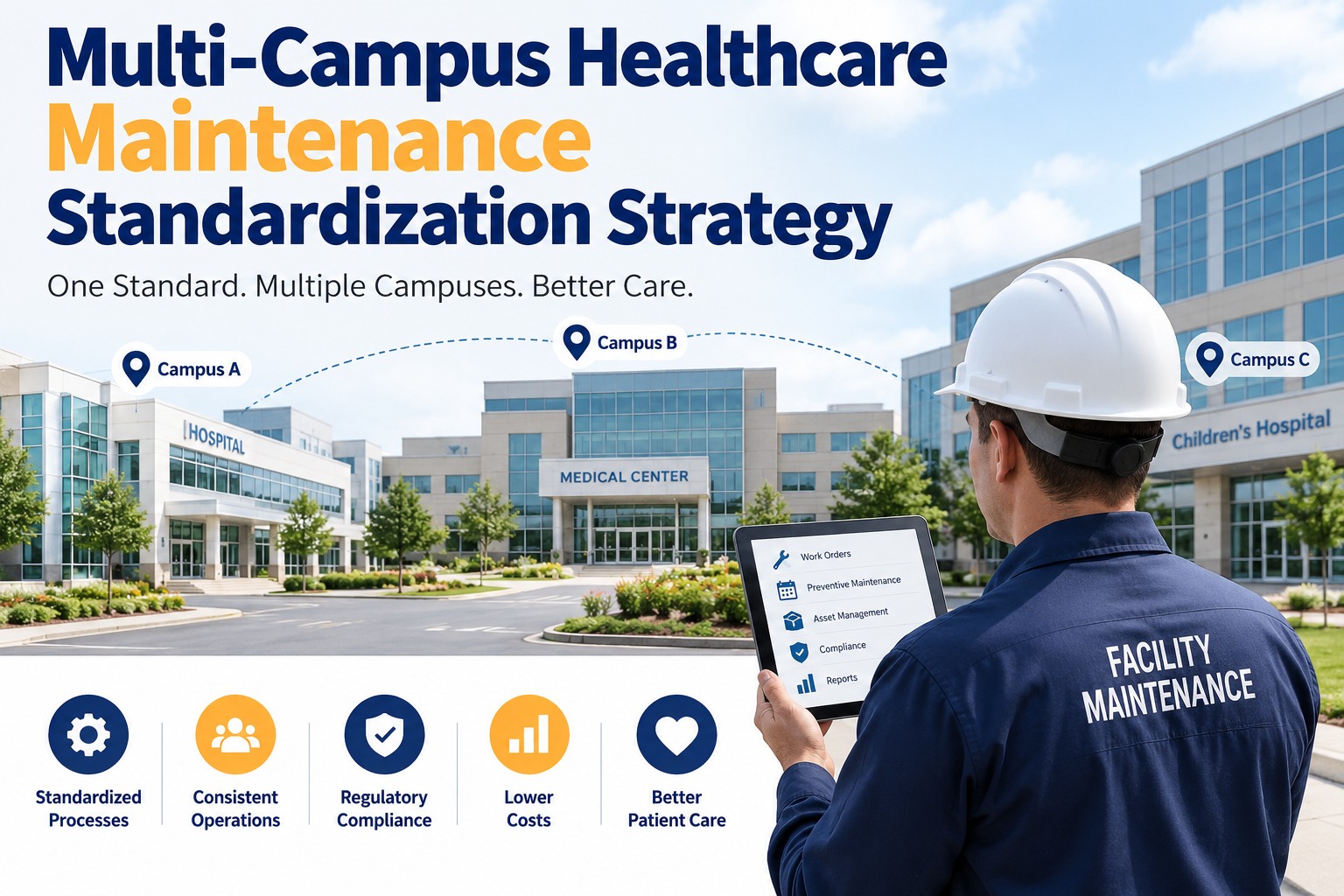
Multi-Campus Healthcare Maintenance Standardization Strategy
Move from 27 different versions of maintenance to one — with a unified asset hierarchy, standardized PM templates & a portfolio dashboard. OXMAINT AI, an AI-powered healthcare CMMS, gives every site operational autonomy while giving system leadership real cross-campus visibility.
15,000+
assets a mid-size hospital manages
94%
JC survey readiness with dedicated CMMS
41%
reported reduction in biomed downtime
6–10 wks
typical multi-campus rollout window
The "27 Versions" Problem
Every multi-campus health system tells the same story. Each site was self-sufficient for years, built its own tools, hired its own biomed lead, and developed its own way of recording PMs. The result is a network where nothing is comparable — site benchmarks are guesses, portfolio dashboards don't reconcile, and every accreditation cycle re-invents the audit. Standardization isn't about taking away site autonomy; it's about making the site data comparable at the network level. Start free and end the 27-versions problem on your first site.
Before Standardization
27 Versions of One CMMS
Each site tracks work differently
Asset naming varies — "CT-01" vs "Scanner_Radiology_A"
PM cadences aren't comparable across sites
Every audit submission looks different
Portfolio dashboard is a spreadsheet reconciliation
Leadership can't answer "how is Site D doing"
After Standardization
One Operating Model, Many Sites
Same WO workflow & templates network-wide
Unified asset naming & parent-child hierarchy
PM cadences aligned to OEM & JC standards
Audit-ready records in one format, on demand
Live portfolio dashboard, drill-down to site
Cross-site benchmarking & peer comparison
The 5 Pillars of Multi-Campus Standardization
Every successful multi-campus standardization program aligns on the same 5 pillars — get any one wrong & the portfolio view breaks. OXMAINT AI enforces each pillar as a system-level configuration that sites inherit rather than reinvent. Book a demo to see all 5 pillars configured in OXMAINT AI.
01
Asset Hierarchy
One naming convention & parent-child structure network-wide: Health System → Region → Facility → Department → Asset Class → Individual Asset. Every asset finds its place in the same tree.
02
PM Template Library
Central PM templates per asset class — MRI cryogen log, CT tube heat unit, HVAC filter change — cascaded to sites so cadence & checklist stay consistent, with site-level variance allowed only where OEM demands it.
03
Compliance Framework
One TJC / DNV / HFAP / CMS compliance library aligned to the 2026 Physical Environment consolidation, applied at every site, with a compliance dashboard rolling up to leadership.
04
Role-Based Access
Site technicians see & edit their site. Regional leaders see their region. System-level executives see everything. One user record, scoped permissions.
05
Portfolio Dashboards
Cross-site KPIs (PM %, uptime, backlog, cost/bed) reconciled from a single source of truth. Drill from portfolio → region → facility → asset in three clicks.
The Enterprise Asset Hierarchy — The Anchor Everything Hangs On
Standardization starts with a single hierarchy the entire network agrees on. Six levels, one shape, every asset in the system placed once. This is the tree OXMAINT AI configures at system level & enforces at asset creation, so a new imaging suite in Site F auto-inherits the right structure from day one. Sign up free and load the 6-level hierarchy on your network.
L1
Health System
e.g. Regional Health Network
L2
Region
e.g. East, West, South clusters
L3
Facility
Individual hospital / outpatient clinic / ambulatory site
L4
Department
Radiology, ICU, OR, ED, Facilities, Life Safety
L5
Asset Class
MRI, CT, HVAC AHU, Fire Panel, Ventilator, Infusion Pump
L6
Individual Asset
Serial-tracked instance with full attribute payload & history
Site Autonomy + Network Comparability. Both, Not Either.
Standardization is not centralization. Every site keeps its own equipment inventory, its own team & its own operational autonomy. What changes is that the shape of the data is the same — so a network leader can compare Site D to Site K, spot the outlier before it becomes a survey finding, and share what's working from Site B with everyone.
The Portfolio Site Scorecard
One of the highest-leverage artifacts a standardized program produces is the portfolio site scorecard — every site on one grid, same KPIs, same targets, colour-coded so the outliers announce themselves. Here's what leadership sees on the OXMAINT AI portfolio view. Book a demo to see the site scorecard on your network.
Note: illustrative values. On a real portfolio, Site D would be the immediate leadership focus — sub-80% PM, rising backlog, five aged P1s & a 22% cost overrun.
The 4-Phase Multi-Campus Rollout
Standardization is a project, not a switch. The teams that succeed run it as a phased rollout — anchor site first, cluster next, portfolio dashboard live before the last sites go online. Here's the 4-phase playbook OXMAINT AI runs multi-hospital networks through. Sign up free and start Phase 1 on your anchor site today.
Weeks 1–2
Design the Model
Define hierarchy: Health System → Region → Facility → Department → Class → Asset
Build the master PM template library per asset class
Draft the compliance framework & site-scorecard KPIs
Weeks 3–4
Anchor Site Live
Import asset register on the largest / most complex site first
Configure user roles & site-scoped access
Prove the model works on real data before scaling
Weeks 5–7
Cluster Rollout
Bring sites live in clusters of 2–3, using the anchor as the template
Train site biomed & facilities leads on mobile WO capture
Activate portfolio dashboard as sites report in
Weeks 8–10
Portfolio Live & Sustain
Final sites onboarded — every asset in the shared hierarchy
Site scorecard reviewed monthly by system leadership
Governance cadence locked: weekly ops, monthly portfolio, quarterly benchmark
The Governance Rituals That Keep It Standard
Standardization drifts without governance. Six months in, a well-meaning site lead will start "just tracking this one PM outside the system" — and the network view breaks. These are the four rituals OXMAINT AI supports to keep the operating model intact. Book a demo to see the governance cadence in OXMAINT AI.
Weekly
Site-level ops review — WO status, aged P1s, upcoming PMs on the site dashboard
Monthly
Portfolio site scorecard reviewed by system leadership — outlier sites flagged & supported
Quarterly
Benchmark against industry standards — cost/bed, PM %, uptime, compliance readiness
Annual
Hierarchy & PM template refresh — OEM updates, JC/DNV/CMS changes, new asset classes
What OXMAINT AI Gives a Multi-Campus Health System
OXMAINT AI is built for portfolio-scale healthcare — one platform, one hierarchy, one compliance framework, many sites. Here's what a network operations team gets on day one. Sign up free and start on your anchor site this week.
6-Level Asset Hierarchy
Health System → Region → Facility → Department → Class → Asset enforced at creation so every new asset lands in the right place.
Centralized PM Templates
Master library per asset class cascaded to every site, with site-level variance allowed only where OEM specification demands it.
Role-Based Site Access
Site technicians, regional leads & system executives on one user record with scoped views — no dual accounts, no permission sprawl.
Portfolio Site Scorecard
Live dashboard comparing every site on the same KPIs — PM %, uptime, backlog, P1 aging, cost per bed — with drill-down.
Unified Compliance Framework
TJC 2026 Physical Environment, DNV, HFAP & CMS libraries applied network-wide with one audit-ready export per site.
Benchmark Overlays
Cost per bed & PM compliance benchmarked against industry standards so leadership sees where every site sits vs peer networks.
"
We ran the health-system-wide MRI PM cadence across eleven facilities and got eleven different answers — different intervals, different checklists, different sign-off practices. The audit exposure alone was keeping me up at night. Nine weeks after we started on OXMAINT AI, every site is on the same hierarchy, the same PM templates & the same compliance framework. The monthly portfolio scorecard tells me in one screen which site needs support this month, and site leadership still has full autonomy over their day-to-day work. It's not that we took anything away from the sites — we just gave leadership something they never had, which is a network view they could actually trust.
VP Operations & Facilities · 11-Hospital Health System
Frequently Asked Questions
Why do multi-campus health systems need CMMS standardization?
Because without it, portfolio-level reporting is impossible — every site tracks work differently, uses its own asset naming, and produces its own audit format. Standardization gives system leadership one comparable view without taking away site operational autonomy.
What's the right asset hierarchy for a health system?
Six levels: Health System → Region → Facility → Department → Asset Class → Individual Asset. Every asset in the network finds one place in this tree. OXMAINT AI enforces the hierarchy at asset creation so a new imaging suite in a new facility automatically inherits the right structure.
Does standardization mean sites lose autonomy?
No — and this is the biggest cultural point in a rollout. Each site keeps its own inventory, PM schedules & team. What changes is that the shape of the data & the compliance framework are the same. Site autonomy at execution, network comparability at reporting.
How long does a multi-campus OXMAINT AI rollout take?
6–10 weeks is typical, depending on the size of the asset registry & the number of sites. The playbook is: Weeks 1–2 design the model, Weeks 3–4 anchor site live, Weeks 5–7 cluster rollout, Weeks 8–10 portfolio live & governance cadence locked.
Which KPIs go on the portfolio site scorecard?
PM Compliance %, Critical Equipment Uptime, Backlog Ratio, aged P1 count, Cost per Bed vs benchmark — the network-level KPIs that let leadership spot outlier sites at a glance. Each is auto-calculated in OXMAINT AI from live work-order data with drill-down to asset level.
One Operating Model. Every Site. Every Asset.
Move from 27 versions of maintenance to one — with a unified 6-level asset hierarchy, standardized PM templates, one compliance framework & a live portfolio site scorecard, all on OXMAINT AI. Start free — no credit card, unlimited users.