An Emergency Operations Center cannot be maintained the same way a standard government building is maintained — because an EOC has no scheduled downtime. When a Category 4 hurricane makes landfall, when a mass casualty incident triggers full activation, or when a cyberattack forces government into emergency continuity mode, the EOC must be fully operational within 2–4 hours and must sustain 24-hour operations for 7–21 days without any maintenance intervention on critical systems. FEMA's Power Outage Incident Annex documents that backup generator failure rates increase to approximately 15% after 24 hours of continuous use. A generator that has not been load-tested in 6 months is not a redundancy asset — it is a liability with a nameplate on it. The $103.2 million FEMA allocated to the EOC Grant Program in FY2024 funds facilities and equipment. The resilience maintenance programme that keeps those systems ready to activate is the responsibility of the jurisdiction — and most jurisdictions manage it with the same reactive maintenance approach they apply to a parks department storage building. Book a demo to see OxMaint's Shutdown Management module for EOC resilience maintenance — or start free today.
Article · Emergency Preparedness · Shutdown Management · CMMS
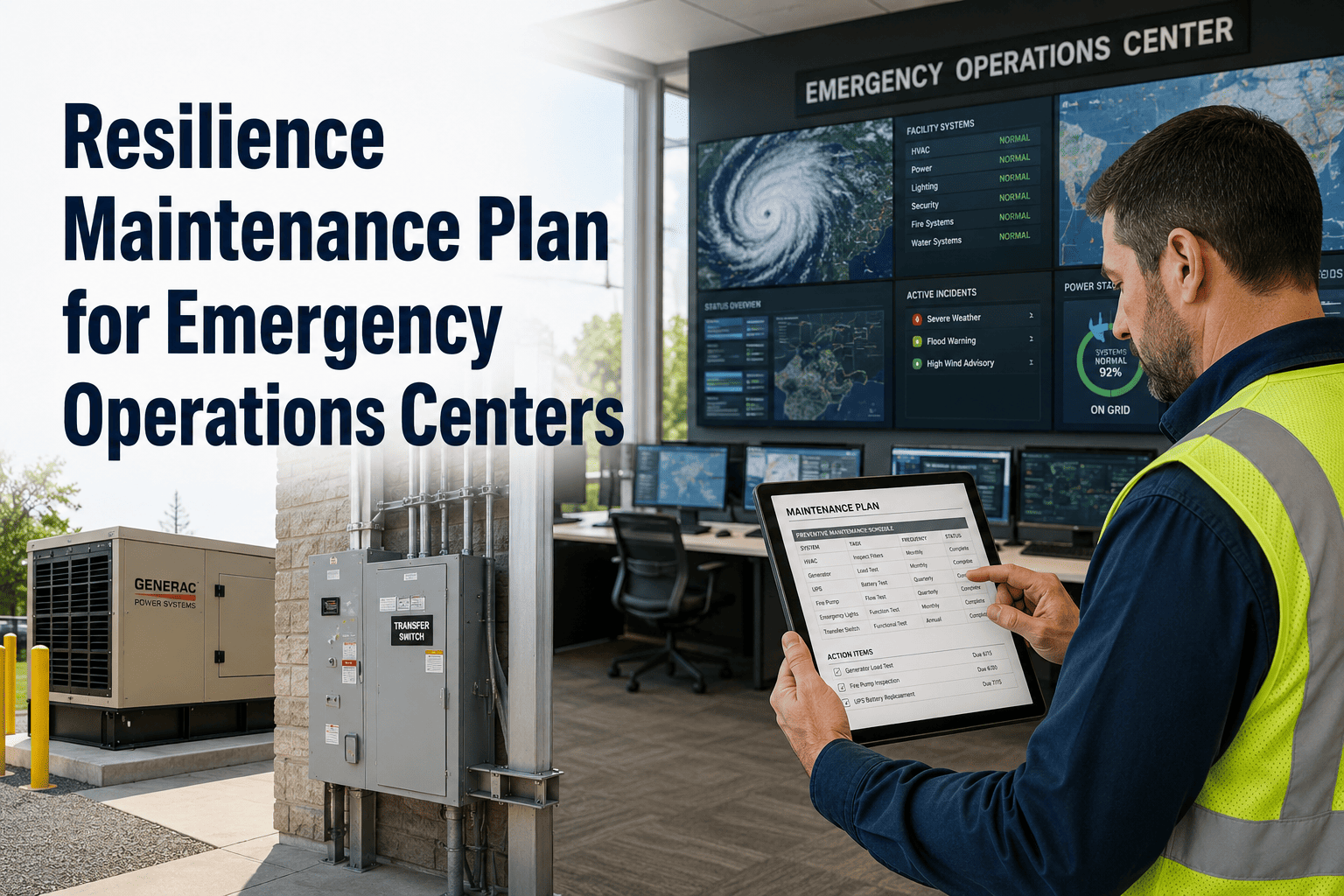
Resilience Maintenance Plan for Emergency Operations Centers
How to structure a maintenance programme for an EOC that must activate within hours, sustain continuous operations for weeks, and never experience a critical system failure during the event it was built to manage.
15%
Generator failure rate after 24 hrs continuous use — FEMA Power Outage Incident Annex
7–21 days
Typical EOC activation duration — systems must sustain continuous operation with no maintenance window
$103.2M
FEMA EOC Grant Program FY2024 — funding facilities, not the maintenance plan that keeps them ready
EOC System Criticality Tiers — Not All Systems Are Equal
An EOC resilience maintenance plan must classify every system by what happens if it fails during activation. The three-tier classification below drives maintenance frequency, redundancy requirements, and the shutdown management decisions that determine when a system can be safely taken offline for service.
Tier 1 — Mission Critical
Failure = EOC activation stops
Emergency power generation (primary and backup generators)
UPS systems — all communications and IT infrastructure
Redundant HVAC for communications/IT equipment rooms
Primary communications infrastructure (radio, satellite, internet)
Water supply for extended shelter-in-place operations
Maintenance: Monthly load testing + quarterly full PM + pre-activation readiness check within 72 hrs of activation
Tier 2 — Operations Support
Failure = degraded operations, personnel impact
Personnel HVAC — comfort and cognitive performance during extended activation
Lighting systems including emergency and egress lighting
Access control and physical security systems
Backup communications (secondary radio systems, hotlines)
Sewage and waste management for extended occupancy
Maintenance: Quarterly PM + semi-annual functional test + included in pre-activation readiness protocol
Tier 3 — General Facility
Failure = inconvenience, not operational impact
General office HVAC in non-critical areas
Non-emergency lighting in administrative spaces
General plumbing in non-operational areas
Exterior maintenance (parking, landscaping, non-critical access)
Maintenance: Standard facility PM schedule — can be deferred during activation, scheduled during standby periods
The Activation Readiness Matrix — What Must Be Verified Before Every Potential Activation
EOC activations are not always predictable — a major incident can require activation within 2 hours of the first alert. The readiness matrix below defines the verification protocol that must be current at all times for an EOC to be reliably activatable on short notice.
| System |
Verification Task |
Required Frequency |
Failure Risk Without Verification |
OxMaint Trigger |
| Primary generator |
Load test at 100% rated capacity for minimum 2 hours |
Monthly |
15% failure rate after 24 hrs (FEMA) — failure during activation is catastrophic |
Calendar-based PM with mandatory load test result entry; test failure auto-escalates to emergency repair WO |
| Backup / transfer generator |
Automatic transfer switch test; load test at 75% rated capacity |
Quarterly + after any utility power event |
Transfer switch failure means no power handover — facility goes dark when utility power fails |
PM triggered by calendar and by utility outage event log — any utility interruption triggers next-day ATS verification WO |
| UPS — communications and IT |
Battery capacity test; runtime verification at full load; cell voltage check |
Quarterly capacity test; battery replacement at 80% of rated service life |
UPS failure on switchover means communications blackout — exactly at the moment an emergency is causing the power event |
Battery age tracked per serial number; replacement work order auto-generated at 80% of rated service life |
| Communications/IT room HVAC |
Temperature and humidity verification; redundant unit switchover test; filter inspection |
Monthly operational check; quarterly switchover test |
Equipment room thermal event during activation — server throttling begins within 15 minutes of cooling loss at full IT load |
Temperature trend monitoring linked to CMMS alert; switchover test generates WO and verifies redundant unit picks up full load |
| Reserve water storage |
Level check; quality test; pump and valve function test |
Monthly level; quarterly quality and pump test |
Extended shelter-in-place activation with inadequate water — personnel welfare and operational continuity failure |
Tank level sensor linked to CMMS alert; quarterly pump function test is mandatory pre-activation checklist item |
| Emergency lighting and egress |
30-second function test; annual 90-minute discharge test (NFPA 101) |
Monthly 30-second; annual 90-minute (NFPA 101 requirement) |
Egress lighting failure during activation-related power event — evacuation and life safety impact |
Both test frequencies scheduled in CMMS; failed units auto-generate corrective WO before next scheduled test |
SHUTDOWN MANAGEMENT · OXMAINT · EMERGENCY PREPAREDNESS
An EOC That Has Not Been Maintained Is Not a Resilience Asset. It Is a Risk.
OxMaint Shutdown Management plans, sequences, and documents every EOC system maintenance event — ensuring Tier 1 systems are never offline simultaneously, activation readiness is verified on schedule, and every test result is documented and reportable for FEMA grant compliance.
Shutdown Management for EOC Maintenance — Sequencing Without Risking Readiness
Performing maintenance on an EOC Tier 1 system requires a shutdown management discipline that standard facility maintenance does not — because taking a generator offline for service while the backup generator has a known fault creates a single point of failure in a facility that must never have one.
1
Confirm redundant system is fully operational before taking primary offline
OxMaint Shutdown Management requires a confirmed pass on the redundant system's most recent test before issuing a work order to take the primary system offline. If the backup generator's last load test failed or is overdue, the primary generator PM is blocked until the backup is verified — not deferred to a paper checklist.
2
Issue permit with defined maintenance window and re-energisation protocol
Every Tier 1 system maintenance event requires a digital permit specifying the maintenance window, the person authorised to re-energise the system, and the test that must pass before the system is returned to ready status. The permit cannot be closed until the post-maintenance test result is entered and passing.
3
Monitor readiness status during maintenance window for activation risk
OxMaint displays a live readiness dashboard showing which Tier 1 systems are currently in a maintenance state. If an emergency activation alert is received while a generator is offline for service, the dashboard shows the EOC Director exactly which systems are unavailable and what the estimated return-to-service time is — enabling an informed activation decision rather than discovery of a critical gap under pressure.
4
Document test results for FEMA grant compliance and audit readiness
Every load test result, every battery capacity test, every transfer switch exercise is stored as a timestamped, technician-attributed record in OxMaint. FEMA EOC Grant Programme recipients must demonstrate that funded systems are properly maintained — OxMaint generates the maintenance history report that satisfies that requirement in minutes, not days of manual file assembly.
Expert Review
"The maintenance gap in EOC resilience planning is structural. Emergency managers focus on activation procedures, interoperability, and communications — all critical. But the physical facility that hosts the EOC activation — the generator that must run for 14 days, the UPS that must bridge the power gap, the equipment room cooling that must maintain server inlet temperatures while the building is fully occupied at 2 AM — receives maintenance planning that is indistinguishable from a standard office building. The FEMA generator failure data is the most important number in EOC facility management: 15% failure rate after 24 hours of continuous use. A generator that has been tested monthly under load is not a statistic that applies to you. A generator that is started and idled for 20 minutes once a month — which describes the maintenance regime at many EOCs — absolutely is. The difference between a generator maintenance programme and a generator reliability programme is whether the test exposes the failure modes before the activation, or whether the activation exposes them during it."
Dr. Maria Santos, PE, CEM, LEED AP
Licensed Professional Engineer · Certified Energy Manager · LEED Accredited Professional · 21 years public sector facilities and emergency operations infrastructure management · Former Director of Public Works, mid-sized US municipality · Specialist in EOC resilience infrastructure planning and FEMA grant programme compliance
Frequently Asked Questions
How often should EOC backup generators be load tested?
NFPA 110 — the standard for emergency and standby power systems — requires that generators be load tested at
not less than 30% of nameplate rating monthly, and that a full-load test be conducted at least annually. For EOC applications, industry best practice and FEMA guidance recommend monthly tests at 100% rated load for a minimum of 2 hours, because an EOC activation during a major disaster will demand full rated load immediately and sustained for days — not the light loads that a 30-minute idle start test exposes. The 15% failure rate FEMA documents after 24 hours of continuous use applies to generators that have not been tested under full-load conditions. Monthly full-load testing substantially reduces this risk.
Book a demo to see how OxMaint schedules and documents generator load tests for EOC facilities.
What maintenance records does FEMA require for EOC Grant-funded systems?
FEMA EOC Grant Programme recipients are required to maintain funded equipment in good working order and to provide documentation of maintenance activities upon request during compliance reviews and audits. Required records typically include:
preventive maintenance schedules and completion records for all funded systems;
test results for generators, UPS, and communications systems;
service records for repairs to funded equipment; and
calibration and certification records for communications equipment. Grant recipients who cannot produce these records during a monitoring visit risk grant disallowances. OxMaint generates a maintenance history report by asset tag — the same tag used in the FEMA grant inventory — covering all PM completions, test results, and repair work orders for the grant review period.
Start free to link your FEMA asset inventory to OxMaint maintenance records.
How is EOC shutdown management different from standard facility shutdown management?
Standard facility shutdown management sequences maintenance to minimise operational disruption. EOC shutdown management has an additional constraint: maintaining activation readiness throughout the maintenance window. This means the sequence must verify that the redundant system is fully operational before taking the primary offline, that a maximum maintenance window is defined and monitored, and that an emergency activation protocol is pre-planned for the scenario where an activation alert arrives while a Tier 1 system is undergoing maintenance. OxMaint's Shutdown Management module enforces these constraints — blocking primary system offline permits if the redundant system has an open fault or an overdue test, and displaying live readiness status to the EOC Director throughout any planned maintenance event.
What is the minimum maintenance frequency for EOC UPS battery systems?
UPS battery maintenance for EOC applications requires three levels of attention: monthly visual inspection of battery terminals, connections, and cabinet temperature; quarterly capacity testing — verifying that batteries can deliver rated runtime at full load (not just that the UPS passes a self-test); and replacement at 80% of rated service life rather than at failure. Lead-acid batteries in UPS systems degrade gradually — a battery testing at 82% capacity will fail under the sustained load of a 14-day activation even though it passed the last quarterly test. The replacement trigger must be based on capacity percentage and service life, not visual inspection or brief self-test. OxMaint tracks battery serial numbers, installation dates, and quarterly capacity test results — auto-generating replacement work orders when either the service life threshold or the capacity threshold is reached.
SHUTDOWN MANAGEMENT · EMERGENCY PREPAREDNESS · OXMAINT
The Generator That Has Not Been Load-Tested Is Not Backup Power. It Is a Risk With a Nameplate.
OxMaint Shutdown Management gives EOC facility managers the system criticality tiers, activation readiness verification, sequenced maintenance protocols, and FEMA-compliant documentation that convert an EOC from a building to a resilience asset — by ensuring every Tier 1 system is ready to activate before it is needed, not discovered to be broken after.