A resident photographs a pothole on their morning commute and submits a service request at 7:42 AM. By 8:00 AM they have a confirmation number. By 9:15 AM a work order has been assigned to the nearest available crew. By 2:30 PM the repair is complete and they receive a photo notification with before-and-after images. That sequence — from citizen report to confirmed resolution in under seven hours — is not exceptional for well-run municipalities using integrated service request platforms. But for the majority of cities still routing public works requests through phone queues, paper forms, and email chains, the same citizen may still be waiting six weeks later with no acknowledgement and no idea whether anyone received their report. OxMaint's citizen service portal connects every public works request directly to the CMMS work order system — so the moment a request is submitted, a work order exists, a crew is assigned, a timeline is established, and the citizen is kept informed at every stage.
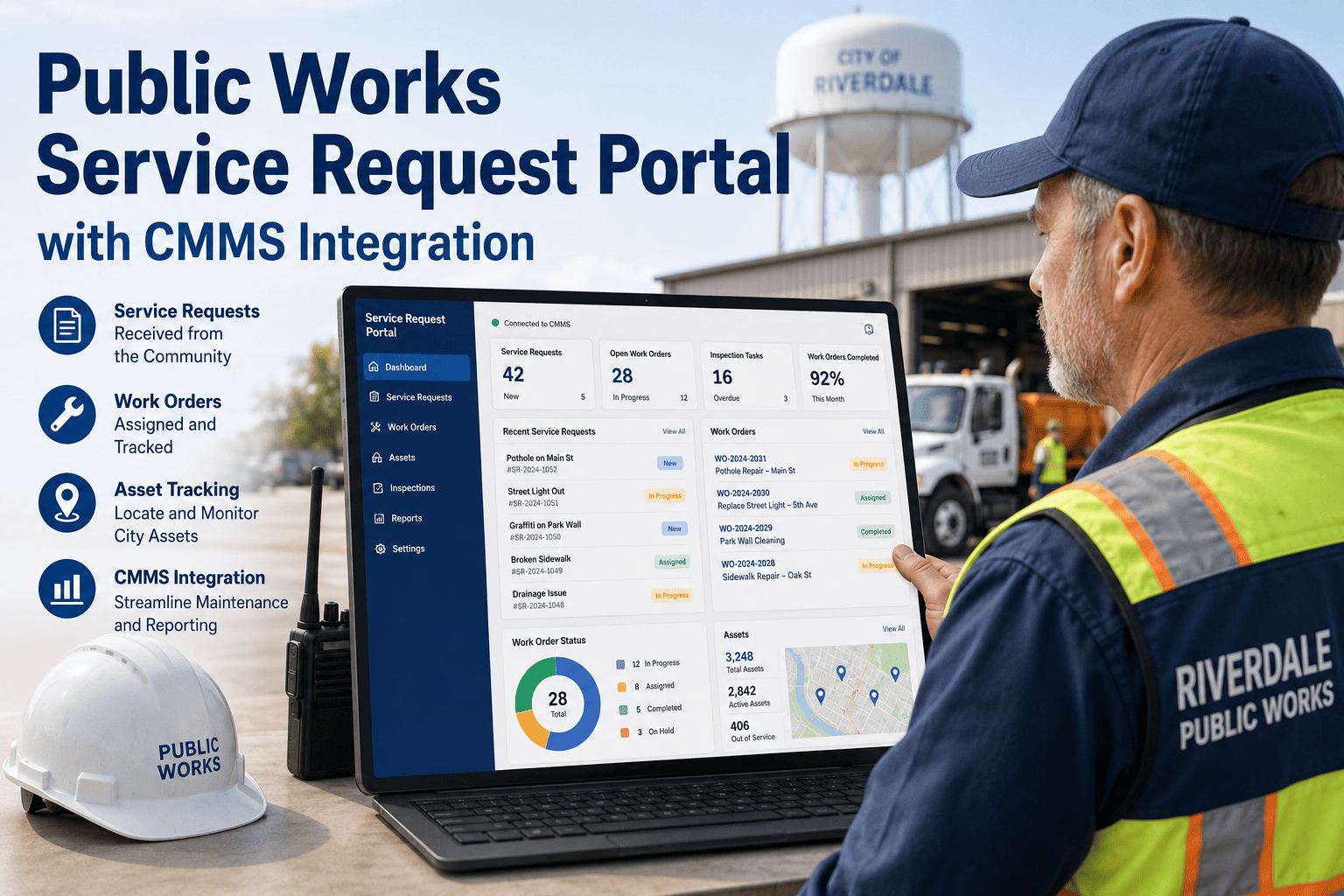
Public Works Service Request Portal with CMMS Integration
QR code at the pothole. Mobile app photo submission. Web portal form. Phone-to-digital transcription. Every channel. Every request. One work order system. Real-time status updates for citizens. Live dashboards for directors.
The Two Problems Every Public Works Department Is Solving Simultaneously
A citizen service portal isn't just a resident-facing tool. It solves two distinct problems that public works directors and city administrators face simultaneously — one visible to the public, one invisible until it becomes a management crisis.
How a Citizen Request Becomes a Completed Work Order in OxMaint
Service Request Categories and Response SLA Standards
| Request Category | Common Examples | Default Priority | Response SLA | OxMaint Routing |
|---|---|---|---|---|
| Safety Hazard | Large pothole on arterial road, downed tree blocking road, broken traffic signal, open manhole | P1 | <4 hours | Emergency crew dispatch + supervisor alert + citizen hourly update |
| Road & Pavement | Pothole, cracked pavement, damaged road marking, drainage issue, shoulder erosion | P2 | 24–48 hours | Roads department, nearest crew, GPS-tagged location pre-loaded on work order |
| Parks & Grounds | Damaged playground equipment, graffiti, irrigation failure, fallen tree, illegal dumping | P2–P3 | 48–72 hours | Parks department, park ID pre-populated from GPS location |
| Street Lighting | Outage, damaged pole, flickering light, wiring exposure | P2 | 24–48 hours (dusk-to-dawn) | Electrical crew, asset ID from lamppost QR code, AHJ permit check |
| Waste & Sanitation | Missed collection, overflow bin, illegal dumping, hazardous waste | P2–P3 | 24 hours | Sanitation department, route-linked for efficient scheduling |
| Building & Facility | Community centre HVAC, library plumbing, government building accessibility issue | P3 | 5 business days | Facility maintenance team, asset-linked to building record |
What the Director Sees: The Public Works Performance Dashboard
The frustration residents express about local government service delivery is almost never really about how long something takes. When I've conducted satisfaction research across municipal service delivery programmes, the overwhelming finding is that people can accept reasonable timelines — they cannot accept silence. A resident who reports a pothole and receives an immediate confirmation, a 48-hour timeline, and a completion notification is typically satisfied with the experience — even if the repair took 52 hours. A resident who reports the same pothole, hears nothing for three weeks, calls back and gets put on hold, and eventually discovers the request was "lost in the system" is not just dissatisfied — they are now an active critic of local government. The technology to close that gap costs a fraction of what municipal governments spend managing the reputational and political fallout from poor service communication. Citizens don't need government to be instant. They need government to be honest, predictable, and present.
Frequently Asked Questions
Does OxMaint replace our existing 311 phone system?
OxMaint does not replace your 311 phone line — it integrates with it as a parallel intake channel. Operators answering 311 calls use OxMaint's web intake form to transcribe requests into structured digital work orders directly during the call — eliminating the paper-to-digital transcription step that creates delays and lost requests. Mobile app, web portal, and on-site QR code submissions flow into the same OxMaint queue alongside operator-entered requests. Citizens who prefer phone service continue to be served; cities gain the operational advantages of a digital work order system regardless of which channel a citizen chooses to use. Start your free trial to configure the multi-channel intake workflow.
How are duplicate requests handled when multiple citizens report the same issue?
OxMaint's duplicate detection engine identifies requests that match a recently submitted item based on GPS proximity (within a configurable radius, typically 25–100 metres), category, and submission timeframe. When a duplicate is detected, the new submission is linked to the existing open work order rather than creating a second job — the original requester's timeline is preserved and the new requester receives a confirmation that the issue is already being addressed. This prevents crews from being dispatched twice to the same pothole and gives directors accurate request volume data that isn't inflated by repeat submissions. Book a demo to see the duplicate detection configuration for your geographic areas.
Can the portal be configured with the municipality's branding and language options?
Yes. The citizen-facing portal is fully brandable — municipal logo, colours, and domain. Request categories, field labels, and confirmation messaging are configured to match local department names and service descriptions rather than generic defaults. Language support covers English and Spanish as standard, with additional language configuration available for municipalities serving multilingual communities. The portal URL is configured as a subdomain of the municipality's own website, so citizens see a seamless government service experience rather than a third-party platform. Start your free trial to configure the branded portal for your municipality.
What data does the request heat map provide for capital planning?
The heat map aggregates GPS-tagged requests over configurable time windows (12 months is most useful for capital planning purposes) and identifies segments, parks, or facilities with disproportionate request volumes. A street generating 20+ road repair requests over 12 months at an average repair cost of $800 per job is a $16,000/year recurring cost that a $40,000 mill-and-overlay would eliminate for 15 years. This data makes capital budget arguments to council and state/federal infrastructure grant applications objectively defensible — the request history is the evidence of need. Book a demo to see the heat map and capital planning data export.
Citizens Don't Need Government to Be Instant. They Need It to Be Present.
OxMaint connects every citizen service request — from any channel — directly to the public works CMMS work order system, keeping residents informed at every stage and giving directors the operational data to manage, report, and continuously improve service delivery.