Listeria monocytogenes lives in drains. That is not an exaggeration — it is the consensus finding of over two decades of food plant environmental monitoring programmes across dairy, ready-to-eat meat, produce, and bakery facilities. Drains that are improperly sloped, inadequately trapped, infrequently sanitized, or designed with harborage-friendly geometry become persistent Listeria reservoirs that routine surface swabbing consistently misses until an environmental positive or — worst case — a product recall forces a root cause investigation. GFSI-benchmarked schemes including BRCGS, SQF, FSSC 22000, and FSMA Preventive Controls require documented drainage maintenance programmes as part of environmental monitoring and infrastructure PRPs. Start a free trial on Oxmaint to build your drainage maintenance PM programme, or book a demo and see how CMMS tracks every drain, trap, and sanitation record across your facility.
Food Plant Sanitary Drainage Design and Maintenance for Listeria Control
Trench drains, hub drains, trap design, floor slopes, sanitation frequencies, and CMMS-tracked records — for food safety teams managing environmental Listeria programmes in high-care and RTE zones.
Why Drains Are the Primary Listeria Harborage Site in Food Plants
Listeria monocytogenes is uniquely adapted to food plant drainage environments. It forms biofilms on stainless steel, concrete, and plastic drain components that resist standard sanitizer concentrations, grows at temperatures as low as 0.4°C, and survives in wet, organic-matter-rich environments that are precisely what floor drains provide. Unlike surface contamination that is visible and accessible to routine sanitation, Listeria residing in drain biofilms, trap sediment, and concrete cracks beneath drain grates is largely invisible to visual inspection and often negative on surface swabs until cell counts exceed detectable thresholds.
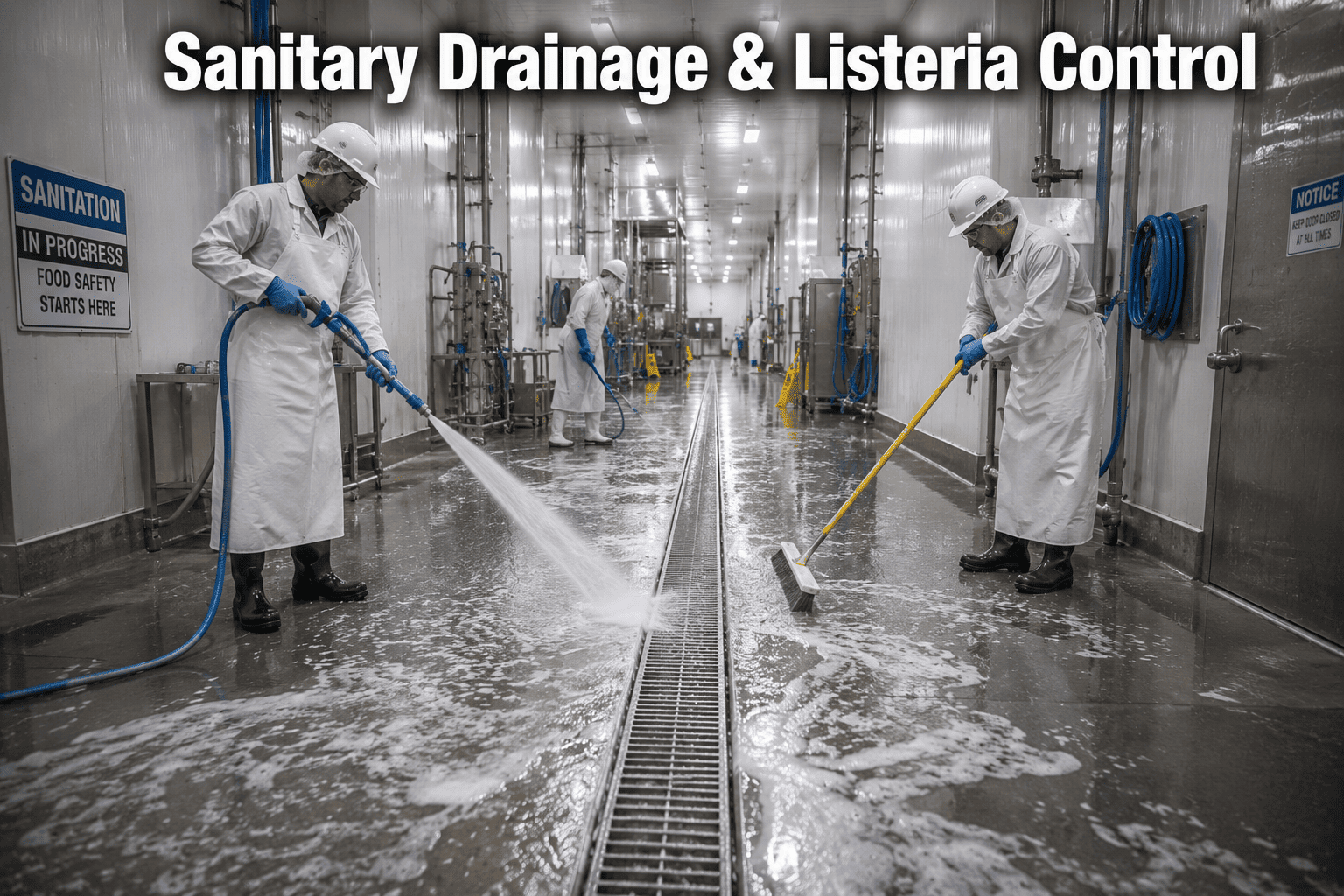
The mechanism of spread from drain to product is direct aerosol transfer during high-pressure cleaning — a practice that the USDA FSIS, FDA, and GFSI Technical Committee on Listeria all identify as a primary route of post-process contamination in ready-to-eat environments. Water droplets carrying Listeria from drain surfaces travel up to 3 metres during pressure washing, colonising food contact surfaces, equipment bases, and air handling inlets. This is why proper drain placement relative to open product, drainage flow direction, and sanitation sequencing are as important as the drain's physical design and material specification.
GFSI-benchmarked standards respond to this risk by requiring drainage to be designed, maintained, and documented as part of the environmental monitoring programme. BRCGS Clause 4.4.8 specifically requires adequate drainage and drainage maintenance records. SQF Element 11.3 requires drain maintenance and environmental monitoring to be integrated. FSMA Preventive Controls requires harborage site identification and remediation to be documented in the food safety plan. Oxmaint turns these documentation obligations into automated, traceable CMMS records — start a free trial to build your drainage maintenance programme on Oxmaint, or book a demo to see how environmental monitoring and PM records integrate in one platform.
8 Core Concepts in Sanitary Drainage Design and Maintenance
Minimum 1:50 slope (2%) toward drains in wet processing areas. Inadequate slope creates standing water — a persistent Listeria growth zone. Slope must direct water away from open product zones and toward perimeter drains, not across traffic paths.
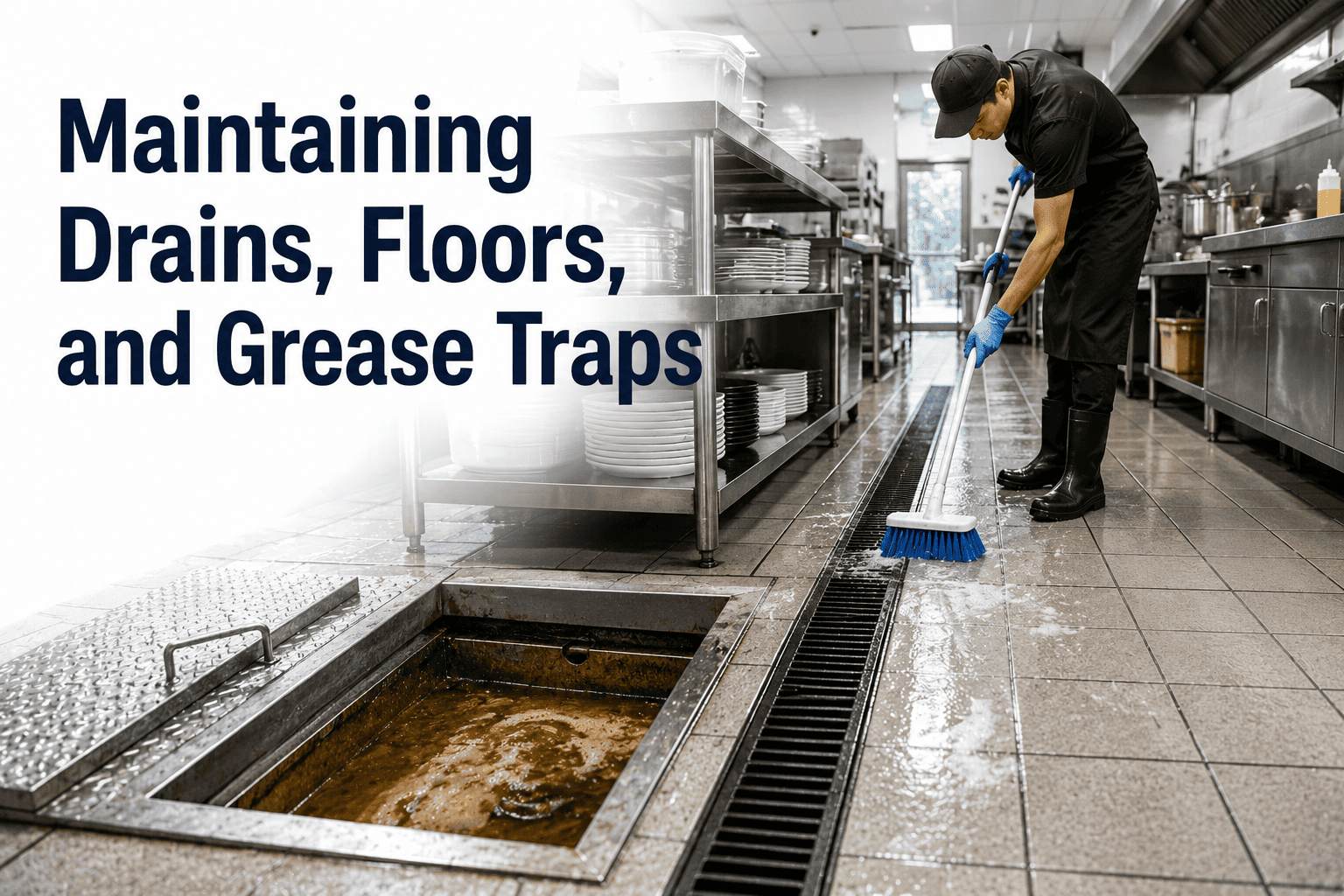
Trench drains in high-throughput wash areas must have smooth, crevice-free interiors with no internal ledges or right-angle joints. Stainless steel is preferred over cast iron or concrete channel. Grate design must allow full access for mechanical cleaning and swabbing.
Hub drains must not be placed directly below equipment bases, under conveyor frames, or in floor depressions where organic matter accumulates. They must be accessible for grate removal and drain body inspection at documented maintenance intervals.
Listeria Risk
P-traps prevent sewer gas backflow but accumulate organic sediment that feeds Listeria biofilms. Deep-seal traps in infrequently used drains dry out, eliminating the backflow barrier entirely. Both require scheduled inspection and sanitizer flooding at defined intervals.
The junction between drain body, floor concrete, and wall base is the highest-risk harborage site in most food plants — cracks in coved tile or epoxy at this junction trap organic matter inaccessible to standard cleaning. This interface must be on the glass-and-brittle audit equivalent: a crack-and-harborage register.
Drains must be sanitized last in the sanitation sequence — after all surfaces above drain level are cleaned and rinsed. High-pressure cleaning of drains must never occur when adjacent product zones are open. Pressure limits for drain cleaning should be set in the sanitation SOP and verified with pressure gauges.
Drainage from high-care zones must not flow into or share infrastructure with drains serving raw material or non-food areas. Drains serving coolers, condensate lines, and equipment sanitize stations must be zone-segregated to prevent cross-contamination via drain backflow or aerosol during cleaning.
Drains and the 30cm radius around drain grates are Zone 3 environmental monitoring sites requiring scheduled swabbing in FSMA and GFSI programmes. Swab results must link to the drain asset record so that positive findings trigger corrective work orders for deep cleaning and sanitizer change rather than just re-swabbing.
6 Drainage Maintenance Failures That Drive Listeria Findings
Most facilities cannot produce a complete list of drains by type, location, zone classification, and last maintenance date. Without a register, maintenance is reactive and audit-driven rather than systematic. GFSI auditors increasingly ask for drain maintenance records by zone — and "we clean them regularly" is not an acceptable answer without documented evidence.
Sanitation teams under time pressure frequently clean drains before product zones are fully secured. A single high-pressure spray event from a contaminated drain into an open product zone can result in 3–5 metres of aerosol contamination. This is the mechanism behind the majority of post-process Listeria positives in USDA and FDA outbreak investigations.
Gaps in coved tile at drain bases, cracks in epoxy flooring adjacent to drains, and unsealed penetrations for drain pipes through walls are harborage sites that standard sanitation cannot reach. These must be identified, registered, and either repaired or managed as high-frequency swab sites — but most facilities have no formal harborage registry linked to a repair programme.
P-trap sediment accumulation provides the organic substrate that supports Listeria biofilm development in drain bodies. Trap cleaning requires physical access, not just chemical sanitizer application — and most facilities have no CMMS-scheduled PM trigger for trap cleaning, relying on annual or ad hoc deep-cleans that are insufficient for high-throughput wet zones.
When Zone 3 environmental swabs return Listeria positives from drain areas, the corrective action is usually re-swabbing after intensified sanitation — without ever pulling the drain asset record to check when the trap was last cleaned, whether the grate-to-body interface is cracked, or what sanitizer rotation has been used. The root cause remains unaddressed — start a free trial to see how Oxmaint links swab results to drain asset maintenance histories.
Listeria biofilms develop resistance to repeated use of the same sanitizer class. Drain sanitation programmes that use the same quaternary ammonium or chlorine-based product at the same concentration for months or years select for resistant strains. Alternating sanitizer classes on a documented rotation is an FDA and GFSI requirement for harborage site management — but most facilities have no formal rotation schedule.
How Oxmaint Builds a Defensible Drainage Maintenance Programme
Every drain — trench, hub, floor, equipment, cooler condensate — is registered as a CMMS asset with type, zone classification (high-care, high-risk, ambient, non-food), last maintenance date, and assigned PM schedule. Auditors pull the complete registry in seconds.
High-care drain sanitation triggers at higher frequencies than ambient zone drains. Trap cleaning, grate-to-body inspection, and sanitizer rotation are each scheduled as separate PM tasks — so no element of drain maintenance is missed because it was bundled into a single generic cleaning record.
Physical harborage sites — drain interface cracks, unsealed penetrations, grout gaps — are registered as linked sub-assets to each drain. Each harborage site has a repair status, a swab frequency, and a target repair date tracked in Oxmaint until the defect is closed or the repair work order is completed.
Zone 3 swab results link directly to the drain asset record in Oxmaint. A positive finding automatically triggers a corrective work order for deep cleaning, sanitizer evaluation, and root cause investigation — with the full maintenance history visible in the same screen for immediate root cause analysis.
Oxmaint PM tasks include chemical fields that record the sanitizer product, concentration, and contact time used at each drain on each cleaning event. Rotation compliance is visible at the drain asset level and across the facility — auditors and food safety managers can verify the rotation protocol was followed without manual log review.
When environmental monitoring returns a positive, Oxmaint's corrective action workflow walks the team through the required response steps — intensified sanitation, root cause investigation, harborage site assessment, and repeat swabbing — with each step documented as a timestamped work order record for GFSI and FSMA compliance.
Facilities using Oxmaint to manage drain PM programmes reduce time-to-corrective-action after environmental positives by an average of 60% because the asset history and maintenance records are immediately accessible — start a free trial to build your drainage programme, or book a demo to see how environmental monitoring and CMMS integrate in practice.
Before Oxmaint vs After Oxmaint — Drainage Maintenance and Listeria Control
| Programme Area | Before Oxmaint | After Oxmaint |
|---|---|---|
| Drain Inventory | No complete drain list. Maintenance based on memory and daily walk. High-care and ambient drains managed identically. | Complete CMMS register by zone, type, and risk classification. Zone-differentiated PM frequencies auto-trigger per drain. |
| Trap Cleaning | Cleaned annually or when odour detected. Trap sediment accumulates unnoticed for months. Biofilm established before action taken. | CMMS-triggered trap cleaning at zone-specific frequencies. Completed trap cleaning logged per drain with technician and date. |
| Environmental Positive Response | Re-swab, intensify cleaning, hope for negative. Root cause rarely found. Positive recurs within 4–6 weeks. | Positive triggers corrective WO with asset history review, harborage site inspection, sanitizer change prompt, and documented root cause. |
| Harborage Site Management | Cracks noted on walkthroughs, reported verbally, sometimes repaired. No tracking. Same sites recur at every audit. | Each harborage site registered as a linked asset with repair status, priority, and target date. Open sites generate swab frequency increase automatically. |
| Sanitizer Rotation | Same sanitizer product used for years. No rotation documentation. GFSI auditors cite as missing element of harborage control programme. | Rotation schedule built into PM task fields. Sanitizer product and concentration logged per cleaning event. Rotation compliance visible at audit. |
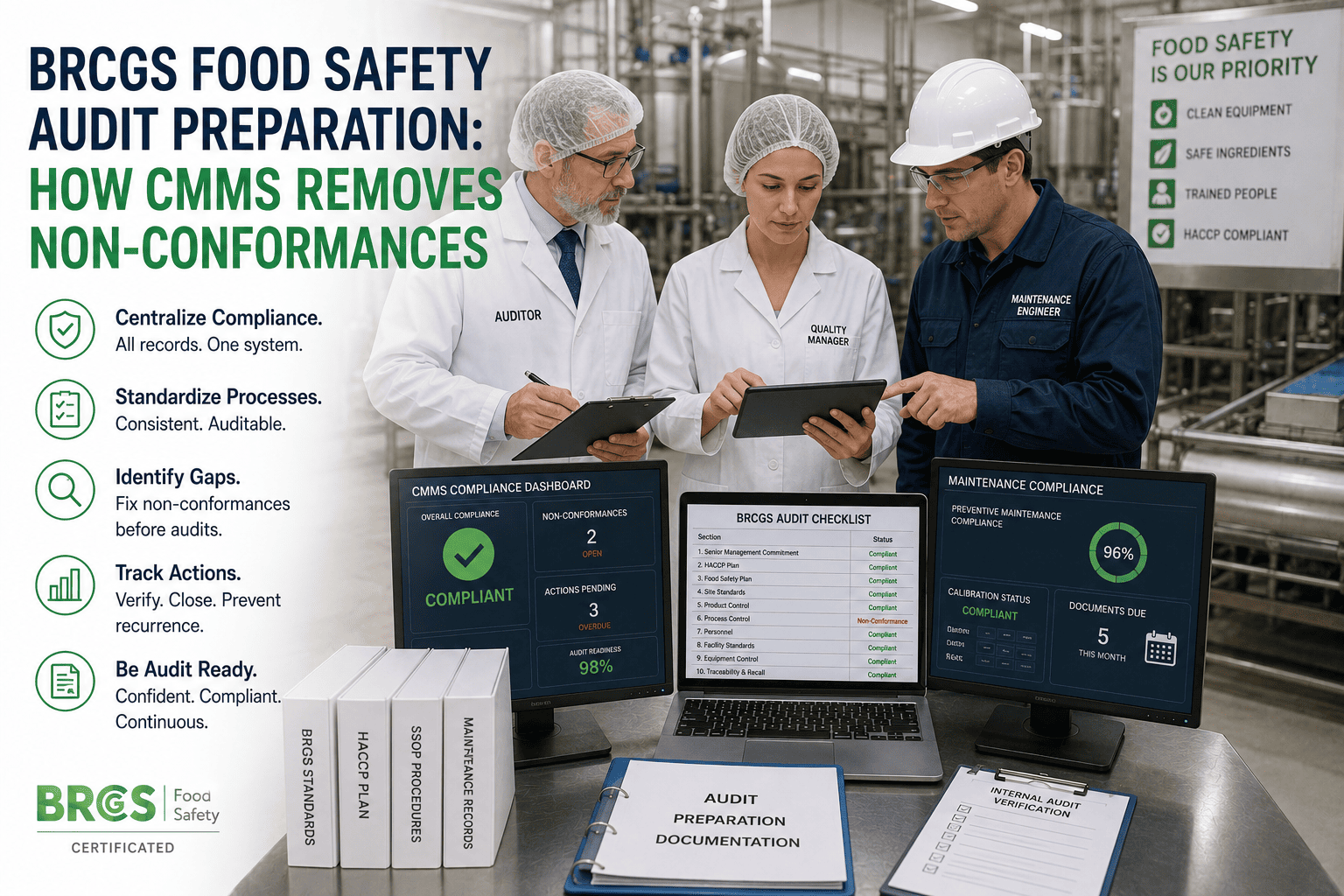
| Audit Readiness | 3–4 days pulling paper logs and spreadsheets. Gaps in records. Auditor cites documentation nonconformance alongside physical findings. | One-click drainage maintenance report for BRCGS, SQF, and FSMA auditor requests. Complete, timestamped, traceable. Ready in under 10 minutes. |
What Structured Drainage Maintenance Delivers in Measurable Outcomes
The return on structured drainage maintenance is asymmetric — the cost of a proper CMMS programme is a fraction of one environmental investigation, and negligible compared to the cost of a recall. Teams that implement CMMS-managed drain PM report that the first GFSI audit cycle is the first time they have been able to demonstrate drainage control with evidence rather than explanation — start a free trial and see measurable results in the first 30 days, or book a demo to see your ROI on your specific facility footprint.
Frequently Asked Questions
How frequently should drain traps be physically cleaned in a high-care RTE zone?
Can Listeria be completely eliminated from food plant drains, or is the goal management and control?
What sanitizer rotation is recommended for drain Listeria biofilm control?
What does BRCGS require for drainage documentation in food manufacturing facilities?
Stop Losing Ground to Listeria in Your Drainage System
Turn every drain, trap, harborage site, and environmental swab into a traceable, audit-ready GFSI record — managed automatically by Oxmaint.
- Real-time drain asset registry with zone-differentiated PM frequencies
- Environmental swab results linked directly to drain maintenance histories
- 5–10 year CapEx forecasting for drain repair and replacement programmes
Works across multi-site portfolios · No heavy implementation required · Live in days, not months
Used by operations teams managing 10,000+ assets — see measurable results in the first 30 days