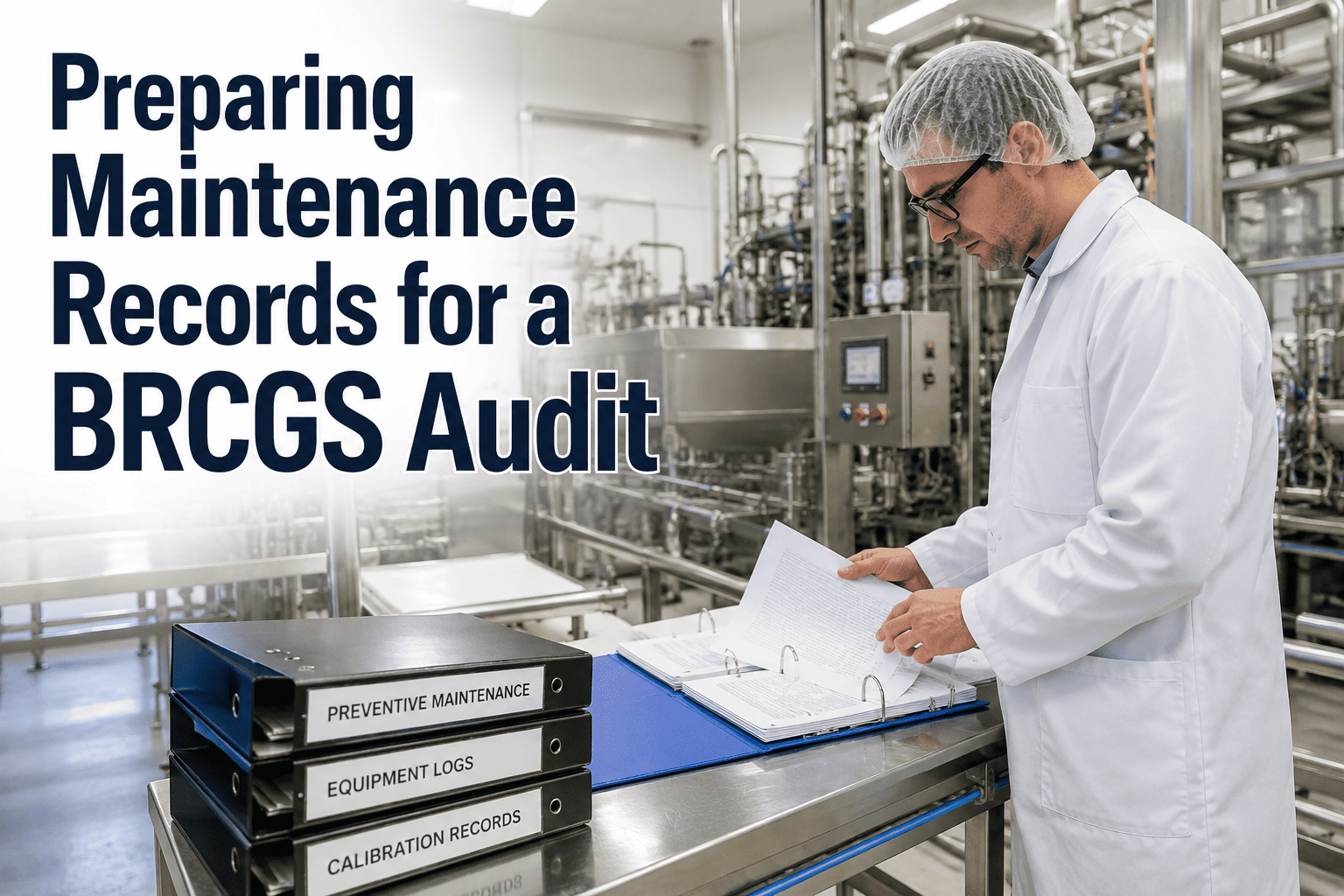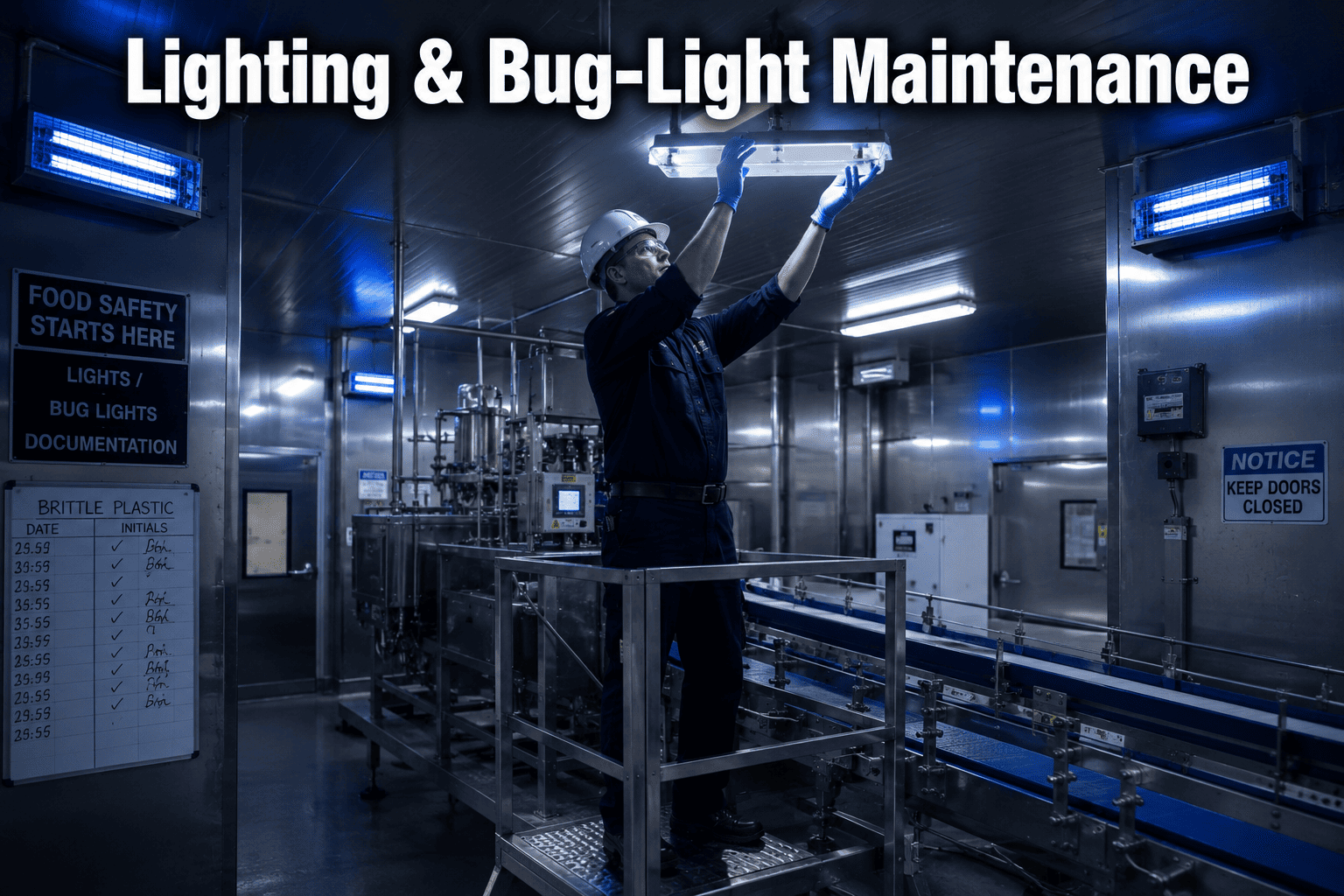
Food manufacturing facilities operate under relentless regulatory scrutiny, and lighting is far more than a visibility issue — it is a contamination control system. GFSI-benchmarked schemes including BRCGS Food Safety Issue 9, SQF Edition 9, FSSC 22000, and IFS Food require documented programmes covering fixture shielding, bug-light placement, glass-and-brittle inventories, lux levels, and corrective work orders. A single unshielded fluorescent tube over an open product line is a foreign body risk, an audit nonconformance, and a potential recall trigger. Start a free trial on Oxmaint to digitize your lighting PM programme, or book a demo and see how CMMS tracks every fixture, shield, and bug-light replacement across your facility.
Food Plant Lighting and Bug-Light Maintenance
Shatterproof fixtures, bug-light placement, glass-and-brittle audits, lux compliance, and CMMS-tracked GFSI records — built for food safety teams managing high-care and high-risk zones.
What Is Food Plant Lighting Compliance Under GFSI
Food plant lighting compliance under GFSI-benchmarked standards is a structured programme that ensures every light fixture in a food production facility — from receiving docks to high-care packaging zones — is shatterproof or properly shielded, correctly positioned, maintained at required lux levels, and documented through traceable records. The requirement exists because broken or deteriorating light fixtures are one of the most common sources of glass and hard plastic contamination in food, both of which trigger mandatory recall procedures under FDA and EFSA frameworks.
BRCGS Issue 9 Clause 4.9.2 requires all lighting in production and storage areas to be shatter-resistant or protected with shatterproof guards, with a formal glass-and-brittle register maintained and audited at defined frequencies. SQF Edition 9 Element 11.6 mirrors this, adding specific lux requirements differentiated by zone type — production, storage, and inspection surfaces each carry distinct minimum readings. FSSC 22000 aligns with ISO 22000 and sector-specific PRPs, where lighting is treated as an infrastructure prerequisite that must be verified through documented PM schedules.
Bug-light maintenance adds a second layer: electrocutor-style insect control devices must be positioned to attract insects away from open product zones, cleaned on documented schedules to prevent accumulation of dead insect material, and inspected to confirm UV tube effectiveness — since expired UV bulbs cease to attract insects but remain powered, creating a false sense of control. Oxmaint centralises fixture registries, PM schedules, lux readings, glass-and-brittle audits, and bug-light records in one CMMS — start a free trial to see how it works across your production zones, or book a demo and we will walk through your specific facility layout.
8 Key Concepts Every Food Safety Team Must Understand
Fixtures must be constructed from shatter-resistant material or enclosed in a protective polycarbonate sleeve or diffuser. Bare glass tubes above open product zones are an automatic critical nonconformance under BRCGS and SQF.
A documented inventory of every glass and brittle plastic item in the facility — including light fixtures, sight glasses, gauges, and laboratory equipment — with location, risk classification, and audit frequency assigned to each item.
Inspection surfaces require 540 lux minimum. General production areas require 220 lux. Storage areas require 110 lux. Readings must be taken at the work surface level and recorded with a calibrated lux meter at defined PM intervals.
Insect electrocutor devices must be positioned away from open product — never directly above — to prevent dead insect debris from falling into food. Devices must be placed near entry points and drains where insects congregate, not over production lines.
GFSI Critical
Bug-light UV tubes lose effectiveness after 8,000–12,000 hours of use regardless of visible light output. BRCGS and SQF require replacement at manufacturer-recommended intervals — typically annually — with dates logged in the CMMS.
LED conversion eliminates UV degradation and glass shatter risk but requires verification that replacement fixtures meet shatterproof standards and that lux levels are re-validated post-installation. Update the glass-and-brittle register when any fixture is changed.
Polycarbonate shields and diffusers become brittle and yellow over time, reducing both light transmission and shatter resistance. Shields must be inspected for cracks, discolouration, and secure mounting — not just the tubes inside.
Any fixture breakage above or near open product triggers a product hold, a contamination assessment, and a corrective work order with root cause and prevention measures. The entire sequence must be documented and linked to the fixture asset record in CMMS.
6 Pain Points Costing Food Plants Audit Points and Product
Registers built once and never updated miss retrofit fixtures, replacement lamps, and temporary equipment. BRCGS auditors require evidence that the register is actively maintained — a static spreadsheet from 18 months ago will not pass. Teams using CMMS-linked registers report 100% register accuracy at audit time.
Accumulation of dead insect debris in electrocutor trays is a foreign body and microbial risk. Cleaning frequencies vary by season and facility pest pressure, but many sites have no CMMS trigger for tray cleaning — relying on memory or walkthroughs that miss high-ceiling units.
Many facilities verify lux levels during initial fitout and never re-verify after lamp changes, shield replacements, or layout modifications. SQF auditors increasingly request current lux records — verbal assurances of compliance are not accepted. Production environments lose 20–30% lux output annually through lamp aging.
When a polycarbonate shield breaks, the failure is often repaired without triggering a product contamination assessment or a formal corrective action. This gap creates audit exposure and — more critically — means contaminated product may leave the facility. One missed hold can trigger a recall costing hundreds of thousands of dollars.
A bug-light with an expired UV tube looks operational — it still emits visible light — but provides zero insect attractant function. Facilities without CMMS-triggered replacement schedules routinely run UV tubes 2–3 years past their effective life, exposing open product lines to uncontrolled insect pressure.
Finding a cracked shield and fixing it on the same walk — without generating a work order — leaves no audit trail. GFSI schemes require evidence that findings are documented, actioned, and closed with root cause analysis. Untracked corrections are treated as recurring failures by auditors — start a free trial to see how Oxmaint auto-generates corrective work orders from inspection findings.
How Oxmaint Solves Food Plant Lighting Compliance
Every fixture, shield, sight glass, and brittle item is registered as a CMMS asset with location, risk classification, and inspection interval. Updates sync in real time as fixtures are replaced or added — no spreadsheet lag, no audit-day scramble.
Automated work orders trigger UV tube replacements, tray cleanings, and shield inspections at manufacturer-recommended or GFSI-required intervals. Technicians receive mobile notifications — no checklist needed in memory, no missed seasonal adjustments.
Technicians log lux meter readings directly in the mobile app against each zone asset. Calibration records for lux meters are tracked as separate assets — auditors can pull both the reading history and the meter calibration status in one search.
When a technician logs a shield breakage, Oxmaint auto-generates a linked corrective work order, flags the finding for supervisor review, and prompts completion of a contamination risk assessment — closing the gap between physical repair and food safety documentation.
One-click reports export the complete fixture inventory, PM completion rates, open nonconformances, corrective action status, and lux verification history — formatted for BRCGS, SQF, and FSSC 22000 auditor requests without any manual compilation.
Operations teams managing multiple plants see lighting compliance status across the entire portfolio — overdue bug-light replacements, cracked shields, lux deficiencies — ranked by risk level and plant, with drill-down to individual asset work orders.
Food safety teams that migrate lighting PM from spreadsheets to Oxmaint close their first audit cycle with zero documentation nonconformances — start a free trial and see measurable results in the first 30 days, or book a demo to identify hidden cost leaks in your current lighting programme.
Reactive Lighting Management vs Planned CMMS Programme
| Area | Reactive / Paper-Based | Planned / Oxmaint CMMS |
|---|---|---|
| Glass-and-Brittle Register | Static spreadsheet updated ad hoc. Misses new fixtures, LED retrofits. Auditors cite as incomplete. | Live digital register. Every fixture change auto-updates the register. Auditor pulls current version instantly. |
| Bug-Light UV Tube Replacement | Replaced when someone notices. Average tube runs 2.3 years past effective life. Open product line exposed. | CMMS triggers replacement at 12-month interval per device. Technician receives mobile work order. Completion logged with timestamp. |
| Lux Level Verification | Verified at commissioning. Never re-tested. Lamp aging reduces lux 25–30% — invisible until audit. | Lux readings scheduled by zone at defined intervals. Calibrated meter records stored per asset. Trend data shows degradation before failure. |
| Broken Shield Response | Technician replaces shield. No product hold. No corrective work order. No root cause. Audit nonconformance. | Breakage triggers product hold prompt, contamination assessment, corrective WO with root cause — all linked to fixture asset record. |
| Bug-Light Tray Cleaning | Cleaned when visibly full. High-ceiling units missed for months. Foreign body risk accumulates unnoticed. | Cleaning WOs triggered by season and pest pressure settings. High-ceiling units get same CMMS schedule as accessible units. |
| Audit Preparation Time | 2–5 days compiling records from emails, spreadsheets, paper logs. High error risk. Senior time consumed. | One-click GFSI report exports complete lighting compliance record in under 5 minutes. Zero manual compilation. |
What Facilities Gain from CMMS-Driven Lighting Compliance
Facilities that shift lighting compliance from reactive walk-throughs to CMMS-scheduled PM see audit performance improve by the first certification cycle — start a free trial to see how much cost you can eliminate from reactive maintenance, or book a demo to see your ROI on your actual asset count.
Frequently Asked Questions
Does BRCGS require every light fixture to have a polycarbonate shield, or does shatter-resistant glass qualify?
How often must bug-light tray cleaning be documented under SQF?
What lux levels are required at inspection stations under GFSI schemes?
If a light shield breaks above a closed product line, does a product hold still apply?
Stop Losing Audit Points to Lighting Documentation Gaps
Turn every fixture, shield, bug-light, and lux reading into a traceable, audit-ready GFSI record — managed automatically by Oxmaint.
- Real-time glass-and-brittle register across every zone and site
- Automated bug-light UV tube and tray cleaning schedules
- 5–10 year CapEx forecasting for fixture replacement programmes
Used by operations teams managing 10,000+ assets · No heavy implementation required · Live in days, not months
See measurable results in the first 30 days — limited onboarding slots available this quarter