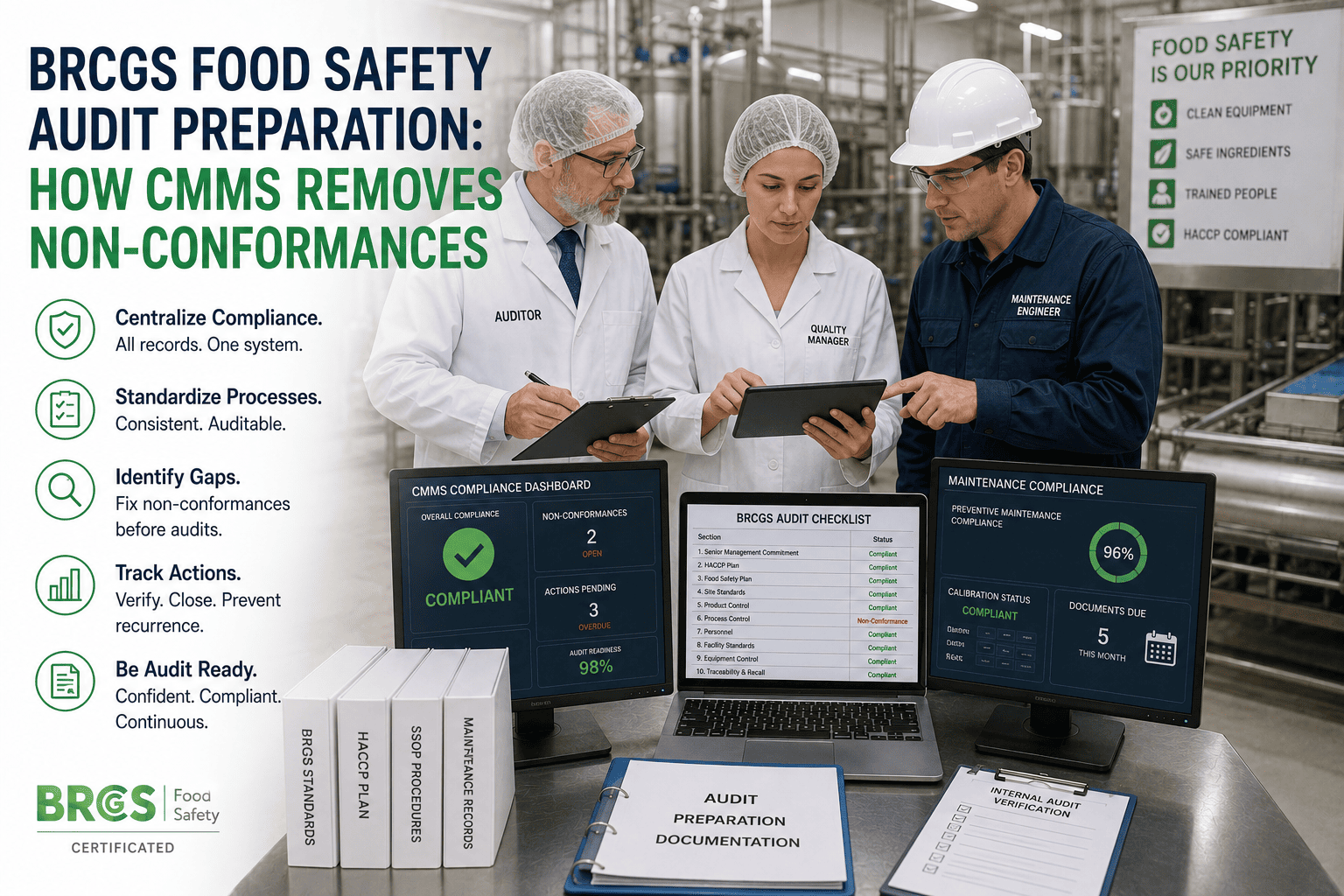
Your BRCGS auditor doesn't start on the production floor. They start with a login screen or a filing cabinet, asking to see your planned maintenance schedule, your calibration certificates, and your last five post-repair sanitation sign-offs. More than a third of all BRCGS non-conformances trace back to maintenance and calibration paperwork, not an actual equipment breakdown. One missing signature on a repair sign-off, or one calibration certificate that isn't traceable to a national standard, is enough to turn a Grade A site into a Grade B overnight. See how OxMaint keeps every maintenance record audit-ready, every single day.
BRCGS Issue 9 / Maintenance & Engineering
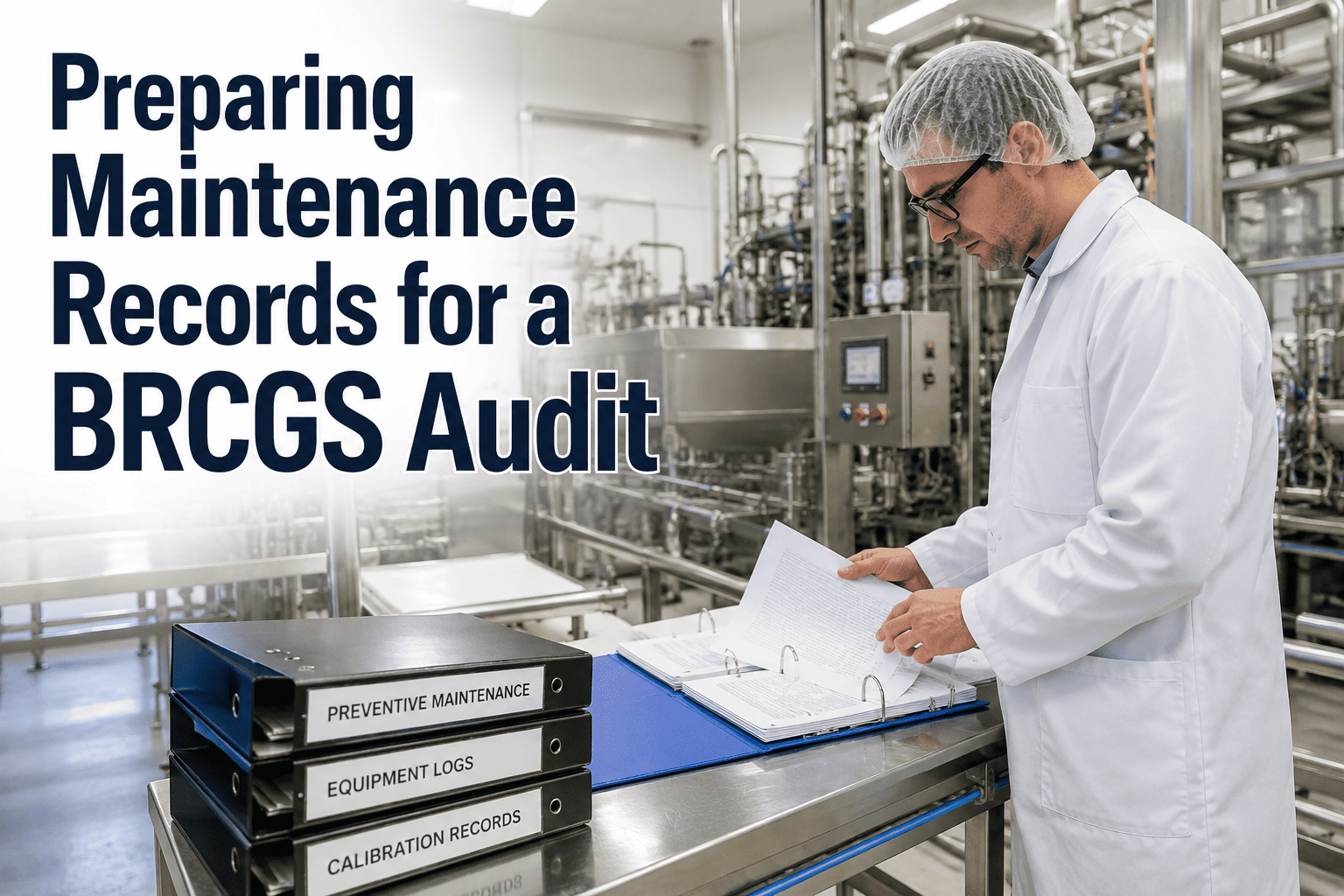
Preparing Maintenance Records for a BRCGS Audit
Clause 4.7 is a standalone clause in BRCGS Issue 9, and a planned maintenance programme is a Fundamental requirement. A gap here does not stay a maintenance problem — it becomes a certification problem, a retailer-listing problem, and a Monday-morning-call-with-the-board problem.
BRCGS Grade Scale
One overdue calibration or an unsigned repair sign-off can move a site from AA to B in a single audit cycle
Where Auditors Focus When They Open Your Maintenance File
BRCGS Issue 9 addresses maintenance across Section 4 (Site Standards) and Section 6 (Process Control). Auditors work clause by clause, and each one carries a different amount of grade-determining weight.
Clause 4.7.1 · Fundamental
Planned Maintenance Programme
A documented, operating maintenance schedule must cover every asset critical to product safety, legality, and quality. Because this is a Fundamental clause, its absence generates an automatic Critical non-conformance, regardless of how the rest of the audit goes.
Clause 4.7.2 · High Risk
Calibration & Traceability
Every instrument monitoring a critical-to-quality parameter must carry a current calibration status, traceable to a national or international reference. Auditors can raise a Major finding from a single out-of-spec instrument alone.
Clause 4.7.4 · Site Standards
Temporary Repairs
Temporary fixes are permitted, but only when logged as temporary, backed by a food-safety risk assessment, and closed out against a defined deadline. A temporary repair left in place past its own deadline is one of the most common findings on site.
Clause 6.4 · Process Control
Evidence of Execution
A schedule that only shows tasks were planned is not enough. Auditors expect a closed work order for every task — technician sign-off, completion timestamp, and parts consumed — as proof the work actually happened.
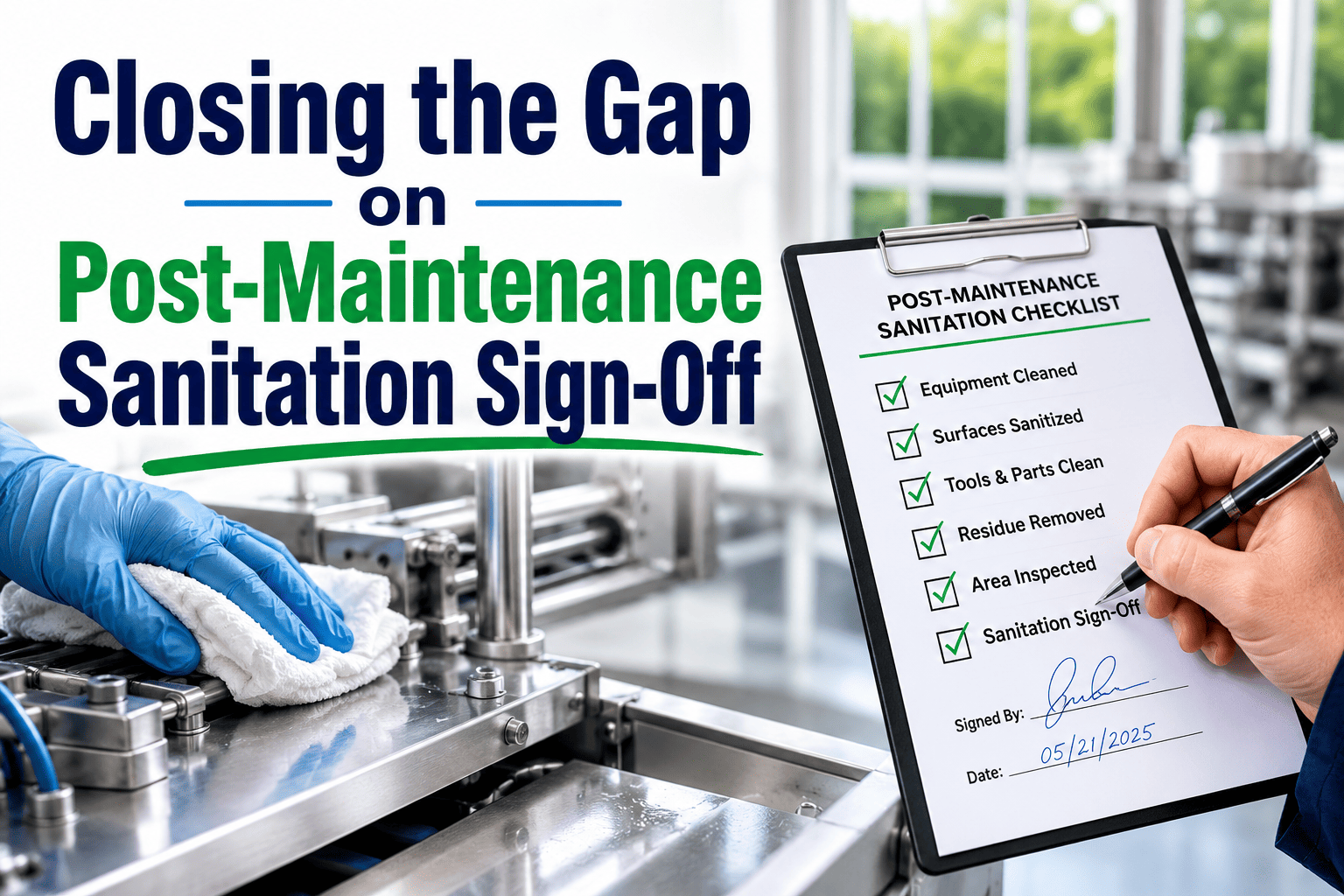
The Post-Maintenance Gap Auditors Almost Always Find
A repair being finished is not the same as a line being cleared for food production. BRCGS requires a documented handback sequence before the equipment runs again, and skipping a step here is one of the fastest routes to a non-conformance.
Repair completed
Technician closes the work order with parts used, cause, and time taken.
→
Inspection
Equipment is checked for stray fasteners, debris, or foreign material risk.
→
Sanitation verification
Food-contact surfaces are cleaned and verified before product touches them again.
→
Authorised sign-off
A named, dated approver confirms the line is safe to restart production.
Missing or undated sign-offs on this handback sequence are consistently among the most cited maintenance findings in BRCGS audits.
Four Records Every Auditor Will Ask to See
A BRCGS technical reviewer works through documentation in a fairly predictable order. Keep these four record types current, complete, and easy to pull up, and most maintenance-related findings disappear before the walk-through even starts.
| Record Type |
What It Must Show |
Typical Finding If Missing |
| Maintenance schedule |
Frequencies, asset ownership, planned vs. actual completion for buildings, fabric, equipment, and utilities |
Critical — Fundamental clause failure |
| Calibration log |
Calibration date, method, instrument used, and traceability to a national standard |
Major, even for a single instrument |
| Deviation & corrective action record |
Root cause, immediate containment, product-safety assessment, preventive action taken |
Major or Minor depending on scope |
| Post-repair sanitation sign-off |
Inspection and cleaning confirmation, dated, with a named authoriser before restart |
Major — recurring audit theme |
How OxMaint Closes These Gaps Before the Auditor Arrives
OxMaint structures your BRCGS maintenance obligations into daily digital workflows, so audit-ready evidence is a by-product of normal operations rather than a scramble the week before the visit.
Clause-Mapped PM Schedules
Every asset critical to food safety is registered with a PM schedule mapped to the exact BRCGS clause it satisfies, with planned vs. actual completion tracked automatically.
Calibration Tracking
Calibration certificates are stored against the instrument, with due-date alerts before a single sensor drifts out of its traceable window.
Digital Handback Sign-Off
Repair closure, inspection, sanitation verification, and restart authorisation are captured as one linked digital record, timestamped and named.
Temporary Repair Countdown
Temporary fixes are logged with a risk assessment and a permanent-correction deadline, with visibility on anything running past its own timeline.
Closed-Loop Corrective Actions
Every deviation carries root cause, containment, product-safety assessment, and preventive action through to a verified close-out.
One-Click Audit Export
Ninety days or a full certification cycle of maintenance, calibration, and sign-off records, exported in the order a technical reviewer expects to see them.
An 8 to 12 Week Runway to Your Next Audit
Sites that treat audit prep as a single event tend to fail on the same clauses every cycle. Sites that treat it as a rolling 8 to 12 week programme rarely do.
Week 12
Pull an overdue-PM and overdue-calibration report; close every gap found
Week 8
Review open corrective actions and temporary repairs against their deadlines
Week 4
Walk the fabric and equipment for condition issues before the auditor does
Week 1
Confirm ninety days of consistent, signed, dated records are ready to export
Frequently Asked Questions
Can a BRCGS audit fail purely on maintenance findings?
What counts as acceptable evidence for a temporary repair?
The repair needs to be logged as temporary, paired with a written food-safety risk assessment, and given a defined date for the permanent fix. A temporary repair with no deadline, or one still in place after its deadline has passed, is treated as unmanaged risk by most auditors.
Does a completed repair alone clear a line to restart production?
How much maintenance history should be available before an audit?
Most technical reviewers expect at least ninety days of consistent, complete records. That window is what lets an auditor see a genuine operating pattern rather than paperwork assembled the week before the visit.
Why do calibration gaps escalate so quickly to a Major finding?
Get Audit-Ready
Your Next BRCGS Auditor Will Ask for Records You Haven't Thought About Since Last Cycle. OxMaint Keeps Them Ready Every Day.
Planned maintenance schedules, calibration logs, post-repair sanitation sign-offs, and closed-loop corrective actions — all mapped to the clauses that determine your grade, and exportable in minutes instead of days.