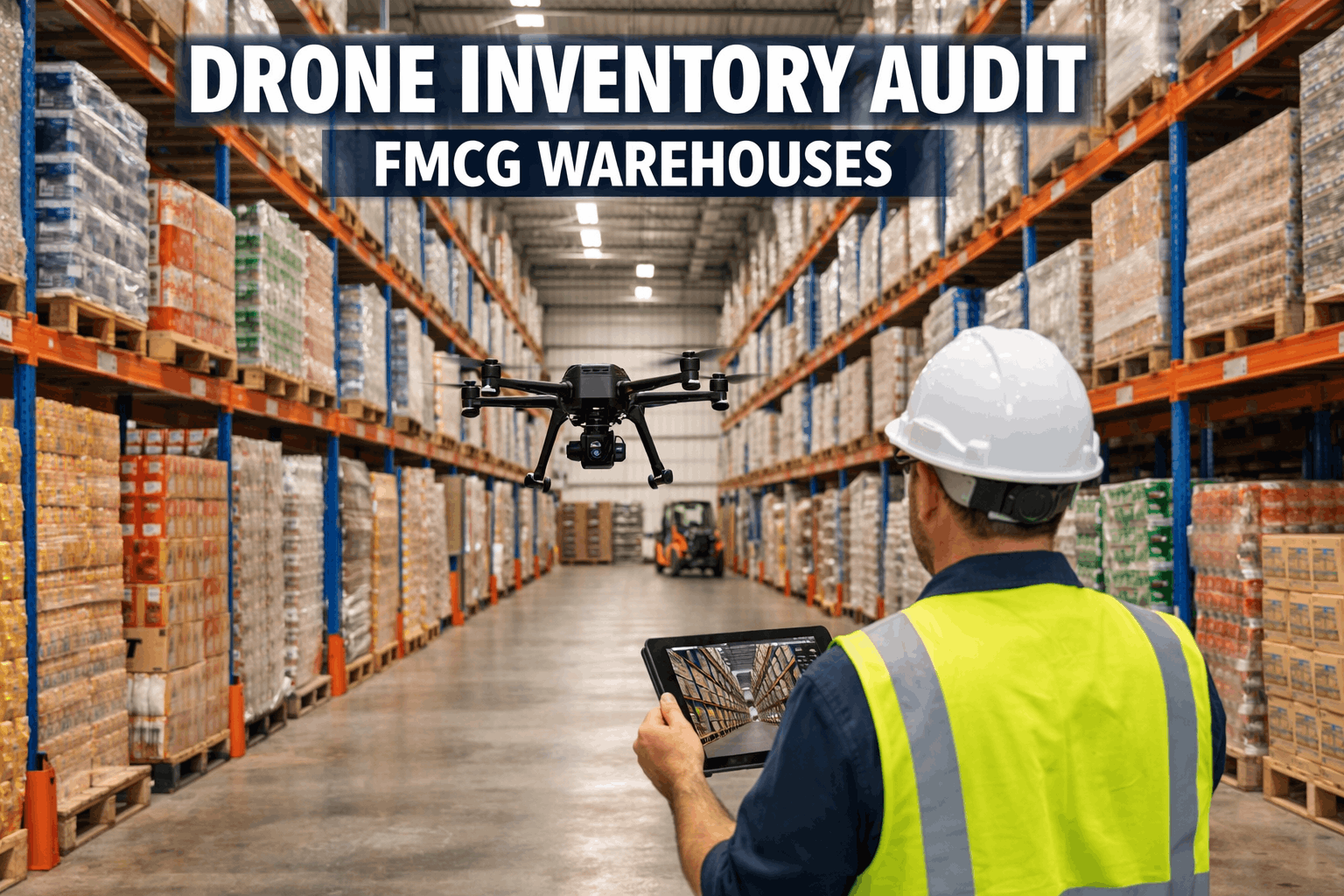
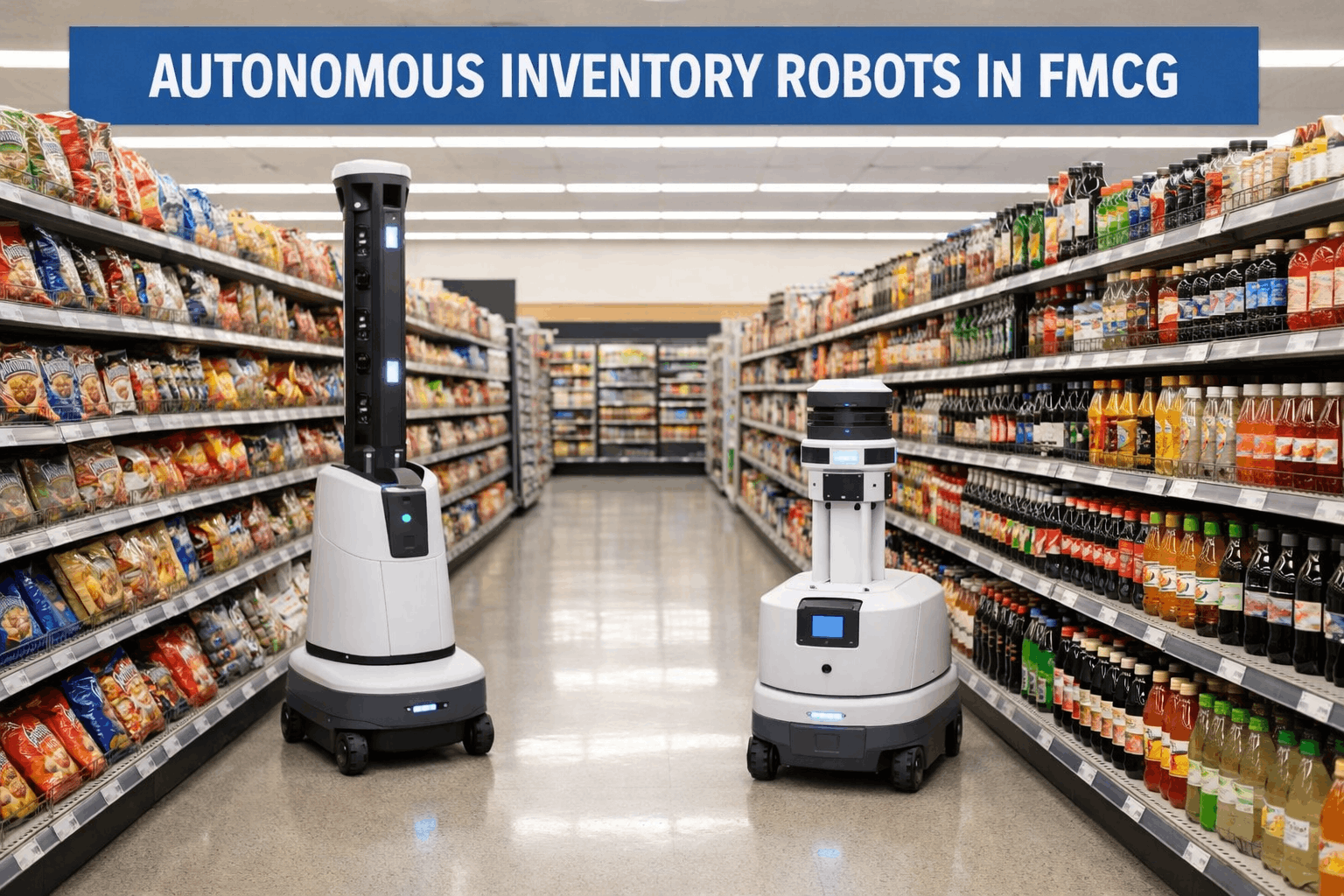
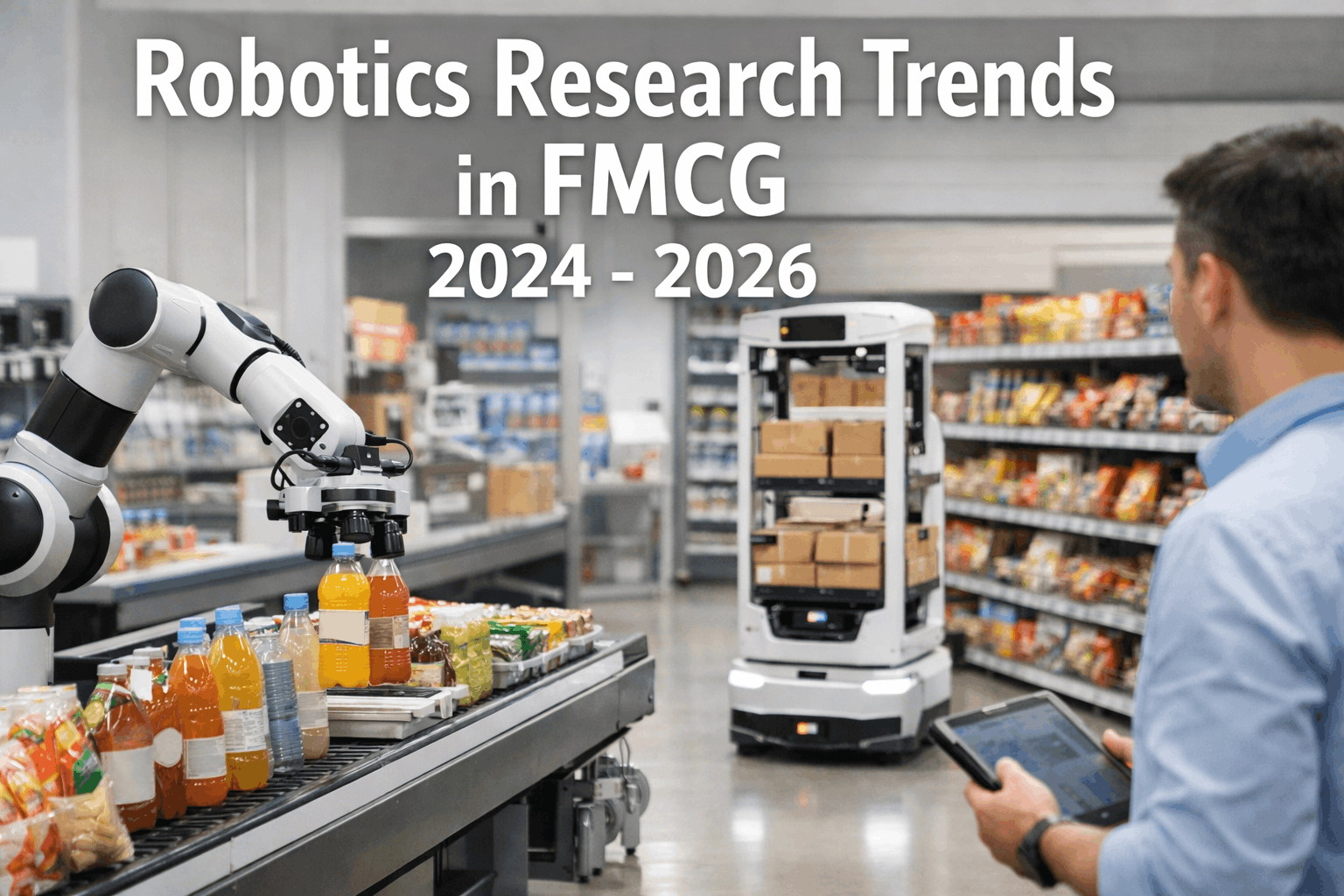
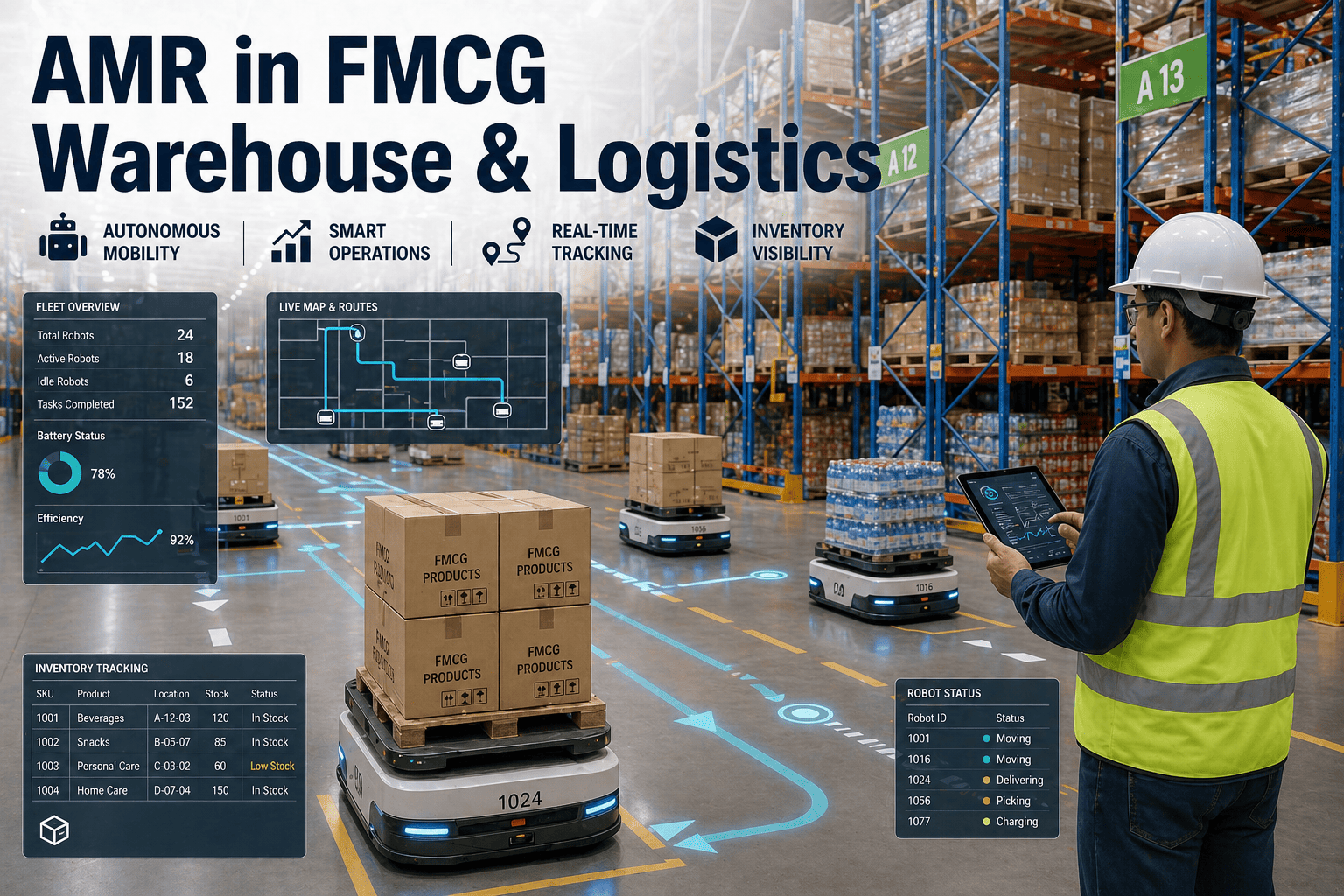
A top-five North American FMCG distributor running 1.2 million square feet of warehouse space deployed 86 autonomous mobile robots across two distribution centers and integrated them with a CMMS-driven maintenance and inventory platform. Order accuracy climbed from 96.3% to 99.7%, throughput increased 3.1× per labor hour, and unplanned robot downtime stayed below 1.4% — because every battery, drive motor, and navigation sensor was tracked against operating data, not calendar dates. The facilities capturing full robotics ROI are the ones managing robots as a fleet of maintainable, trackable assets — not just capital equipment. Schedule a demo to see robot fleet maintenance and inventory sync in action.
What if every warehouse robot generated its own maintenance work orders — before a breakdown stalls your pick lines?
Oxmaint connects to your robot fleet telemetry — battery health, motor diagnostics, navigation accuracy — and auto-generates prioritized work orders with the exact parts and procedures your technicians need. One platform that turns raw fleet data into scheduled maintenance, tracks every spare part, and gives operations real-time fleet readiness visibility.
Why FMCG Fulfillment Cannot Scale on Manual Labor Alone
| Challenge | Manual Fulfillment Reality | Robot-Augmented Fulfillment |
|---|---|---|
| Labor Scalability | Overtime premiums, temp agency markups, 60–90 day training cycles | Add robot units in weeks, redeploy staff to value-added tasks |
| Order Accuracy | 96–97% pick accuracy with paper-based or RF scanning | 99.5–99.9% accuracy with vision-verified goods-to-person picking |
| Peak Surge Capacity | Constrained by available labor pool and overtime limits | Scale fleet hours, not headcount — robots run 20+ hours/day |
| Inventory Visibility | Cycle counts delayed, shrinkage discovered after the fact | Real-time bin-level accuracy updated with every robot transaction |
| Fulfillment Cost per Case | Rising 8–12% annually with wage inflation | Declining cost curve as fleet utilization and efficiency improve |
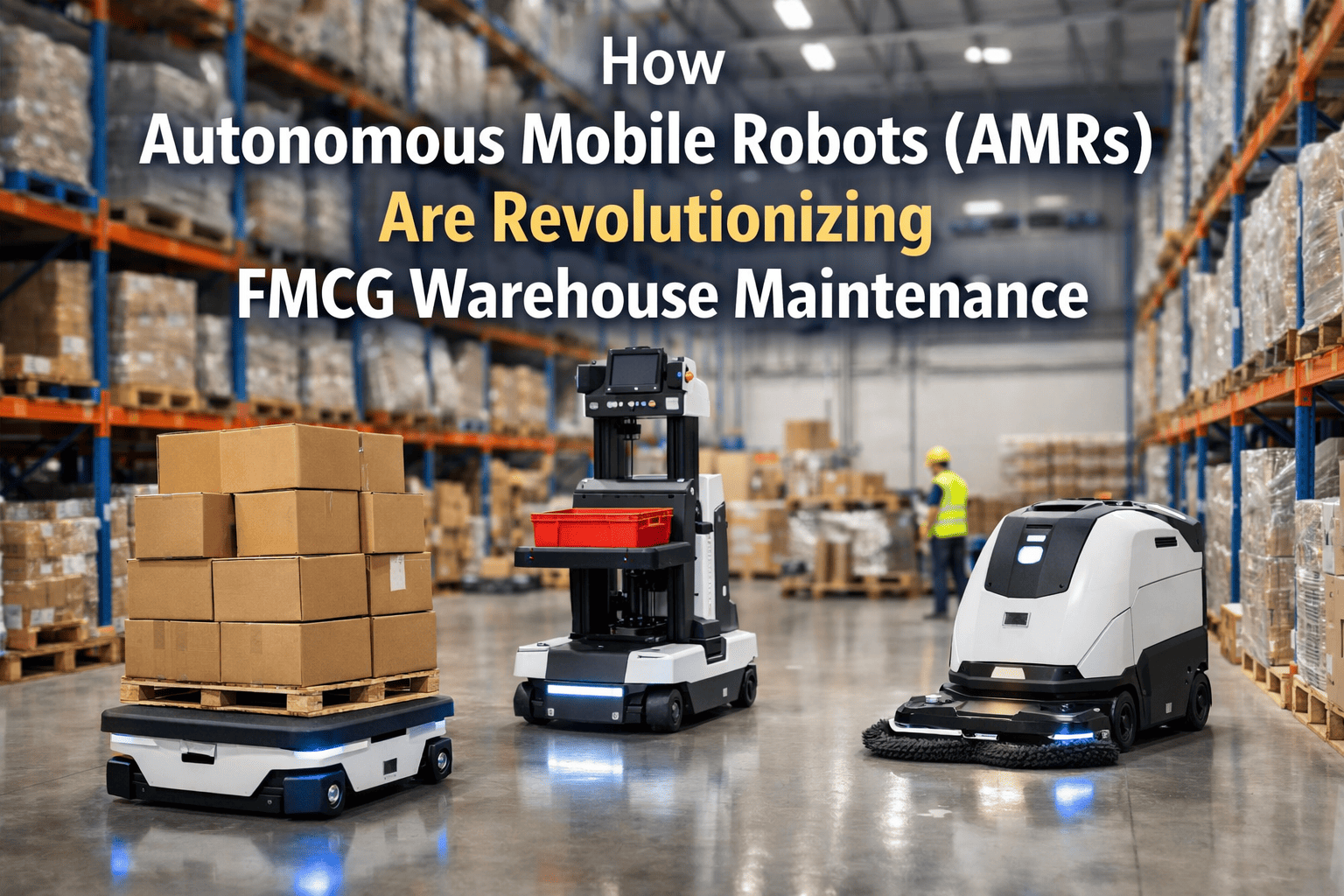
Warehouse Robot Types for FMCG in 2026
| Robot Type | Best FMCG Application | Key Maintenance Components | Typical Fleet Size |
|---|---|---|---|
| Goods-to-Person AMRs | Each-pick fulfillment for high-SKU, high-velocity DCs | Drive motors, LiDAR sensors, batteries, caster wheels | 50–500+ per DC |
| Autonomous Case-Pick Robots | Case-level order building for retail replenishment | Vacuum pumps, gripper pads, vision cameras, servo joints | 4–20 per DC |
| Cube Storage Systems | Small-item and e-commerce fulfillment with extreme density | Grid rail wheels, lifting mechanisms, batteries, bin condition | 20–200+ per installation |
| Sortation Robots | Order consolidation and parcel sortation | Drive units, tilt mechanisms, charging contacts, bumper sensors | 100–1,000+ per system |
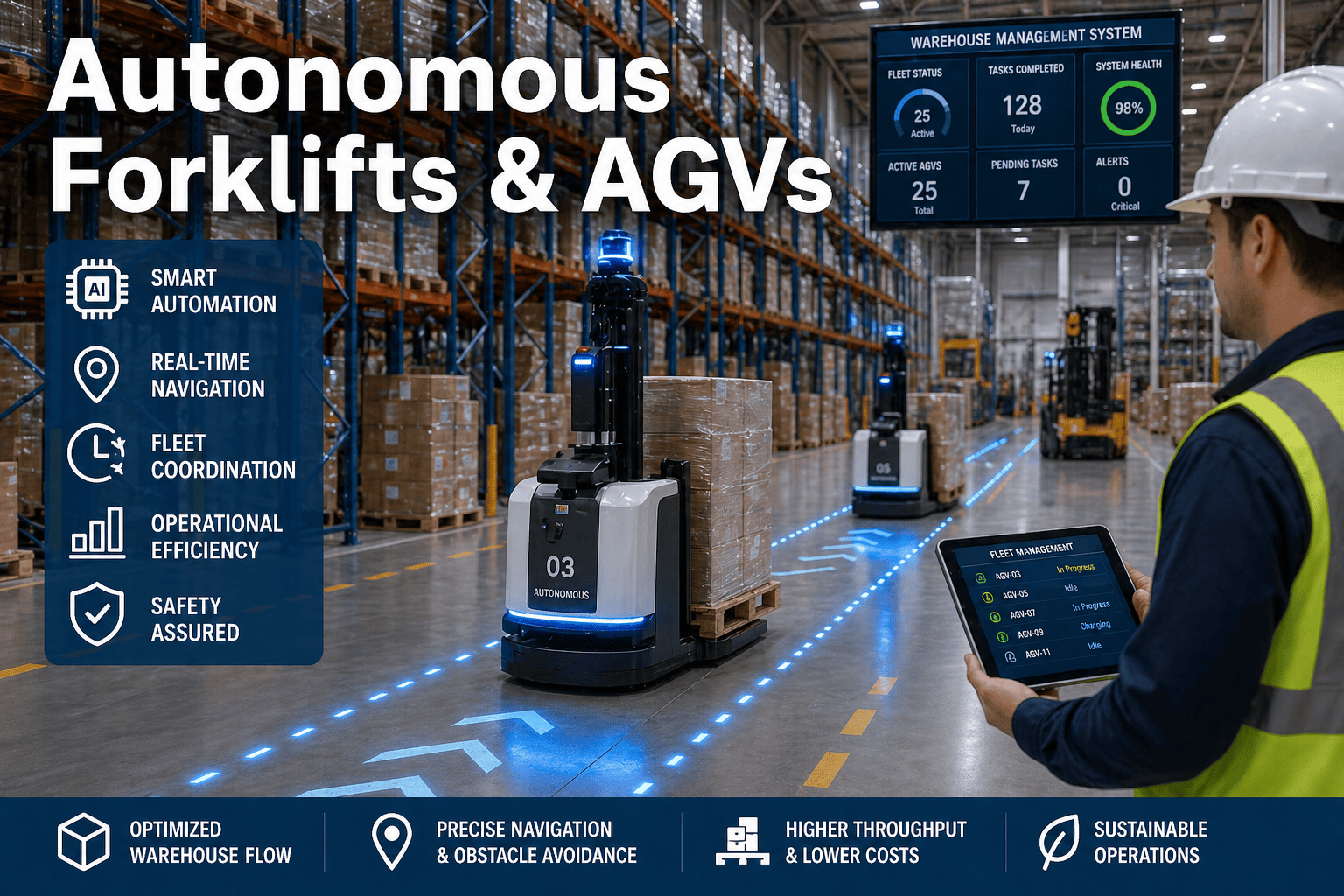
| Autonomous Forklifts | Pallet receiving, replenishment, and dock-to-stock movement | Hydraulic systems, LiDAR/camera arrays, batteries, mast chains | 5–30 per DC |
| Inventory Scanning AMRs | Perpetual inventory verification replacing manual cycle counts | Scanning optics, navigation sensors, batteries, propulsion | 2–8 per DC |
Fleet Telemetry to Work Orders: How CMMS Integration Works
Every robot streams motor current, battery state, navigation accuracy, and cycle counts to a centralized platform 24/7
ML models compare live telemetry against baseline patterns and known failure signatures across the fleet
CMMS generates work orders with predicted failure mode, required spare parts, and optimal scheduling window
Every completed pick, put-away, and movement transaction updates bin-level inventory in real time
Robot OEM dashboards show status and utilization — but they do not generate maintenance work orders, track spare parts inventory, calculate cost-per-robot, or correlate robot health with fulfillment accuracy. A CMMS integration layer transforms vendor telemetry into actionable maintenance intelligence and connects robot uptime directly to order performance.
Robot Subsystem Monitoring and Maintenance Priorities
Every warehouse robot is a collection of subsystems that degrade at different rates under FMCG conditions. Focus maintenance investment on the subsystems with the highest failure cost and best predictive signal. Start building your robot fleet maintenance program — sign up free.
| Robot Subsystem | Degradation Signals | Failure Consequence | Predictive Lead Time | Prevented Cost |
|---|---|---|---|---|
| Battery Packs | Capacity fade, charge time increase, cell imbalance | Robot stranded mid-aisle, pick line stalled | 3–8 weeks | $4,000–12,000 |
| Drive Motors & Wheels | Current draw increase, vibration signature shift | Navigation errors, dropped payloads, aisle blockage | 2–6 weeks | $2,500–8,000 |
| LiDAR & Navigation Sensors | Localization confidence drop, increased re-planning events | Collisions, fleet traffic jams, throughput collapse | 1–4 weeks | $5,000–20,000 |
| Gripper / End-Effector | Grip force decline, vacuum leak rate, cycle time creep | Dropped items, mispicks, line stoppage | 2–4 weeks | $1,500–6,000 |
| Vision & Barcode Cameras | Read rate decline, calibration drift | Mispicks, inventory inaccuracy, false exceptions | 1–3 weeks | $3,000–15,000 |
Spare Parts: The Hidden Bottleneck in Fleet Uptime
A perfectly timed work order means nothing if the replacement part is in an OEM warehouse 2,000 miles away. CMMS-integrated inventory eliminates both overstocking (capital waste) and understocking (downtime risk).
| Spare Part | Replacement Interval | OEM Lead Time | Stocking Rule | Emergency Premium |
|---|---|---|---|---|
| Battery Packs (AMR) | 18–24 months | 4–8 weeks | 1 per 10 robots + reorder at 80% life | 2.5–3× cost |
| Drive Motor Assemblies | 12,000–18,000 hrs | 3–6 weeks | 1 per 15 robots on hand | 2× cost |
| LiDAR Units | 20,000–30,000 hrs | 6–10 weeks | 1 per 20 robots — critical long-lead | 3× cost |
| Caster Wheels & Bearings | 4,000–8,000 hrs | 1–2 weeks | Min. 6-week supply per fleet | 1.5× cost |
| Gripper Pads / Suction Cups | 2,000–4,000 hrs | 1–3 weeks | Min. 8-week supply per pick robot | 1.3× cost |
Implementation Roadmap
Start with your highest-value fleet segment and expand based on measured results. No need to pause operations or replace existing robots. Schedule a demo to plan your rollout.
- Inventory all robots by type, OEM, age, operating hours, and zone assignment
- Calculate downtime cost per robot type and map spare parts gaps
- Identify top 3–5 highest-ROI robot groups for initial CMMS integration
- Connect robot fleet APIs to Oxmaint; register every unit as a tracked asset with BOM and PM schedules
- Configure spare parts catalog with min/max reorder points and preferred suppliers
- Establish baseline operating metrics: battery health, motor current, navigation accuracy
- AI models learn fleet-specific degradation patterns; activate predictive work order generation
- Integrate robot transactions with WMS for real-time inventory reconciliation
- Train technicians on mobile work orders and establish fleet health dashboard for leadership
- Expand to all robot types and DC locations; integrate procurement automation
- Benchmark cross-site performance; use trending data for capital planning and fleet refresh timing
Measuring Fleet ROI
Percentage of fleet hours operational vs. down for maintenance. Target: 97%+ for AMRs, 95%+ for case-pick robots.
Total labor, parts, and contractor costs divided by fleet size. Target: below $7,500/robot/year, declining over time.
Correlate with robot maintenance events — accuracy dips after navigation sensor drift or gripper degradation. Target: 99.7%+.
Percentage of AI alerts resulting in confirmed maintenance needs. Target: 85%+ after 6 months, 92%+ after 12 months.
Frequently Asked Questions
Oxmaint gives your DC a single platform to manage every robot OEM — auto-generating predictive work orders from fleet telemetry, tracking spare parts with min/max reorder automation, and correlating robot health with fulfillment accuracy in real time. Request a fleet assessment and we will walk through your specific robot types, maintenance gaps, and the dollar impact of closing them.
.png)