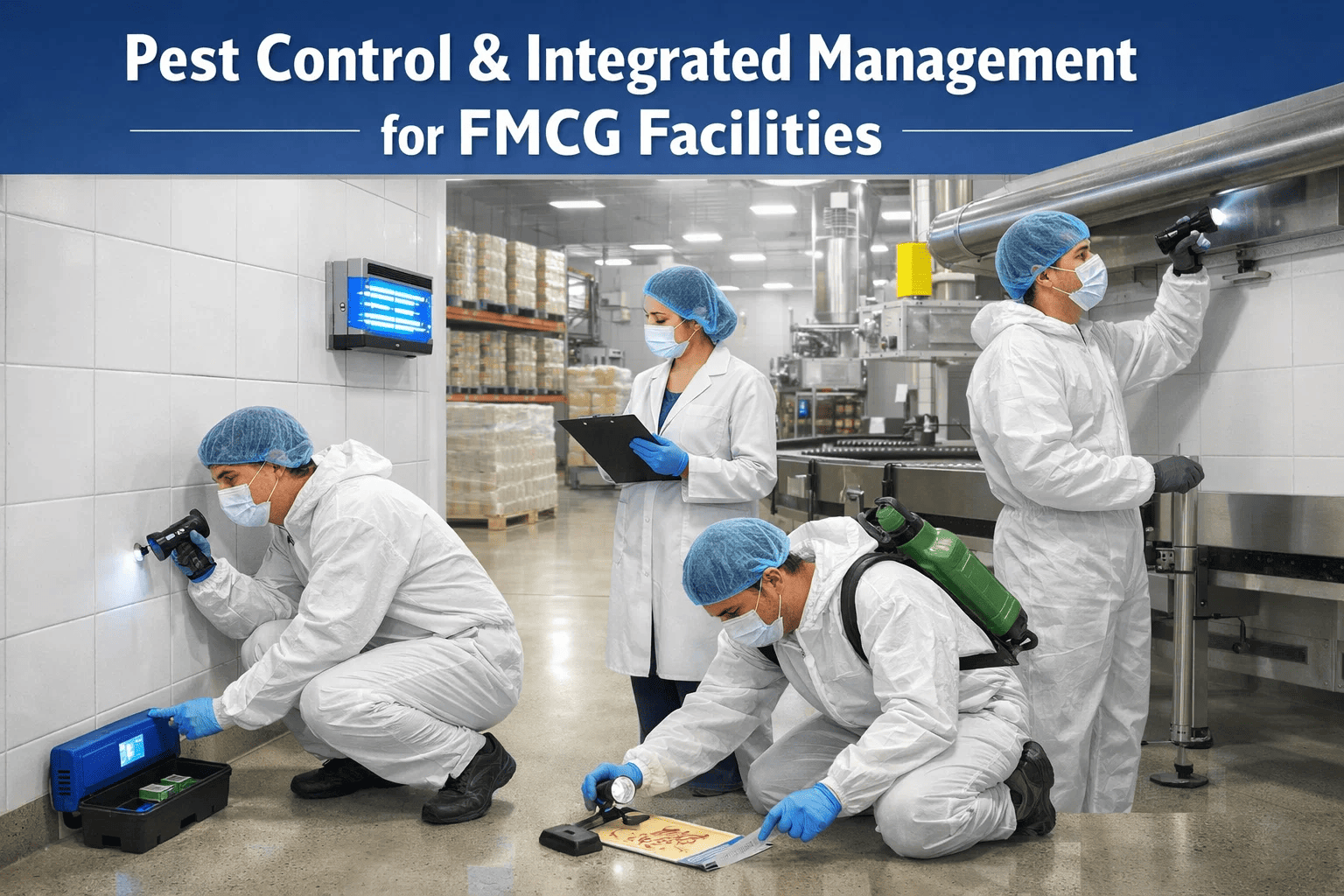
Pest contamination is one of the most frequently cited violations in FDA warning letters to food manufacturing facilities — and one of the most preventable. For FMCG plants operating under 21 CFR Part 117, FSMA, BRC Global Standards, and SQF, the gap between a compliant IPM program and a recall-triggering infestation often comes down to documentation quality, not pest activity levels. Start a free trial of Oxmaint and bring every bait station log, pest sighting report, and corrective action record into a single auditable CMMS — or book a 30-minute demo to see how FMCG plants manage IPM compliance at scale.
FMCG Compliance Guide · Integrated Pest Management
FMCG Pest Control Documentation: CMMS-Integrated IPM Records That Survive Audits
Pest control is the #1 recurring citation in FDA food facility warning letters. Without structured documentation — bait station logs, sighting trends, corrective action trails — a compliant program becomes an indefensible one the moment an auditor arrives or a product recall begins.
#1
Recurring citation category in FDA food facility warning letters (FDLI, 2024)
$10M+
Median producer cost per pest-triggered recall event (Journal of Food Protection, 2025)
41%
Of food firms report business disruption lasting as long as the infestation itself (Cebr / Manufacturing.net)
21%
Of consumers never buy from the same manufacturer again after a recall (Harris Interactive)
What Is CMMS-Integrated Pest Control Documentation?
Integrated Pest Management (IPM) in FMCG manufacturing is a structured, evidence-based program that prevents pest entry, monitors activity levels, and responds to findings with documented corrective actions — all before a contamination event reaches the production floor. Under 21 CFR Part 117 (FSMA Preventive Controls for Human Food) and equivalent standards including BRC Issue 9 and SQF Edition 9, IPM is not optional: facilities must demonstrate ongoing monitoring, documented response, and trend analysis as part of their food safety plan.
CMMS-integrated IPM takes this a step further. Instead of managing bait station logs in paper binders, pest sighting records in spreadsheets, and contractor service reports in email threads, a CMMS like Oxmaint creates a living digital record — linking every inspection, sighting, corrective action, and trend report to a mapped asset (each bait station, fly unit, or entry point is an asset in the registry). The result is a program that is both operationally effective and instantly auditable. Start a free trial to build your IPM asset registry in days.
Most FMCG facilities have a pest control program. Far fewer can produce a complete corrective action trail for the last 12 months in under 60 seconds during an FDA inspection.
Six Core Components of a Compliant FMCG IPM Program
A complete integrated pest management program for food manufacturing covers six functional areas. Each requires its own documentation cadence — and each becomes a compliance gap if records are incomplete, unsigned, or inaccessible.
01
Pest Exclusion & Facility Mapping
Documented inspection of all entry points — doors, drains, pipe penetrations, dock seals. Each point mapped to a digital asset record with condition scoring and remediation status tracked over time.
02
Bait Station Network Management
Every interior and perimeter rodent bait station registered as an individual asset with GPS-level location, inspection frequency, bait consumption log, and contractor sign-off — queryable by zone or station ID.
03
Pest Sighting Records & Trend Analysis
Every sighting — rodent, insect, bird — logged with date, zone, evidence type, and severity rating. Trend dashboards identify patterns: rising activity in a zone before it triggers a production shutdown.
04
Insect Light Trap (ILT) Monitoring
Weekly catch counts recorded by trap, with species identification and zone heatmaps. Automated alerts when counts exceed threshold levels defined by the food safety team or third-party pest control provider.
05
Corrective Action & Close-Out Trails
Every finding links to a work order — remediation task assigned, completed, verified, and photographically documented. Auditors see a closed loop from sighting to resolution, not an open finding with no record of action.
06
Contractor Service Report Integration
06
Contractor Service Report Integration
Third-party pest control service reports attached to the relevant inspection record in Oxmaint, eliminating the "report filed somewhere" problem. Renewal dates, certifications, and visit schedules tracked automatically.
Four Critical Pain Points in FMCG Pest Documentation
Most FMCG plants have a pest control contractor and a binder of service reports. That is not a compliant IPM program — it is a reactive paper trail that will fail during a GFSI audit, an FDA inspection, or a product liability review. These are the documentation failures that trigger the most serious consequences, and you can book a demo to see exactly how Oxmaint closes each one.
01
No Centralized Sighting Log
Pest sightings reported verbally, via WhatsApp, or in shift handover notes never enter a searchable record. During an audit or incident investigation, there is no documented history of when the issue first appeared — or what was done about it. FDA warning letters repeatedly cite "no evidence of monitoring" as a distinct violation separate from the infestation itself.
02
Bait Station Inspections Missed Without Escalation
Paper schedules and clipboard logs have no escalation mechanism. A missed weekly check goes unnoticed for weeks. By the time the lapse is discovered, there is a documented gap in monitoring — exactly what 21 CFR 117 Subpart B requires facilities to prevent and prove they prevented.
03
Corrective Actions Without Close-Out Evidence
A sighting is logged. A work request is raised verbally. The technician fixes the drain seal. Nothing is photographed or linked to the original finding. Three months later, an auditor asks for evidence that the corrective action was completed and verified — and there is none. This is the documentation pattern that converts a minor finding into a major nonconformance.
04
Trend Blindness Until Crisis Point
Without aggregated data across bait stations and ILT traps, rising activity in a specific production zone goes unnoticed until product is at risk. Research from Cebr found that 28% of pest-related costs in food manufacturing come from contamination of raw materials — a cost that structured trend monitoring can eliminate entirely by detecting pressure before product exposure occurs.
A pest control contractor visiting once a month cannot protect a facility that produces 24 hours a day. The documentation program running between visits is the real safety net — and for most FMCG plants, that net has holes.
How Oxmaint Closes the IPM Documentation Gap
Oxmaint's CMMS is purpose-built for the asset and compliance complexity of FMCG operations. The IPM module maps every bait station, ILT unit, and monitored entry point as an asset — with its own inspection schedule, service history, contractor records, and compliance status. Every component of the documentation chain that auditors expect to see is generated automatically as a byproduct of running the program, not assembled manually before an audit.
Digital Bait Station Registry
Every station on the facility map, with individual inspection schedules. Overdue checks trigger escalation automatically — no missed monitoring goes undetected.
Mobile Pest Sighting Log
Production staff and supervisors log sightings from the floor on mobile. Photo, zone, species type, and severity captured in under 60 seconds — no paper forms, no delays.
Automated Work Order Generation
Every sighting and threshold breach auto-generates a corrective action work order — assigned, tracked, verified, and closed out with evidence attached before the loop closes.
Pest Activity Trend Dashboards
Zone-level heatmaps and weekly trend lines surface rising activity before it reaches a threshold that puts product at risk. FMCG QA managers see the pressure building, not the result.
Contractor Record Integration
Service reports, treatment records, and certification documents attached to inspection records — not filed in a folder that takes 20 minutes to retrieve during an unannounced audit.
Audit-Ready Export in One Click
12-month corrective action trails, bait station inspection logs, and sighting trend reports exported as audit packs in seconds. BRC, SQF, FSSC 22000, and FDA inspection-ready formats.
Reactive Pest Response vs. CMMS-Integrated IPM
| Documentation Area |
Reactive / Paper-Based |
CMMS-Integrated IPM (Oxmaint) |
| Bait Station Logs |
Paper clipboard, filed monthly — gaps go unnoticed for weeks |
Digital record per station, missed inspections auto-escalate within 24 hours |
| Pest Sighting Reports |
Verbal reports, WhatsApp messages, shift notes — no searchable history |
Structured mobile log with photo, zone, species, severity — instantly searchable |
| Corrective Actions |
Verbal instructions, no close-out evidence — open findings at audit time |
Auto-generated work orders, verified close-out with photo evidence required |
| Trend Analysis |
None — infestations discovered after product exposure, not before |
Zone heatmaps and threshold alerts surface rising pressure 2–4 weeks earlier |
| Contractor Records |
PDF reports in email archives — location unknown at audit time |
Attached to the relevant inspection record, retrievable in seconds |
| Audit Preparation |
2–3 days to compile documentation before each scheduled audit |
One-click audit pack export — unannounced inspections carry zero preparation risk |
| Recall Risk |
No documented monitoring history to defend corrective action response |
Complete chain of custody from sighting to close-out reduces liability exposure |
IPM Compliance: What the Regulations Actually Require
Regulatory requirements for pest management in FMCG manufacturing are more specific than most plants realize. Documentation gaps — not pest activity — are the primary source of warning letters and audit nonconformances. Understanding what the regulations require for records is the starting point for building a defensible program. Operations teams ready to close the gap can start a free trial and have their IPM asset registry running within a week.
21 CFR Part 117
FSMA Preventive Controls (Human Food)
Requires facilities to exclude pests, maintain sanitary conditions, and document monitoring of the pest control program. Records must be retained for a minimum of 2 years and be accessible during FDA inspections. Pest control is identified under both cGMP and Preventive Controls requirements.
BRC Global Standard Issue 9
BRC Food Safety Standard
Section 4.14 requires a fully documented IPM program including pest maps, inspection schedules, contractor qualifications, sighting logs, corrective action records, and trend analysis. Pest control documentation is a common source of Major nonconformances in BRC audits globally.
SQF Edition 9
SQF Food Safety Code
Module 11 (Good Manufacturing Practices) requires written pest management procedures, a documented pest monitoring schedule, signed contractor service records, and evidence of corrective actions taken within specified timeframes for all findings.
FSSC 22000 v6
FSSC 22000 / ISO 22000
Pest management is addressed under prerequisite programs (PRPs). FSSC 22000 v6 requires documented procedures, evidence of implementation, competence records for pest control personnel, and periodic review of the program's effectiveness — including trend analysis of monitoring data.
IPM Documentation Results: What Structured Programs Deliver
The return on a properly documented IPM program is not just regulatory compliance — it is measurable reduction in contamination risk, recall exposure, and audit remediation costs. These are outcome benchmarks from structured CMMS-integrated pest management programs in food manufacturing environments. Operations teams can book a demo to model the impact against their own facility profile.
72%
Reduction in documentation gaps
Facilities moving from paper IPM logs to CMMS-integrated records eliminate the majority of open-finding documentation gaps within the first audit cycle
2–4 wks
Earlier detection of rising pest pressure
Zone trend dashboards surface elevated activity before it reaches threshold levels that trigger product quarantine or production suspension decisions
$10M+
Median recall cost avoided
Journal of Food Protection (2025) estimates median per-producer recall costs at $3M–$72.7M. Documented corrective action trails reduce recall scope and liability exposure materially
Zero
Audit preparation days required
Oxmaint's one-click audit export eliminates the 2–3 day documentation scramble before scheduled audits — and removes the risk entirely for unannounced inspections
Frequently Asked Questions
What records does FDA expect to see for pest control during a 21 CFR Part 117 inspection?
Under 21 CFR Part 117, FDA inspectors expect to see documented evidence that pest monitoring is occurring on a scheduled basis, that sightings and pest activity findings are recorded, that corrective actions are taken and documented when findings exceed acceptable levels, and that the overall pest control program is reviewed for effectiveness. Records must be retained for a minimum of 2 years from the date of creation. The most common documentation failures cited in warning letters are missing or incomplete monitoring records, corrective actions that are noted but have no close-out evidence, and pest control contractor service reports that cannot be produced during the inspection.
Start a free trial to build a compliant digital IPM record structure that satisfies all four documentation requirements.
How does Oxmaint handle bait station mapping for facilities with multiple production zones?
In Oxmaint, each bait station, insect light trap, and monitored entry point is registered as an individual asset within the facility hierarchy — Portfolio > Site > Building > Zone > Asset. Every asset carries its own inspection schedule, location identifier, service history, and trend data. For multi-zone facilities, the pest activity dashboard aggregates data by zone, allowing QA managers to see which areas are experiencing elevated pressure relative to baseline. Alerts are configurable by zone threshold, so a rising catch count in a high-risk area (raw material storage, dry goods room) triggers a different response priority than the same count in a lower-risk zone. This zone-level visibility is what enables early intervention — catching pressure trends 2–4 weeks before they reach a level that puts product at risk.
Can Oxmaint integrate with third-party pest control contractor service management systems?
Oxmaint supports attachment of contractor service reports, treatment records, and certification documents directly to the relevant inspection or work order record. For contractors using digital reporting platforms, service data can be imported via API into the Oxmaint asset record, eliminating manual re-entry. The system also tracks contractor certification expiry dates, visit schedules, and performance metrics (response time, finding close-out rates) against service level agreements. This means that when an auditor asks to see the last 12 months of contractor service records alongside the in-house monitoring data, both are accessible from the same interface — not scattered across two systems and an email archive.
How quickly can an FMCG facility get its IPM documentation into Oxmaint and be audit-ready?
Most FMCG facilities with an existing bait station map and contractor service history can complete the initial asset registry setup in Oxmaint within 3–5 working days. The process involves registering each monitoring point as an asset, configuring inspection schedules per zone, setting threshold alert levels, and uploading historical contractor service records as attachments. Once set up, the system begins generating a live compliance record automatically with each inspection logged. Facilities report being audit-ready — able to produce a complete 12-month IPM documentation pack in under 60 seconds — within their first full month of operation.
Book a demo to see the onboarding process and timeline for your facility size and zone complexity.
FMCG Compliance · IPM Documentation · CMMS Integration
Stop Building Your IPM Defense After the Audit Starts
Used by ops teams managing multi-site FMCG operations. Measurable compliance improvements in the first 30 days. No heavy implementation — live in days, not months.
- Complete bait station and ILT asset registry with zone-level trend dashboards
- Automated corrective action work orders — every sighting closes with documented evidence
- One-click audit pack export for BRC, SQF, FSSC 22000, and FDA inspections
See your full IPM compliance status in 30 minutes. No commitment required.