DVIR Compliance: How Digital Inspections Replace Paper and Prevent Violations
By Eric Abidal on March 19, 2026
Driver Vehicle Inspection Reports are among the most frequently cited DOT compliance failures — not because fleets ignore the requirement, but because paper-based DVIR processes systematically break down at the certification chain. Drivers complete post-trip inspections but skip or illegibly document defects. Mechanics repair issues without certifying the DVIR record. The next driver departs without reviewing or signing the prior report. Any break in that three-party chain — reporting driver, certifying mechanic, reviewing driver — constitutes a citable violation independent of whether the underlying vehicle condition is roadworthy. In 2026, 61% of DVIR-related citations involve chain-of-custody failures rather than actual mechanical defects. Digital DVIR platforms like OxMaint eliminate every paper failure mode simultaneously: structured mobile inspection workflows that enforce completion before submission, photo-verified defect documentation, automatic work order creation from flagged defects, dispatch gates that prevent vehicle departure without the full three-party certification, and FMCSA-compliant electronic record retention that makes every inspection audit-ready within seconds.
Fleet Compliance · Blog · 2026
DVIR Compliance: How Digital Inspections Replace Paper and Prevent Violations
Digital DVIR platforms replace paper inspection forms with mobile photo-verified reports that auto-create work orders, enforce the three-party certification chain, and maintain FMCSA-compliant electronic records — eliminating the chain-of-custody failures that generate 61% of DVIR citations.
Why Paper DVIR Fails — The 5 Systemic Failure Points
Paper DVIR programs are not failed by intent — they are failed by process. The fundamental issue is that a paper-based inspection process has no enforcement mechanism at any step. A driver can submit a blank or incomplete form because there is nothing blocking departure. A mechanic can verbally confirm a repair without documenting it because no system requires the entry before the vehicle is dispatched. A reviewing driver can skip the prior report sign-off because no gate prevents them from taking the keys. Each of these failure points is invisible in real time and only surfaces during a DOT audit or post-accident investigation — when the cost of discovery has already compounded.
Paper DVIR — 5 Systemic Failure Points
1
Incomplete Driver Reports
No structured inspection checklist forces drivers through every item. Defects missed or undocumented because paper forms allow arbitrary skip-through.
Cited as: Missing or unsigned pre/post-trip report
2
Undocumented Defect Descriptions
Paper forms allow vague entries ("brake issue") that cannot be verified, reproduced, or cross-referenced. No photo evidence means disputed defect history.
Cited as: Inadequate defect documentation
3
Missing Mechanic Certification
Most common chain failure. Mechanic repairs the defect verbally and vehicle is dispatched before the DVIR certification entry is made — or ever made.
Cited as: Uncertified repair in DVIR record
4
Next Driver Skip-Through
Prior driver's report not reviewed or signed before departure. Vehicle dispatched without the reviewing driver acknowledging prior defect status.
Cited as: Prior report not reviewed/signed
5
Record Assembly at Audit
Paper records stored across depots, filing systems, and personnel — 4+ hours to assemble 90-day file for DOT review. Missing records generate independent citations.
Cited as: Records not available on demand
FMCSA DVIR Requirements: What the Regulation Actually Requires
Under 49 CFR 396.11 and 396.13, every commercial motor vehicle subject to FMCSA regulations requires a post-trip inspection report at the end of each day of operation, a mechanic certification for any defects noted, and a reviewing driver acknowledgment before the next trip. The regulation specifies what must be documented but does not mandate paper forms — electronic DVIR records are fully compliant provided they meet the data content, accessibility, and retention requirements. Electronic records must be accessible on demand during roadside inspections and DOT audits, contain all required data elements, and be retained for a minimum of 90 days. Most digital DVIR platforms exceed these minimums, and OxMaint's CMMS DVIR records are permanently retained by default — satisfying both the 90-day FMCSA minimum and the longer retention windows required for warranty claims and litigation exposure.
49 CFR 396.11
Driver Post-Trip Report
Required at end of each day of operation. Must cover: service brakes, steering, lighting, tires, horn, windshield wipers, mirrors, coupling devices, wheels, and emergency equipment.
Every operating day · Per vehicle · Driver signed
49 CFR 396.11(b)
Mechanic Defect Certification
Any defect noted in the driver report must be certified repaired by a qualified mechanic before the vehicle returns to service. Certification must appear in the DVIR record.
Per defect · Qualified mechanic · Before next dispatch
49 CFR 396.13
Next Driver Acknowledgment
The driver operating the vehicle next must review the prior driver's DVIR, acknowledge review in writing, and confirm defects have been resolved before operating the vehicle.
Before each trip · All CMV operations · Signed acknowledgment
49 CFR 396.11(c)
Record Retention
DVIR records must be retained for a minimum of 90 days from the date of the inspection. Records must be available on demand for roadside inspection and DOT audit review.
Photo-Verified Digital DVIR: Why Photos Change Everything
Photo documentation transforms the DVIR from a compliance checkbox into a defensible maintenance record. When a driver notes "brake wear indicator at limit" on a paper form, that entry is unverifiable — it may be accurate, it may be an overly cautious interpretation, and it cannot be reviewed without physically re-inspecting the vehicle. When a driver photographs the brake pad from the same angle with a measurement reference in frame and timestamps the image to the vehicle record, the documentation is verifiable, reproducible, and dispute-proof. In the event of a DOT inspection, an insurance investigation, or a liability claim, photo-verified DVIRs provide a factual record that cannot be challenged on the grounds of driver interpretation or documentation inaccuracy.
Paper vs. Photo-Verified DVIR — Documentation Quality Comparison
Paper DVIR Entry
Defect Description
"Brake issue — left rear"
Evidence
None
Verifiable?
No — requires re-inspection
Dispute-proof?
No — subject to interpretation
Audit admissible?
Marginally — no corroboration
Digital Photo-Verified DVIR
Defect Description
"LR brake pad at 2mm — wear indicator contact" + 3 photos
Evidence
Timestamped GPS-tagged photos attached
Verifiable?
Yes — measurement visible in photo
Dispute-proof?
Yes — photographic record with metadata
Audit admissible?
Yes — full evidentiary standard
Auto Work Order Creation: Closing the Defect-to-Repair Loop
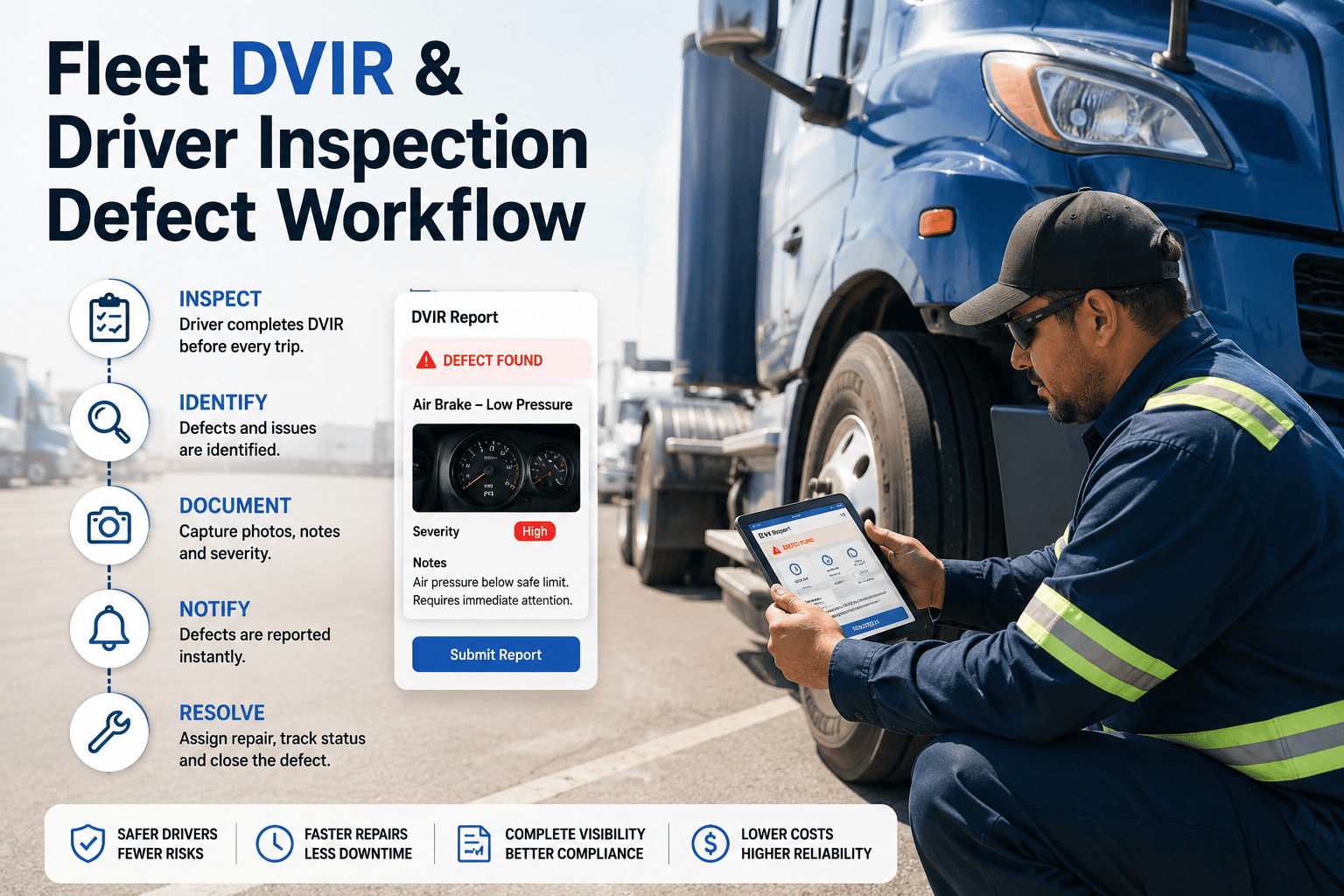
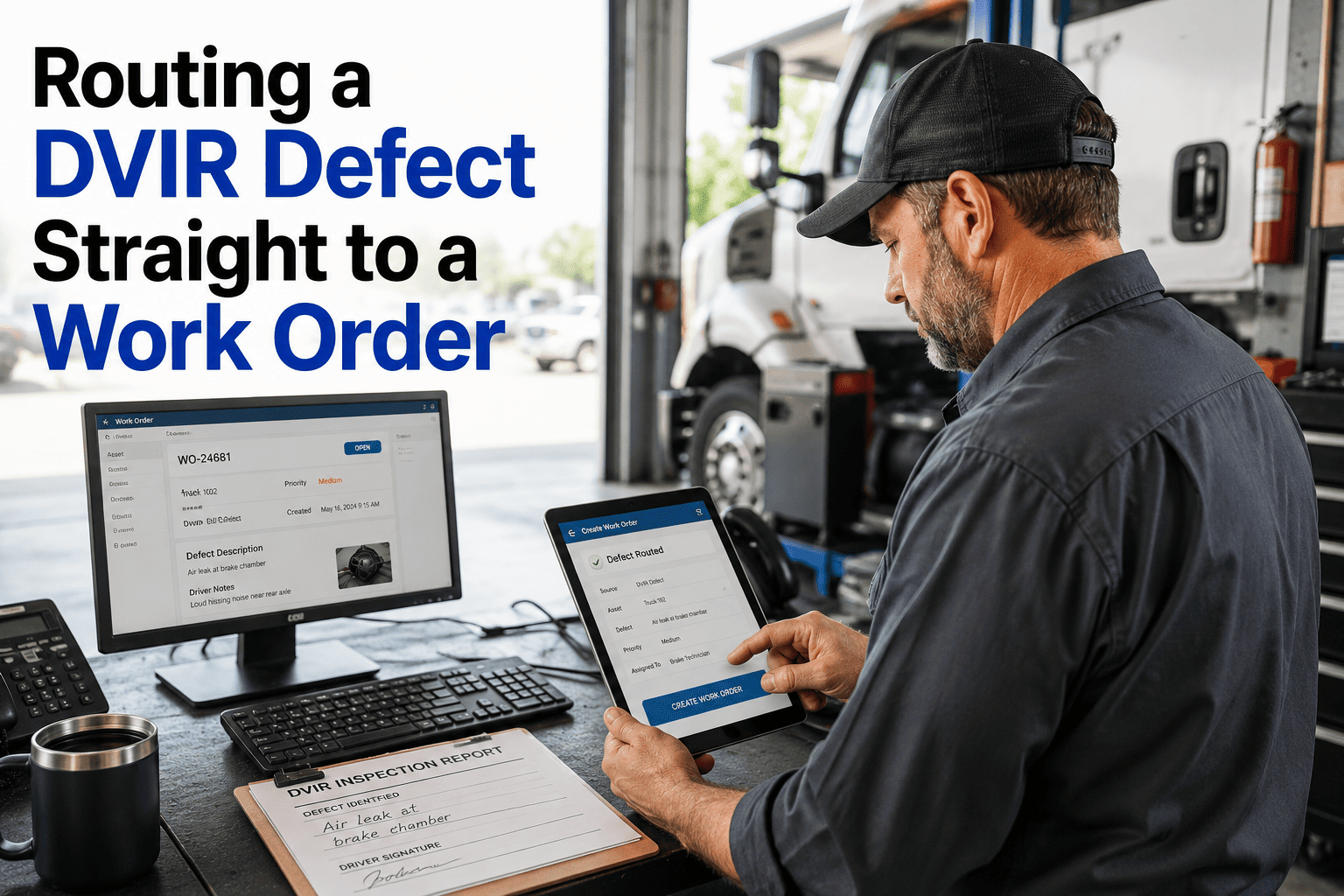
The gap between defect identification and repair scheduling is where preventable breakdowns are born. In a paper DVIR process, a driver documents a defect, the paper form travels to a maintenance office, a manager reviews it at some point, and a work order may or may not be created. The average time from paper DVIR defect notation to maintenance work order creation is 1.8 days in fleets without digital integration — a window during which the vehicle may operate with a known defect, compounding both the repair cost and the compliance exposure. Digital DVIR with CMMS work order integration eliminates this gap entirely: any defect marked in the mobile DVIR generates a work order in the maintenance queue automatically, routes it to the appropriate technician, and flags the vehicle as requiring certification before the next dispatch.
Digital DVIR — Defect to Certified Repair Workflow
Driver
At trip end · <8 min
Completes structured mobile inspection. Photos defect, marks severity, and submits signed report.
Automatic
Instant · Zero manual steps
Defect triggers work order instantly. Vehicle flagged, parts inventory checked, technician notified, dispatch gate activated.
Mechanic
Before next dispatch
Reviews work order with defect photos. Performs repair. Certifies completion in CMMS with repair notes, parts used, and signature.
Next Driver
Before departure · Gate enforced
Reviews prior DVIR in mobile app. Sees defect, repair cert, and technician sign-off. Acknowledges and signs — vehicle dispatch unlocks.
Complete Record
Audit-ready · Permanent
Full chain timestamped automatically — driver report, defect photos, work order, mechanic cert, and next-driver acknowledgment all in one permanent record.
Mobile DVIR App: What the Inspection Experience Looks Like in Practice
The adoption barrier for digital DVIR is almost always driver experience — if the mobile inspection process takes longer than the paper form or requires technical sophistication, completion rates fall and compliance gaps open immediately. A well-designed driver inspection app should complete a standard pre-trip or post-trip inspection in 5–8 minutes with guided prompts, one-tap status marking for each inspection category, optional photo attachment that defaults to camera rather than gallery, and a clear submission confirmation that closes the inspection record. OxMaint's driver inspection app is designed around this workflow — structured enough to enforce FMCSA-required categories, simple enough that drivers complete it willingly without training resistance.
Digital DVIR Mobile App — Core Features
Guided Inspection Checklist
FMCSA-required categories pre-loaded. Driver taps Pass / Defect per item — cannot submit without completing every category.
Enforced
One-Tap Photo Capture
Defect flagged → camera opens immediately. Photo timestamped, GPS-tagged, and attached automatically — no manual upload.
Photo Evidence
Offline Mode
Inspections stored offline when no cellular signal. Syncs to CMMS automatically on reconnect — zero lost inspections.
Always Works
Prior Report Review Gate
Driver must sign the prior report before completing their own inspection. Cannot be bypassed — dispatch gate enforced at system level.
Gate Enforced
Severity Classification
Defects classified as Minor, Major, or OOS at point of entry. OOS-level defects block dispatch immediately and push-alert the fleet manager.
OOS Blocking
Digital Signature Capture
On-screen signature legally equivalent to paper under federal e-sign law. Timestamped and attributed to driver ID automatically.
Legally Valid
FMCSA-Compliant Electronic Record Retention
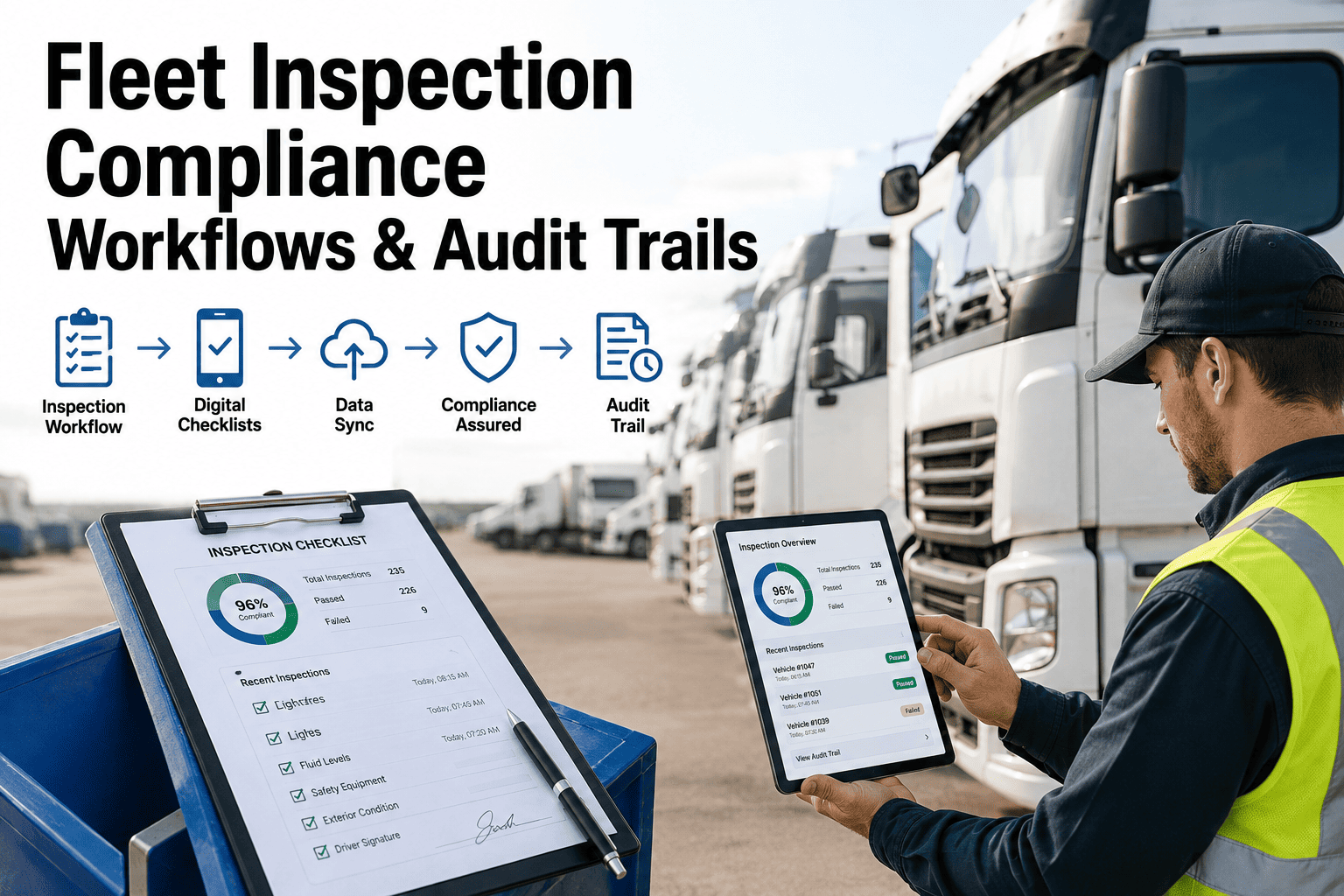
Record retention is where paper DVIR programs generate some of their most expensive violations — not from incomplete inspections but from records that were completed and subsequently lost, misfiled, or simply unavailable when a DOT auditor requests them. FMCSA requires 90-day retention with on-demand accessibility; an auditor who requests records and receives "we'll have to look for those" has already found a citation. For fleets with accident exposure, litigation timelines extend record retention needs well beyond 90 days — and records that were destroyed within the statutory minimum become evidence of spoliation in civil proceedings. Digital DVIR records stored in a cloud-based CMMS are permanently retrievable by vehicle, by date, by driver, or by defect type — in seconds, not hours.
Record Retention Requirements by Purpose — Paper vs. Digital
Purpose
Required Retention
Paper Fleet Reality
OxMaint Digital
FMCSA compliance minimum
90 days
Often incomplete — records misfiled or lost
✓ Automatically retained, searchable
Insurance claim investigation
12 months
Rarely retained past 90 days
✓ Permanent by default
Civil litigation window
3–5 years
Not retained — spoliation risk
✓ Permanent, legally retrievable
Warranty claim support
Warranty period
Inconsistent — depends on filing discipline
✓ Per-vehicle history, exportable
DOT comprehensive review
On-demand, 90-day sample
4.2 hrs avg assembly time
✓ <60 seconds retrieval
Paper fleets average 4.2 hours assembling 90-day DVIR records for a DOT audit request — digital fleets produce the same package in under 60 seconds
Replace Paper DVIRs With Photo-Verified Digital Inspections
OxMaint's digital DVIR platform enforces the three-party certification chain, auto-creates work orders from defects, and retains all records permanently. Free to start. No hardware required.
Paper vs. Digital DVIR: The Complete Compliance Comparison
Compliance Factor
Paper DVIR
Digital DVIR (OxMaint)
Inspection completion enforcement
None — driver can submit blank or partial form
Cannot submit without completing every FMCSA-required category
Defect documentation quality
Text-only — vague, unverifiable, disputes common
Photo + text + severity — timestamped, GPS-tagged, dispute-proof
Work order creation from defect
Manual — avg 1.8 day delay from defect to work order
Automatic — work order created instantly on defect flagging
Mechanic certification
Manual entry — commonly missed or undated
Required step in CMMS workflow — cannot dispatch without it
Next driver acknowledgment
No enforcement — driver can depart without signing
App gate — dispatch blocked until prior report acknowledged
DOT audit retrieval time
4.2 hrs avg — records across files, depots, systems
<60 seconds — centralized, searchable, exportable
Record retention beyond 90 days
Rare — paper destroyed or lost after compliance minimum
Permanent by default — legally retrievable for litigation
34%
Fewer roadside violations in fleets using digital DVIR with photo verification
Photo-verified inspections improve defect detection accuracy and create defensible records that reduce citation risk at inspection.
1.8 days → 0
Average delay from defect documentation to work order — eliminated by automatic creation
Instant work order generation prevents the compounding damage from vehicles operating with known defects for 1–2 days post-inspection.
61%
Of DVIR citations are chain-of-custody failures — all eliminated by digital workflow gates
Every chain failure mode is a process problem that digital enforcement solves without relying on individual compliance behavior.
<60 sec
DOT audit record retrieval time vs. 4.2 hrs for paper fleets
The administrative cost difference alone — hours of staff time per audit event — represents a meaningful ongoing saving for any fleet with regular compliance reviews.
Frequently Asked Questions
Are electronic DVIRs legally accepted by FMCSA?
Yes. FMCSA regulations do not require paper DVIR forms — they require that the inspection be conducted, documented, and retained in accordance with 49 CFR 396.11 and 396.13. Electronic records that meet the data content requirements (all required inspection categories, driver identification, defect descriptions, mechanic certifications, and driver acknowledgments) are fully compliant. The records must be accessible on demand during roadside inspections and DOT audits. OxMaint's digital DVIR records meet all FMCSA data requirements and are accessible instantly from any device with an authorized login.
What happens if a driver refuses to complete the digital DVIR before departure?
Digital DVIR platforms with dispatch gate integration prevent vehicle dispatch until the inspection is completed and signed — the gate is enforced by the system, not by manager oversight. If the vehicle has a physical key system, the dispatch gate can be complemented by a manager approval workflow that requires sign-off before keys are issued. The compliance documentation value of digital DVIR also creates accountability that paper forms lack — incomplete digital inspections generate an automatic exception report, while incomplete paper inspections are simply never discovered. Book a demo to see how the dispatch gate workflow functions in OxMaint.
How does digital DVIR handle vehicles that do not find defects — are daily no-defect reports still required?
Yes. Even when no defects are found, a signed driver report is required under 49 CFR 396.11 — the "no defects" finding must be documented and signed, not assumed from the absence of a report. Digital DVIR makes no-defect inspections faster than defect inspections — drivers complete the checklist (all Pass) and submit with a single signature. The record is just as complete as a defect report and satisfies the FMCSA documentation requirement identically. OxMaint's inspection workflow treats no-defect and defect inspections identically from a compliance documentation perspective.
How long does it take to roll out digital DVIR across a fleet?
For most fleets, digital DVIR deployment takes 1–2 weeks: vehicle assets configured in the CMMS in day 1–2, driver app installation and a 20-minute walk-through training in day 3–5, and full compliance operation by end of week 2. Driver adoption is typically faster than managers expect — the app is simpler than most paper forms once drivers do it once. Sign up for OxMaint free to begin the setup process today.
61% of Your DVIR Citations Are Process Failures. Digital Fixes All of Them.
OxMaint's digital DVIR platform enforces the complete three-party certification chain, captures photo-verified defect documentation, auto-creates work orders, blocks dispatch on uncertified defects, and permanently retains every record for audit, insurance, and litigation use — eliminating every systemic failure mode of paper DVIR simultaneously. Go from 4.2-hour audit assembly to 60-second retrieval. Deploy in 2 weeks. Free to start. No hardware required. Join 1,000+ fleets running digital DVIR compliance with OxMaint.