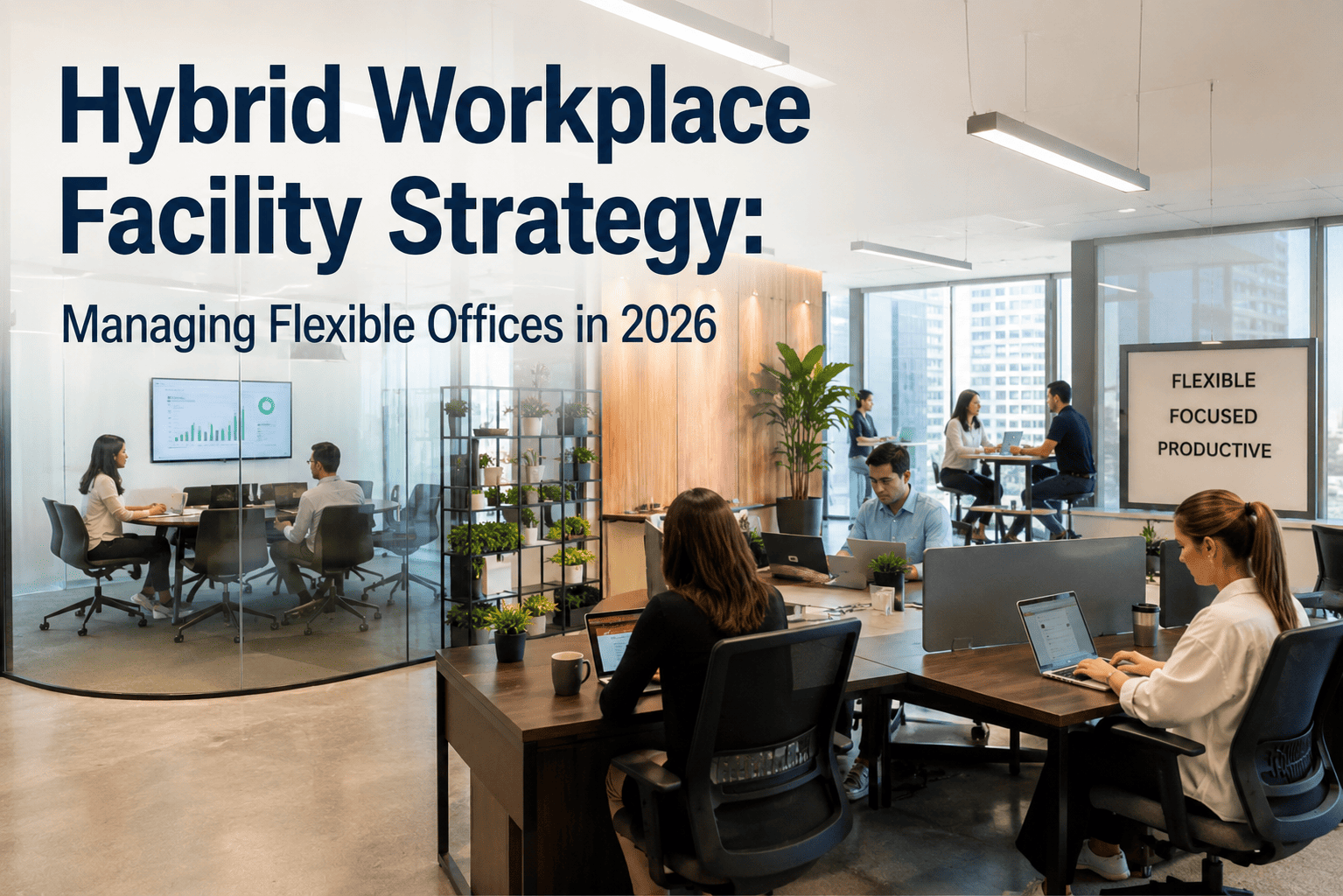
Hybrid Workplace Facility Strategy: Managing Flexible Offices in 2026

By James Smith on May 16, 2026

hybrid-workplace-facility-strategy-2026

By 2026, 87% of companies operate in hybrid mode — yet most facility management programs were designed for a world where every desk had an owner, every floor ran the same cleaning schedule, and HVAC ran on the same timetable Monday through Friday. That world is gone. Hybrid work has made occupancy unpredictable, space utilization asymmetric, and the traditional fixed-schedule PM model structurally inefficient. Facility managers who adapt their maintenance strategy to actual occupancy data — not calendar assumptions — are reducing operating costs, extending asset life, and producing the evidence base needed to make defensible real estate decisions. Book a demo with Oxmaint to see how occupancy-triggered maintenance works across your building zones.

The 2026 Reality

What Hybrid Work Has Done to Office Operations

50%
Average weekly time office workers spend in the workplace — down from 70% pre-pandemic
40–60%
Typical conference room vacancy rate — most rooms are empty during their booked hours
30%
Operating cost reduction possible when hot desking cuts space by 15–25% (CBRE 2026)
34%
of employers are actively reducing their traditional office footprint by 20% or more
The Core FM Problem

Why Traditional PM Schedules Fail in Hybrid Buildings

A fixed PM schedule treats every floor identically — same cleaning frequency, same HVAC runtime, same desk inspection interval — regardless of whether that floor had 80 people on Tuesday or 12 on Friday. The result is predictable: facilities teams over-service empty zones and under-service high-traffic areas simultaneously. When occupancy data and maintenance scheduling exist in separate systems with no integration, this mismatch is invisible until a reactive complaint or compliance finding surfaces it.

Traditional FM Approach
Same cleaning schedule regardless of actual floor traffic
HVAC runs full timetable even on low-attendance days
Desk condition tracked at floor level — no individual hot-desk records
Real estate decisions based on headcount, not occupancy evidence
Fault reporting depends on desk user — no one reports when no one owns the desk

Oxmaint Occupancy-Driven FM
Cleaning triggered by occupancy threshold, not calendar date
HVAC runtime adjusted to actual zone occupancy via sensor integration
Every hot desk registered as individual asset with condition record and inspection schedule
12-month occupancy trend report by zone with cost-per-square-metre overlay
Inspection-triggered fault detection replaces user-reported faults
Start Today
Connect Your Occupancy Sensors to Your Maintenance Schedule

Oxmaint integrates with occupancy sensor platforms and desk booking systems via API — so cleaning frequencies, HVAC runtime, and inspection cycles adjust automatically to actual building usage, not assumptions.

Zone Management Strategy

How to Structure Hybrid Facility Zones in Your CMMS

Zone Type Typical Occupancy Pattern FM Adjustment in Hybrid Mode CMMS Trigger Type Cost Impact
Hot-Desk Floor 60–80% Tue–Thu; under 30% Mon and Fri Cleaning schedule mirrors booking data; individual desk inspection records per asset Occupancy threshold + booking system integration 15–30% cleaning cost reduction
Collaboration Hubs Variable — peaks 2–3 hours around events Post-use cleaning triggered by room booking close; AV and furniture condition checked at inspection intervals Booking system event closure trigger Reduced over-cleaning of empty rooms
Quiet / Focus Zones Low but consistent daily use Standard weekly PM; air quality and temperature monitoring via IoT sensors Calendar + IoT condition trigger Minimal change — consistent usage
Executive / Assigned Areas Predictable 5-day occupancy Standard FM schedule maintained; no change required from hybrid model Calendar (unchanged) No reduction — full occupancy maintained
Low-Use Satellite Floors Under 20% average occupancy Reduced HVAC to setback mode; weekly visual inspection only; candidate for repurposing or lease surrender Occupancy sensor — low threshold alert HVAC 40–50% energy saving; lease review triggered
Hot Desk Maintenance

Managing Hot Desks as Individual Maintainable Assets

Hot desking removes the fixed-user relationship that traditionally surfaced desk faults. When no one owns a desk, no one reports that the monitor mount is loose or the cable management is damaged — until the issue affects enough users to trigger a complaint. The FM approach that works in hybrid environments treats each hot desk as an individual asset record in the CMMS, with its own condition score, inspection schedule, and fault history. A floor with 60 desks serving 100 users on a 3:2 hybrid model has different PM requirements than a fixed-assigned floor — and those requirements must be reflected in the CMMS asset hierarchy, not averaged across the floor.

01
Individual Asset Registration
Each hot desk registered in Oxmaint with unique asset ID, desk number, zone, and equipment list — monitor, sit-stand mechanism, cable tray, chair. Individual record captures full fault history independent of who used the desk.
02
Booking-Linked Inspection Triggers
Booking system integration counts cumulative desk uses. After a defined threshold — typically 50–80 uses — an inspection work order fires automatically. High-demand desks get inspected more frequently than low-use desks on the same floor.
03
Condition Scoring and Trend Tracking
Each inspection records a condition score per desk component. Over time, CMMS identifies desks deteriorating faster than average — typically sit-stand mechanisms in high-traffic areas — for prioritized replacement before they fail during a shift.
04
Zone-Level Reporting for Real Estate Decisions
Oxmaint aggregates individual desk condition and usage data to zone-level reports. FM teams see which zones are experiencing high wear relative to their utilization — the evidence base for investment decisions about desk replacement, zone redesign, or repurposing.
Expert Perspective

What Facility Directors Are Reporting in 2026

The most consequential change we made was not the sensor installation — it was linking the occupancy data to our CMMS. Within six months of connecting our desk booking system to Oxmaint, we had the 12-month occupancy trend data that supported a floor consolidation decision that reduced our lease commitment by 18%. That evidence did not exist before.
Head of Facilities Operations
Financial services firm, 1,400 employees, three-city portfolio
Our cleaning costs were the fastest to respond when we moved to occupancy-based triggers. On low-attendance Fridays — typically under 25% of desks occupied — we shifted from a full-floor clean to a targeted touch-point service. The annualized saving on that single day alone funded the CMMS integration project within seven months.
Workplace Experience Manager
Technology company, 850 seats, hybrid-first policy since 2022
Frequently Asked Questions

Hybrid Workplace FM: Common Questions

A minimum of 6–12 weeks of daily peak occupancy by zone provides sufficient baseline data for CMMS trigger calibration. You do not need a full year before beginning to adjust schedules — even 6 weeks of data will identify your Tuesday-to-Thursday peak pattern, your low-Friday attendance, and the zones consistently running below 25% occupancy. Start with threshold-based triggers at a conservative level and refine as more data accumulates over the following months. Oxmaint begins capturing occupancy trend data from day one of integration with your desk booking or sensor platform, so by the end of your first trial month you have the data foundation in place.
There is no universal answer — it depends entirely on your specific hybrid attendance pattern. Most organizations target sharing ratios between 1.2 and 2.0 employees per desk, meaning for every desk, between 1.2 and 2 employees share it across the week. A ratio below 1.5 is appropriate for teams with high in-office frequency; ratios approaching 2.0 work for teams with strong remote-first cultures and predictable anchor days. The critical variable is peak-day occupancy: plan for your 90th percentile peak day, not your average, or you will face desk shortages that drive employees away from the office. Book a demo to see how Oxmaint FM data supports desk ratio modeling for your specific building zones and team schedules.
Occupancy-based cleaning works by replacing calendar-fixed schedules with threshold-triggered work orders — when a zone's occupancy data shows it reached the cleaning trigger level (for example, 40 desk bookings on a floor), a cleaning work order fires for that zone. In practice, this means restructuring cleaning contracts from fixed daily visits to flexible-scope agreements where the scope adjusts to a CMMS-generated schedule. Most commercial cleaning contractors in 2026 are familiar with this model and can price it under a flexible-scope contract. The key is ensuring your CMMS can generate a forward schedule for the contractor to staff against — Oxmaint produces this automatically from occupancy data. Start a free trial to see how cleaning work orders are generated from occupancy triggers in your building zone configuration.
Smarter FM
Manage Your Hybrid Building on Real Occupancy Data, Not Calendar Assumptions

Oxmaint connects to your occupancy sensors and desk booking system to drive maintenance schedules, cleaning triggers, and HVAC runtime from actual building usage — giving facility managers the data to reduce costs, improve the employee experience, and make defensible real estate decisions.
Share This Story, Choose Your Platform!