ISO 45001:2018 is the international standard for occupational health and safety management systems — and its clause structure demands something most facility management teams discover only when preparing for their first audit: the standard requires not just that hazards are identified and controlled, but that every corrective action, safety inspection, incident investigation, and management of change record is documented, retrievable, and demonstrably connected to the facility's asset register. A CMMS that tracks corrective maintenance but treats safety inspections as a separate paper process leaves a structural gap in the OHS management system that ISO 45001 auditors will find consistently. Start a free trial on OxMaint or book a demo to see how Oxmaint CMMS supports ISO 45001 certification across your facility asset register, safety inspection schedules, and corrective action workflows.
Blog · ISO 45001 · Occupational Health & Safety
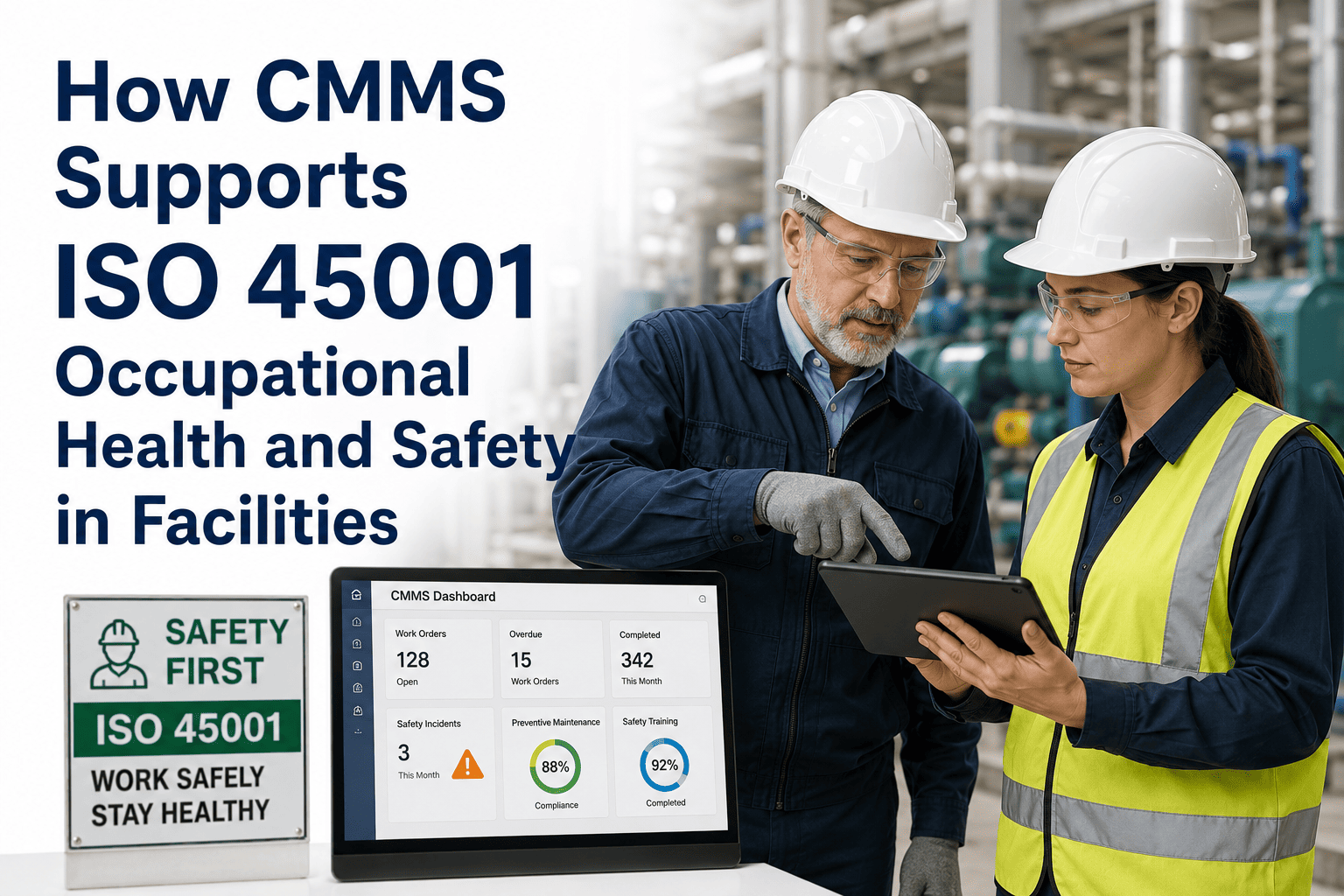
How CMMS Supports ISO 45001 Occupational Health and Safety in Facilities
How Oxmaint CMMS maps to ISO 45001 clause requirements — hazard tracking, safety inspection documentation, corrective action workflows, and the audit trails that certification auditors require at every surveillance visit.
45001
ISO 45001:2018 — the international standard replacing OHSAS 18001 for OHS management systems
Clause 8
Operational planning and control — where most facility management CMMS integration applies
Clause 10
Improvement — corrective actions, incident investigation, and nonconformity tracking
Annual
Surveillance audits require continuous documented evidence — not point-in-time preparation
Book a Demo
ISO 45001 Clause Mapping — Where CMMS Evidence Is Required
ISO 45001 is a process-based management system standard — not a checklist. Its clauses require systematic, documented evidence of OHS hazard identification, operational control, and continual improvement. The table below maps the clauses most directly supported by CMMS documentation.
| ISO 45001 Clause |
Requirement Summary |
Facility CMMS Evidence Required |
OxMaint Feature |
| 6.1.2 — Hazard Identification |
Ongoing identification of hazards associated with assets, activities, and changes |
Asset-linked hazard records; management of change work orders when assets are modified or replaced |
Asset hazard classification + change trigger work orders |
| 8.1 — Operational Planning and Control |
Processes to manage OHS risks — including maintenance activities that create or control hazards |
Maintenance work orders with embedded safety controls (PPE requirements, LOTO procedures, isolation permits) |
Safety-tagged work orders with mandatory safety precondition fields |
| 8.1.3 — Management of Change |
Documented evaluation of OHS impact when changes are made to assets, processes, or contractors |
Change event work orders with hazard re-evaluation, updated risk assessments, and sign-off records |
Change management work order type with OHS risk re-evaluation step |
| 9.1 — Monitoring and Measurement |
Performance against OHS objectives — including safety inspection completion rates and hazard close-out rates |
Safety inspection completion records, overdue task tracking, corrective action close-out data |
Safety inspection PM schedules + KPI dashboard |
| 10.2 — Nonconformity and Corrective Action |
Documented investigation of nonconformities, root cause analysis, and corrective actions with completion tracking |
Nonconformity work orders linked to specific assets, RCA documentation, corrective action WOs with due dates and sign-off |
Nonconformity work order type + corrective action tracking to closure |
| 9.2 — Internal Audit |
Evidence that the OHS management system is functioning as planned — audit records, findings, and corrective actions |
Audit finding work orders, documentation of corrective actions raised and closed from audit findings |
Audit finding work orders with mandatory closure verification |
The Six CMMS Capabilities That Drive ISO 45001 Compliance
ISO 45001 requires an integrated OHS management system — not separate safety and maintenance programmes running in parallel. The following six CMMS capabilities are where Oxmaint creates the integration that auditors look for as evidence of a functioning system.
01
Safety-Tagged Work Orders with LOTO and PPE Requirements
Every maintenance work order involving a defined hazard — electrical isolation, confined space, working at height, stored energy — is tagged with the relevant safety controls. Mandatory fields require the technician to confirm LOTO applied, PPE selected, and permit obtained before the task can progress. The safety evidence is part of the work order record, not a separate paper form that may not be retained.
02
Hazard Classification on Asset Records
Each asset in OxMaint carries a hazard classification — electrical, pressure, chemical, mechanical, confined space — visible to technicians at QR scan before they begin any work. When the hazard classification changes (a boiler replacement, a new chemical process, a structural change), a management of change work order is automatically generated and routed for OHS sign-off before any work on the modified asset proceeds.
03
Safety Inspection Scheduling — Separate from Maintenance PM
ISO 45001 requires safety inspections as a distinct OHS monitoring activity — not just maintenance tasks that happen to check safety items. OxMaint generates dedicated safety inspection work orders for fire extinguisher checks, eyewash station inspections, emergency exit audits, safety signage verification, and life safety equipment tests — on their own regulatory schedule, with their own compliance tracking distinct from equipment PM.
04
Nonconformity and Corrective Action Workflow
When a safety inspection identifies a nonconformity — a blocked emergency exit, a defective safety guard, an uncontrolled chemical storage risk — OxMaint creates a nonconformity work order with priority classification, assigned owner, root cause analysis requirement, and corrective action deadline. The ISO 45001 auditor sees a closed loop: nonconformity identified, investigated, corrected, and verified. Not a finding in a report that nobody followed up.
05
Contractor Safety Documentation
ISO 45001 Clause 8.1.4 requires control of contractors who may affect OHS — including evidence that contractors received the site safety briefing, acknowledged site hazards, and hold current competency certifications for the work scope. OxMaint's vendor management module attaches contractor safety credentials to every outsourced work order, with expiry alerts when contractor certifications lapse before work begins.
06
Audit Trail Generation for Surveillance Visits
ISO 45001 surveillance audits require evidence that the OHS management system has been functioning continuously since the previous audit — not just at the time of review. OxMaint generates a structured audit evidence package: safety inspection completion rates, corrective action open and close rates, nonconformity trends, and management of change records — exported by date range, asset, or OHS requirement category. Audit preparation that previously took a week is completed in under four hours.
Safety Inspection Compliance — Before vs After CMMS Integration
Before OxMaint — Paper-Based Safety Inspections
Safety inspection schedule maintained on spreadsheet — overdue tasks not escalated automatically
Inspection records on paper forms — filed in binders, not linked to specific assets or hazard classifications
Nonconformities recorded in inspection report — corrective actions tracked informally, follow-through inconsistent
Contractor safety credentials held in paper folder — expiry not monitored; lapsed credentials not flagged before work starts
Audit preparation: 5–10 days of manual record retrieval and compilation before each surveillance visit
After OxMaint — CMMS-Integrated Safety Inspections
Safety inspection work orders auto-generated by calendar trigger — overdue tasks escalate to supervisor at 24 hours
Inspection records digital, timestamped, and asset-linked — retrievable in seconds by asset ID, date, or ISO clause
Nonconformities generate corrective action work orders automatically — tracked to verified closure with mandatory RCA field
Contractor credential records in OxMaint with expiry alerts 30 and 60 days in advance — work orders blocked for expired credentials
Audit evidence package: under 4 hours to produce complete structured export for any date range or clause category
OxMaint supports ISO 45001 Clauses 6, 8, 9, and 10 with safety-tagged work orders, inspection scheduling, corrective action tracking, contractor credential management, and audit-ready exports from one platform.
Most facilities teams configure their first ISO 45001-aligned safety inspection schedule in OxMaint within 48 hours of going live.
Book a Demo
"The facilities management teams I audit that have the strongest ISO 45001 systems share one characteristic: their safety inspections and their maintenance work orders live in the same platform. When safety and maintenance are managed in separate systems — or when safety is still on paper while maintenance is in a CMMS — the integration evidence that ISO 45001 requires simply does not exist. Clause 8.1 requires that operational controls for OHS risks are embedded in the work process, not bolted on afterwards. A maintenance technician who completes a LOTO isolation as part of a digital work order that records the isolation performed, the energy source confirmed, and the task completed is providing exactly the operational control evidence the standard requires. The same technician filling out a separate paper LOTO record that may or may not be filed against the right asset record is providing documentation that looks like compliance but cannot be verified as system-wide compliance at audit. The CMMS that integrates safety controls into the work order is not just more efficient — it is structurally closer to what the standard actually requires."
Karen Adebayo, CMIOSH, Chartered MCIBSE
Chartered Member, Institution of Occupational Safety and Health · Chartered Member, Chartered Institution of Building Services Engineers · 19 years ISO 45001 and OHSAS 18001 certification auditing and implementation in commercial and industrial facility management · Specialist in integrated OHS and FM management systems
Frequently Asked Questions
Does ISO 45001 require a CMMS, or is it satisfied by a paper-based maintenance programme?
ISO 45001 does not specify technology — it specifies outcomes: documented hazard identification, operational control evidence, corrective action tracking, and continual improvement records that are retrievable and demonstrably connected to the OHS management system. A paper-based maintenance programme can technically satisfy these requirements, but in practice it cannot produce the continuous, systematically structured evidence that surveillance audits require without significant manual effort and risk of documentation gaps. The standard requires evidence of a functioning system over time — which is structurally easier to demonstrate with a CMMS that generates work orders, tracks completion, and maintains audit trails automatically than with paper records assembled retrospectively.
Start a free trial to configure ISO 45001-aligned workflows in OxMaint.
What is the difference between ISO 45001 and OHSAS 18001?
OHSAS 18001 was the predecessor to ISO 45001 — retired in 2021. ISO 45001 introduces stronger requirements for worker participation in OHS risk identification, a leadership accountability structure that requires top management to demonstrate active OHS commitment, and explicit integration with the organisation's strategic context and risk management framework. The clause structure aligns with ISO's High Level Structure used by ISO 9001 and ISO 14001, making integrated management system certification significantly more straightforward. For facilities, the most significant difference is the explicit requirement for operational control to be embedded in work processes — which is where CMMS integration becomes structurally important rather than just administratively convenient.
Book a demo to discuss the OxMaint ISO 45001 integration framework for your facility type.
How should safety inspections be structured for ISO 45001 compliance in a commercial facility?
ISO 45001-compliant safety inspections should be asset-linked (tied to specific equipment, areas, or systems), scheduled at defined frequencies based on risk level, documented with timestamped digital records, and closed out with clear pass/fail criteria that trigger corrective action work orders on any failure. Inspection findings that identify nonconformities must generate corrective action records with root cause analysis, corrective action description, assigned responsibility, due date, and verified closure. The inspection programme should be reviewed at management review to assess whether frequencies are appropriate for the identified hazard level. OxMaint supports all of these requirements natively in the safety inspection work order type.
Start a free trial to build your ISO 45001 safety inspection schedule in OxMaint.
Can OxMaint generate the evidence needed for an ISO 45001 surveillance audit?
Yes. OxMaint exports structured compliance packages by date range, clause category, or asset group — covering safety inspection completion rates, corrective action status (open, in progress, closed), nonconformity trend data, management of change records, and contractor credential logs. All records include timestamps, technician attribution, and asset linkage that auditors require to verify the management system has been functioning continuously. Most facilities teams using OxMaint complete their ISO 45001 surveillance audit evidence package in under four hours — compared to 5–10 days of manual record assembly from paper-based systems.
ISO 45001 Requires a Functioning Safety Management System — Not Just Safety Records
OxMaint integrates safety inspections, hazard controls, corrective actions, contractor credentials, and management of change into the same work order system as your maintenance programme — giving ISO 45001 auditors the evidence of a continuously functioning OHS management system, not a paper file assembled the week before they arrive.