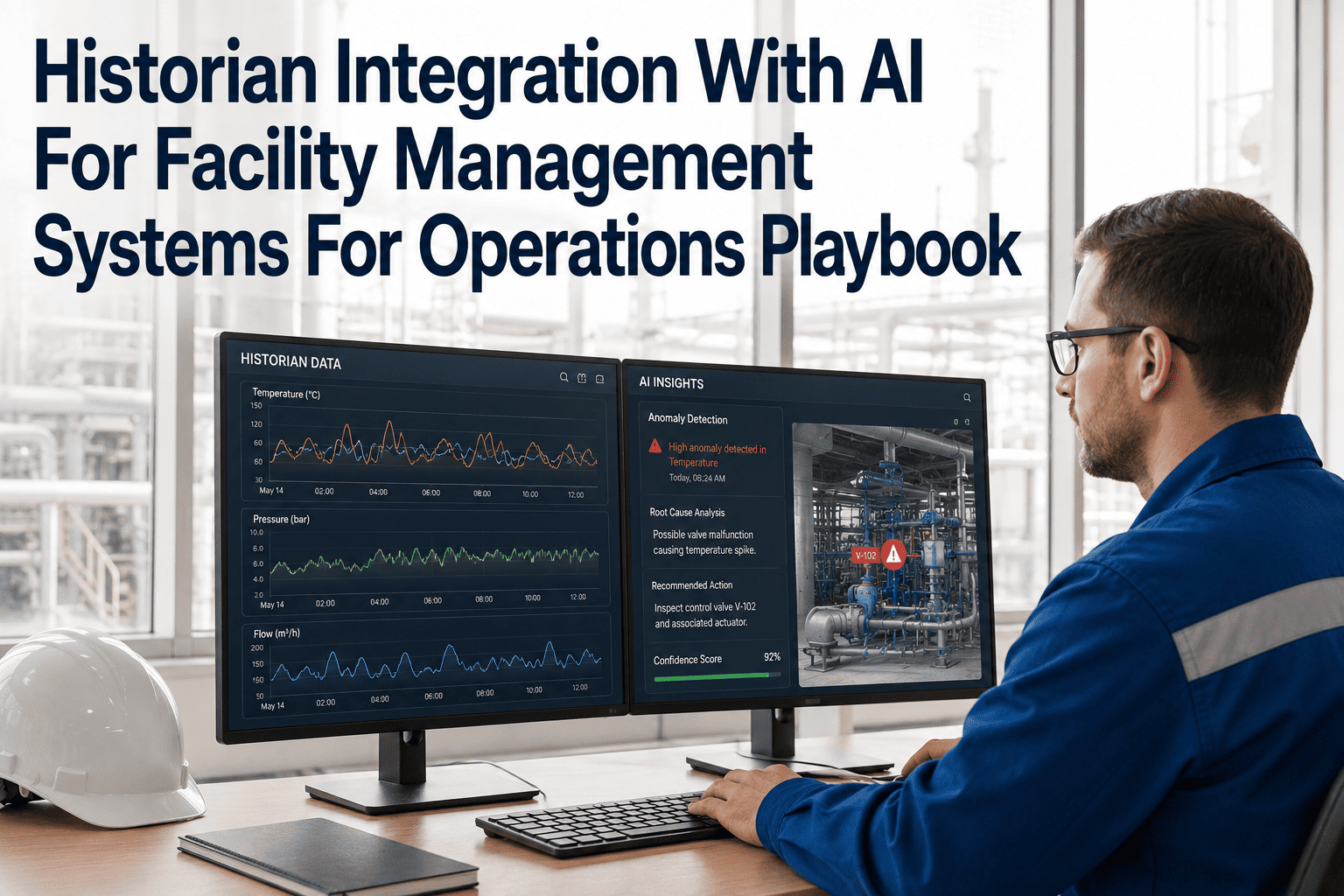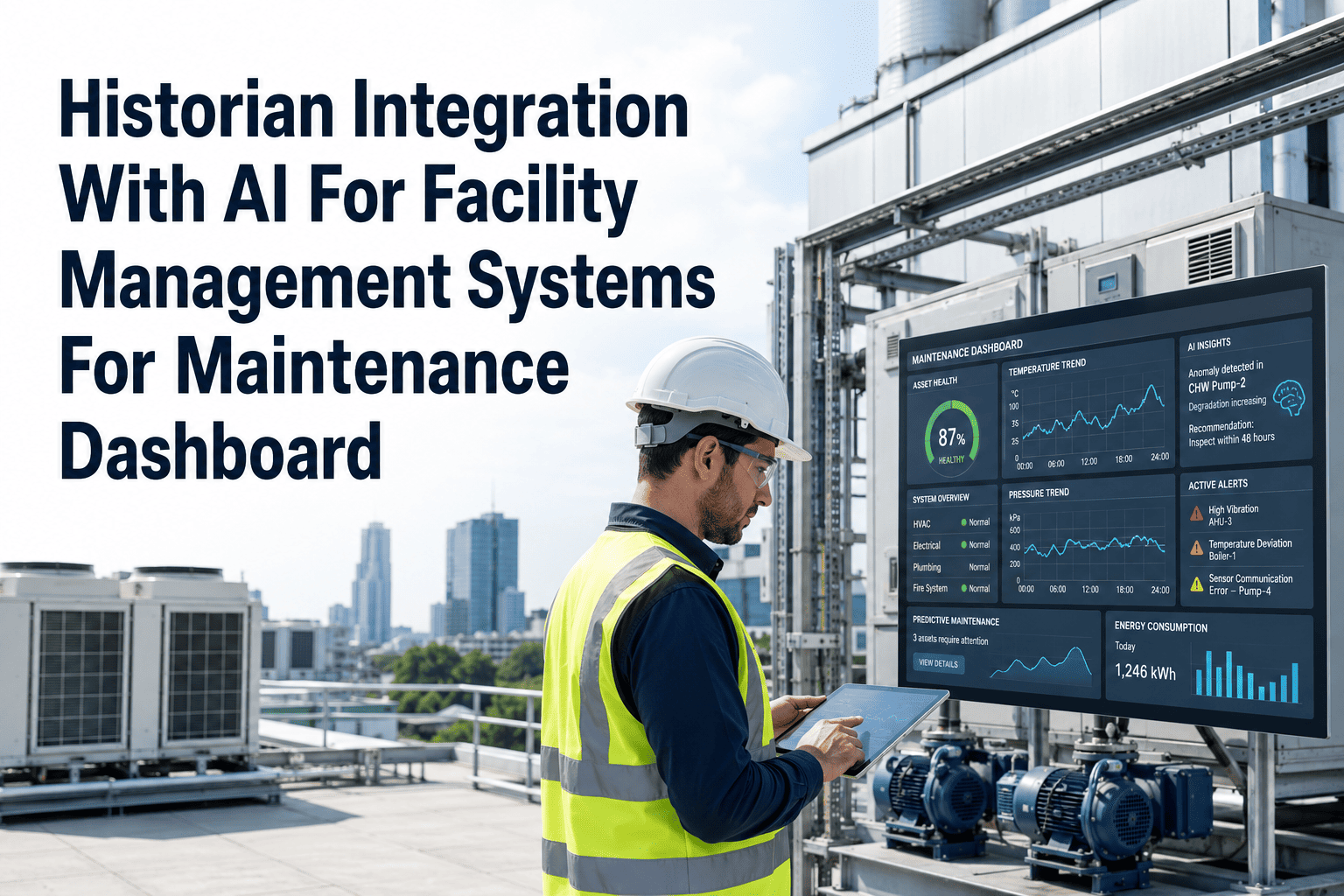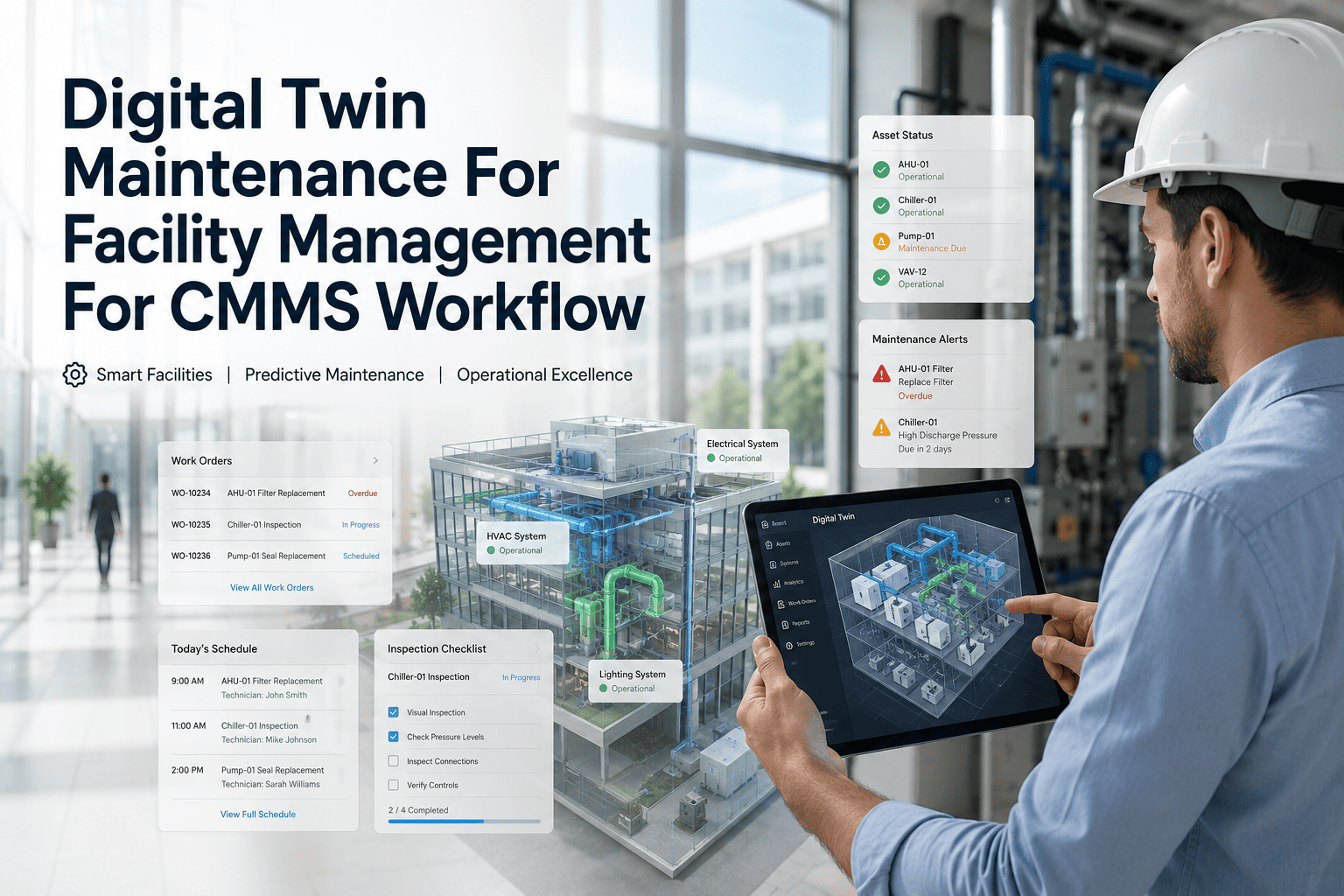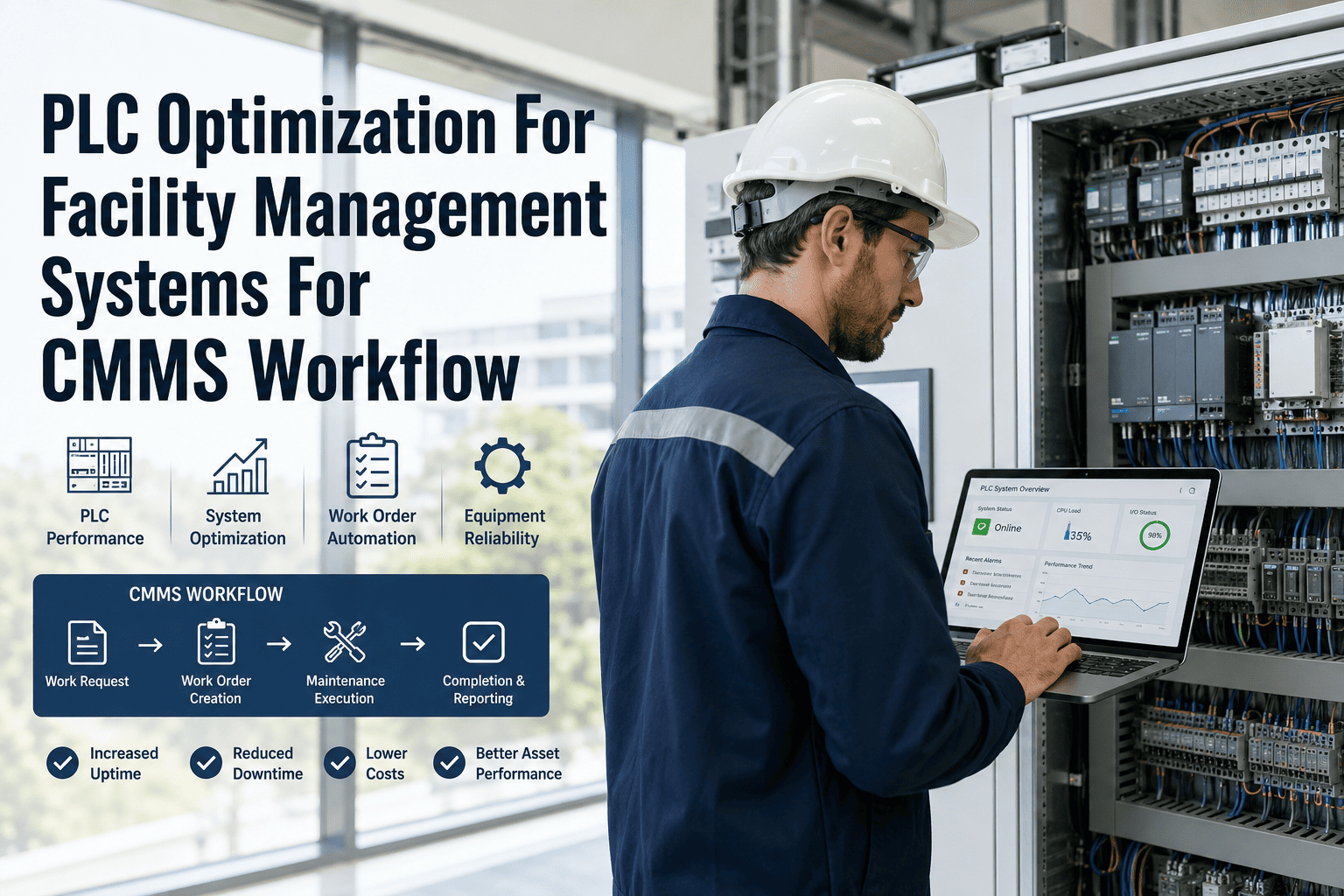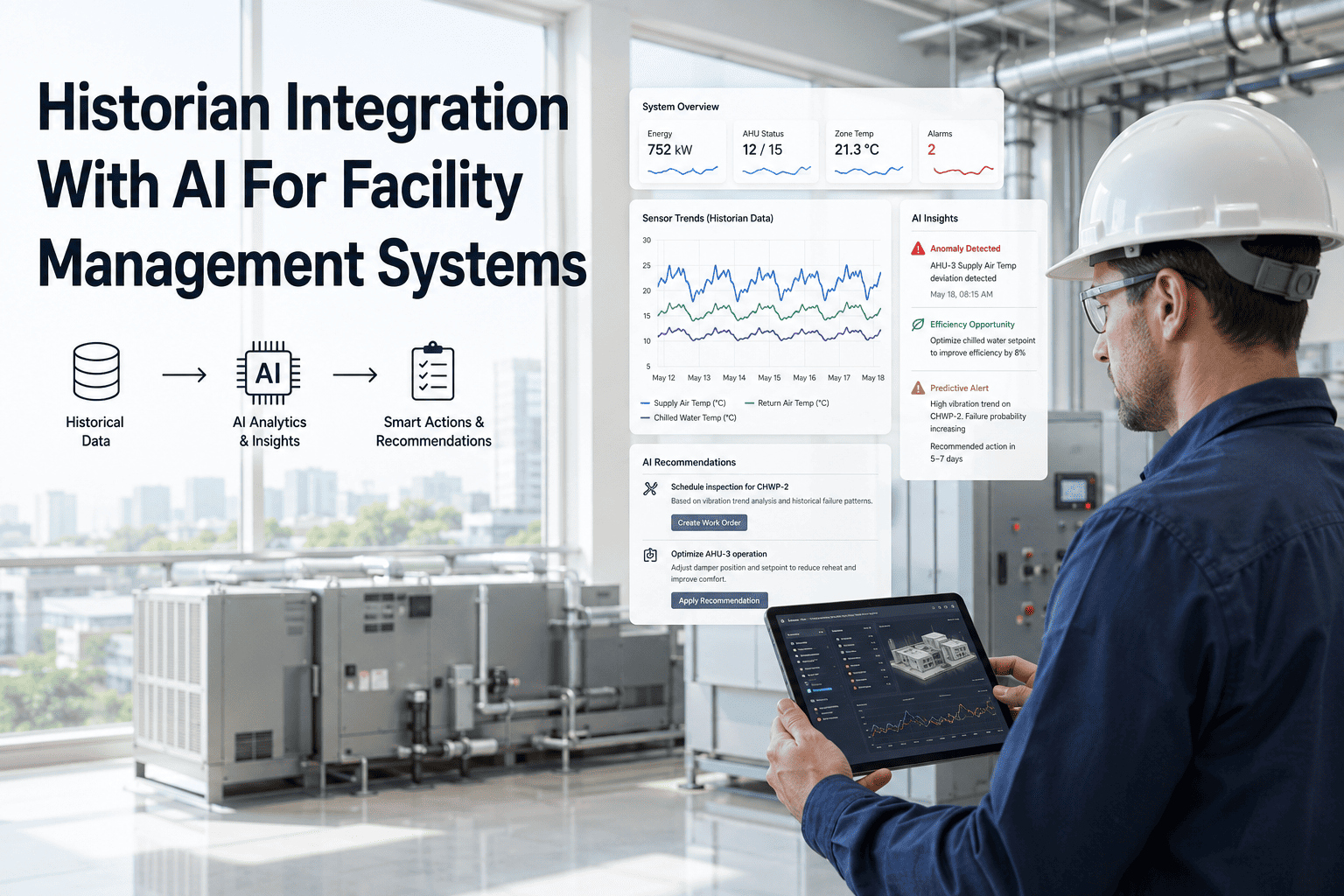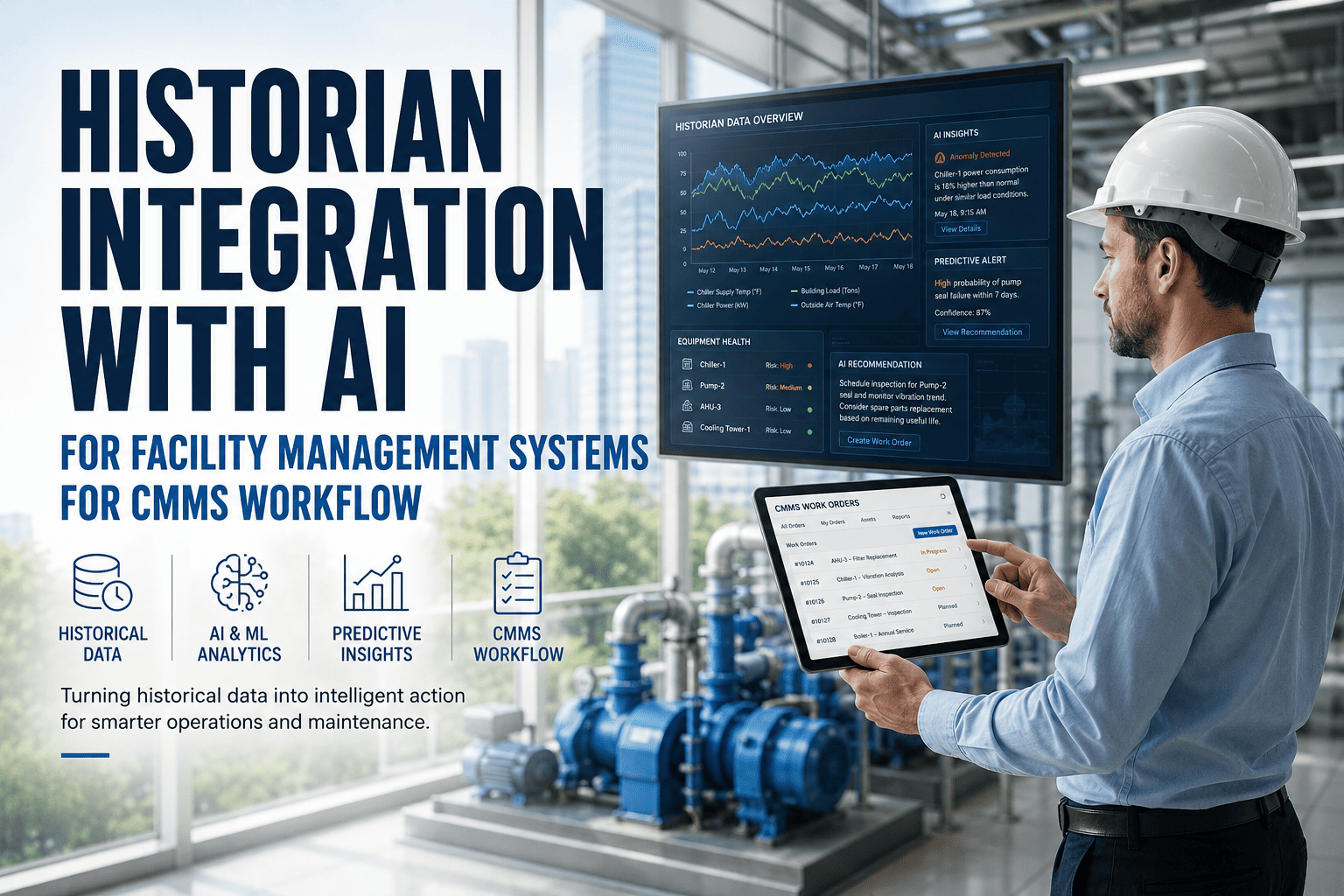
HVAC service teams managing large commercial and industrial building portfolios face a persistent data fragmentation problem: building automation historians hold years of equipment runtime data, performance curves, and alarm histories — while the CMMS holds work orders, PM schedules, and part records — and rarely do these two systems communicate. Historian Integration with AI for Facility Management Systems and CMMS Workflow eliminates this fragmentation by applying AI anomaly detection to live historian streams from HVAC equipment and routing detected faults directly into OxMaint work orders with full performance trend context attached. OxMaint's AI maintenance automation connects HVAC historian data — chiller COPs, AHU discharge temperatures, cooling tower approach temperatures, and VFD performance curves — to the maintenance action layer, ensuring every historian-detected anomaly becomes a structured, prioritized work order rather than a logged data point that no one acts on. For HVAC service teams responsible for multi-building portfolios, this integration reduces emergency service calls, extends equipment life, and builds the documented maintenance history that equipment warranties and insurance policies require.
AI Historian · HVAC Service Teams · Maintenance Automation
HVAC Historian Data That Actually Drives Maintenance Action
OxMaint's AI reads historian streams from chillers, AHUs, cooling towers, and VFDs — automatically converting performance anomalies into structured CMMS work orders before equipment fails.
48 hr
average early warning time: OxMaint detects HVAC anomalies 48 hours before failure in controlled studies
31%
reduction in HVAC emergency call-outs after historian AI integration — industry average across early adopters
7x
return on CMMS investment when HVAC historian integration prevents a single chiller compressor replacement
HVAC Equipment OxMaint Monitors via Historian Integration
CHW
Chillers
COP trend, approach temperature, condenser fouling factor, compressor current draw, refrigerant pressure differential
Action: Tube fouling WO, compressor PM trigger, refrigerant top-up alert
AHU
Air Handling Units
Supply air temperature, static pressure, filter differential pressure, fan current, mixed air temperature
Action: Filter change WO, belt tension PM, coil cleaning schedule trigger
CT
Cooling Towers
Approach temperature, basin temperature, fan motor current, make-up water flow, cycles of concentration
Action: Chemical dosing WO, drift eliminator inspection, fan blade balance PM
VFD
Variable Frequency Drives
Output frequency, drive temperature, DC bus voltage, fault code history, harmonic distortion index
Action: Drive fault WO, heat sink cleaning PM, capacitor replacement schedule
Historian AI Maintenance: Fault Detection Timeline
Day 0
Chiller COP begins declining — historian records data. No alert generated by BAS as value remains within absolute limits.
Day 2
OxMaint AI detects trend deviation from seasonal baseline — condenser fouling pattern identified. Work order for tube cleaning created and assigned to HVAC team.
Day 3
HVAC technician cleans condenser tubes — COP returns to baseline. Work order closed with service evidence and part records logged in asset history.
Without OxMaint
Fouling continues undetected. By Day 12, compressor overheats and fails — emergency replacement cost $22,000. Building cooling unavailable for 4 days.
Expert Review — HVAC Predictive Maintenance
HVAC historian data is the most underutilized asset in commercial building maintenance. Every chiller, AHU, and cooling tower produces a continuous performance signature that, when analyzed correctly, predicts failure weeks before it happens. The gap has always been connecting that data to maintenance action without requiring a human to review thousands of data points daily. AI-powered historian integration in a CMMS closes that gap — the historian sees the trend, the AI classifies it, and the work order gets created. HVAC service teams that implement this stop chasing emergency breakdowns and start managing reliability.
Principal HVAC Engineer and Building Performance Consultant, Commercial Real Estate Services Group
Let Your HVAC Historian Do the Maintenance Planning
OxMaint's AI reads your building's historian data and converts performance trends into maintenance action — automatically. No data science team required.
Frequently Asked Questions
Which HVAC-specific historian data types does OxMaint's AI analyze for anomaly detection?
OxMaint analyzes chiller COP trends, condenser approach temperatures, AHU supply and mixed air differentials, filter differential pressure rise rates, VFD current signatures, and cooling tower approach temperature progression. Each data type is analyzed against an equipment-specific and season-specific baseline — so a chiller running at 5.8 COP in summer is evaluated differently than the same chiller in shoulder season. Anomaly detection thresholds are configurable per equipment class, and maintenance managers can adjust sensitivity per asset based on criticality. Book a demo to configure HVAC monitoring parameters for your portfolio.
Can OxMaint integrate with BACnet-based BAS systems to access HVAC historian data?
OxMaint integrates with BACnet/IP and BACnet MS/TP building automation systems via a BACnet gateway bridge — supporting trend log object access for historian data retrieval without modifications to the BAS program. Niagara Framework (JACE) installations connect via the Niagara API, enabling access to all historian trend data stored in the Niagara database. For sites using Siemens Desigo CC, Johnson Controls Metasys, or Honeywell Alerton, OxMaint provides vendor-specific integration connectors. Direct MODBUS integration is also available for standalone HVAC controllers without full BAS connectivity.
How does OxMaint handle seasonal HVAC performance variation when detecting anomalies?
OxMaint's AI baseline modeling accounts for seasonal and load-condition variation by building separate performance envelopes per equipment, per season, and per load band. A chiller's baseline COP at 100% load in peak summer differs from its baseline at 60% load in spring — and OxMaint's AI evaluates historian readings against the appropriate context-specific envelope. This prevents seasonal transitions from triggering false-positive anomaly alerts while maintaining sensitivity to genuine performance degradation patterns. Seasonal baselines are recalibrated annually using the previous year's historian data. Book a demo to see HVAC seasonal baseline modeling for your equipment portfolio.
HVAC Failures Your Historian Already Predicted. OxMaint Makes Sure Someone Acts.
OxMaint connects your building automation historian to AI-powered anomaly detection and automatic work order creation — so every HVAC performance trend becomes a maintenance action, not a missed opportunity.