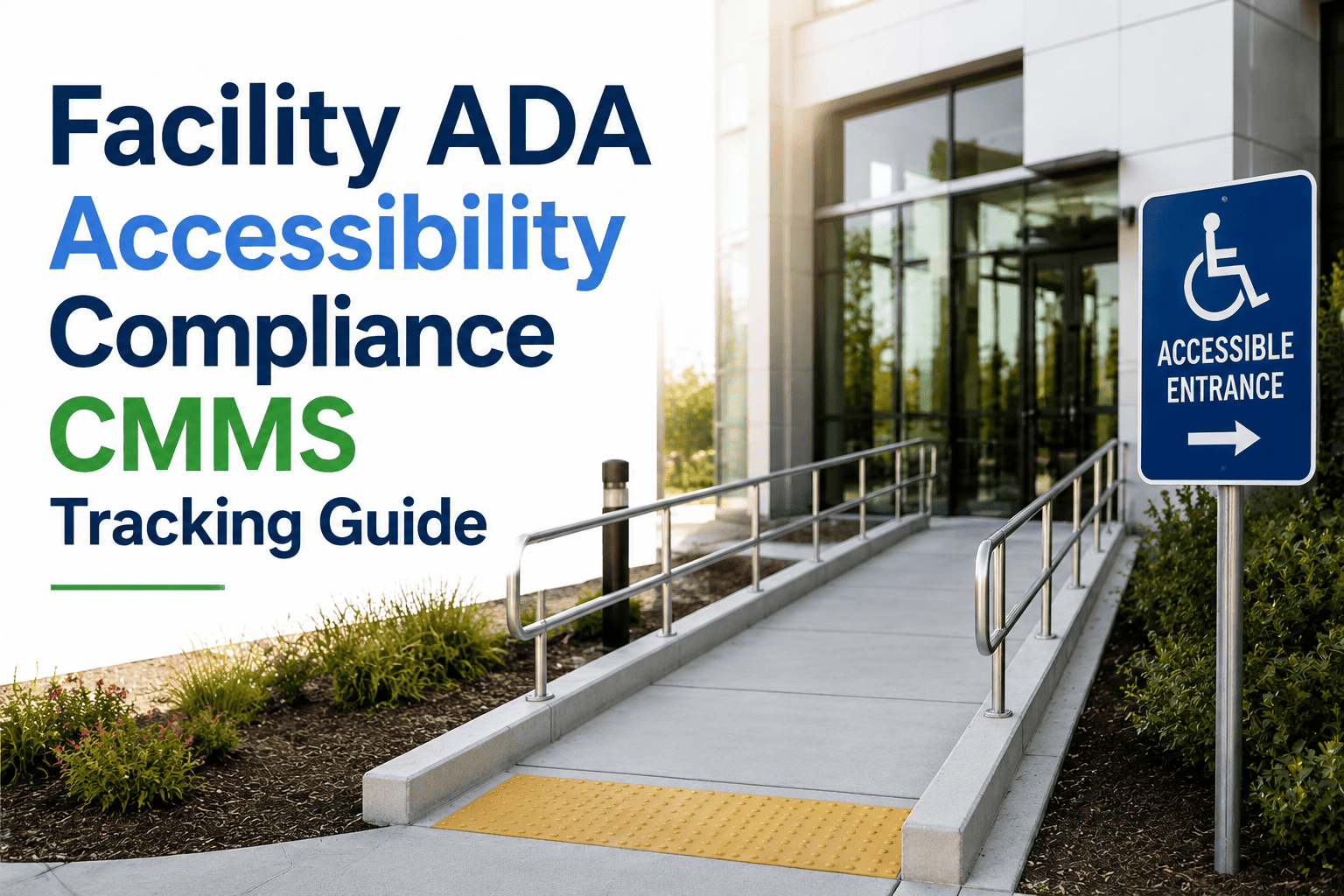
A regional hospital passed its ADA facility audit in 2023 with zero findings. Two years later, a routine complaint prompted a walk-through, and the compliance officer identified fourteen violations across the same building — an exam-room door handle swapped for a non-compliant knob during a callout, a restroom mirror mounted an inch too high after a plumbing repair, a directional sign relocated during a lobby refresh to a height a wheelchair user could no longer read. The original design was compliant. The maintenance drift was not. ADA violations rarely come from bad architecture; they come from the ordinary work orders that touch accessible components and never verify what got put back, which is exactly the gap OxMaint accessibility compliance tracking was built to close.
ADA Facility Compliance · CMMS Tracking · OxMaint
The ADA Does Not Age Out. Every Repair, Every Replacement, Every Relocation Either Holds The Standard — Or Quietly Breaks It.
Register every accessibility-relevant component, tie its ADA dimensional tolerance to the asset record, and force verification on every work order that touches it. Compliance stops depending on the annual audit and starts existing in every ticket you close.
8,667
Federal ADA Title III lawsuits filed in 2025 — up 27% year over year and rising into 2026
$75K – $150K
DOJ civil penalty range for first violation, escalating for repeat findings; state statutes stack on top
40%
Share of 2025 federal filings brought by pro-se plaintiffs, many using AI tools to identify violations
2010
Standards for Accessible Design — the dimensional baseline still governing every facility inspection today
The Drift Problem
Facilities Do Not Fail ADA On Opening Day. They Fail It One Work Order At A Time.
A building certified compliant at handover starts drifting the moment normal facility work begins. A closer gets adjusted and door force climbs past 5 pounds. A grab bar comes off for tile repair and returns half an inch out of the 33 to 36 inch range. A soap dispenser is replaced with whatever stock the storeroom held, mounted outside the 15 to 48 inch reach zone. None of it is deliberate. All of it is now a violation the DOJ can cite and a plaintiff can price.
Year 0
Fully Compliant
Construction certification confirms dimensions match the 2010 Standards throughout every accessible route.
Year 1
Early Drift
Door closer adjustments, replaced soap and paper dispensers, minor signage relocations start creeping outside tolerance.
Year 3
Visible Barriers
Restroom refurbishments, entrance rework, and vendor-swapped fixtures produce multiple violations across public zones.
Complaint
Litigation Exposure
DOJ complaint or private lawsuit surfaces the drift that maintenance never flagged and no audit ever captured.
Six Facility Zones. One Inspection Discipline. Every Dimension That Actually Gets Cited.
DOJ enforcement concentrates in six physical zones on almost every facility complaint. OxMaint registers each zone as a set of components with dimensional tolerances embedded, so the technician who touches a grab bar cannot close the work order without re-verifying it.
01
Accessible Parking
Van-accessible space with 8-foot access aisle, slope not exceeding 1:48, current striping, tow-away signage mounted at least 60 inches to sign bottom. Ratio of accessible spaces to total spaces scales with lot size and must be maintained after every re-striping.
Slope max 1:48 · Van aisle 8 ft · Sign 60"+
02
Entrances & Doors
Door opening force capped at 5 pounds for interior non-fire doors, maneuvering clearance intact on both sides, threshold no higher than half an inch, hardware operable with one hand and no tight grasping. Any closer replacement or hardware swap resets the compliance clock.
Force ≤ 5 lb · Threshold ≤ 1/2" · Lever hardware
03
Accessible Routes & Corridors
Minimum 36-inch clear width maintained end to end, 60-by-60 inch passing space where corridors exceed 200 feet, no protruding objects between 27 and 80 inches, surface stable and slip-resistant. Storage in corridors is the fastest way to convert a compliant route into a citable barrier.
Width ≥ 36" · Passing 60" × 60" · No protrusions 27–80"
04
Accessible Restrooms
Toilet centerline 16 to 18 inches from side wall, grab bars 33 to 36 inches above finished floor, mirror bottom edge no higher than 40 inches, dispensers within a 15 to 48 inch reach range, stall door clear of the required clearance envelope. Every dimension is the citation waiting to happen.
Grab bar 33–36" · Mirror ≤ 40" · Reach 15–48"
05
Signage & Wayfinding
Permanent room-identification signs mounted on the latch side of the door with raised characters and Grade 2 Braille, mounting height between 48 and 60 inches to baseline, color contrast sufficient for low-vision readers. Temporary signs during construction are the point signage compliance most commonly breaks.
Height 48–60" · Braille required · Latch-side
06
Elevators & Vertical Circulation
Cab dimensions sized to fit a wheelchair with a companion, tactile floor buttons at prescribed mounting height, audible and visual signals functioning, third-party ASME A17.1 inspection current. Monthly functional test and quarterly full inspection is the defensible internal cadence.
ASME A17.1 · Monthly test · Tactile controls
OxMaint · Accessibility Compliance Tracking
Turn Every Work Order Into A Verified Accessibility Record — Before The Complaint Ever Arrives.
Register the component. Attach the 2010 Standard. Require dimensional confirmation on completion. Preserve every inspection with photo, date, and technician identity — permanently.
The ADA Priority Pyramid — Where DOJ Wants Barrier Removal Sequenced
The 2010 Standards define a four-priority ordering that determines which existing-building barriers should be removed first. OxMaint tags every open corrective action to its priority tier so remediation budgets get spent where DOJ enforcement lands first, not where the easiest fix happens to sit.
Priority 1
Access From Site To Facility
Parking, drop-off, exterior route to the accessible entrance. This is the first barrier a person with a disability meets — and the first one DOJ evaluates.
Priority 2
Access To Goods & Services
Interior routes, service counters, sales floors, waiting areas, program spaces. The reason the visitor came to the building in the first place.
Priority 3
Restroom Access
At least one fully accessible restroom on any floor where restrooms are provided — the single most cited zone in DOJ Title III enforcement.
Priority 4
Remaining Elements
Drinking fountains, telephones, vending, cash machines, and other public amenities. Compliance obligation is the same; sequencing sits at the base.
Dimensional Cheat Sheet — The Numbers OxMaint Locks Into Every Work Order
Component
2010 ADA Tolerance
Most Common Drift
OxMaint Verification
Door opening force
Max 5 lb (interior non-fire)
Closer adjustment during callout
Gauge reading required at close-out
Ramp slope
Max 1:12 running, 1:48 cross
Overlay repair changes gradient
Slope measurement in mobile form
Grab bar mounting
33–36" above finished floor
Tile repair, re-mount off-spec
Height photo before technician can close
Reach range
15–48" forward reach
Dispenser swap outside range
Mount-height field required
Mirror bottom edge
Max 40" above floor
Replacement mounted too high
Height + photo captured on install
Corridor clear width
Min 36"
Storage or new fixture narrows route
Width check on any corridor work
Signage mount height
48–60" to baseline of raised text
Refresh mounts at eye level
Braille + height verification field
Van-accessible aisle
96" wide with 98" vertical
Re-striping narrows aisle
Post-stripe measurement captured
How OxMaint Stops Drift Before It Becomes A Complaint
Accessibility Register At The Asset Level
Every accessibility-relevant component — door, grab bar, dispenser, sign, ramp, elevator car — is registered with its applicable 2010 Standard reference, dimensional tolerance, and last verified date. The asset record carries its own compliance identity, not a folder somewhere.
Work Orders Surface The Standard
The moment a technician accepts a work order that touches a flagged component, the applicable ADA specification appears in the mobile view. No searching binders, no wrong assumption about height, force, or clearance — the number the technician must hit is right there.
Verification Blocks Work Order Closure
Dimensional fields, photo evidence, and a technician signature are required before the ticket can close. A door that was adjusted cannot be closed without a force-gauge reading. A grab bar re-mounted cannot be closed without the height photo. The record builds itself.
Replacement Triggers Re-Certification
When a flagged component is replaced, the new component starts its own dimensional baseline and the old component's inspection history is preserved on the asset lifecycle record. Drift from vendor substitutions cannot enter the building unrecorded.
Recurring Zone Inspections
Parking and route inspections quarterly, restroom inspections monthly, signage annually, elevators per state and ASME A17.1 cadence — every interval loaded as a scheduled work order with photo-required fields and digital sign-off, not a spreadsheet reminder someone forgot.
One-Click Complaint Response
When a DOJ complaint or plaintiff demand letter arrives, the inspection trail for any zone exports as one file — dates, technician names, photos, dimensional readings, and corrective actions. Good-faith compliance evidence assembled in minutes, not months.
What Happens When A Complaint Arrives — With OxMaint And Without
Without A Compliance Platform
Panic Reconstruction
Facilities scrambles to locate the last inspection paperwork — often kept by a vendor
Photos and dimensional records inconsistent between different maintenance staff
Corrective actions closed verbally with no dated evidence to demonstrate good faith
Response letter to DOJ arrives late and incomplete, escalating the matter
Settlement pressure builds because the defense is undocumented, not because barriers exist
With OxMaint
Structured Evidence, Same Day
Zone-level inspection trail retrieves in under a minute per accessibility asset
Photo, dimensional reading, technician identity, and date attached to every finding
Corrective action closure documented with re-verification against the applicable standard
Good-faith compliance evidence exports as one file for DOJ or counsel review
Complaints resolve at inquiry stage far more often than they escalate to litigation
The Accessibility-Ready Building
What Facilities Running OxMaint Look Like When The Complaint Actually Arrives
Zero
Undocumented component swaps when every work order re-verifies against the 2010 Standard
Under 60s
Retrieval of any zone's inspection trail with photos, dates, and dimensional readings intact
6 zones
Parking, entrance, route, restroom, signage, elevator — every citation-frequent zone tracked
4 tiers
Corrective actions auto-tagged to the DOJ priority pyramid for defensible sequencing
Frequently Asked Questions
Both. New construction must be fully compliant with the 2010 Standards. Existing Title III buildings must remove barriers where readily achievable — evaluated against the organization's overall financial resources. OxMaint tracks both new-work verification and ongoing existing-building barrier removal. Start a free trial to see the register.
Best practice is a full facility audit annually plus a targeted inspection any time a covered area is altered, repaired, or repurposed. OxMaint schedules zone-level recurring inspections on shorter intervals so drift is caught continuously rather than only at the annual review.
A documented record showing the asset was on a regular inspection schedule, inspections completed as scheduled, defects found were repaired within a defined timeframe, and maintenance has been consistent. OxMaint assembles that record continuously as a natural output of every work order.
No. OxMaint tracks the physical building components covered by the 2010 ADA Standards for Accessible Design. The Title II web accessibility rule addresses digital content under WCAG and is a separate compliance workstream typically owned by communications and IT. The two should report to one accessibility coordinator but use different tooling.
Priority 1 is site-to-facility access, Priority 2 is access to goods and services, Priority 3 is restrooms, Priority 4 is remaining elements. OxMaint tags every open corrective action to its priority tier so remediation budget lands where DOJ enforcement lands first. Book a demo to see the priority view.
Register · Verify · Preserve · Export
Accessibility Is A Maintenance Discipline. OxMaint Turns It Into A Structured, Audit-Ready Programme.
Every accessible component registered · every ADA tolerance embedded · every work order verified · every complaint answered with a same-day evidence file.