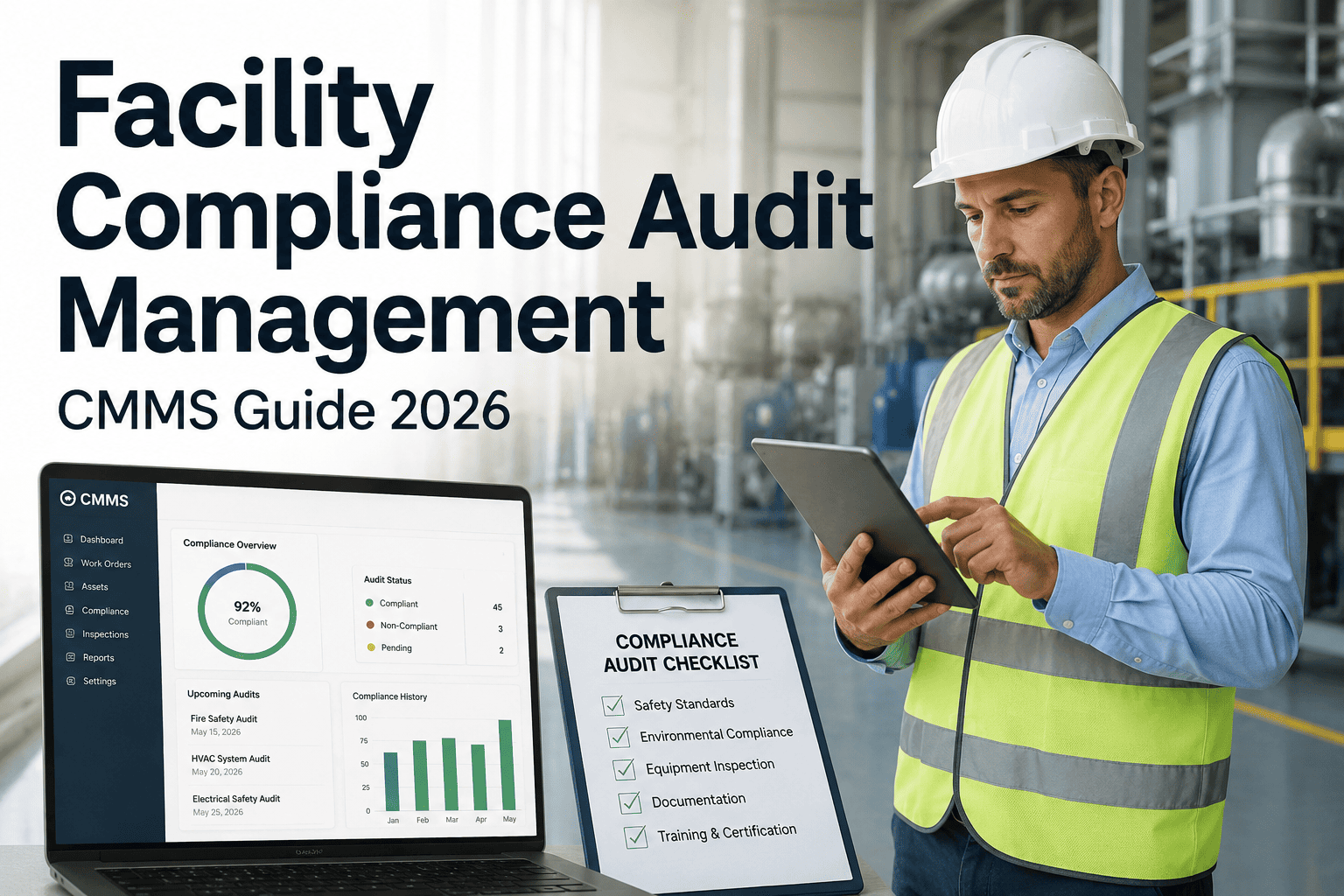
A regional healthcare system with fourteen buildings passed its OSHA inspection, its fire marshal walkthrough, and its ADA accessibility review in the same quarter — and still received a citation, because none of the three inspection files could be produced together when the surveyor asked for all of them at once. The work had genuinely been done: sprinklers tested, ramps measured, extinguishers tagged. What the facility lacked was one system that could prove all of it, for every building, on demand. Facility compliance in 2026 spans OSHA recordkeeping, ADA accessibility maintenance, NFPA fire and life-safety testing, and Building Safety Act structural reviews — four regulators, four documentation formats, and one auditor who does not care which department owns which form. Centralising every inspection, certification, and corrective action inside OxMaint CMMS turns that scramble into a single export.
Four Regulators Watch Your Facility. Only One System Should Have To Answer Them.
OSHA, ADA, NFPA fire safety, and the Building Safety Act each run on a different clock and a different form. OxMaint schedules every inspection, captures every sign-off, and exports one audit-ready file the moment an inspector walks in.
Four Regulators, One Inspection Window
An OSHA compliance officer wants your 300 logs and hazard communication plan. A fire marshal wants NFPA 25 sprinkler tests and NFPA 72 alarm cycles. A DOJ complaint wants accessible route and restroom fixture records tied to your last alteration. A building inspector wants elevator and pressure vessel reinspection under local code. None of these four care that your facility keeps them in four different binders, three different spreadsheets, and one contractor's inbox. They only care whether the record exists and whether you can produce it before they leave the building. OxMaint ties every inspection type to the vehicle of compliance that actually matters — the asset — so one export covers all four regulators at once.
The Four Frameworks Every Facility Team Tracks In 2026
OSHA Recordkeeping & Safety
300 and 300A injury logs, hazard communication plans, training records, and safety data sheets. Recordkeeping gaps are themselves a citable violation, even when every underlying hazard was actually corrected on time.
ADA Accessibility Compliance
Accessible route, restroom fixture, signage, and ramp gradient checks, run as a full facility audit yearly with quarterly reviews of entrances, restrooms, and parking, plus any time an alteration touches a primary function area.
Fire & Life Safety (NFPA)
Wet pipe sprinkler inspections on a quarterly cycle with a full annual system test, plus fire alarm testing on defined intervals under NFPA 72, each with documented, timestamped results.
Building Safety Act & Code
Elevator systems, pressure vessels, emergency lighting, and exit signage under IBC scoping and local authority having jurisdiction rules, each on its own reinspection interval and its own certification format.
The Auditor Does Not Ask Which Department Owns The Record. They Just Ask For It.
Every inspection, certification, and corrective action lives on the asset it belongs to — exportable as one file across every regulator, in under a minute.
Paper Registers vs. A Single Compliance Record
| Compliance Task | Four Separate Paper Registers | With OxMaint |
|---|---|---|
| Scheduling recurring inspections | Tracked by memory or spreadsheet per framework | Auto-scheduled PM task per code cycle |
| Proof of completion | Signed paper form, filed by whoever did it | Digital sign-off with technician and timestamp |
| Cross-framework export | Manually compiled across four sources | One export, all frameworks, one click |
| Corrective action tracking | Deficiencies noted, closure rarely confirmed | Deficiency linked to work order until closed |
| Time to produce an audit file | Hours to days, across departments | Under 60 seconds, any device |
Six Habits That Keep A Multi-Framework Facility Audit-Ready
Schedule Every Inspection As A PM Task
Sprinkler tests, alarm checks, elevator reinspections, and ADA route reviews each get a recurring task tied to their real regulatory cycle, not a calendar reminder someone forgets to set.
Attach A Checklist To Every Work Order
When a door handle is replaced or a grab bar is removed for repair, the applicable ADA or code checklist rides along on the same work order, so drift gets caught before it becomes a violation.
Capture Sign-Off At The Point Of Work
Technician name and timestamp are logged the moment a task closes, not reconstructed later from memory when an inspector requests proof the work happened on schedule.
Flag Alterations That Trigger New Reviews
Any renovation touching a primary function area automatically flags the accessible path leading to it, so path-of-travel upgrades are never missed after the fact.
Keep A Rolling Deficiency Register
Every finding across all four frameworks sits in one register with a corrective-action owner and due date, closing the gap between what was found and what was actually fixed.
Export One File, Not Four
When the inspection window opens, a consolidated record covering OSHA, ADA, fire safety, and building code compliance is ready to hand over before the walkthrough even starts.
Frequently Asked Questions
The Next Inspector Will Ask For All Four. Have The Answer Ready Before They Do.
One asset record. Every framework. An audit-ready export in under sixty seconds.