University research facilities consume 78% of the nation's liquid helium supply — and a single undetected leak in a helium recovery manifold can waste $45,000 in cryogenic helium per year at current market prices of $35–$55 per liquid liter. Compressed gas manifolds serving NMR spectrometers, MRI systems, chemistry labs, and clean rooms operate at pressures from 15 psi to 2,400 psi, with failure consequences ranging from interrupted research to catastrophic personnel injury. Despite this, 61% of universities do not track gas manifold components as individual CMMS assets with scheduled PM — they treat gas systems as "infrastructure" that gets attention only after a regulator fails or a leak alarm sounds. If your campus gas systems are maintained reactively, start a free trial or book a demo to see component-level gas system PM in Oxmaint.
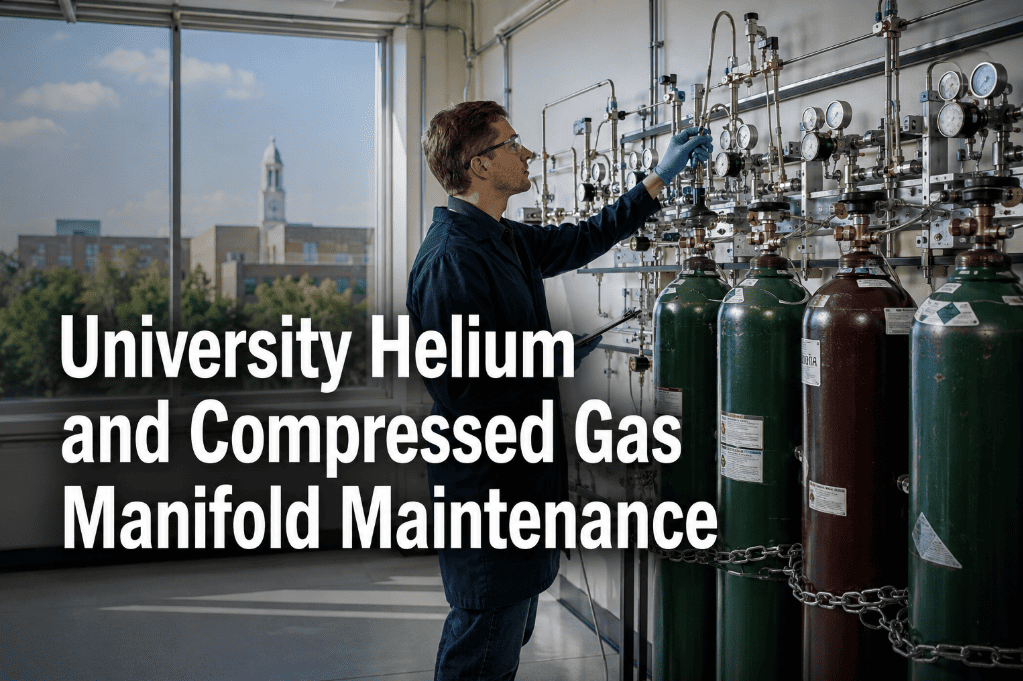
University Helium and Compressed Gas Manifold Maintenance
Universities consume 78% of U.S. liquid helium. One undetected manifold leak wastes $45K/year. CMMS-tracked gas system PM protects research continuity and personnel safety.
A Gas System Failure Does Not Send an Email First
When a pressure regulator fails on a nitrogen manifold serving a chemistry lab at 11 PM, there is no advance warning — there is a high-pressure gas release in an occupied building. When a helium recovery compressor goes down during an NMR experiment, the magnet quenches and $200K in cryogenic helium boils off in hours. Every gas system failure is a PM failure that was preventable with scheduled regulator testing, leak detection, and compressor service. Oxmaint tracks every manifold component with the same rigor it applies to HVAC and electrical systems. See the gas system PM workflow — start a free trial or book a demo.
Six University Gas Systems Requiring Separate CMMS PM Schedules
Closed-loop helium recovery for NMR, MRI, and cryogenic research. Components: recovery bags, compressors, purifiers, liquefiers, storage dewars, and transfer lines. A recovery system failure causes magnet quench — $150K–$300K in helium loss plus instrument downtime.
Bulk liquid nitrogen supply with vaporizers feeding manifold distribution to labs. Used for cryopreservation, glove boxes, and inerting. Manifold regulators, relief valves, and vaporizer coils require scheduled inspection. Regulator creep causes over-pressurization of downstream lab piping.
High-purity hydrogen for analytical instruments (GC, fuel cells) and chemistry research. Hydrogen is flammable at 4–75% concentration in air — the widest flammable range of any common gas. Leak detection, flow monitoring, and ventilation verification are safety-critical PM items.
Ultra-high-purity argon, carbon dioxide, and specialty gas blends for welding labs, spectrometry, and materials science. Manifold crossover contamination from faulty check valves degrades gas purity and ruins experiments. Purity verification and check valve testing are PM requirements.
Campus health centers and veterinary hospitals with piped medical oxygen. Regulated under NFPA 99 Health Care Facilities Code. Zone valve testing, alarm verification, and source equipment PM are compliance-mandatory with documentation requirements.
Oil-free compressed air for dental schools, clean rooms, and instrument air. Compressor PM, dryer service, filter replacement, and downstream particulate testing. Contaminated instrument air causes analytical instrument calibration failures and clean room classification breaches.
Gas System PM Intervals for University Research Facilities
| System Component | Service Action | Interval | Standard |
|---|---|---|---|
| Helium recovery compressor | Oil analysis, valve inspection, vibration check | 4,000–6,000 hrs | OEM spec |
| Manifold pressure regulators | Output pressure accuracy, creep test, diaphragm check | Semi-annually | CGA E-4 |
| Relief valves | Pop test and reseat verification | Annually | ASME / CGA |
| Gas leak detection | Electronic sniffer survey of all joints and fittings | Quarterly | OSHA / EHS |
| Cylinder restraints and storage | Chain/bracket integrity, signage, segregation compliance | Monthly | OSHA 1910.253 |
| Gas detection alarms | Calibration and sensor replacement | Semi-annually | Manufacturer |
| Piping integrity | Visual inspection, pressure decay test | Annually | ASME B31.3 |
| Vaporizer coils | Heat exchanger efficiency, frost pattern, relief valve | Semi-annually | OEM spec |
How Oxmaint Manages University Gas System Maintenance
Oxmaint registers every gas manifold component — regulators, relief valves, compressors, detectors, piping zones — as individually scheduled CMMS assets with compliance-linked PM intervals. Campus EHS and facilities teams ready to bring gas systems under structured maintenance can start a free trial or book a demo.
Each gas system component registered with gas type, pressure rating, location, manufacturer, and linked PM schedule — enabling component-level service history and replacement forecasting.
PM schedules aligned to applicable codes and standards with auto-generated work orders at required intervals — ensuring no regulator test, relief valve pop test, or detector calibration is missed.
Leak detection results recorded by manifold zone with repair verification tracking. Trend analysis identifies chronic leak locations that indicate piping degradation or fitting failures requiring system-level remediation.
Track helium consumption, recovery rates, and loss events per instrument. Correlate recovery system PM compliance with helium cost — demonstrating the direct ROI of compressor and purifier maintenance.
Track cylinder location, gas type, pressure, restraint compliance, and hydrostatic test dates. Monthly inspection checklists verify proper storage, segregation, and labeling per OSHA 1910.253.
All gas system PM records, leak detection results, and detector calibration certificates accessible to EHS for regulatory audits — eliminating the "where are the gas system records?" scramble during OSHA inspections.
Reactive Gas System Management vs. CMMS-Tracked PM
Outcomes from Structured Gas System Maintenance
Scheduled leak detection and recovery system PM prevent the chronic losses that cost $45K+ annually per manifold system
Documented PM records for regulators, relief valves, detectors, and cylinder storage satisfy OSHA inspection requirements
Scheduled compressor and purifier maintenance prevents the unplanned failures that cause magnet quench events
Each prevented NMR magnet quench saves $150K–$300K in helium replacement and instrument downtime costs
Frequently Asked Questions
How often should helium recovery compressors be serviced?+
What is the ROI of quarterly gas leak detection surveys?+
Can Oxmaint track gas detector calibration certificates?+
How does Oxmaint handle multi-gas manifold systems with different PM intervals?+
Your Research Depends on Gas Systems That Never Fail Unannounced
Component-level gas system PM prevents the $45K helium leaks, the $200K magnet quenches, and the OSHA citations that reactive management guarantees. First gas system PMs scheduled in the first week.