K-12 facility directors are managing more compliance obligations than ever — and the most dangerous ones are not the obvious violations that show up on inspection checklists. They are the slow-moving gaps that accumulate silently between annual audits, invisible until a regulator, a parent, or a personal injury attorney makes them very visible. Across school districts in the US, Canada, UK, and Australia, the pattern repeats: facilities teams are stretched thin, deferred work grows, and documentation trails go cold. The result is not just regulatory exposure — it is real risk to student and staff safety. Districts that have moved to a structured CMMS approach report 40% fewer compliance findings and eliminate the audit scramble entirely. If your district is still running on spreadsheets and paper logbooks, start a free trial and see what structured compliance tracking looks like in practice, or book a demo with our education facilities team.
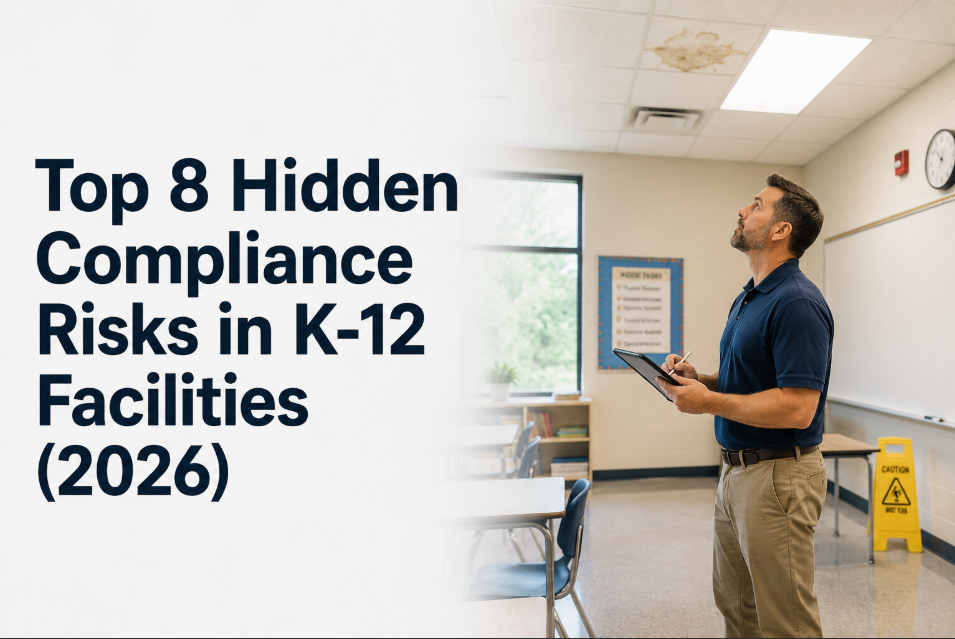
Top 8 Hidden Compliance Risks in K-12 Facilities (2026)
The compliance gaps that inspection checklists miss — and how district facility teams are closing them before they become violations, injuries, or headlines.
Why K-12 Compliance Is a Different Problem
University facilities get capital planning cycles and dedicated compliance officers. K-12 districts get deferred maintenance backlogs, aging buildings, and one facilities director covering twenty schools. The regulatory burden is identical — AHERA, NFPA, OSHA, EPA, ADA, local fire codes — but the resource gap is severe. That asymmetry is precisely where hidden risks accumulate. The eight risks below are not hypothetical. They appear repeatedly in state audit findings, EPA enforcement actions, and personal injury litigation records across North America and the UK. Each one is preventable with the right documentation system.
The 8 Hidden Compliance Risks — Ranked by Exposure Severity
These risks are ordered by the combination of likelihood and consequence. A risk that is common and carries legal liability ranks higher than one that is severe but rare in K-12 settings.
AHERA requires every K-12 school to maintain an Asbestos Management Plan, conduct 6-month periodic surveillance, and complete 3-year re-inspections by an accredited inspector. The hidden risk is not missing asbestos — it is missing documentation. Districts commonly have the inspections done but fail to maintain the written records in a retrievable, date-stamped format. EPA enforcement actions show civil penalties up to $37,500 per day per violation. Districts with buildings constructed before 1980 face the highest exposure.
EPA's IAQ Tools for Schools framework is voluntary nationally but mandatory in 14 states and growing. The hidden risk is HVAC filter change intervals that drift — PM schedules set in year one but never reviewed as building occupancy or usage patterns changed. CO2 levels above 1,100 ppm reduce student cognitive performance by 15%, and HVAC systems running on deferred filter schedules are the primary driver. When a parent files an IAQ complaint, the district's first question from legal counsel is: "Show me the filter change logs for the past 36 months."
NFPA 80 requires annual fire door inspections. In K-12 settings, fire doors are frequently propped open, damaged by students, or have hardware replaced without documentation. The hidden risk is that 68% of fire door deficiencies found during insurance and fire marshal audits were not on any previous inspection record — meaning facilities teams thought they were compliant when they were not. A single non-compliant fire door in a corridor can void building fire rating certifications for the entire wing.
CPSC and ASTM F1487 standards require regular playground equipment inspections — routine (weekly), periodic (monthly), and annual. The hidden risk is that verbal or informal inspections generate no documentation, meaning districts cannot demonstrate due diligence when injury claims are filed. Playground injury litigation in school districts averages $185,000 per settled claim. Insurance carriers are increasingly requiring proof of documented inspection frequency as a condition of coverage renewal.
Following the Federal Lead Service Line Replacement and Notification Act and state-level mandates (California AB 746, New York law), K-12 districts must test drinking water outlets and document remediation when lead exceeds 5 ppb (the new EPA action level). The hidden risk is districts that completed initial testing but have no re-testing schedule in place — and fixture replacements that were never formally closed out in a compliance record. With over 400,000 school buildings in the US, regulators are actively prioritizing K-12 lead compliance enforcement in 2026.
NFPA 101 and local fire codes require monthly 30-second tests and annual 90-minute load tests on emergency lighting. In K-12 facilities, emergency light testing is one of the most commonly deferred PM tasks because it requires a technician to walk every corridor and classroom. Districts with 20+ buildings find the task administratively unmanageable without a scheduling system. Battery failures discovered only during a real emergency are the worst-case outcome — but failing an annual fire marshal inspection is the more common consequence, resulting in required remediation timelines and re-inspection fees.
ADA-required elevators and platform lifts in K-12 buildings carry state-mandated annual inspection certificates. The hidden risk is certificate expiry going unnoticed — particularly in districts where the facilities director manages 15+ schools and tracks inspection due dates manually in a spreadsheet. An elevator in service with an expired inspection certificate exposes the district to immediate shutdown orders, ADA compliance findings, and potential liability for any injury that occurs during the gap period. State elevator divisions have increased random school inspections by 22% since 2023.
Annual backflow preventer testing is required by most municipal water authorities as a condition of water service. In K-12 settings, backflow preventers protect potable water systems from contamination by irrigation lines, chemical dispensers, and science lab plumbing. The hidden risk is that these tests are often outsourced to a plumbing contractor with no systematic tracking — invoices are filed, but due dates for next year are not scheduled. Districts that fail municipal testing requirements can face water service interruptions. With summer construction and landscape irrigation increases in 2026, backflow failures are trending upward.
Risk Severity at a Glance
| Compliance Risk | Regulation | Inspection Frequency | Max Penalty / Consequence | CMMS Prevention |
|---|---|---|---|---|
| AHERA Asbestos Plan Gap | EPA AHERA | 6-month + 3-year | $37,500/day/violation | Auto-scheduled, doc attached |
| IAQ / HVAC Filter Slip | EPA IAQ + State | Per PM schedule | Litigation avg $2.3M | PM auto-escalation |
| Fire Door Maintenance | NFPA 80 | Annual | Rating void + insurance | Digital inspection + photo |
| Playground Inspection | CPSC / ASTM F1487 | Weekly / Monthly / Annual | Avg $185K per claim | Tiered schedule per asset |
| Lead in Water Testing | EPA / State mandate | Initial + re-test cycle | Enforcement + shutdown | Outlet-level asset tracking |
| Emergency Lighting Test | NFPA 101 | Monthly + Annual | Fire marshal re-inspection | Scheduled mobile checklist |
| Elevator Certificate Expiry | State elevator code | Annual | Shutdown + ADA finding | Expiry alert + doc linked |
| Backflow Preventer Testing | Municipal water code | Annual | Water service interruption | Contractor-linked work order |
Before CMMS vs. After CMMS: Compliance Operations
How Oxmaint Is Built for K-12 Compliance
Oxmaint is not a generic CMMS adapted for schools. The platform is structured around the operational realities of multi-site K-12 districts — limited staff, high asset counts, and compliance documentation that must survive personnel turnover.
Frequently Asked Questions
Does our district need a dedicated compliance officer to use Oxmaint effectively?
How does Oxmaint handle compliance requirements that differ between states?
Can Oxmaint track both in-house technician work and third-party contractor inspections?
What happens to our compliance history when a facilities director leaves the district?
Stop Managing Compliance from Spreadsheets
Every one of the eight risks above is preventable. Oxmaint gives K-12 facilities directors a single platform to schedule, document, and report on every compliance obligation across every building in their district — without adding headcount. Most districts are generating audit-ready compliance records within their first week. See how it works for your specific district size and building profile.