University facilities teams manage compliance across dozens of regulatory frameworks — AHERA asbestos management, NFPA fire and life safety, EPA refrigerant tracking, ADA accessibility, and lab-specific requirements for fume hoods and biosafety cabinets. The obvious risks get attention. It is the hidden ones — the slowly drifting fire door closer that fails inspection, the fume hood face velocity that dropped below 100 fpm six months ago, the biosafety cabinet certification that expired without anyone noticing — that create the largest compliance exposure. In 2026, university facilities are facing stricter enforcement, higher liability, and increased public scrutiny. This page identifies the 7 compliance risks that university facilities teams most commonly miss — and how a CMMS platform like OxMaint prevents each one through automated scheduling, condition tracking, and audit-ready documentation. If any of these risks sound familiar, it may be time to start a free trial and book a demo to see how these gaps get closed.
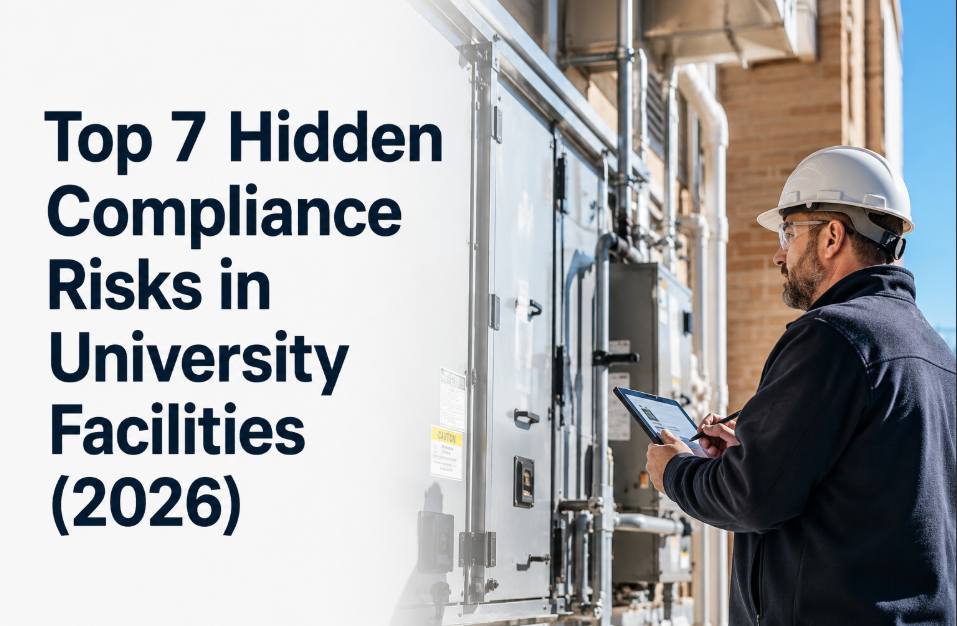
Top 7 Hidden Compliance Risks in University Facilities
The compliance gaps that pass unnoticed until audit day — AHERA drift, NFPA 80 fire door creep, fume hood velocity drops, BSC expiry, and more — with CMMS prevention strategies for each.
Why "Hidden" Compliance Risks Are the Most Dangerous
The compliance items that cause the most damage are rarely the ones on the front page of the facilities checklist. They are the slow-drift items — systems and components that degrade incrementally below compliance thresholds over months without triggering an obvious alarm. Fire door closers that lose tension. Fume hood face velocities that drift from 110 fpm to 85 fpm. Asbestos management plans that have not been reviewed since the last personnel change. These risks compound silently until an audit, an incident, or an insurance review exposes them all at once. The cost of discovery at that point is 5-10x the cost of prevention.
The 7 Hidden Compliance Risks
Each risk below includes the regulatory standard, why it gets missed, the exposure it creates, and how CMMS prevents it. These are not theoretical — they are drawn from real university audit findings in 2025-2026.
AHERA requires triennial re-inspections and semi-annual surveillance of asbestos-containing materials in all education buildings. 43% of universities have at least one building with an overdue re-inspection. The plan exists in a binder — but the surveillance schedule is not tracked systematically, and new construction or renovation projects disturb materials without proper notification.
NFPA 80 requires annual inspection and functional testing of every fire door assembly. On a campus with 500+ fire doors, tracking each inspection on paper is virtually impossible. The most common failure mode is not the door itself — it is the closer. Closers lose tension over 18-24 months, causing doors to not latch. 31% of university fire doors fail latching tests during surprise audits.
ANSI/AIHA Z9.5 recommends a minimum face velocity of 80-100 fpm for chemical fume hoods. Velocities drift downward as filters clog, motors age, and ductwork deteriorates. Annual certification catches this — but mid-year drift exposes lab workers to chemical vapors for months before the next test. 27% of university fume hoods tested mid-cycle show velocity below the safe threshold.
NSF/ANSI 49 requires annual certification of Class II biosafety cabinets. Expired certifications mean labs are operating BSCs that may not contain aerosols properly — a direct biohazard risk. On campuses with 100+ BSCs across multiple buildings and departments, tracking expiry dates through spreadsheets leads to 15-20% of cabinets operating past certification on any given month.
ANSI Z358.1 requires weekly activation testing of emergency eyewash stations and showers. With hundreds of stations across labs, workshops, and custodial areas, weekly testing often gets missed during busy academic weeks. Stagnant water in untested units creates Legionella risk. 38% of universities report inconsistent testing schedules.
ASME A17.1 and state codes require annual elevator inspections with documented records. Universities with 30-60 elevators across campus often have inspection records scattered across vendor files, state databases, and facilities filing cabinets. During ADA compliance reviews, missing or incomplete elevator records create immediate exposure — especially for passenger lifts in residence halls.
EPA Section 608 requires tracking of refrigerant usage for all equipment containing 50+ pounds of refrigerant. Universities with large chiller plants and distributed HVAC systems often have 20-40 units subject to this rule. Manual refrigerant logs are inconsistent — 25% of universities cannot produce complete refrigerant tracking records for all qualifying units during EPA review.
Compliance Risk Exposure: Manual Tracking vs. CMMS
Cost of Compliance Failure vs. Cost of Prevention
How OxMaint Prevents Each Hidden Risk
OxMaint is built for facilities teams that need compliance without complexity. Every compliance item becomes a scheduled, tracked, and documented event — not a hope. The platform handles the scheduling, reminders, escalations, and documentation so your team handles the actual work. Want to see how it applies to your campus? Start a free trial and book a demo with the compliance team.
Frequently Asked Questions
Can CMMS track compliance for lab-specific equipment like fume hoods and BSCs?
How does CMMS handle AHERA compliance across multiple buildings?
What if our compliance records are currently scattered across vendors and binders?
Does OxMaint handle EPA refrigerant tracking?
Close These Gaps Before the Next Audit
Hidden compliance risks do not announce themselves — they accumulate until the cost of discovery becomes catastrophic. OxMaint turns every compliance item into a scheduled, tracked, and documented event. Most campuses are generating compliance work orders within their first week. See how it works for your university in a 30-minute walkthrough.