The call comes at 4:47 PM on a Tuesday in October — campus police radio dispatch to facilities: "We've got 8 inches of standing water across the east quad. It's flowing into the ground-floor corridor of the humanities building through three doorways. Students are wading through it to get to their cars." Your crew arrives to find the 36-inch trunk line catch basin at the quad's low point completely blocked — a season's worth of leaves, sediment, and construction debris from the summer renovation project have reduced flow capacity to near zero. The storm is a 2-year recurrence event, nothing extraordinary — 1.8 inches in 90 minutes — but with the primary drain at 5% capacity, the quad has become a retention pond. Water is 4 inches deep inside the humanities building. The carpet, drywall, electrical outlets, and faculty offices on the ground floor are saturated. Three classrooms will be offline for the rest of the semester. The basement archive room with 40 years of departmental records is taking water through the floor drain backflow. Total damage: $340,000 in building restoration, $85,000 in lost equipment and materials, and a construction debris lawsuit with the renovation contractor. The catch basin cleanout that would have prevented all of it takes one crew member 45 minutes and costs $0.
Campus stormwater infrastructure is invisible until it fails — and when it fails, water goes everywhere gravity takes it: into buildings, across walkways, through parking structures, and into environmentally sensitive areas that trigger Clean Water Act violations. A mid-size university campus has 200–500 catch basins, 5–15 miles of underground storm pipe, dozens of outfall structures, and retention/detention facilities that collectively manage millions of gallons of runoff per storm event. Every one of these components accumulates sediment, debris, and biological growth that progressively reduces capacity — silently, predictably, and preventably. This checklist provides the systematic inspection protocols that keep campus stormwater infrastructure functioning at design capacity through every storm season. Sign Up — digitize your stormwater inspections and eliminate paper forms.
A 45-minute catch basin cleanout or a $425,000 flood damage restoration — your stormwater system is deciding right now.
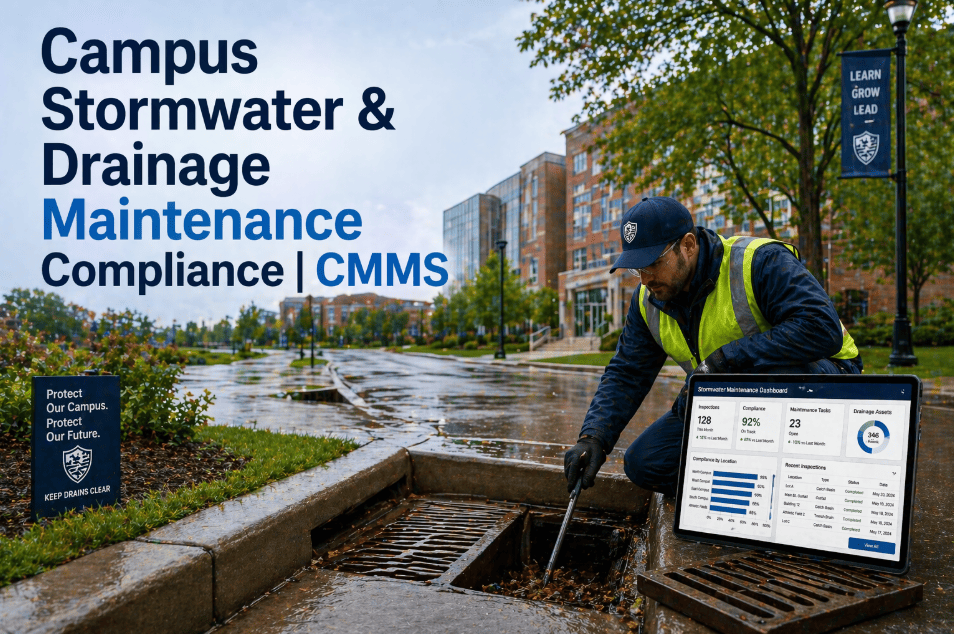
Oxmaint replaces clipboard-based drain inspections with mobile-first checklists your crews complete at every catch basin — GPS-tagged, photo-documented, with defects generating work orders before the next storm arrives. Campuses using scheduled stormwater PM reduce flood-related building damage by 85% and maintain MS4 permit compliance with audit-ready digital records.
average building damage from a single campus flooding event caused by blocked drainage
200-500
catch basins on a typical mid-size university campus requiring seasonal inspection
85%
of campus flooding events are preventable through routine drain maintenance
MS4
Municipal Separate Storm Sewer System permit — federal compliance requirement
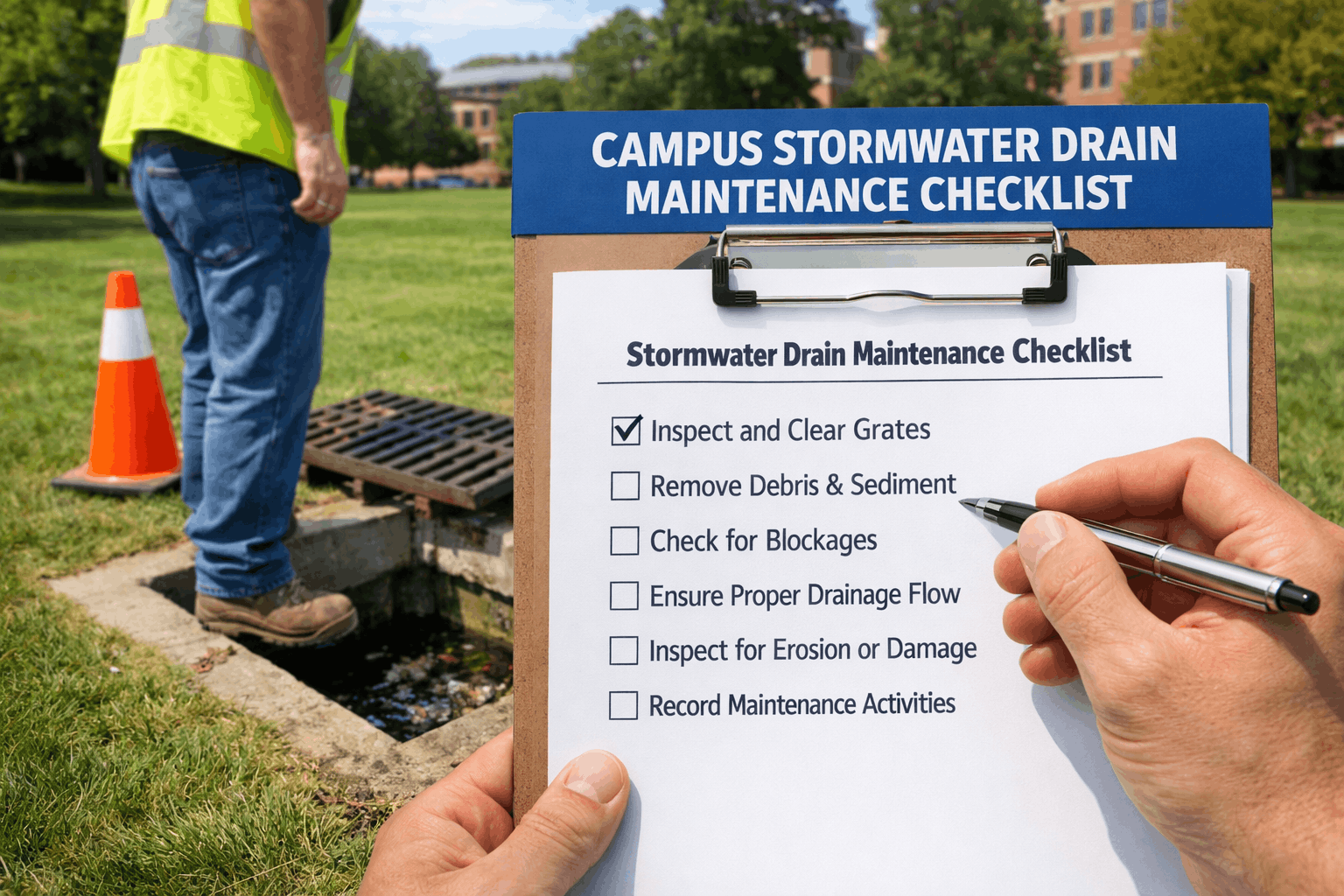
How to Use This Checklist: Complete each section during scheduled stormwater inspections. Work systematically from surface infrastructure (catch basins, grates) through conveyance (pipes, channels) to outfall and retention structures. Photo-document all defects and sediment levels. Inspections take 15–25 minutes per drainage zone depending on component density.
Section 1: Catch Basin & Inlet Inspection
Catch basins are the entry points of your stormwater system — and the components most likely to fail from debris accumulation. A single blocked catch basin can flood an entire building quad. Inspect every catch basin in the drainage zone systematically, starting at the highest elevation and working downhill. Allow 2–3 minutes per basin.
Surface drainage directs stormwater toward collection points. When grading is compromised by settlement, erosion, or construction activity, water pools in unintended locations — against building foundations, across walkways, and in areas where it causes structural and safety damage. Walk the drainage zone observing flow paths during or immediately after rainfall for best assessment.
Surface drainage problems cause 60% of campus building water intrusion. Digital inspections with GPS-tagged defect locations create the maintenance map your crew needs to prioritize grading corrections before the next storm.
The underground pipe network carries stormwater from catch basins to outfalls. Blockages, collapses, and capacity restrictions in the conveyance system cause surcharging that floods the surface at locations far from the actual problem — making root cause identification impossible without systematic inspection. Focus on manholes, pipe junctions, and known problem areas.
Outfalls are where campus stormwater enters receiving waters — streams, rivers, wetlands, or municipal systems. These are the most heavily regulated inspection points under your MS4 permit and the locations where EPA or state inspectors focus their compliance reviews. Inspect every outfall at least quarterly and after significant storm events. Allow 10–15 minutes per outfall.
Outfall inspections are the #1 audit point for MS4 permit compliance. Digital inspection records with timestamped photos and GPS coordinates satisfy every element regulators require — and they're available in seconds, not file cabinets.
Section 5: Retention/Detention & Green Infrastructure
Retention ponds, detention basins, bioswales, rain gardens, and permeable pavement systems are engineered stormwater controls that require specific maintenance to function. Neglected green infrastructure loses treatment capacity within 2–3 years, converting from a compliance asset into a liability. Inspect these facilities seasonally and after major storm events.
After any significant storm event (≥1 inch in 24 hours, or any event that produces visible surface flooding), conduct a rapid assessment of all stormwater infrastructure. Post-storm inspections identify new damage, verify system performance, and create the documentation required by most MS4 permits. Complete within 48 hours of storm cessation.
By completing this checklist, you have verified the condition of all stormwater infrastructure in this drainage zone. Generate work orders for all defects identified, prioritizing items that affect building protection and regulatory compliance. Schedule cleaning for all catch basins with sediment exceeding 50% sump depth.
Digitize Your Stormwater Inspections
Paper inspection forms get wet, lost, and filed without action. Digital stormwater inspections give your crew GPS-tagged checklists at every catch basin, photo-verified sediment measurements, instant defect routing to work orders, and the audit-ready MS4 compliance records your environmental officer needs. Oxmaint's preventive maintenance scheduling auto-triggers seasonal inspections, post-storm assessments, and cleaning work orders based on actual sediment data — so your stormwater system is always ready for the next storm, not recovering from the last one.
Paper stormwater inspection forms have been the standard for decades — but they create critical gaps in both operational effectiveness and regulatory compliance. Understanding these failures explains why campuses managing MS4 permits are transitioning to digital inspection platforms.
1
No Location Verification
Problem: Paper forms can't prove which catch basin was actually inspected. Inspectors may check "inspected" for basins they drove past without stopping.
Real Example: Auditor asks for proof that Outfall #7 was inspected on March 15. Paper form says "inspected" but there's no GPS data, no photo, and no way to verify the inspector was actually at that outfall. Permit deficiency issued.
Digital Solution: GPS-verified inspection location, timestamped photo documentation, and asset-linked checklists prove exactly which structure was inspected, when, and by whom.
2
Sediment Data Never Gets Analyzed
Problem: Sediment depth measurements written on paper are filed and never aggregated. No one tracks which basins fill fastest or predicts when cleaning is needed.
Real Example: Catch basin CB-47 has been measured at 60%, 70%, and 85% full over three inspections. Nobody notices the trend because the three forms are in three different folders. The basin overflows during the next storm and floods the adjacent building.
Digital Solution: Automatic sediment trending by basin. System alerts when sediment depth crosses cleaning threshold and auto-generates a vac-truck work order.
3
MS4 Annual Reporting Nightmare
Problem: MS4 permits require annual reporting of inspection counts, maintenance activities, and pollutant quantities removed. Compiling this from paper records takes weeks of manual data entry.
Real Example: Environmental compliance officer spends 3 weeks assembling annual MS4 report from paper inspection forms, hauler receipts, and maintenance logs. Numbers don't reconcile. Report is submitted late. State issues warning letter.
Digital Solution: Dashboard generates MS4 annual report data in minutes — inspection counts, sediment removed (tons), outfall screening results, and maintenance completion rates all tracked automatically.
4
Defects Die on Paper
Problem: An inspector notes "erosion at Outfall #12" on a paper form. The form goes in a folder. The erosion progresses through two more storm seasons until the outfall structure is undermined.
Real Example: Outfall headwall noted as "cracking" on 4 consecutive quarterly inspections. No work order ever generated. Headwall collapses during spring storm. Repair cost: $38,000. The 4 inspection forms documenting the progressive failure actually increase the institution's negligence liability.
Digital Solution: Every defect auto-generates a prioritized work order. Unresolved defects escalate automatically. Management dashboard shows open defects by age and severity — nothing gets filed and forgotten.
5
Seasonal Inspections Get Missed
Problem: Fall leaf season demands more frequent catch basin inspections, but without automated scheduling, the increased frequency is forgotten until overflow complaints start.
Real Example: Campus maintenance plan calls for monthly catch basin inspections October through December. October inspection is done. November is skipped because of a staffing shortage. December is skipped because "we'll catch up in January." By January, 40% of catch basins are more than half full of leaf debris — and the spring thaw floods three buildings.
Digital Solution: Automated PM scheduling triggers seasonal inspection work orders on configured intervals. Missed inspections generate escalation alerts. Completion rates are tracked on the management dashboard.
How often should campus catch basins be inspected?
At minimum, inspect all catch basins twice per year — spring (after snowmelt/thaw) and fall (before leaf season). High-priority basins protecting building perimeters or in high-sediment areas should be inspected quarterly. During fall leaf season (October–December), increase frequency to monthly for basins under tree canopy. Post-storm inspections should cover all basins in flood-affected areas within 48 hours. Most MS4 permits require at least annual inspection of all stormwater structures with documentation. Sign Up free to auto-schedule seasonal catch basin inspections campus-wide.
What does our MS4 permit require for stormwater inspections?
MS4 (Municipal Separate Storm Sewer System) permits under the Clean Water Act require six minimum control measures, several of which directly involve inspection and maintenance: illicit discharge detection and elimination (IDDE) requires dry weather outfall screening; post-construction stormwater management requires maintenance of green infrastructure; and pollution prevention/good housekeeping requires inspection and maintenance of the storm sewer system. Specific frequencies vary by permit, but annual inspections of all structures and outfalls, plus post-storm inspections, are standard requirements. Documentation must include inspection date, inspector, structure ID, conditions found, and corrective actions. Book a Demo to see MS4-compliant inspection documentation.
When should catch basins be cleaned versus just inspected?
Clean catch basins when sediment depth exceeds 50% of the sump depth — at this point the basin can no longer effectively trap sediment and pollutants pass through to the conveyance system. Basins near construction zones, unpaved areas, or heavy tree canopy may reach this threshold within one season. Basins in paved areas with minimal landscaping may go 2–3 years between cleanings. Digital inspection records tracking sediment depth over time let you predict cleaning needs by basin rather than cleaning all basins on the same schedule — saving 30–40% in vac-truck costs by targeting only the basins that actually need it.
How do we handle stormwater inspections during construction projects?
Construction projects dramatically increase sediment loading on downstream stormwater infrastructure. During active construction, increase catch basin inspection frequency to weekly for all basins within 200 feet of the construction disturbance area. Verify contractor-installed inlet protection (filter fabric, inlet inserts, gravel bags) at every inspection. Document deficiencies and report to the project manager immediately — the construction SWPPP (Stormwater Pollution Prevention Plan) makes the contractor responsible for erosion controls, but the campus MS4 permittee is ultimately liable for discharges from the campus system. Sign Up — track construction-related stormwater inspections separately from routine PM.
What is the most commonly missed stormwater maintenance item?
The most frequently neglected items are: (1) cleaning catch basins BEFORE fall leaf season rather than after the damage is done, (2) inspecting outfall structures for dry weather flow (IDDE screening — the #1 MS4 audit finding), (3) maintaining green infrastructure like bioswales and rain gardens that require different maintenance than conventional drainage, (4) post-storm inspections within the 48-hour window required by most permits, and (5) tracking sediment removal quantities for annual reporting. Each of these items has direct regulatory consequences when missed. Book a Demo — we'll show you which inspection items get skipped most often in your system.
Protect Your Campus. Protect Your Compliance. Protect Your Budget.
Every catch basin, outfall, and retention facility on your campus is either being maintained to standard or silently losing capacity. Oxmaint's preventive maintenance scheduling puts every stormwater asset on an automated inspection cycle — seasonal, post-storm, and construction-triggered — with GPS-verified checklists, photo documentation, and instant defect work orders. When the MS4 auditor arrives or the next major storm hits, your campus has either a filing cabinet full of paper or an audit-ready digital record for every structure in the system. One of these protects your institution. The other doesn't.