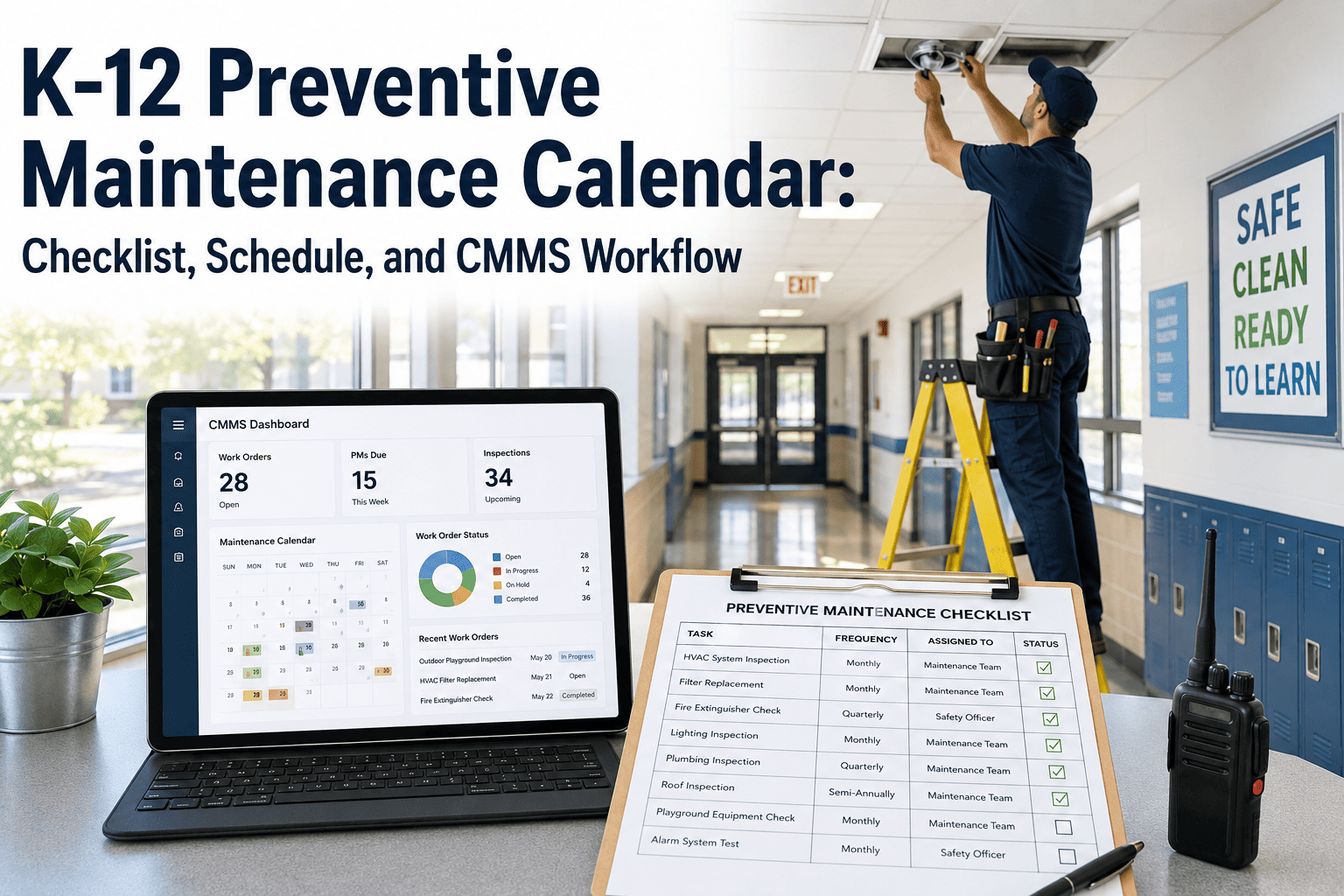
K-12 district facility directors juggle 15 to 120 school buildings, a workforce shortage that leaves 43% of maintenance positions unfilled, a deferred maintenance backlog averaging $4,900 per student, and compliance requirements that multiply every year — from playground safety inspections to IAQ monitoring mandates. Despite this complexity, 61% of school districts in 2025 were still managing maintenance with spreadsheets, email chains, or first-generation CMMS platforms designed for single-building commercial properties. The cost of this mismatch is measurable: districts on generic platforms complete only 48% of scheduled PMs, spend 4.2x more on emergency repairs than planned maintenance, and cannot produce compliance documentation without weeks of manual assembly. The CMMS features in this guide represent the specific capabilities K-12 districts need in 2026 — not what software vendors want to sell you, but what operational reality demands. Districts using platforms built for multi-site education — like Oxmaint — report 37% higher PM completion, 52% fewer emergency work orders, and ESSER compliance documentation produced in minutes instead of weeks. Use this as your RFP scoring matrix. Want to test these features on your buildings? Book a demo or start a free trial.
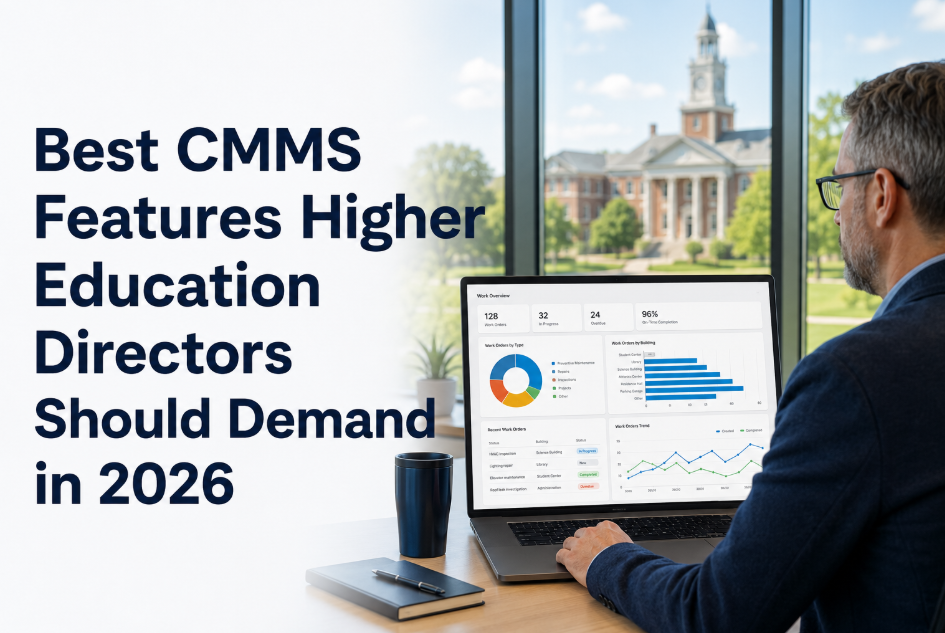
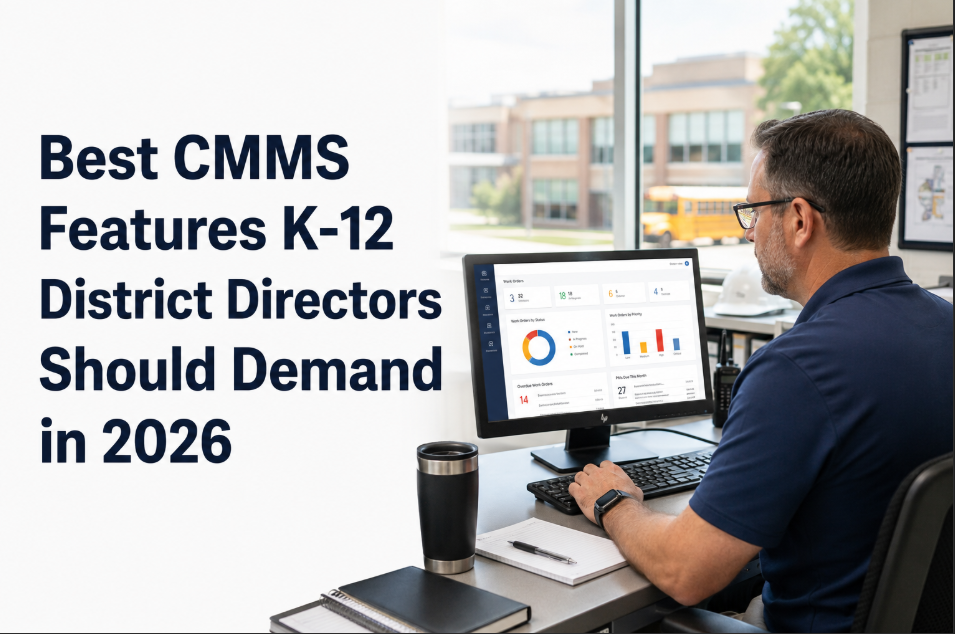
Best CMMS Features K-12 District Directors Should Demand in 2026
Mobile offline, IAQ integration, ESSER reporting, playground inspection logic, free-tier requestor licenses, and 10 more features — your complete K-12 CMMS evaluation checklist.
Test These Features on Your Actual Schools
Start a free pilot on 2–3 buildings. See mobile work orders, PM scheduling, playground inspections, and compliance dashboards running on your real data — before any commitment.
The Must-Have Features for K-12 CMMS in 2026
K-12 maintenance teams work in boiler rooms, portables, and underground utility tunnels where cellular and Wi-Fi signals don't exist. The mobile app must operate fully offline — work order completion, photo documentation, inspection checklists, and parts requests — with automatic sync when connectivity returns. If it requires Wi-Fi, your team will use paper.
22 states now have enforceable indoor air quality mandates for schools. The CMMS must accept CO2, temperature, humidity, and particulate data from IAQ sensors and trigger corrective work orders when readings exceed thresholds. Manual IAQ logging is already a compliance risk in states with documentation requirements.
$190 billion in ESSER funds must be fully documented by September 2026. The CMMS must tag work orders, parts purchases, and labor hours to ESSER funding codes — producing audit-ready reports that show allowable use, timelines, and total spend by category. Districts assembling ESSER compliance manually are at significant audit risk.
CPSC and ASTM F1487 require documented playground safety inspections at defined intervals. The CMMS must support playground-specific checklists (fall zone surfacing, hardware integrity, entrapment hazards), photo documentation, and automatic deficiency work order generation when inspections fail.
Teachers, principals, and office staff need to submit maintenance requests. If the CMMS charges per requestor, a 45-school district with 2,000 staff faces a licensing cost that makes the platform unaffordable. Demand unlimited free requestor accounts with a simple web-based portal — no app download, no training, no account creation.
The CMMS must understand school calendars — summer break, winter break, spring break, testing weeks, and event dates. PM tasks that require classroom access should auto-schedule during breaks. Tasks that generate noise should avoid testing weeks. Generic CMMS platforms schedule boiler maintenance during school hours because they don't know school is in session.
A district-grade CMMS must support District > School > Building > Floor > Room > System > Asset hierarchies across 15 to 120+ sites. Each school should operate independently while district leadership sees consolidated reporting. Zone-based technician assignment, cross-school work order routing, and per-school budget tracking are essential.
School boards approve capital budgets. They need visual, dollar-denominated evidence of the deferred maintenance backlog — by school, by system, by priority. The CMMS must produce FCI-based reports that a non-technical board member can understand in 60 seconds. If your director has to build PowerPoint slides manually, the CMMS isn't doing its job.
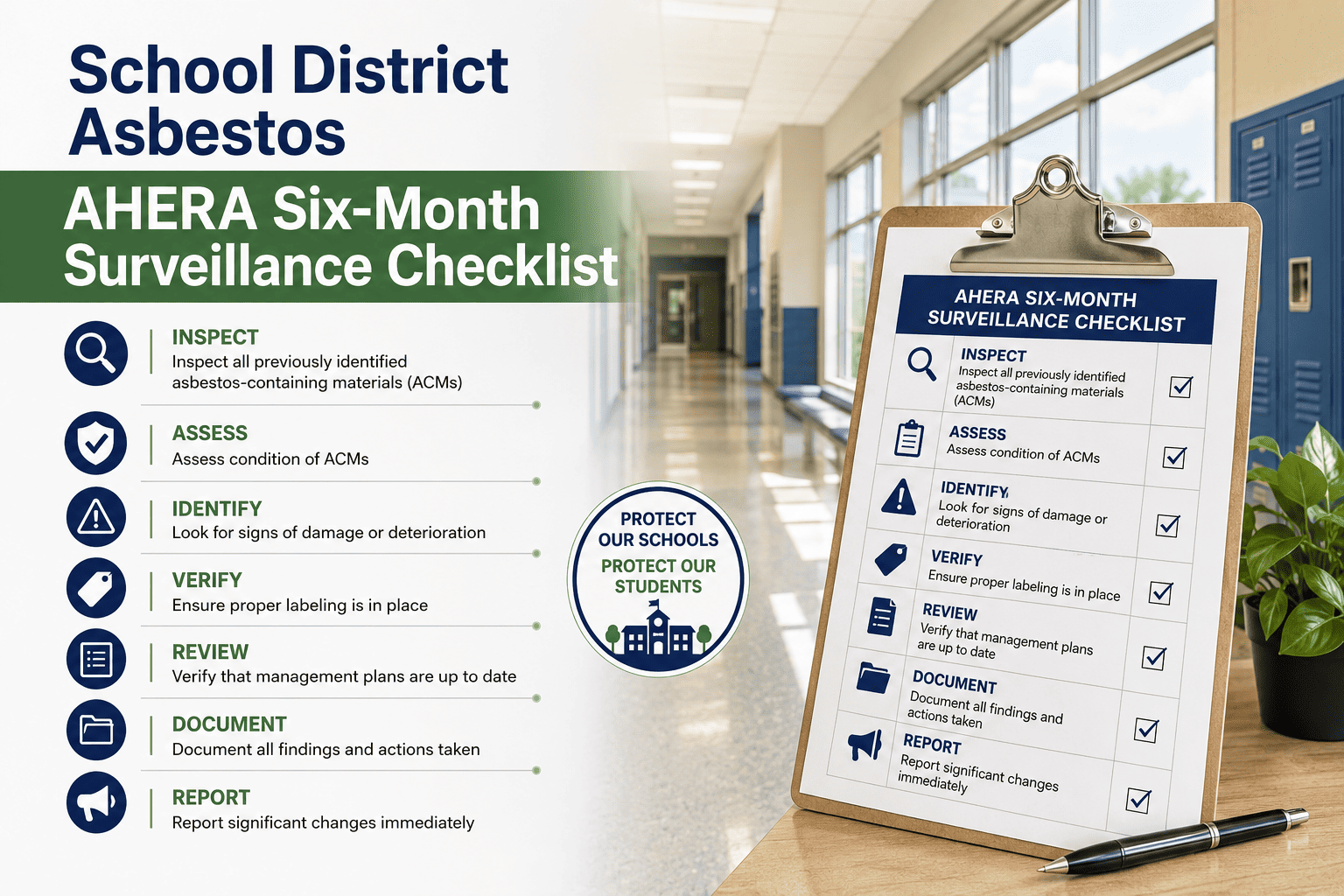
Fire extinguisher inspections, fire door checks, emergency lighting tests, and AED inspections all require documented proof at regular intervals. The CMMS must support configurable inspection checklists with pass/fail logic, photo capture, and automatic deficiency work order generation.
K-12 budgets are tight and scrutinized. The CMMS pricing must be predictable — no per-user escalation, no module unbundling, no surprise integration fees. Demand a written 36-month TCO that includes every school, every user, every feature, and every integration. If the vendor won't provide this, walk away.
Generic CMMS vs K-12-Ready CMMS
- No school calendar awareness
- Charges per requestor license
- No playground inspection templates
- ESSER tagging requires manual workarounds
- Single-site architecture stretched across district
- No IAQ sensor integration
- PMs auto-schedule around school calendar
- Unlimited free requestor accounts
- CPSC/ASTM playground checklists built-in
- ESSER funding code tagging on every work order
- True multi-site with per-school budget tracking
- IoT IAQ sensor integration with auto-alerts
Print this feature list and score every vendor you evaluate. Then bring it to an Oxmaint demo and watch us answer each item on live screens with your district's real buildings. Most districts are running digital work orders within the first week.
District-Level ROI Metrics
Frequently Asked Questions
How quickly can a 30-school district implement Oxmaint?
Can teachers submit work requests from their phone without downloading an app?
Does the CMMS handle school bus fleet maintenance too?
What about districts with very limited IT support?
Your District Deserves a CMMS Built for K-12
Stop forcing 45 schools into a platform designed for one commercial building. Oxmaint handles school calendars, playground inspections, ESSER documentation, IAQ compliance, and unlimited teacher requests — all in a platform your maintenance team can learn in one shift. See it on your schools in 30 minutes.