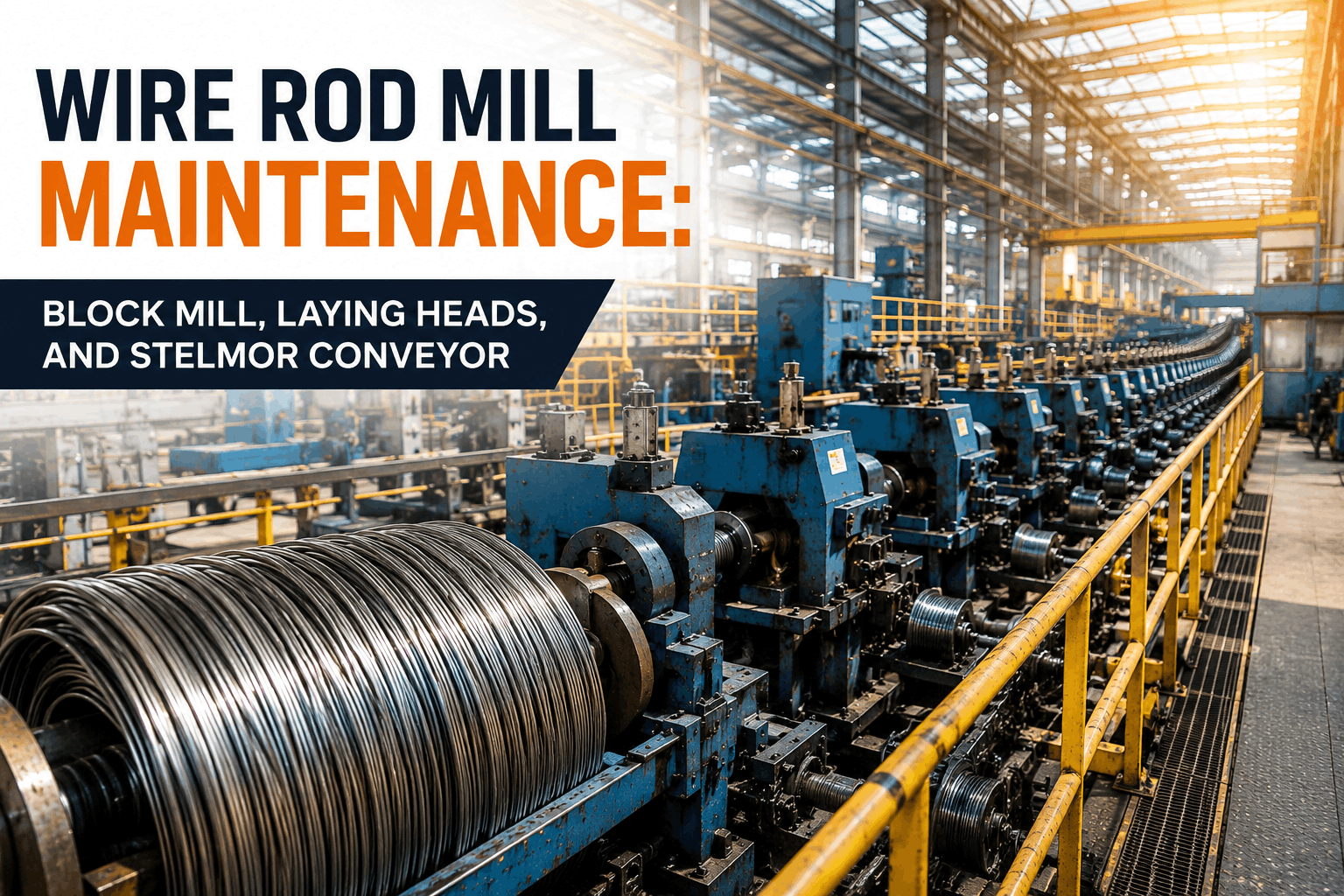
A U.S. wire rod mill operating at full capacity produces 500–800 tonnes per day of finished product — meaning a single unplanned breakdown on the block mill (the primary forming station) or the laying head assembly costs the operation $80,000–$120,000 in direct lost production within the first 24 hours. Wire rod is a continuous-flow, high-speed process where the block mill rotates at 500–1200 RPM, the laying heads cycle at 100–300 cycles per minute, and the Stelmor cooling conveyor must operate without interruption or the hot-rolled product jams and requires manual extraction. The maintenance program for a wire rod mill differs fundamentally from other long-product rolling mills because wire rod equipment experiences sustained high-frequency cyclic loading rather than the intermittent impacts of plate or bar mill stands — bearing failures accelerate from detection to catastrophic breakage in 2–4 weeks, roll wear rates are linear and predictable, and cooling system failures cascade instantly through the entire production line. This guide covers the essential maintenance lifecycle for wire rod block mills, laying head assemblies, and Stelmor conveyors with CMMS-tracked wear campaigns, predictive maintenance trigger points, and the scheduling precision required to prevent emergency shutdowns at a U.S. long-products facility.
Wire Rod Block Mill: Continuous High-Speed Rotating Load
The wire rod block mill is a four-high stand where work rolls continuously rotate at 500–1200 RPM under extreme radial loads — converting 2000°C hot ingot into rod diameter in a single stand. Unlike plate or bar mills where stands cycle intermittently and rest between passes, the wire rod block mill runs continuously during a heat sequence, generating sustained bearing wear, roll thermal cycling, and spindle stress. Rolling forces in the block mill approach 30,000–50,000 tonnes per rolling bite, concentrating these forces on work roll bearings (four point contacts) and backup roll bearings (two contacts). Bearing life at these speeds and loads is 8–15 months of continuous operation — making predictive bearing replacement scheduling the difference between planned maintenance during a scheduled mill stop and an emergency bearing seizure that forces immediate shutdown and 2–3 week extraction/replacement. Oil analysis iron content trending and vibration envelope analysis (BPFO/BPFI detection) are essential for wire rod mills because a bearing fault will progress 3–4× faster at 800 RPM continuous loading than at the intermittent cycling of bar mill drive motors.
Work roll and backup roll bearings wear linearly at wire rod speeds — a 12-month bearing life means approximately 1% wear loss per month. Oil analysis detects accelerated wear (2–3% per month) 6–8 months before seizure, allowing planned replacement before catastrophic failure. Bearing geometry tracking in Oxmaint (pitch diameter, contact angle, ball count) enables automatic BPFO/BPFI frequency calculation for every bearing, so vibration analysts arrive at the block mill equipped with the exact bearing fault frequencies to monitor.
Wire rod work rolls wear 2–4 mm per 100,000 tonnes of product rolled — a predictable linear relationship. Measuring roll neck diameter at each mill stop allows forecasting the exact tonnage remaining until rolls reach the 85% wear limit requiring replacement. Oxmaint's roll life tracking automatically calculates remaining wear life based on rolling rate and historical wear patterns, triggering procurement and crew scheduling 4–6 weeks before the replacement becomes due.
Weekly vibration routes on the block mill drive motor and spindle bearing housings capture BPFO/BPFI frequency envelopes — detecting outer race bearing defects 4–6 weeks before oil analysis iron levels spike. The combination of vibration envelope and oil ferrous particle analysis gives a 10–12 week advance warning window, transforming a potential emergency shutdown into a scheduled bearing replacement during the next planned mill stop.
Roll thermal cycling during wire rod rolling generates 40–60°C temperature swings per pass — excessive cooling rate causes roll stress and surface cracking. Temperature monitoring at the spindle and roll neck ensures cooling water flow remains optimal; high discharge temps signal developing cooling circuit blockage or pump degradation. Water chemistry (pH, hardness, inhibitor concentration) must be monitored monthly to prevent scale formation inside spindle cooling passages that reduces heat transfer and accelerates roll failure.
Oxmaint tracks each block mill component's wear life as a continuous campaign — bearing hours, roll tonnes, cooling cycle count — all in a single equipment record. When any campaign parameter reaches 90% of planned life, the CMMS auto-generates a maintenance work order with material procurement, crew scheduling, and estimated downtime pre-populated. This prevents the scenario where one component (e.g., bearing) is ready for replacement but crew assumes everything is fine and schedules the mill stop months away, resulting in a second component failure before the first planned maintenance.
Laying Head Assembly: Precision Mechanical Cycling at 100–300 CPM
The laying head assembly forms and deposits the continuous hot wire rod onto the Stelmor cooling conveyor in precise coils — cycling at 100–300 cycles per minute depending on rod diameter and mill speed. Each laying head cycle involves mechanical actuation (pneumatic or servo-driven), positional accuracy (±2 mm), and timing synchronization with the incoming rod stream. The laying head bears no direct rolling load but experiences sustained mechanical fatigue from rapid cyclic actuation, guide bearing wear from the precision positioning, and the thermal environment radiating from the 900–1000°C hot rod. Laying head bearing wear is invisible until catastrophic mechanical backlash develops — at which point coil deposit patterns become erratic, leading to misfeeds, jamming on the Stelmor conveyor, and cascading production delays.
Stelmor Cooling Conveyor: Inline Continuous Operation with Zero Interruption Tolerance
The Stelmor cooling conveyor is a continuous motorized serpentine track that accepts hot rod coils from the laying heads, cools them through air circulation and water spray, and ejects finished product to the coiling pit. The conveyor operates continuously during the entire block mill heating cycle — any jam or bearing seizure stops the entire production line. The Stelmor chain and rollers operate at 50–100 meters per minute under the weight of hot product and sustained thermal stress. Chain link wear (pitch elongation) and roller bearing wear are the primary failure modes — detectable through vibration analysis (BPFO for roller bearings) and visual chain pitch measurement. Oxmaint tracking of chain wear campaigns (measuring pitch at 10-link intervals monthly) provides early warning when pitch elongation reaches the 1% wear threshold triggering replacement before chain breakage forces emergency shutdown.
"At our Midwest wire rod facility, we were averaging 4–5 emergency bearing failures per year on the block mill — each one costing $100K+ in lost production. After implementing Oxmaint with oil analysis tracking and vibration monitoring, we haven't had a single emergency bearing failure in 18 months. Every bearing is replaced on schedule during planned mill stops. The predictive maintenance program paid for itself in the first prevented failure."
-programs.png)