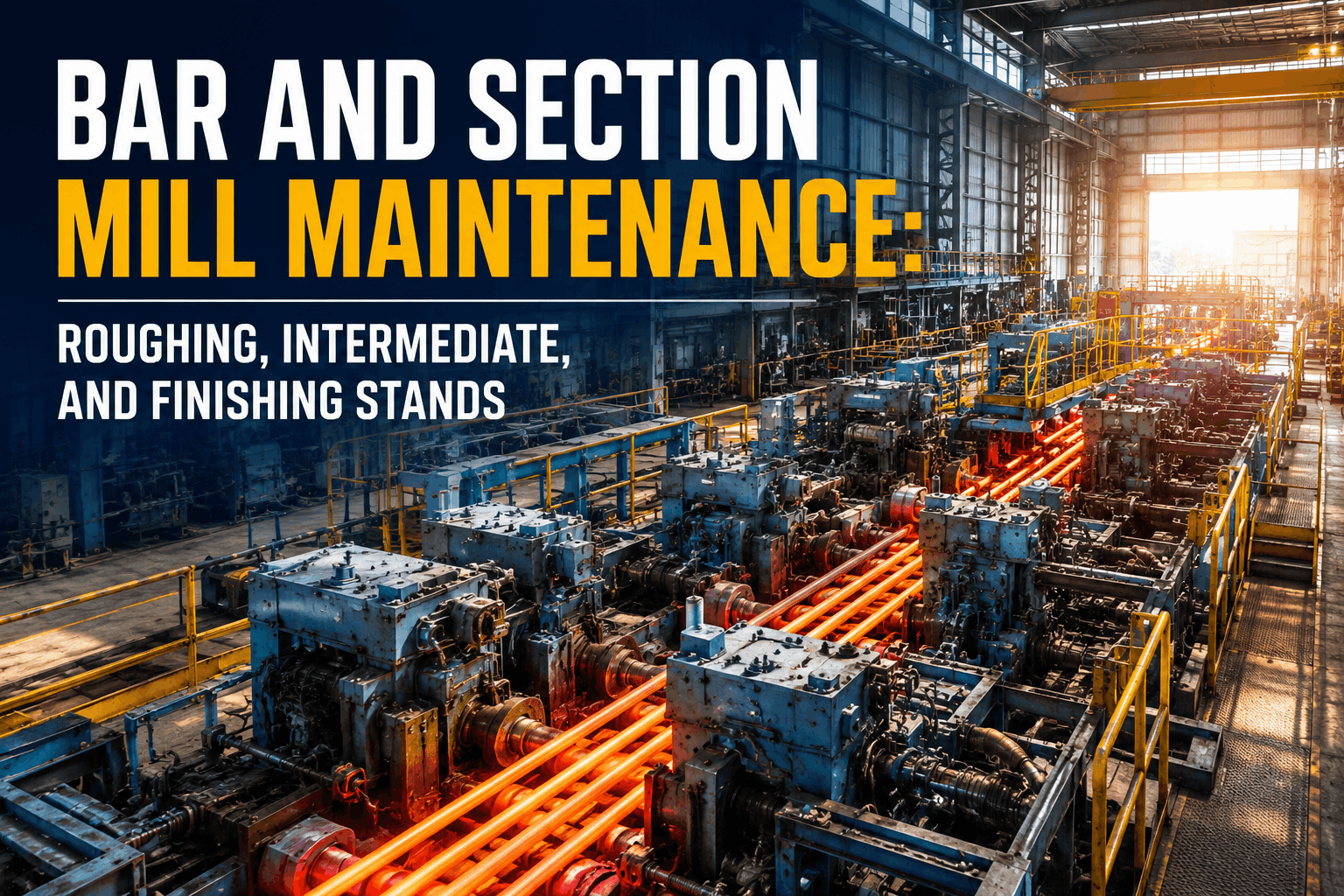
Bar and section mills represent critical revenue-generating assets for integrated steelmakers — processing 500–3,000 tons daily through integrated roughing, intermediate, and finishing stands converting reheated steel ingots into bars, rods, and structural shapes for automotive, construction, and industrial markets. Yet 72% of North American mills operate bar mills with fragmented maintenance records across multiple systems, preventing predictive failure identification and forcing reactive crisis management when stands fail mid-production. A single bar mill stand failure during peak production cascades across entire mill line: rolling stops, product quality deteriorates, customer delivery delays trigger contractual penalties, and equipment damage compounds repair costs exponentially. Preventive maintenance programs tracking roughing stand roll wear, intermediate stand bearing performance, finishing stand dimensional control, and cooling bed reliability enable proactive replacement scheduling preventing catastrophic failures. OxMaint's bar mill maintenance solution integrates roughing stand performance monitoring, intermediate equipment condition tracking, finishing stand precision calibration, and cooling bed management into unified CMMS program — enabling mills to maintain continuous production while extending equipment life through systematic discipline. Explore this comprehensive guide to bar and section mill maintenance covering stand-by-stand equipment requirements, cooling bed optimization, product quality integration, and CMMS-backed preventive discipline that keeps your bar mill profitable and reliable throughout extended production campaigns.
Bar Mill Maintenance Built on Continuous Performance Monitoring
OxMaint tracks roughing stand roll wear, intermediate bearing health, finishing stand precision, and cooling bed performance — integrating bar mill equipment into unified CMMS enabling predictive maintenance and campaign-long reliability.
Bar and Section Mill Operations: Equipment Complexity and Maintenance Criticality
Bar mills convert 1,200–1,400°C reheated steel ingots into finished products through series of coordinated stands: roughing stands reduce ingot dimensions rapidly (4–6 passes), intermediate stands refine shape (2–4 passes), and finishing stands apply final dimensional control and surface quality (2–6 passes). Each stand operates under extreme conditions: work rolls experience 50,000–150,000 psi rolling pressure, backup rolls support work rolls preventing deflection, guide rolls center material, water-cooling systems manage thermal stress, and precision bearings enable synchronization across 2–6 minute cycles. Equipment failure at any stage disrupts entire mill: roughing stand bearing failure forces ingot removal and restart delaying production 4–8 hours; intermediate stand roll chipping creates surface defects requiring rework or scrap; finishing stand precision drift causes dimensional variation triggering customer rejection; cooling bed conveyor failure prevents finished product removal blocking entire line. Integrated maintenance discipline prevents cascade failures: bearing condition monitoring (vibration analysis, temperature trending) predicts failure 2–4 weeks in advance enabling planned replacement; roll wear tracking predicts replacement needs before chipping occurs; cooling bed preventive maintenance prevents conveyor blockages. Mills without integrated maintenance operate reactively: maintenance responds to failures after production impact rather than preventing failures before occurrence. This reactive approach multiplies costs: emergency repairs cost 3–5x more than planned maintenance; production losses during emergency downtime dwarf maintenance costs; equipment damage compounds repair scope escalating total impact. Leading mills embed bar mill maintenance into production planning: maintenance schedules synchronize with ingot delivery timing (maintenance windows during material shortages), equipment replacement aligns with product mix changes (roughing stands replaced during lightweight product campaigns when loads are lower), and preventive discipline extends equipment life 20–30% enabling more production campaigns per equipment generation.
Maintenance Critical: Work roll wear (10–20mm per 1,000 tons), bearing degradation under extreme loads, frame alignment maintaining roll gap precision.
Maintenance Critical: Bearing preload requiring quarterly verification, guide roll wear (wear plates replaceable), roll surface quality preventing product marking.
Maintenance Critical: Roll dimension control (grinding intervals 500–1,000 tons), surface condition preventing product defects, bearing precision (runout <0.25mm).
Maintenance Critical: Conveyor bearing wear, chain link replacement (wear tolerances <1mm), water pump performance, nozzle pattern preventing cold spots causing product defects.
Bar Mill Equipment Maintenance Framework: Stand-Specific Requirements and Predictive Indicators
Work roll wear accelerates exponentially: first 500 tons gradual, next 500 tons rapid acceleration, final 500 tons critical threshold approaching. Measure roll diameter weekly identifying wear rate trend. Replace rolls when wear exceeds 20mm preventing surface defects. OxMaint auto-calculates replacement timing based on wear rate enabling 2-week advance notice.
Bearing preload loss causes increased runout (tolerance drift >0.3mm indicates preload issue). Measure runout quarterly using dial indicator identifying degradation before product quality impact. Reload or replace bearings when runout exceeds tolerance. OxMaint tracks runout trending predicting maintenance needs 1–2 months in advance.
Finishing rolls must maintain diameter precision ±0.5mm and surface finish preventing product scratches. Grind rolls every 500–1,000 tons depending on product mix. Measure roll diameter and surface finish immediately post-grind establishing baseline. OxMaint tracks grinding intervals and surface quality trending predicting finish degradation.
Chain link wear accumulates: measure chain tension monthly, replace worn links (wear tolerance <1mm) before failure. Bearing degradation indicated by vibration increase (>2x baseline = replacement needed). OxMaint schedules chain inspections and tracks bearing vibration trending enabling proactive replacement preventing line blockage.
Cooling water flow imbalance creates temperature variations across product surface causing cold-spot defects. Verify nozzle spray patterns quarterly (ultrasonic flow measurement identifies clogging). OxMaint integrates water cooling data enabling predictive alerts when flow trends indicate blockage risk requiring nozzle cleaning.
Frame deflection under rolling loads causes roll gap drift (tolerance typically ±2mm for roughing, ±0.5mm for finishing). Measure frame alignment (laser alignment) monthly identifying creep. Adjust frame preload or replace foundation bolts when alignment exceeds tolerance. OxMaint tracks alignment data predicting maintenance timing.
Bar Mill Maintenance Best Practices: Campaign-Long Reliability and Production Continuity
Leading mills track roll wear daily (automatic roll balance measurement provides wear rate feedback). Calculate projected replacement date (based on current wear rate) enabling 2–3 week advance notice. Schedule replacement during planned maintenance windows or product mix changes preventing emergency disruptions.
Continuous monitoring (rolling torque, product temperature, stand vibration) reveals performance degradation before catastrophic failure. Torque spikes indicate roll wear acceleration or bearing issues; temperature changes signal cooling system problems. OxMaint integrates real-time data enabling instant alerts when metrics drift beyond acceptable ranges.
Systematic maintenance records show equipment lifespan (roll life in tons, bearing life in years) and cost trends. Mills identify highest-cost equipment guiding capital replacement decisions. OxMaint maintains equipment lifecycle documentation supporting CapEx justification and maintenance budgeting.
Heavy product campaigns (large diameter bars, structural shapes) stress equipment more; lightweight campaigns enable maintenance windows. Mills align equipment replacement with campaign transitions managing downtime impact. OxMaint integrates production schedules enabling maintenance planning synchronized with production needs.
Bar Mill Equipment Failure Analysis: Cost of Reactive Maintenance vs. Preventive Discipline
Bar Mill Maintenance in OxMaint: Integrated Equipment Tracking and Campaign-Long Reliability
OxMaint maintains work roll, backup roll, bearing, and cooling system inventories per stand. Equipment relationships enable synchronized replacement (if roughing stand 1 work roll fails, backup roll replacement scheduled concurrently). Campaign-long visibility prevents component orphaning.
OxMaint records roll weight measurements (daily or shift-based) automatically calculating wear rate. Trends wear against product tonnage, composition, temperature. Projects end-of-life based on current wear rate enabling advance planning.
OxMaint stores quarterly runout measurements, bearing preload values, and vibration data. Trending shows degradation rate predicting failure before tolerance violation. Automated alerts trigger bearing maintenance before product quality impact.
OxMaint integrates cooling water flow data, temperature readings, and product surface quality metrics. Correlates water flow with surface defects identifying nozzle blockages before defect accumulation. Triggers maintenance based on flow trend degradation.
OxMaint generates campaign reports: equipment life (tonnage rolled, hours operated), maintenance frequency, failure incidents. Report shows which equipment requires upgrade vs. reuse. Guides capital investment decisions balancing replacement capex against extended maintenance costs.
Customer Success: How Systematic Bar Mill Maintenance Extended Campaign Life and Reduced Downtime 35%
"Preventive Roll Monitoring Prevented Emergency Shutdown Extending Campaign 3 Months"
"We implemented OxMaint bar mill maintenance tracking roughing stand work roll wear, intermediate bearing runout, and finishing stand precision. Roll balance measurements showed wear rate acceleration indicating replacement needed in 2 weeks. We scheduled replacement during planned maintenance window. Six weeks later, competitor mill's roughing stand experienced catastrophic roll failure requiring emergency shutdown and $180K equipment damage repair. Our systematic monitoring prevented similar failure enabling continuous production. Campaign lasted 8 months (extended 3 months vs. typical 5-month cycle) before planned equipment upgrade. Maintenance discipline prevented unplanned downtime while extending campaign generating additional $4M revenue. Preventive maintenance cost $120K; revenue protection value exceeded $4M." — Plant Manager, Integrated Steel Mill (1.5M ton/year)
Bar and Section Mill Maintenance: FAQ for Operations and Maintenance Engineers
What is typical work roll life and how does wear rate vary with product diameter and rolling temperature?
Work roll life typically 1,500–3,500 tons depending on product diameter (larger bars accelerate wear 2–3x) and rolling temperature (higher temp increases wear exponentially). Measure roll wear weekly identifying rate trend enabling replacement prediction 2–3 weeks in advance.
How does bearing preload degradation impact rolling precision and when should preload be re-established?
Preload loss causes runout increase (>0.3mm indicates problem). Re-verify preload quarterly; preload decay correlates with tonnage rolled and bearing operating temperature. Re-load or replace bearings when runout drift indicates preload loss preventing dimensional tolerance violation.
What finishing stand roll grinding intervals are required to maintain surface quality and dimensional precision?
Grind finishing stand rolls every 500–1,000 tons depending on product mix and surface finish requirements. Measure roll diameter and surface finish post-grind establishing baseline. Automated roll balance measurement tracks wear rate predicting next grind requirement.
How does cooling water flow imbalance impact product surface quality and how is flow verified?
Uneven cooling creates surface temperature variation causing defects (cold spots create brittleness, hot spots affect metallurgy). Verify nozzle spray patterns quarterly using ultrasonic flow measurement identifying clogging. Flow degradation correlates with product surface defect rate increase.
What frame alignment tolerance is required for roughing vs. finishing stands and how frequently should alignment be verified?
Roughing stands: ±2mm tolerance (frame deflection under load acceptable to this level); Finishing stands: ±0.5mm tolerance (precision critical). Measure alignment monthly (laser alignment) identifying creep trends. Adjust preload or replace foundation bolts when tolerance exceeded.
How should cooling bed chain link wear be monitored and what replacement intervals are typical?
Measure chain tension monthly; wear tolerance <1mm (pitch elongation). Replace worn links preventing failure-induced line blockage. Bearing vibration trending identifies degradation — increase >2x baseline signals replacement need. Chain replacement every 2–4 years typical depending on operating speed and load.
What is the economic justification for preventive roll replacement vs. extending use until catastrophic failure?
Preventive replacement cost $35K–$60K scheduled during planned maintenance; emergency replacement/repair cost $50K–$150K plus downtime losses. Preventive discipline prevents production interruption, quality degradation, and equipment damage. Long-term maintenance cost 60–70% lower with preventive approach.
How do bar mill stands integrated into CMMS improve campaign-long reliability and production planning?
CMMS tracks equipment life (tonnage, hours), predicts maintenance needs 2–3 weeks in advance, schedules replacement during planned windows. Campaign-integrated planning synchronizes equipment replacement with product mix changes minimizing downtime. Preventive discipline extends campaign life 20–30% improving equipment utilization.
Bar Mill Maintenance: Continuous Campaign-Long Discipline Preventing Reactive Crises
Bar mill maintenance success depends on systematic discipline tracking equipment life and predicting failures before catastrophic occurrence. Mills without integrated maintenance respond reactively to failures multiplying costs; mills with CMMS discipline prevent failures maintaining continuous production and extending equipment life. OxMaint consolidates bar mill equipment tracking into unified program: all stands monitored, all maintenance automated, all equipment life predictable. Your mill becomes productivity leader through continuous operational excellence.
Transform Bar Mill Maintenance From Reactive Crisis Into Campaign-Long Discipline
OxMaint integrates roughing, intermediate, and finishing stand maintenance into unified program enabling predictive monitoring and extended campaign-long reliability.

-programs.png)