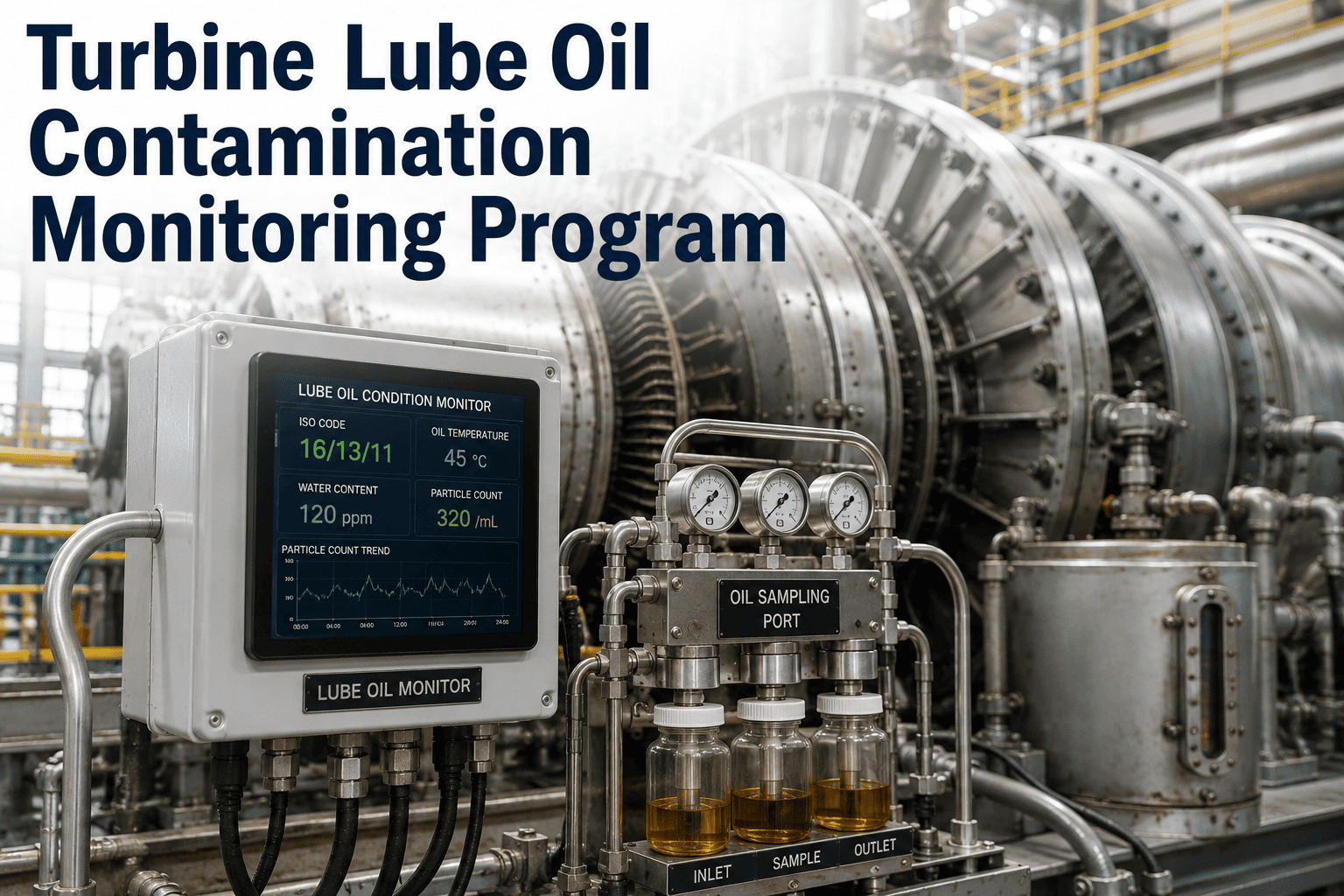
A single turbine bearing can cost six figures to replace, yet the warning signs of its failure show up in the oil weeks before any vibration sensor twitches. Studies show roughly 80% of mechanical wear is caused by particle contamination in the lubricant, and on a gas turbine control valve, a varnish film just one to two microns thick is enough to stick a servo spool and trip the unit. The oil is not just a lubricant — it cools bearings, carries away heat, and protects the most expensive rotating machinery in the plant. Turning that oil into a continuous early-warning system is what separates a planned filter change from a forced outage, and a structured monitoring program built on AI-powered lubrication management is how reliability teams catch the failure while it is still cheap to fix.
Turbine Systems · Lubrication Management · Condition Monitoring
Your Turbine Oil Is Writing a Failure Report. Most Teams Never Read It.
Microscopic metal, dissolved water, and oxidation byproducts accumulate in the reservoir long before a bearing seizes or a valve sticks. A contamination monitoring program reads that report on a schedule — and acts on it before the damage is done.
80%
Of mechanical wear is caused by particle contamination in oil
1–2 µm
Varnish layer on a servo valve enough to cause sticking and trips
1,000 ppm
Water content at which oil condition turns critical for bearings
Weeks
Lead time oil analysis gives before vibration or pressure reacts
The Three Contaminants That Destroy Turbine Oil — and What Each One Wrecks
Turbine oil is under constant attack from three directions at once. Each contaminant degrades the oil through a different mechanism and attacks a different part of the machine. Knowing which threat is rising tells you exactly what to inspect — and a monitoring program that tracks all three is what turns a vague "oil looks dark" into a precise action.
SourceWear debris, ingressed dirt, inadequate reservoir breathers
DamageAbrasive scoring of bearing surfaces, valve sticking, accelerating three-body wear
Measured byISO 4406 particle count at 4, 6, and 14 microns
Why it's silentThe 4–14 µm particles that do the most damage are invisible to the naked eye until 40+ µm
SourceSeal leaks, heat exchanger tube failures, condensation, humid ingress
DamageAccelerated oxidation, rust, reduced film strength, shortened bearing life
Measured byKarl Fischer moisture test, reported in ppm
Why it's silentTurbine seal failures and exchanger leaks show in the oil here first, before any other gauge
SourceHeat, oxygen, metal catalysts, depleted antioxidants over service life
DamageSludge and varnish deposits in bearing housings, sticking servo and governor valves
Measured byRPVOT, RULER, MPC varnish potential, FTIR, acid number (TAN)
Why it's silentHighly refined turbine base oils are poor solvents — deposits form and stay where the damage happens
Reading the ISO 4406 Cleanliness Code
Particle contamination is reported as a three-number ISO 4406 code such as 17/15/12. It looks cryptic, but it is the single most useful number in your monitoring program — and the key fact is that the scale is logarithmic: every one-point increase means the particle concentration has doubled.
17
Particles ≥ 4 µm per mL
/
15
Particles ≥ 6 µm per mL
/
12
Particles ≥ 14 µm per mL
A common turbine target is 17/15/12 or cleaner — roughly a maximum of 1,300 particles per mL above 4 µm, 320 above 6 µm, and 40 above 14 µm. Because each step doubles concentration, a drift from 17/15/12 to 20/18/15 is not a small change — it is eight times more contamination, and it is exactly the kind of trend that a sampling program catches early and a "wait until it fails" approach never sees coming.
From sample bottle to scheduled action
Stop Letting Oil Reports Pile Up in an Inbox Nobody Reads
OxMaint turns every ISO code, moisture reading, and RPVOT result into a trended asset-health record — and auto-generates the work order the moment a value crosses your alarm limit, so a rising number becomes a dispatched technician instead of a missed warning.
The Turbine Oil Test Slate and Its Alarm Limits
A real monitoring program is not a single test — it is a slate of complementary measurements, each with a defined caution and critical threshold drawn from ASTM D4378 in-service turbine oil practice. These are the numbers your reliability team should be trending on every reservoir.
How a Small Reading Becomes a Forced Outage
Turbine oil failures are cascades, not events. A single uncorrected contamination source sets off a chain that ends at the most expensive possible outcome. This is the path a 200 ppm water rise can travel if nobody is trending the data.
1
Contamination ingress begins
A seal starts weeping or a breather lets in humidity. Water and particles enter the reservoir at a low, steady rate. Nothing on the control room screen changes.
2
Oxidation accelerates
Water and metal catalysts speed oil oxidation. Antioxidants deplete, RPVOT falls, and acid number climbs. The oil is degrading faster than its rated service life predicted.
3
Varnish and sludge deposit
Degradation byproducts drop out as varnish in bearing housings and on valve spools. The base oil cannot redissolve them, so deposits accumulate exactly where clearances are tightest.
4
Valve sticks, bearing fails, unit trips
A varnished servo valve sticks or a starved bearing wipes its babbitt. The turbine trips into a forced outage — the one outcome that costs more than every oil test you would ever run, combined.
What an AI-Driven Monitoring Program Actually Does
The hard part of oil monitoring was never the lab work — it was acting on the results consistently across dozens of reservoirs, sampling ports, and overlapping intervals. This is where a connected CMMS turns a stack of PDF lab reports into a living reliability program.
A
Trend Every Reservoir Over Time
ISO codes, moisture, TAN, and wear metals are logged per asset and trended, so the slow drift that a single spot-check misses becomes an obvious, alarmable curve.
B
Auto-Generate Work Orders on Limit Breach
When water crosses 1,000 ppm or a wear metal exceeds 10 ppm, the system creates a prioritized work order automatically — no report sits unread waiting for someone to notice.
C
Schedule Sampling on Cadence
Routine bottle samples and annual RPVOT on large reservoirs are scheduled and tracked, so no critical turbine slips past its sampling interval during a busy season.
D
Connect Inline Sensors to Action
Continuous inline particle and moisture sensors feed live data in, and the platform turns a threshold crossing into a dispatched task rather than a blinking light nobody owns.
E
Link Oil Data to Asset History
Every reading attaches to the turbine's full maintenance record, so a wear-metal spike is read against past bearing work, filter changes, and oil top-ups — not in isolation.
F
Build a Defensible Reliability Record
Timestamped readings, actions, and outcomes form an audit-ready history that proves the monitoring program is working and justifies the oil and filtration spend to leadership.
Frequently Asked Questions
How often should turbine lube oil be sampled and analyzed?
Routine sampling frequency depends on turbine criticality and operating conditions, but most large units follow ASTM D4378 guidance with regular particle count, moisture, viscosity, and acid number checks, plus periodic oxidation testing. RPVOT is typically run annually on very large reservoirs such as steam turbines exceeding 10,000 gallons, since their low makeup-oil rate makes oxidation tracking essential. The key is consistency — trending the same tests from the same ports on a fixed interval is what reveals drift.
Book a demo to see a sampling calendar configured per reservoir.
What is a good ISO 4406 cleanliness target for turbine oil?
Many turbine systems target an ISO 4406 code of 17/15/12 or cleaner, which corresponds to roughly 1,300 particles per mL above 4 microns, 320 above 6 microns, and 40 above 14 microns. The exact target should be set by the most sensitive component on the system — servo valves and journal bearings tolerate far less contamination than bulk circulation. Because each code step represents a doubling of particles, even a two-point drift is a major increase that warrants reviewing filtration and breather condition before wear accelerates.
Why is water contamination so dangerous in turbine oil?
Water is uniquely destructive because it attacks the oil and the machine at the same time. Above about 500 ppm it becomes a caution condition, and above 1,000 ppm it turns critical — water accelerates oxidation, promotes rust, reduces lubricating film strength, and dramatically shortens bearing life. It is also an early indicator of mechanical problems, since turbine seal failures and heat exchanger leaks frequently show up as a moisture rise in the oil before any other instrument reacts. Catching that rise early often means catching a failing seal early too.
What is varnish, and why can't I just filter it out?
Varnish is a thin, lacquer-like deposit formed when oxidation byproducts drop out of the oil onto metal surfaces, and even a one-to-two-micron film on a servo valve spool can cause sticking and unit trips. The challenge is that highly refined turbine base oils are poor solvents, so once varnish forms it stays put rather than redissolving into the oil where a standard filter could remove it. That is why MPC varnish-potential testing and RPVOT oxidation trending matter so much — they catch the conditions that produce varnish before deposits actually form.
Start a free trial to trend varnish risk across your fleet.
How does oil analysis fit with vibration and other condition monitoring?
Oil analysis and vibration monitoring are complementary, not competing — and oil typically gives the earlier warning. Microscopic metal particles, viscosity shifts, and water contamination accumulate in the oil weeks before a developing fault grows large enough to register on a vibration sensor or pressure gauge. A complete program feeds both data streams into the same asset-health record, so a wear-metal trend and a vibration signature can be read together to confirm a diagnosis and time the intervention precisely, rather than reacting after the damage is already advanced.
Read the report your oil is already writing
Catch the Failure While It's Still a Filter Change, Not an Outage
Every turbine in your plant is telling you when it will fail — through the particles, water, and oxidation byproducts building in its oil. OxMaint reads that signal continuously, trends it against your alarm limits, and turns every threshold breach into a scheduled, documented action, so the next bearing you save pays for the entire program.