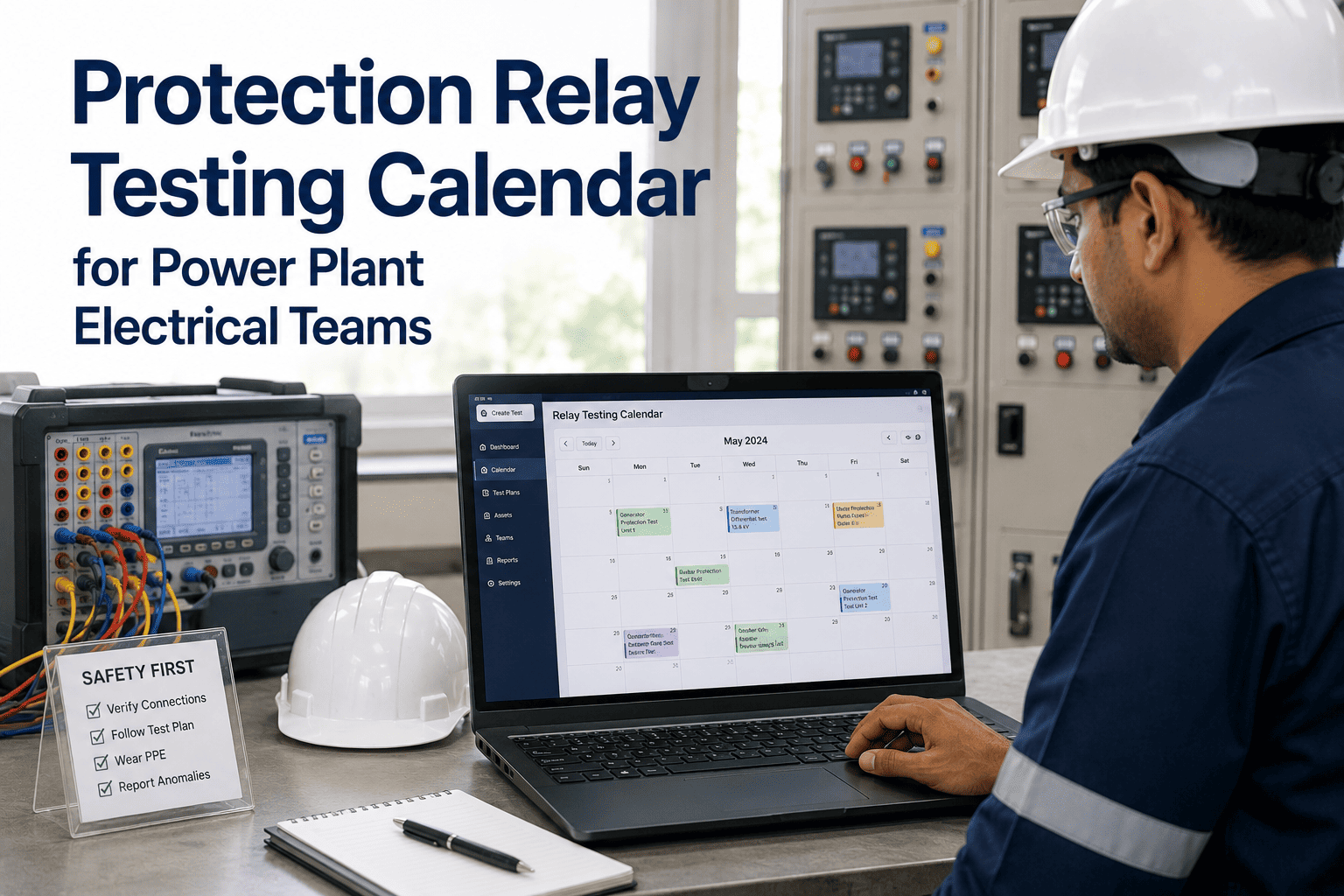
Switchgear maintenance in a power plant is the difference between uninterrupted generation and a cascading grid failure — and protective relay testing is your first line of defense against equipment damage, arc-flash incidents, and regulatory penalties. Industry data shows that 70% of bus-bar failures stem from undetected insulation degradation and mis-coordinated relays that missed their trip windows during fault events. This guide covers circuit breaker testing intervals, relay calibration, and switchgear inspection best practices, and shows how deploying a switchgear CMMS like Start Free Trial transforms your electrical maintenance from reactive scrambling into predictive, audit-ready precision.
Is One Mis-Coordinated Relay Putting Your Entire Plant at Risk?
A single protective relay that fails to trip in 3–5 cycles can destroy a $2M transformer and trigger days of unplanned outages. OxMaint digitizes every circuit breaker PM, relay calibration, and switchgear inspection — so nothing slips through the cracks.
How Often Should Circuit Breaker Testing Happen?
Most power plants follow NETA MTS and IEEE C37.20 intervals, yet 65% still miss scheduled tests due to spreadsheet tracking. Here's what the testing cadence should look like — and how a switchgear CMMS keeps you compliant.
- Inspect for dust, moisture, and tracking marks on bushings
- Verify heater operation (condensation control)
- Check lubrication on operating mechanisms and linkages
- Confirm indicator and shutter alignment
- Contact resistance test (micro-ohm measurement)
- Insulation resistance test (Megger at 1kV or 5kV)
- Timing and travel analysis on breakers >5 years old
- SF6 gas moisture and dew-point analysis
- Primary injection testing on CTs and protection circuits
- Breaker contact erosion and wear assessment
- Full relay coordination study and recalibration
- Arc-flash hazard label refresh (IEEE 1584)
A 180-asset gas peaker plant in Texas was spending $42K/yr on reactive breaker failures and relay mis-operations — averaging 3 unplanned outages per year. After implementing OxMaint for switchgear inspection scheduling and relay test tracking, they eliminated 2 of 3 annual outages in the first year and cut electrical testing labor by 28% through automated PM routing. Net first-year savings: $67K and 91% PM compliance.
Protective Relay Testing Sequence: A 5-Step Timeline
Relay calibration in a power plant follows a strict sequence from isolation to documentation. Skipping or reordering steps risks personnel safety and invalidates compliance records.
De-energize and verify zero-voltage
Isolate the breaker or relay panel, apply working grounds, and verify zero-voltage with a calibrated meter. Allow at least 5 minutes for capacitor discharge on MV equipment before touching terminals.
Check connections, settings, and physical condition
Inspect for loose terminals, discolored wiring, and dust accumulation. Verify the relay settings match the latest coordination study — 40% of relay mis-operations trace back to outdated tap or time-dial settings.
Inject current/voltage and verify pickup & timing
Use a relay test set to inject simulated fault currents and voltages. Verify pickup accuracy within ±5% of setting and timing within ±1 cycle of the coordination curve. Document every test point.
Test individual protection elements and trip logic
Verify overcurrent (50/51), differential (87), distance (21), and ground (51G/51N) elements operate correctly. Confirm trip and close circuits energize the correct outputs and lockout relays.
Re-energize, verify, and log results in CMMS
Remove grounds, restore settings, and re-energize under supervision. Upload all test reports and digital signatures into your switchgear CMMS so auditors can trace every relay to its last calibration date.
What Does Reactive Switchgear Maintenance Actually Cost?
When a relay fails to trip or a breaker seizes, the downstream damage escalates fast. Here's the financial impact of delaying preventive electrical testing — and the ROI of switching to a CMMS-driven approach.
A 500 MW plant with one relay mis-operation per year at 4 hours downtime ($7K/MWh margin) faces $112K in lost generation alone — before any equipment damage or NERC/FERC penalty exposure.
| Cost Category | Reactive (Spreadsheet) | CMMS-Driven (OxMaint) | Annual Savings |
|---|---|---|---|
| Unplanned breaker outages | $48K – $120K | $6K – $15K | $42K – $105K |
| Relay mis-operation damage | $25K – $300K | $0 – $8K | $25K – $292K |
| Audit & compliance labor | $18K | $4K | $14K |
| Testing labor (duplicated/wasted trips) | $32K | $23K | $9K |
| Spare parts rush ordering | $14K | $5K | $9K |
| Total Annual Cost | $137K – $484K | $38K – $55K | $99K – $429K |
Stop Gambling with Spreadsheet-Tracked Relay Tests
See how OxMaint auto-schedules every circuit breaker PM, tracks relay calibration dates, and flags overdue switchgear inspections — before NERC or your auditor does.
Switchgear CMMS Features That Prevent Relay & Breaker Failures
OxMaint maps directly to the electrical maintenance workflow — from scheduling the next insulation resistance test to predicting which breaker is trending toward failure based on micro-ohm data.
Automated PM Scheduling
Auto-generate circuit breaker PM work orders at NETA-defined intervals — 6-month visual, annual electrical, 3-year overhaul — assigned to the right technician with checklists attached. Cuts missed PMs by 85%.
Predictive Trend Analysis
Log every contact resistance and timing test result. OxMaint's AI flags breakers whose micro-ohm readings trend upward — predicting failures 30–60 days before they occur so you can plan outages, not react to them.
Audit-Ready Compliance Records
Every relay test, breaker timing report, and insulation resistance reading is timestamped, geo-tagged, and digitally signed. Pull a full NERC PRC-005 compliance report in under 60 seconds — no more binder-hunting.
Spare Parts & Inventory Linking
When a switchgear inspection flags a worn contact tip, OxMaint auto-reserves the replacement part from inventory and links it to the work order. Eliminates 90% of rush-order premiums and keeps critical spares at min/max.
"We went from 3 breaker-related outages a year to zero in 18 months. OxMaint's trend analysis caught a 480V breaker whose contact resistance was climbing 15% per quarter — we replaced it during a planned outage instead of during peak load."
Switchgear & Relay Testing FAQs
How often should switchgear be inspected in a power plant?
Visual and mechanical switchgear inspections should occur every 6 months, with full electrical testing — including contact resistance, insulation resistance, and SF6 analysis — performed annually per NETA MTS standards. A comprehensive overhaul including primary injection testing and relay coordination studies is recommended every 3 years. Using a switchgear CMMS ensures these intervals are automatically scheduled and never missed.
What does protective relay testing include?
Protective relay testing includes visual inspection, secondary injection testing to verify pickup and timing accuracy, element logic verification for overcurrent (50/51), differential (87), and ground (51N) elements, and trip/close circuit verification. Each relay must be tested within ±5% of its setting and ±1 cycle of its coordination curve, with results documented for NERC PRC-005 compliance. You can Book a Demo to see how OxMaint automates this documentation.
What is the difference between switchgear inspection and circuit breaker testing?
Switchgear inspection covers the entire assembly — bus bars, enclosures, insulators, heaters, and shutters — focusing on visual condition, cleanliness, and mechanical operation. Circuit breaker testing is more specific and invasive, involving electrical measurements like contact resistance (micro-ohms), insulation resistance (Megger), timing and travel analysis, and SF6 gas quality. Both are essential but follow different intervals and procedures.
Can a CMMS help with NERC PRC-005 relay compliance?
Yes — a relay testing CMMS like OxMaint is specifically designed to track protection system maintenance intervals, store digital test records with timestamps and technician signatures, and generate audit-ready compliance reports. It auto-flags relays approaching their testing deadline and maintains a complete maintenance history that directly satisfies NERC PRC-005 documentation requirements. Start Free Trial to see your compliance dashboard.
How much does switchgear maintenance software cost?
OxMaint's switchgear CMMS pricing scales with the number of assets and users, but most power plants see ROI within 3–6 months through reduced unplanned outages, lower testing labor, and eliminated rush-order spare parts costs. Given that a single relay mis-operation can cost $112K+ in downtime, the software typically pays for itself by preventing just one event per year.
Your Breakers Won't Wait — Neither Should You
Join the power plants using OxMaint to automate switchgear inspection, relay calibration tracking, and circuit breaker PM scheduling — and cut unplanned electrical outages by up to 70%.
Free 14-day trial · No credit card