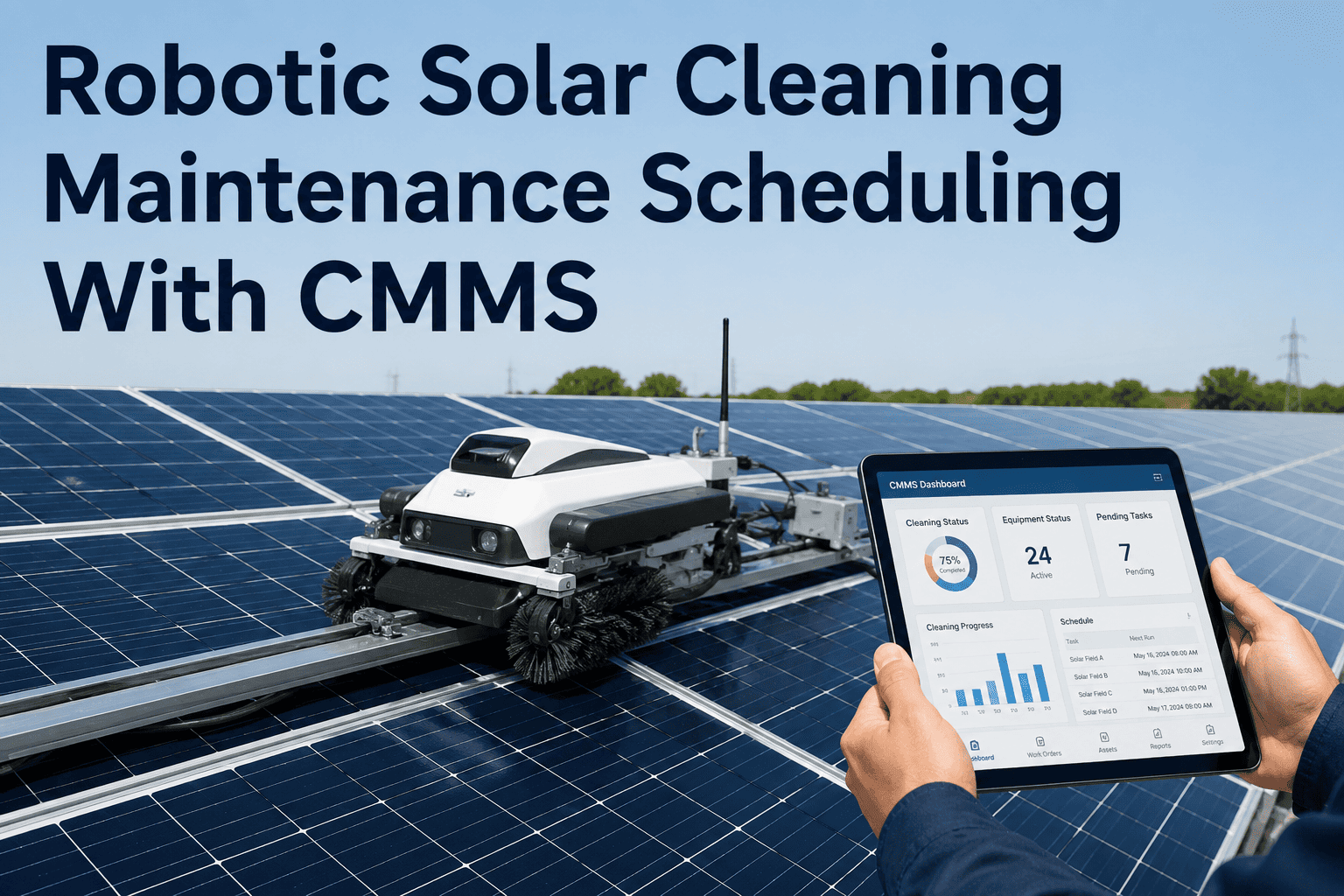
Solar farms lose between 15% and 35% of annual energy output to soiling — dust, pollen, bird droppings, and mineral deposits that accumulate faster than manual wash crews can address them. A 200 MW utility-scale plant with 500,000 panels cannot sustain calendar-based manual cleaning without spiraling labor costs, water consumption, and output loss. Autonomous robotic cleaners solve the physical problem but introduce a new challenge: every cleaning cycle generates data that disappears unless a CMMS captures it. Without structured scheduling, robot fleets clean the wrong rows at the wrong time, maintenance gaps stay invisible, and warranty compliance becomes a guessing game. OxMaint's Preventive Maintenance Scheduling module connects directly to robotic cleaning systems — turning every pass into a tracked maintenance event, every soiling anomaly into a work order, and every cleaning schedule into a data-backed PM calendar your O&M team can actually manage.
Why Robotic Cleaning Without CMMS Is a Hidden Revenue Leak
Schedule Smarter, Clean Better
OxMaint auto-generates PM calendars from soiling rate data, robot utilization history, and outage windows — so your cleaning fleet operates at maximum efficiency with zero manual scheduling effort.
How OxMaint Structures Robotic Solar Cleaning Maintenance
From PM calendar creation to crew coordination, OxMaint provides a complete operational layer on top of your robotic cleaning fleet.
Robotic Cleaning KPIs That OxMaint Tracks Automatically
| KPI | What It Tracks | Without CMMS | With OxMaint |
|---|---|---|---|
| Cleaning Cycle Completion Rate | % of scheduled cycles completed on time | Unknown — estimated | Real-time per robot per zone |
| Soiling Loss Index | Energy yield gap vs. clean-panel baseline | Monthly report lag | Daily deviation alert |
| Robot Availability | % of time each robot is operational | Tracked in robot app only | Unified with CMMS asset record |
| Missed String Rate | Rows skipped due to robot error or access issue | Discovered at next inspection | Auto-flagged same day |
| Robot PM Compliance | % of robot maintenance tasks completed on schedule | Spreadsheet or manual log | CMMS-tracked with mobile alerts |
| Water Usage per MW | Water consumption per MW cleaned (wet-clean events) | Manually logged | Auto-calculated per work order |
Condition-Based vs. Calendar-Based Cleaning: A Scheduling Comparison
Expert Perspective
The biggest mistake solar operators make with robotic cleaning fleets is treating the robots as autonomous and hands-off. A robot that missed 40 rows last Tuesday due to a low-battery cutoff is a soiling problem that compounds daily until someone notices output is off. Connecting your robot fleet to a CMMS changes the game entirely — every exception becomes a work order, every pattern of misses becomes a scheduling insight, and your warranty documentation is always current. We moved from 6.2% soiling loss to under 1.4% in 18 months after integrating our cleaning schedule into OxMaint. The robots didn't change. The scheduling intelligence did.
Frequently Asked Questions
How does OxMaint integrate with existing robotic solar cleaning systems?
OxMaint connects to robotic cleaning platforms via API or scheduled data export, pulling cycle completion data, robot status, and exception logs into the CMMS as asset records. Cleaning events become PM work orders automatically, with timestamps and zone references. No manual data entry is required from the O&M team. Start a free trial to configure your robot fleet integration.
What is the typical soiling loss reduction when moving from calendar to condition-based cleaning?
Utility-scale PV operators typically see soiling losses drop from 5–7% of annual generation to under 1.5–2% when condition-based scheduling replaces fixed calendar cycles. The improvement comes from faster response to high-soiling events and eliminating unnecessary cycles on clean panels — directing robot capacity where yield impact is greatest.
Can OxMaint track maintenance schedules for the cleaning robots themselves?
Yes. Each robot is registered as a named asset in OxMaint with its own PM schedule — brush replacement intervals, motor service, sensor calibration, and battery health checks. When a robot PM is due, the CMMS alerts the assigned technician on mobile before cleaning quality degrades. Robot downtime history is tracked and used to optimize fleet deployment. Book a demo to see robot asset management in action.
How does OxMaint handle cleaning documentation for panel warranty compliance?
Every cleaning event — whether robotic or manual — creates a timestamped, asset-linked record in OxMaint with zone reference, cleaning method, and technician or robot ID. Panel warranty documentation packages are generated from the CMMS in a single export, covering any date range requested by the manufacturer or insurance auditor.
Can cleaning schedules in OxMaint be blocked during planned electrical maintenance?
Yes. OxMaint's outage window management links PM calendars to active electrical work orders. Robotic cleaning cycles are automatically prevented from scheduling on strings or inverter blocks where live electrical maintenance is in progress — eliminating safety conflicts between cleaning operations and technician work zones. Start free to configure outage-aware PM calendars.
Your Robots Are Cleaning. Is Your CMMS Capturing It?
Every cleaning cycle your robots complete without a CMMS record is a data gap — in warranty documentation, in soiling trend analysis, and in your PM compliance score. OxMaint closes that gap from day one.