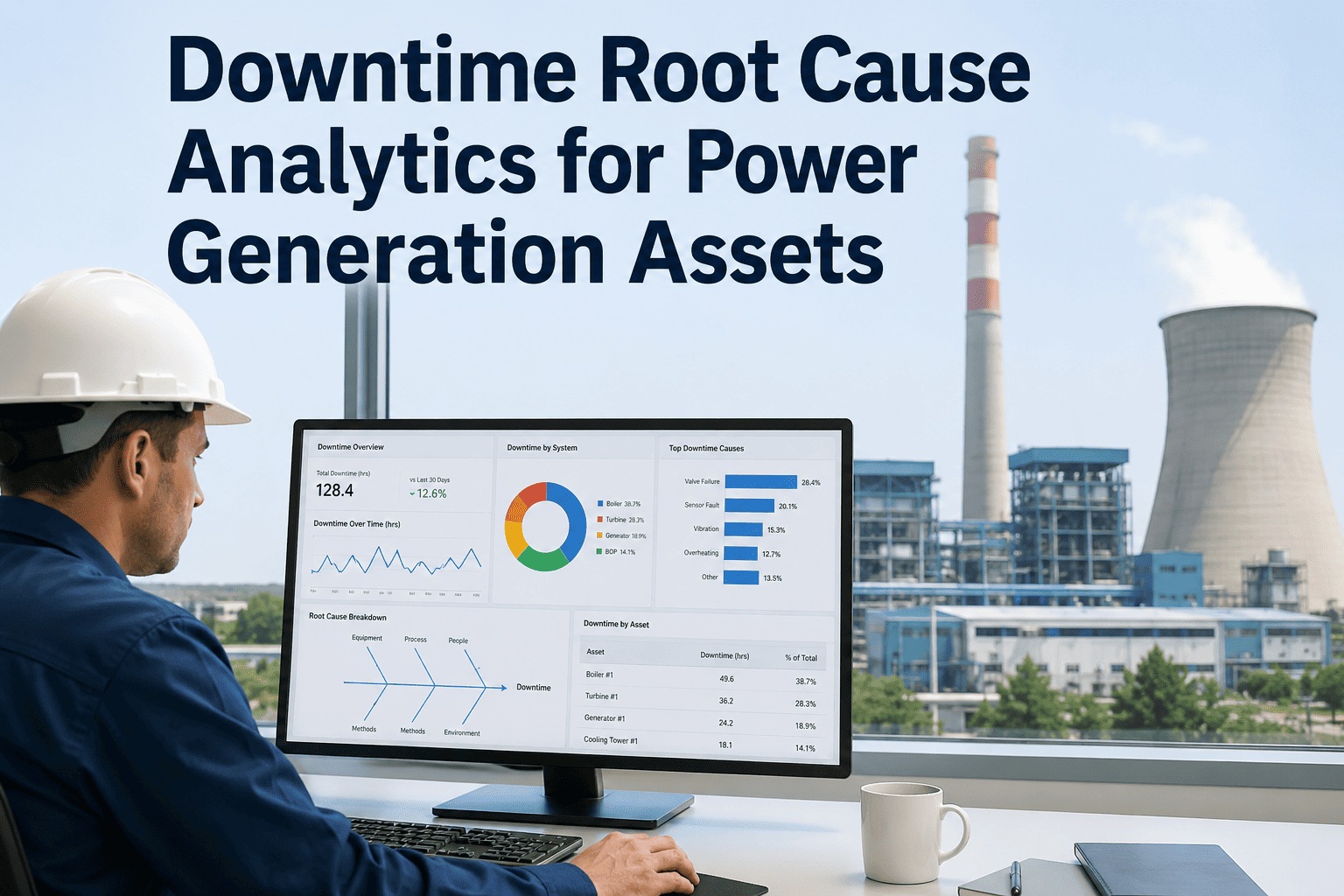
NERC's 2025 reliability data shows the industry moving the wrong way: weighted forced outage rates climbed to 9.2%, up from a historical norm that rarely cleared 8%, with aging coal and combined-cycle units driving most of the increase. The frustrating part is that most of those hours weren't unpredictable industry studies attribute 25–30% of forced outages to preventable degradation that was sitting in the data weeks ahead. Reducing unplanned downtime isn't one fix — it's ranking which assets actually carry the risk, catching degradation before it becomes a trip, and closing the loop on every failure so it doesn't repeat. This guide breaks that strategy into six connected pillars, and shows how OXMAINT AI CMMS runs all six from one system.
Power Generation · Reliability & Forced Outages · Downtime Reduction · 2026
Power Plant Unplanned Downtime Reduction: Complete Reliability Strategy
A forced outage is rarely a surprise — it's a ranked risk nobody acted on, a repeat failure nobody traced, or a part nobody had on the shelf. OXMAINT AI connects the full reliability workflow in one platform: criticality-ranked assets feed predictive and preventive schedules, every finding becomes a tracked work order, and every forced outage feeds a root cause record — so the same failure doesn't cost you a second time.
Criticality Ranking
→
Predictive & PM Scheduling
→
Work Orders
→
RCA & Corrective Action
9.2%
2025 weighted forced outage rate, up from a historical norm under 8% (NERC)
$10K–$100K/hr
typical cost of unplanned downtime on a thermal or combined-cycle asset
25–30%
of forced outages traced to preventable degradation, per EPRI
30–50%
recurrence rate on the same failure mode within 24 months without formal RCA
Pain Point #9: Downtime — Where It Actually Comes From
Ask most plants why a unit tripped and the answer is a part number, not a pattern. The real causes sit further upstream — in how risk gets ranked, how PM gets scheduled, and whether anyone ever closes the loop on the last failure. Sign up free and see your critical-asset risk register built from your own work order history.
📊
No Criticality Ranking
Every asset gets the same PM frequency whether it's a redundant fan or the only feedwater pump on the unit. Risk isn't ranked, so attention goes wherever the loudest complaint is.
📅
Calendar-Only PM
Time-based PM catches some failures and misses others entirely — a bearing can fail three weeks after its last inspection with no calendar rule that would have caught it.
🔁
No Repeat-Failure Tracking
The same coupling fails on the same pump for the third time in two years, and nobody notices because each work order lives in isolation from the last one.
📦
Spare-Parts Blind Spots
The RCA identifies the fix. The part isn't in the storeroom. A five-day repair becomes a three-week wait, and the unit stays down the whole time.
The Criticality Ranking Matrix
Not every asset deserves the same attention. Ranking by consequence of failure against probability of failure tells you exactly where to spend your predictive and preventive budget first — and where a calendar-based PM is genuinely good enough.
Consequence of Failure →
Monitor
Low probability, high consequence — main generator, main transformer. Predictive sensors, low-frequency inspection.
Protect First
High probability, high consequence — boiler feed pumps, critical valves. Predictive alerts, tightest PM interval, parts always in stock.
Run to Fail
Low probability, low consequence — redundant fans, non-critical instrumentation. Reactive maintenance is an acceptable strategy here.
Schedule Tightly
High probability, low consequence — wear parts, filters, seals. Calendar or usage-based PM, no predictive spend needed.
← Probability of Failure
The Six-Pillar Downtime Reduction Strategy
Each pillar closes a different hole. Run all six together and unplanned downtime stops being a surprise and starts being a managed number. Book a demo to see all six pillars running on your asset list.
01
Criticality Ranking
Every asset scored on consequence and probability of failure, so budget and attention go where an outage would actually hurt.
02
Predictive Alerts
Vibration, oil and thermal signals on ranked-critical assets flag degradation weeks ahead, not after the trip.
03
Preventive Maintenance
Calendar and usage-based PM covers everything below the predictive threshold, scheduled by criticality tier, not a flat interval.
04
Repeat-Failure Analysis
Every work order checked against the asset's failure history — a third occurrence of the same failure mode flags itself automatically.
05
Spare-Parts Readiness
Critical-tier assets carry a minimum stock rule tied to their ranking, so a confirmed finding doesn't wait on procurement.
06
Root Cause Analysis
Every forced outage triggers a structured RCA tied to the asset record, so the corrective action outlives the shift that filed it.
A Root Cause Analysis That Isn't Linked to the Asset Record Isn't a Fix. It's a Filed Report.
OXMAINT AI ties every RCA directly to the failed asset, so the next planner sees it before scheduling the next PM — not after the third repeat failure.
The RCA Feedback Loop That Stops Repeat Failures
Most plants run an investigation and file the report. The loop only works if the finding travels back to where the next decision gets made.
1
Forced Outage Occurs
Incident logged against the asset the moment it trips, timestamped automatically.
→
2
RCA Investigation
5 Whys or fishbone structure applied, evidence and maintenance history attached.
→
3
Corrective Action
Fix assigned an owner and a due date — not just written into a report nobody revisits.
→
4
Asset Record Updated
Failure mode and finding attach permanently to the asset, visible to every future planner.
→
5
Repeat Flagged Automatically
If the same failure mode appears again, the work order flags it against the open corrective action.
Reactive Plant vs. Six-Pillar Plant
Reactive, Unranked Maintenance
Every asset on the same PM interval regardless of risk
Predictive alerts, if they exist, sit on a dashboard
Repeat failures go unnoticed across work orders
RCA findings live in a report, not the asset record
Spare parts discovered missing after the trip
Six-Pillar Reliability Program
PM interval and depth set by criticality tier
Predictive alerts route straight into scoped work orders
Repeat failure mode flags itself on the third occurrence
RCA corrective actions attach to the asset permanently
Critical-tier parts carry a minimum stock rule
What OXMAINT AI Gives Reliability Teams
Criticality-Ranked Asset Register
Score every asset by consequence and probability of failure, and let PM frequency and predictive spend follow the ranking automatically.
Predictive-to-Work-Order Bridge
Vibration, oil and thermal alerts on critical-tier assets become scoped work orders — no manual dashboard triage.
Repeat-Failure Detection
Every closed work order checks against the asset's failure history, so a recurring failure mode surfaces instead of hiding across separate tickets.
Spare-Parts Readiness Rules
Set minimum stock levels by criticality tier, so a confirmed critical finding isn't the moment you discover the part is on back-order.
Structured RCA Workflow
Guided root cause investigation tied directly to the originating incident and the asset record, with corrective actions tracked to closure.
Forced Outage Rate Tracking
FOR, repeat-failure count and corrective-action closure rate calculated automatically from work order history — no monthly spreadsheet rebuild.
"
We had a boiler feed pump that took the unit down three times in eighteen months, and every time it was treated as a fresh incident. Once we ranked our assets and started tying RCA findings to the asset record instead of a filed report, the third repeat on that pump flagged itself before the work order was even approved — we caught it at the bearing-wear stage instead of the trip. That's the whole difference between a reliability program and a maintenance log.
Plant Reliability Engineer · Combined-Cycle Facility
Frequently Asked Questions
What's the fastest first step to reduce unplanned downtime?
Criticality ranking. Before adding sensors or rewriting PM schedules, rank your assets by consequence and probability of failure — it tells you exactly which handful of assets deserve predictive investment first, instead of spreading effort evenly across everything.
How does OXMAINT AI detect repeat failures automatically?
Every work order is checked against the asset's failure-mode history. When the same failure mode appears again within a set window, OXMAINT AI flags it against any open RCA corrective action on that asset instead of treating it as an isolated repair.
Do we need predictive sensors on every asset to run this strategy?
No. The criticality matrix is built for exactly this — predictive monitoring and tight spare-parts rules go on the high-consequence, high-probability tier, while lower-risk assets stay on calendar-based PM or even reactive maintenance.
How does RCA connect back to preventive maintenance in OXMAINT AI?
A completed RCA's corrective action attaches to the asset record, so the next PM or predictive schedule review for that asset shows the open finding — closing the loop between "why it failed" and "what we changed" in one place.
Stop Treating Every Forced Outage Like the First One.
Rank the risk, catch the degradation, close the loop on every failure. That's the reliability workflow OXMAINT AI runs end to end.