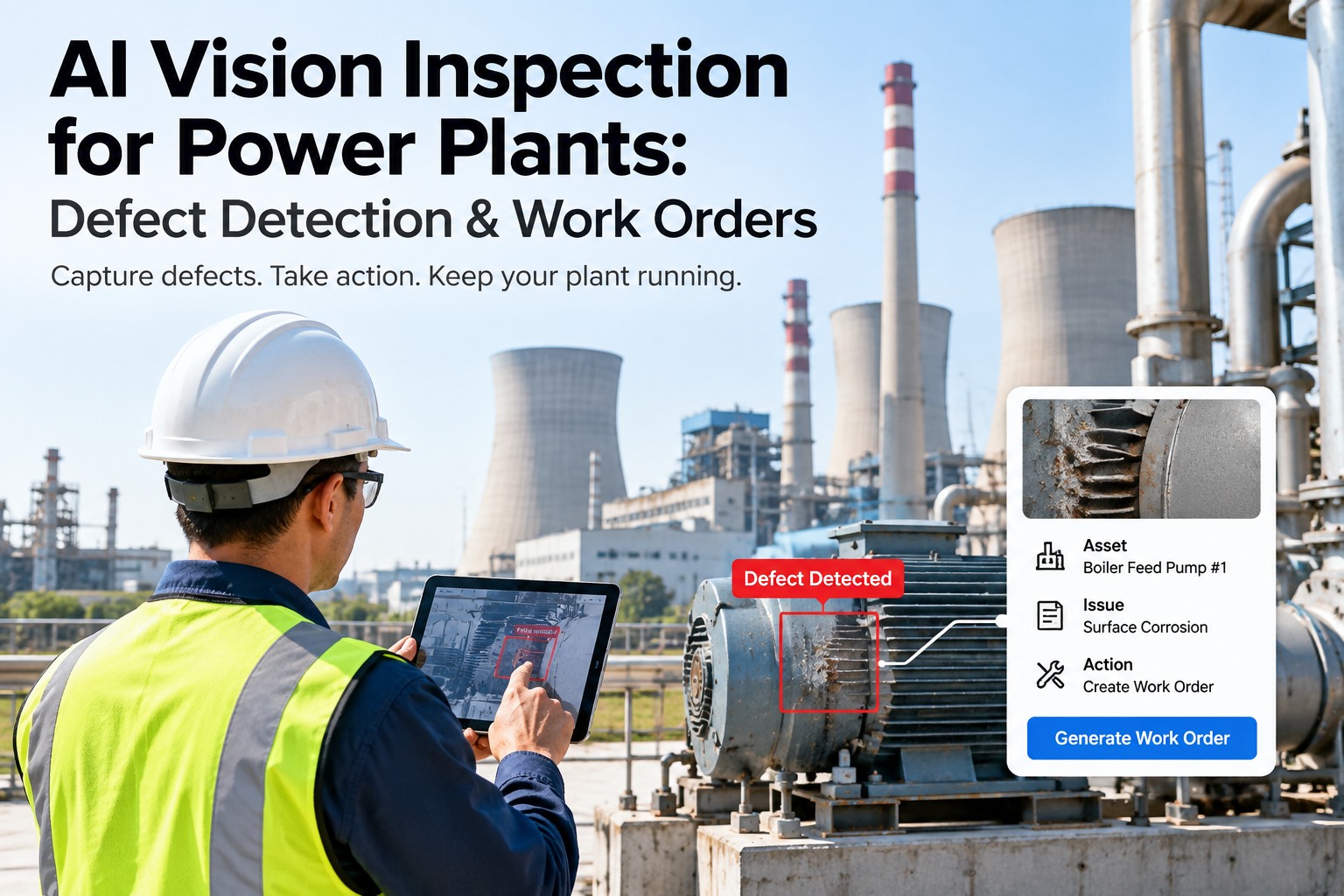
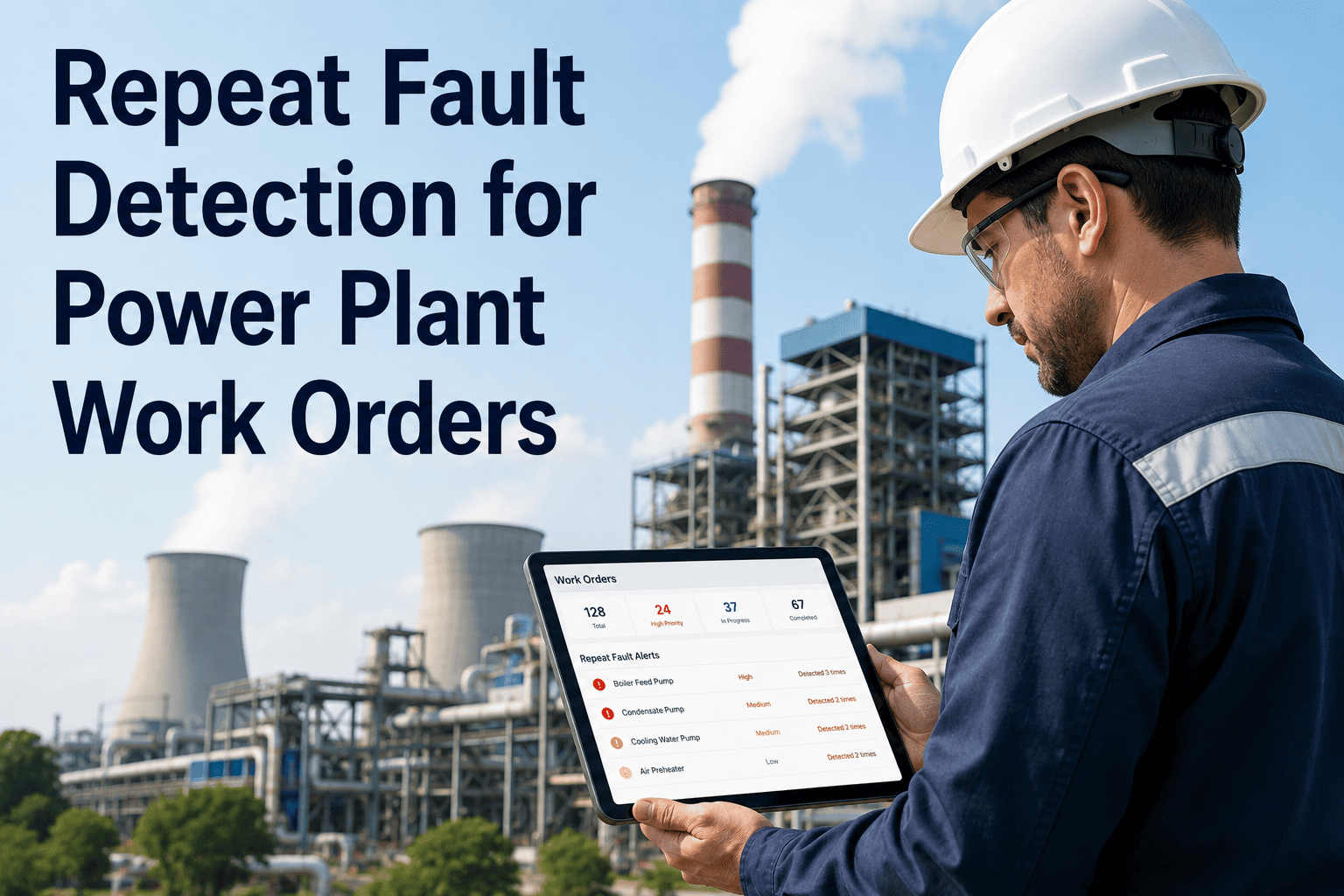
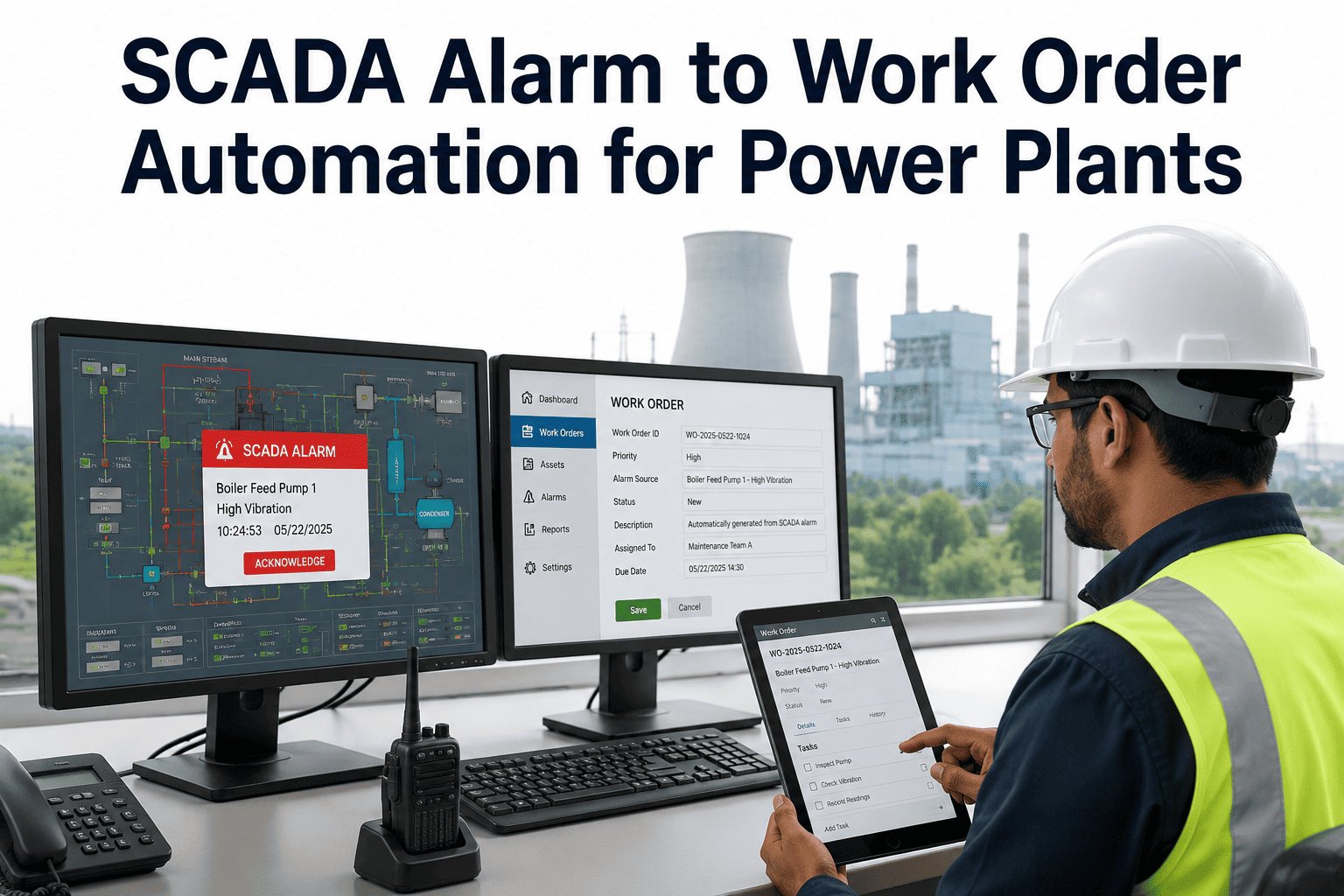
An inspection engineer reviewing 3,000 outage photos on a laptop screen fatigues after the first few hundred — not from carelessness, but because sustained visual attention breaks down after roughly an hour of scanning corrosion patches and thermal imagery. Documented studies on manual visual inspection put mistake rates in the 10–20% range for exactly this reason. AI vision doesn't fatigue — it applies the same detection threshold to image 1 and image 3,000, and the real value only shows up when a flagged defect doesn't just sit in a report but becomes a corrective action against the right asset. This guide covers what AI vision actually classifies on power plant equipment, how detection compares to manual rounds, and how OXMAINT AI turns every flagged image into a tracked work order.
Power Generation · AI Vision Inspection · Defect Detection · 2026
AI Vision Inspection for Power Plants: Defect Detection & Work Orders
A photo of a corroding flange only helps if it turns into a scoped repair before the leak. OXMAINT AI connects that path in one platform: inspection images and video get classified by AI, defects log automatically against the right asset, and every confirmed finding becomes a work order with the photo, severity and corrective action already attached.
Inspection Photos & Video
→
AI Defect Classification
→
Defect Logged to Asset
→
Work Order Created
$15.5B → $89.7B
projected global AI visual inspection market, 2023 → 2033
10–20%
typical mistake rate in manual industrial visual inspection
~94%
defect classification accuracy reported by AI vision systems in field deployments
~50%
reduction in undetected defects when AI vision replaces manual-only inspection rounds
Inspection & AI Vision: Why Manual Rounds Miss What's Already There
The defect is usually visible in the photo. The problem is what happens — or doesn't — after the photo is taken. Sign up free and see your last inspection set re-classified by AI vision.
👁
Attention Fatigue
A technician on an 80-asset round spends about 90 seconds per asset. Early-stage pitting or a hairline weld crack doesn't register at that pace.
📁
Photos Without Follow-Up
The photo gets taken, filed in a folder, and reviewed — if at all — weeks later during the next planned outage prep.
❓
No Asset Match
A flagged image says "corrosion, valve." It doesn't say which valve, its maintenance history, or whether it's already on a repair list.
🗂
Findings Stay a Report
Inspection findings live in a PDF or spreadsheet — disconnected from the work order system that would actually get someone to fix it.
What AI Vision Actually Classifies
Trained on defect patterns specific to power generation equipment, AI vision doesn't just flag "something looks different" — it names the defect type and grades its severity. Book a demo to see the classification categories run on your asset photos.
High
Surface Corrosion
Pitting, rust bloom, galvanic corrosion and coating delamination on pipework, tanks and structural steel.
High
Cracks & Fatigue
Hairline surface cracks on blades, welds and pressure boundaries — often visible weeks before propagation.
Medium
Thermal Hot Spots
Abnormal heat signatures on switchgear, bearings and motor windings, flagged from thermal-camera imagery.
Medium
Insulation & Coating Loss
Missing or degraded lagging, cold spots on piping insulation, and worn protective coatings signaling energy loss.
Watch
Leaks & Weeping
Fluid staining, drip patterns and weep marks around flanges, seals and gaskets caught before a visible leak.
Watch
Mechanical Wear
Surface wear, misalignment marks and loose fasteners visible in routine walk-down photos.
From Photo to Work Order — The Six Steps
Finding #2214 · Auto-Classified
Severity: High
01
Image Captured
Photo or video taken during a routine round, drone flight or fixed camera feed — no special equipment required.
02
AI Classification
Defect type identified and confidence-scored against the trained failure-pattern library.
03
Severity Assigned
Finding graded High, Medium or Watch based on defect type and progression stage.
04
Asset Matched
Image tagged to the specific asset ID, pulling its maintenance and prior-defect history automatically.
05
Corrective Action Logged
Finding recorded against the asset record with the photo and classification attached as evidence.
06
Work Order Created
Scoped work order generated with severity, photo and asset context — routed to the right technician.
A Flagged Photo That Doesn't Reach a Work Order Is Just a Well-Documented Miss.
OXMAINT AI attaches every AI-classified finding to a corrective action and a work order — not a folder of annotated images nobody revisits.
Detection Rate: Manual Rounds vs. AI Vision
The gap isn't close, and it isn't about human effort — it's about what the human eye can catch at inspection speed versus what a model trained on thousands of defect images can catch at any speed.
Early-stage surface corrosion (<1mm)
Pitting on pipework flanges
■ Human visual round■ AI vision
What OXMAINT AI Gives Inspection & Reliability Teams
AI Defect Classification
Upload inspection photos or video and get defects named, graded and matched to the failure-pattern library automatically.
Automatic Asset Matching
Every flagged image ties to a specific asset ID, pulling its history instead of sitting as an unlabeled photo.
Corrective Action Logging
Confirmed findings record permanently against the asset, with the photo and severity kept as evidence.
Auto Work Order Generation
High and Medium severity findings become scoped work orders the moment classification completes — no manual triage step.
Severity-Ranked Review Queue
Engineers review findings ranked by severity, not a raw folder of thousands of unsorted images.
Vendor-Agnostic Image Ingestion
Works with phone cameras, fixed inspection cameras, drone footage or thermal imaging — no proprietary hardware required.
"
We used to hand a folder of two thousand outage photos to a senior engineer and hope she caught everything in the two days we had before the report was due. Now the AI classification runs first, ranks the findings by severity, and she reviews the top forty instead of scrolling through all two thousand. The part that actually changed our numbers is that every one of those findings turns into a work order automatically — nothing sits in a report that never gets read again.
Inspection Engineering Lead · Combined-Cycle Power Plant
Frequently Asked Questions
What kind of images does AI vision inspection need to work?
Standard phone or camera photos, fixed inspection camera feeds, drone footage or thermal imagery all work. There's no requirement for specialized hardware — the classification model reads whatever visual format your team already captures during rounds or outages.
Does every flagged defect automatically become a work order?
High and Medium severity findings generate a work order automatically. Lower-severity "Watch" findings log to the asset record for review at the next scheduled inspection, so minor items don't flood the work order queue.
Can AI vision replace our inspection engineers?
No — it changes what they spend time on. Instead of reviewing every raw image, engineers review a ranked list of pre-classified findings and make the final call, which is where their judgment adds the most value.
How does a flagged defect get matched to the right asset?
Images are tagged during capture — by location, asset ID or inspection route — and OXMAINT AI matches the finding to that asset's record automatically, pulling in its maintenance and prior-defect history for context.
Stop Filing Inspection Photos. Start Turning Them Into Work Orders.
Every defect your camera already captures can be classified, matched to its asset and routed as a scoped work order — before it becomes a failure. That's the loop OXMAINT AI runs.