Power Plant Work Order Management Software: From Reactive to Predictive
By Johnson on March 18, 2026
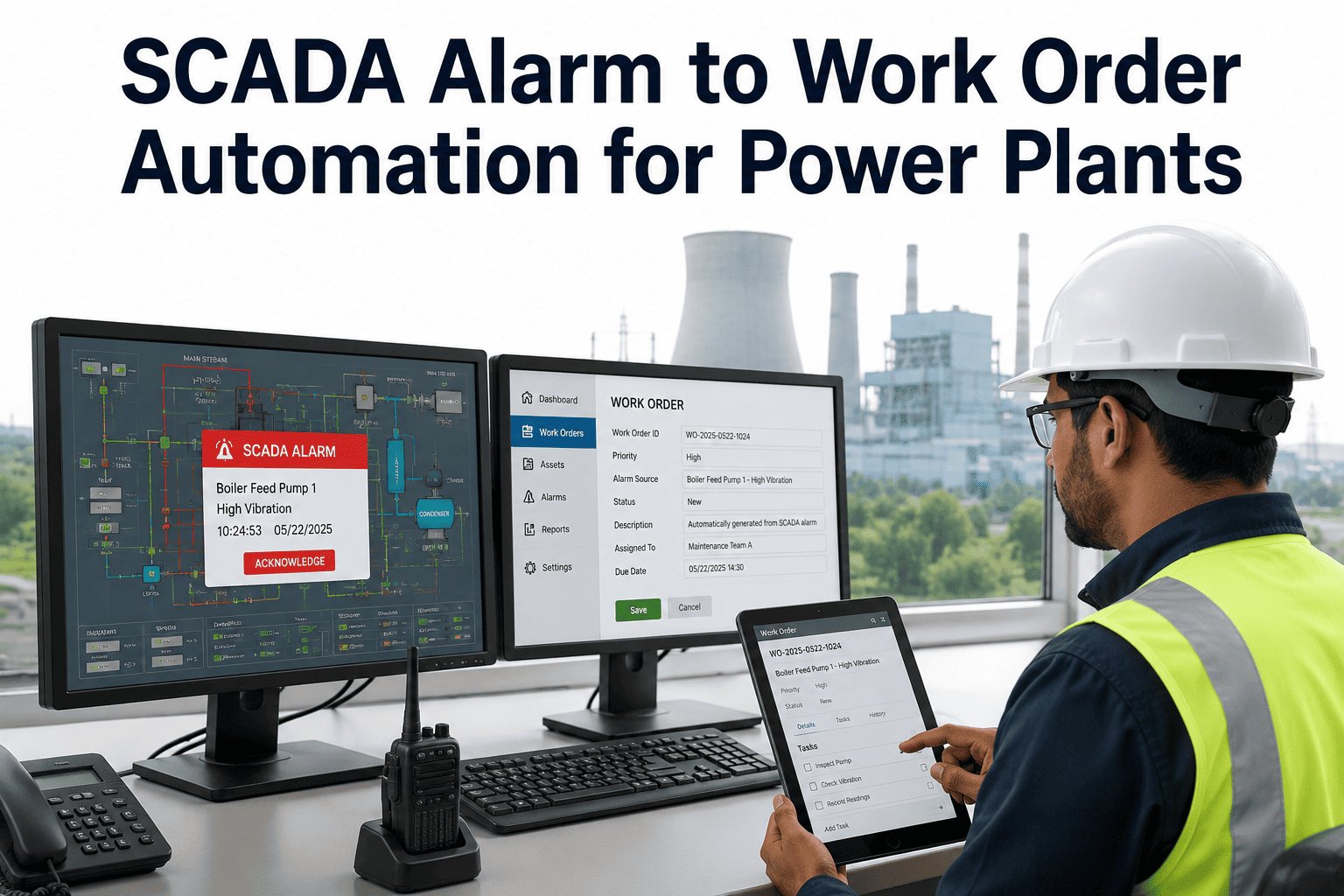
A work order arrives at 2:47 AM. A bearing on Gas Turbine 2 has tripped an alarm. In a reactive plant, that means an overnight call to a senior technician, a manual search for equipment history, a scramble to find the right parts, and a unit sitting idle while the diagnosis happens. In a plant running modern work order management software, that same alarm auto-generates a prioritized work order with the asset's full history attached, routes it to the on-call technician's mobile device, pre-checks inventory for the likely replacement part, and estimates time-to-failure based on live sensor trends — all before anyone picks up a phone. That difference is not incremental. It is the gap between a $600,000 forced outage and a $40,000 planned repair.
Work Order Intelligence — 2026 Guide
Power Plant Work Order Management Software: From Reactive to Predictive
How modern work order automation — from alarm trigger to field execution — is cutting MTTR by 40%, eliminating backlog, and turning unplanned failures into scheduled repairs at 500 power plants worldwide.
Emergency repair cost vs. planned — the reactive maintenance multiplier
40%
MTTR reduction with predictive WO routing
92%
PM compliance rate on Oxmaint (industry avg: 61%)
47%
WO backlog reduction within first 90 days of deployment
The Hidden Cost of Reactive Work Order Management
Most plants track what a repair cost in parts and labor. Very few track what the delay in identifying, routing, and executing that repair actually cost. The gap between detecting a problem and completing its repair is where the real money disappears — and it is almost entirely driven by work order process failures, not equipment failures.
Reactive Process — Where Time and Money Are Lost
0–4 hrs
Detection Lag
Alarm fires. No automatic work order. Operator calls supervisor. Supervisor calls maintenance manager. Phone tag begins.
Lost: $125K/hr × avg 2.5 hr delay = $312K
→
4–8 hrs
Diagnosis Chaos
Technician hunts for equipment history across paper files, spreadsheets, and emails. Wrong asset. Wrong specs. Starts over.
Lost: 3–6 hrs diagnostic labor + incorrect first repair
→
8–24 hrs
Parts Scramble
Right part not in stock. Emergency procurement at 3× cost. Overnight freight. Unit stays down while parts travel.
Emergency parts premium: 3×–5× planned rate
→
24–72 hrs
Unplanned Outage
Unit stays offline through repair, testing, and recommission. Grid penalties accumulate. Lost generation revenue compounds.
Total event cost: $500K – $2.5M
With Oxmaint Predictive Work Order System — Same Scenario
Bearing anomaly detected 9 weeks before failure → WO auto-generated → Part pre-ordered at standard rate → Repair completed in next planned outage window → Cost: $38,000 instead of $600,000+
Anatomy of a Modern Power Plant Work Order
A work order in Oxmaint is not a form — it is an intelligent job packet that arrives in a technician's hands already loaded with everything they need to execute safely and correctly the first time.
One Work Order Contains
Asset History
Full maintenance timeline for that specific asset — last inspection, previous failures, repair cost trend, and OEM service bulletins
Step-by-Step Procedure
OEM-aligned job steps with torque specs, safety lockout sequences, and acceptance criteria — no manual lookup required
Parts Reserved
Required parts auto-identified from job template, stock level checked, and reservation placed before the technician leaves the shop
Assigned Technician
Auto-routed to the right skill set and available resource — certifications checked, workload balanced across the team
Safety Permits
LOTO procedures, confined space permits, hot work authorizations — integrated into job execution, not a separate paper process
Compliance Capture
NERC CIP access logs, EPA inspection records, and insurance documentation auto-captured on closure — zero manual documentation
Reactive vs. Predictive: How Work Order Flow Changes Everything
The shift from reactive to predictive is not just a technology change — it is a fundamental change in how your maintenance team spends every hour of every day. Here is what that transformation looks like across the four dimensions that matter most.
Reactive / Calendar-Based
Predictive (Oxmaint)
Work Order Source
Equipment failure, operator complaint, or calendar date — regardless of actual asset condition
Auto-generated from sensor anomaly 3–18 months before failure — timed to planned outage windows
Priority Assignment
Manual judgment, often based on who shouts loudest — high-criticality jobs delayed behind low-impact tasks
AI-scored by failure consequence, generation impact, and safety risk — highest criticality always actioned first
Technician Routing
Supervisor assigns by availability — skill match manual, certification checks not enforced, workload unbalanced
Auto-routed by skill set, certification, proximity, and current workload — right person, first time, every time
Parts Availability
Stock-out discovered after job starts — emergency procurement at 3–5× cost, unit stays down
Parts reserved weeks before job execution — standard procurement, planned delivery, zero emergency premiums
Field Execution
Paper job packets, manual time tracking, findings recorded in notebooks and re-entered later — error-prone
Mobile work order with live asset data, step capture, photo documentation, and instant closure sync
Compliance Documentation
Manual parallel documentation — hours of re-entry per audit, gaps discovered during review, $180K+ annual labor
Auto-captured on every WO closure — NERC CIP, OSHA, EPA records ready in 4 hours for any audit
MTTR (Mean Time to Repair)
8–72 hours for unplanned events — diagnosis, parts sourcing, and contractor mobilization all add delay
2–6 hours for planned interventions — everything pre-staged, technician walks in ready to work
Mobile CMMS: Work Order Execution Where the Work Actually Happens
Most CMMS platforms were designed to be used at a desk. Power plant maintenance happens at the turbine deck, inside the switchyard, in the penstock, and on the roof of the HRSG. Oxmaint's mobile-first design means every work order feature works exactly the same on a tablet in a high-voltage substation as it does on a desktop in the control room — including offline mode where connectivity is unavailable.
01
Full Offline Functionality
Work orders, asset history, job procedures, and safety permits are cached locally. Technicians execute jobs in dead zones — substation basements, turbine pits, remote renewable sites — and sync automatically when connectivity returns.
02
QR Code Asset Scan
Technician scans asset tag and instantly sees full history, open work orders, pending PMs, and live sensor readings for that specific equipment. No manual asset lookup. No wrong-asset mistakes.
03
Photo and Video Findings
Technicians document findings with annotated photos or video directly in the work order. Abnormal conditions flagged visually, attached to the asset record permanently, and visible to engineering remotely in real time.
04
Real-Time Parts Lookup
Check stock levels, request issue from stores, or trigger a purchase requisition for out-of-stock items — all without leaving the work order. Parts consumed captured automatically for inventory management.
05
Digital Safety Permits
LOTO procedures issued, acknowledged, and cleared digitally. Confined space entry permits with gas test results attached. Hot work authorizations with time-stamps — all auditable, all permanent.
Work Order Priority Scoring: How Oxmaint Decides What Gets Fixed First
In a reactive plant, the loudest problem gets attention. Critical assets silently degrading below alarm thresholds get ignored until they fail. Oxmaint's priority scoring engine eliminates that lottery by ranking every open work order on a composite risk score that your team can see, understand, and act on.
Failure Consequence
Generation loss (MW), safety risk, regulatory penalty, cascade damage potential
40% weight
×
Failure Probability
AI-estimated likelihood of failure within planning horizon based on sensor trends
35% weight
×
Time Sensitivity
Days to predicted failure, next outage window availability, regulatory deadline
25% weight
=
Priority Score
0–100 visible to every technician and manager
85–100
Critical
Immediate — outage window reallocated if needed
65–84
High
Next available planned outage — parts pre-staged now
40–64
Medium
Schedule within rolling 30-day maintenance window
0–39
Routine
Queue for next available technician slot — no urgency
Key Performance Metrics: Before and After Oxmaint Deployment
KPI
Industry Reactive Avg
Calendar-Based CMMS
Oxmaint Predictive
Improvement
Forced Outages / Unit / Year
6–12 events
4–7 events
1–3 events
↓ 65–72%
MTTR (Mean Time to Repair)
18–72 hours
12–24 hours
2–6 hours
↓ 40–75%
PM Compliance Rate
42–55%
60–72%
88–95%
↑ 30–53 pts
Work Order Backlog (open WOs)
200–600+ WOs
100–250 WOs
<50 WOs
↓ 47–90%
Emergency Repair Premium
4.8× planned rate
3× planned rate
1× planned rate
↓ 79% cost
Technician Wrench Time
23–31% of shift
35–42% of shift
55–65% of shift
↑ 35% productivity
NERC CIP Audit Prep Time
4–8 weeks
2–4 weeks
<4 hours
↓ 97% time
Annual Maintenance Cost / MW
$18,000–$28,000
$14,000–$20,000
$9,000–$13,000
↓ 38–46%
Data sourced from operator-reported outcomes, independent industry studies, and Oxmaint customer benchmarks (2024–2025). Combined-cycle and gas turbine fleets, 200–800 MW reference size.
Frequently Asked Questions
How does Oxmaint auto-generate work orders from sensor data?
Oxmaint connects to your existing DCS, SCADA, and historian systems via standard industrial protocols including OPC-UA, Modbus TCP, and OSIsoft PI. The AI layer continuously compares live sensor readings against learned baseline models for each asset. When a statistical deviation is detected — bearing vibration trending up, EGT spread widening, compressor pressure ratio declining — the system classifies the failure mode, estimates time-to-failure, and automatically creates a work order with the asset record, likely cause, recommended procedure, parts list, and priority score attached. The entire process from anomaly detection to work order in the technician's queue takes under 60 seconds, with no human intervention required.
Can the work order system handle both planned outage jobs and emergency reactive work in the same platform?
Yes — and this unified view is one of the most significant advantages over systems that manage planned and unplanned maintenance separately. Oxmaint maintains a single work order queue with priority-scored visibility across all job types: auto-generated predictive WOs scheduled to outage windows, routine PM jobs on calendar or condition triggers, reactive jobs from operator-initiated requests, and inspection-generated work. Supervisors see the complete picture — planned and reactive — with resource conflicts, outage window availability, and parts status all visible in one view. This eliminates the common problem of reactive work constantly displacing planned maintenance because the team had no visibility into the combined demand.
What happens to work order data when a technician is in an area with no connectivity?
Oxmaint's mobile app uses full offline capability — work orders, asset records, job procedures, safety permits, and parts information are all cached locally on the device when connectivity is available. Technicians in substation basements, turbine pits, remote wind or solar sites, or any other dead zone execute jobs identically to connected operation. Time entries, parts consumption, findings, photos, and completion data are stored locally and sync automatically the moment connectivity is restored. No data is lost, no jobs need to be re-entered, and the synchronization is fully transparent to the user.
How long does it take to see a reduction in work order backlog after deployment?
Most plants see measurable backlog reduction within 30–45 days of full deployment, with the primary driver being the elimination of duplicated work orders (multiple tickets for the same underlying issue, a common problem in reactive operations) and improved PM compliance that prevents the reactive demand surge that fills backlogs in the first place. The 47% backlog reduction benchmark is typically achieved within 90 days. The combination of auto-prioritization (ensuring highest-value jobs get done first) and predictive scheduling (spreading workload evenly rather than creating reactive demand spikes) is what drives the sustained improvement rather than a one-time backlog clearing exercise.
Does the work order system integrate with existing inventory and procurement systems?
Yes. Oxmaint integrates with major ERP and procurement platforms including SAP, Oracle, Maximo, and standalone warehouse management systems via API or direct database connectors. When a work order is created, required parts are automatically cross-referenced against current stock levels. If stock is below the required quantity, a purchase requisition is auto-generated and routed for approval. Parts consumption recorded on work order closure updates inventory levels in real time, and reorder points trigger automatically when stock falls below defined thresholds. This closed loop between work order execution and parts management eliminates the stock-out surprises that are one of the primary causes of extended MTTR in reactive operations.
Stop Chasing Failures. Start Scheduling Repairs.
Every alarm your plant generates is an opportunity — either to catch a failure weeks early at planned cost, or to discover it at 2 AM at emergency cost. Oxmaint turns every sensor reading into an intelligent work order, every technician into a mobile-enabled reliability professional, and every maintenance dollar into a measurable return.