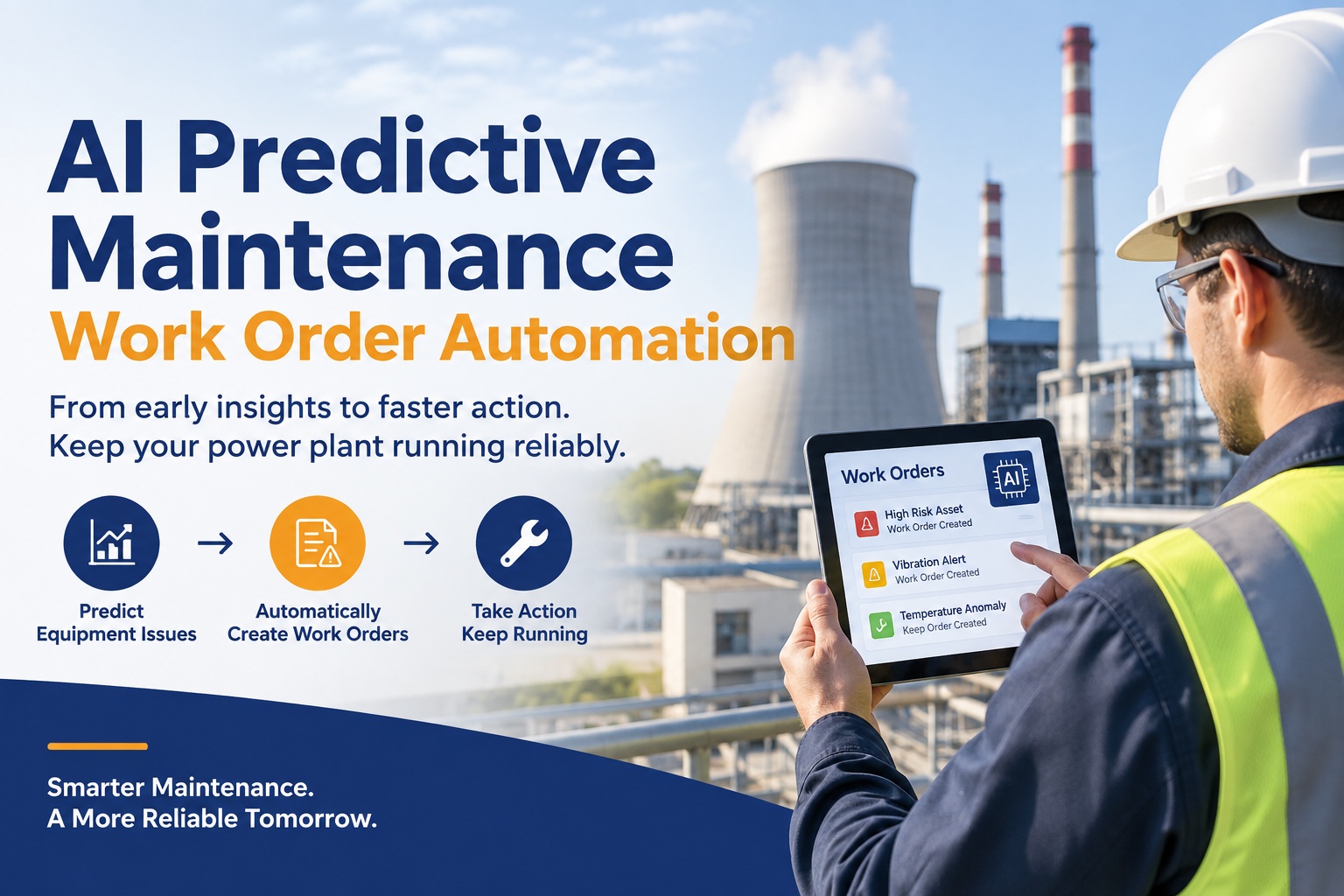
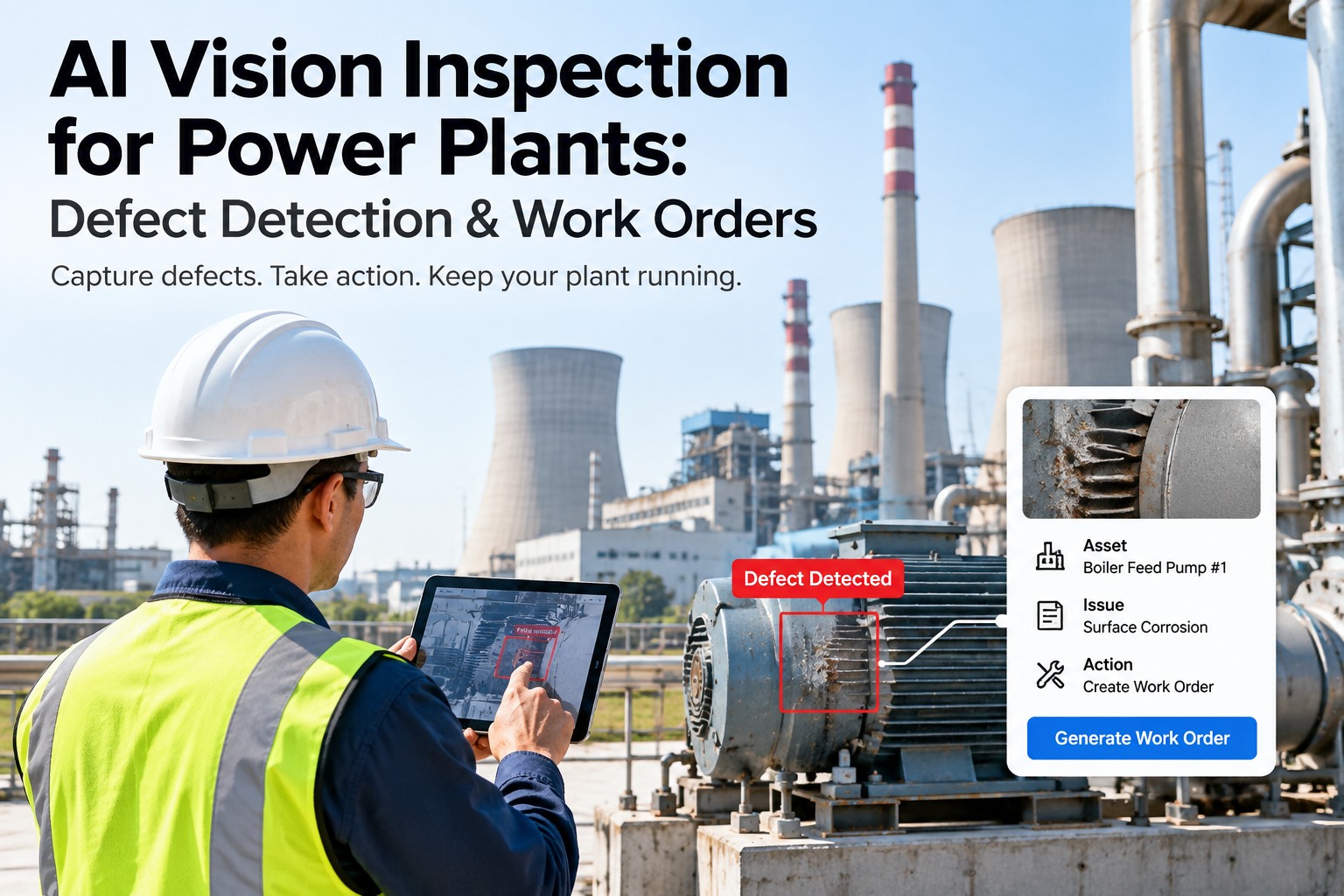
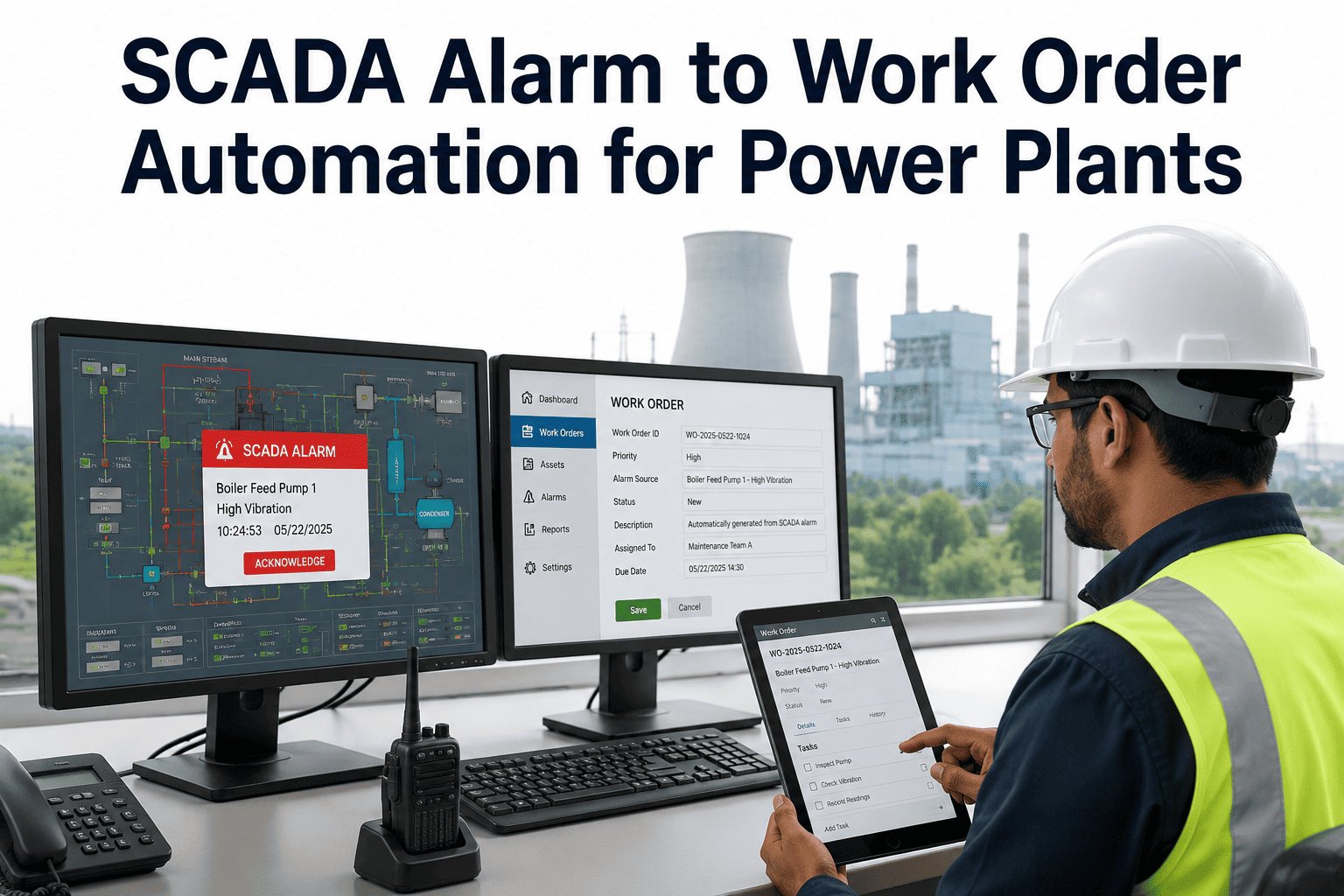
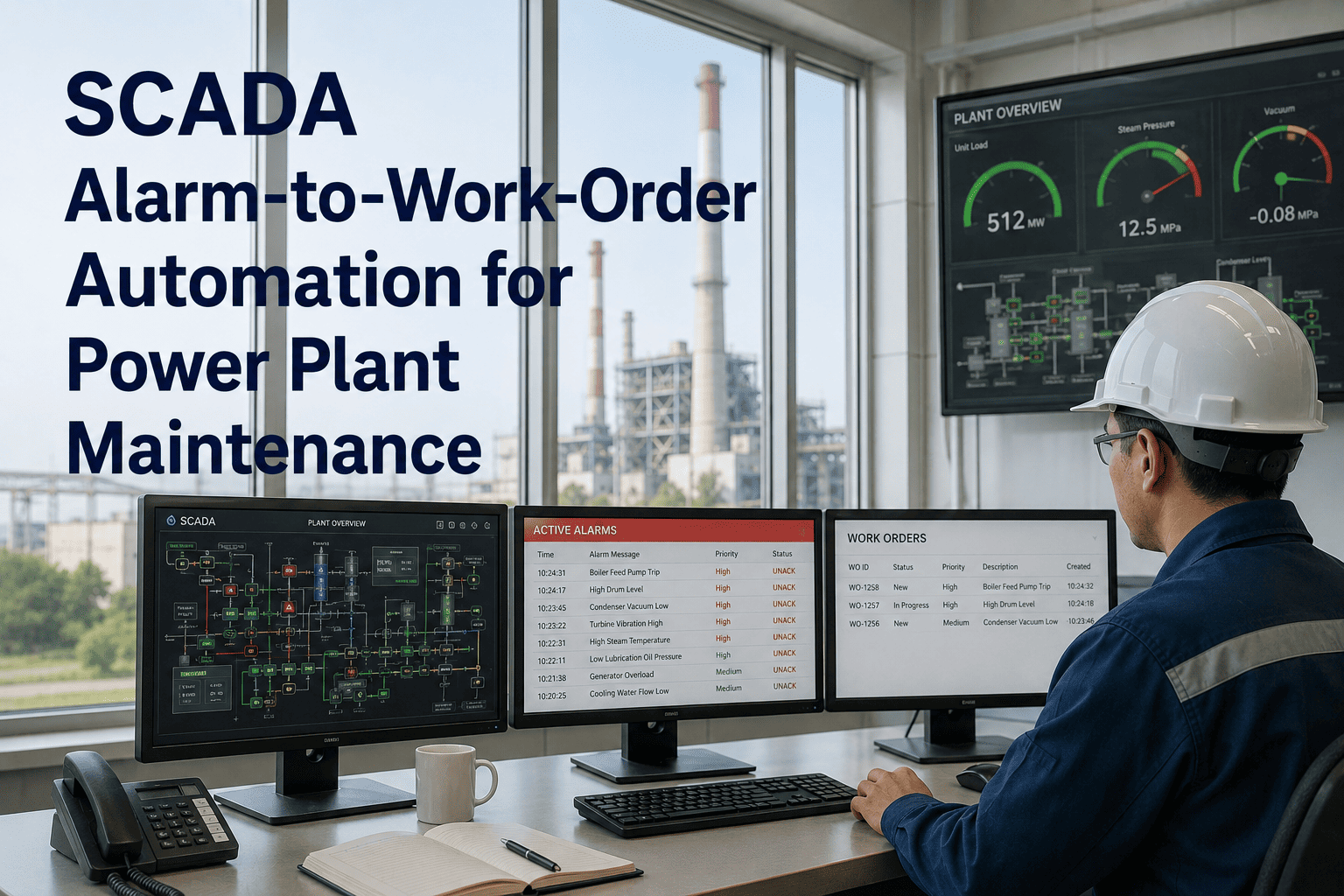
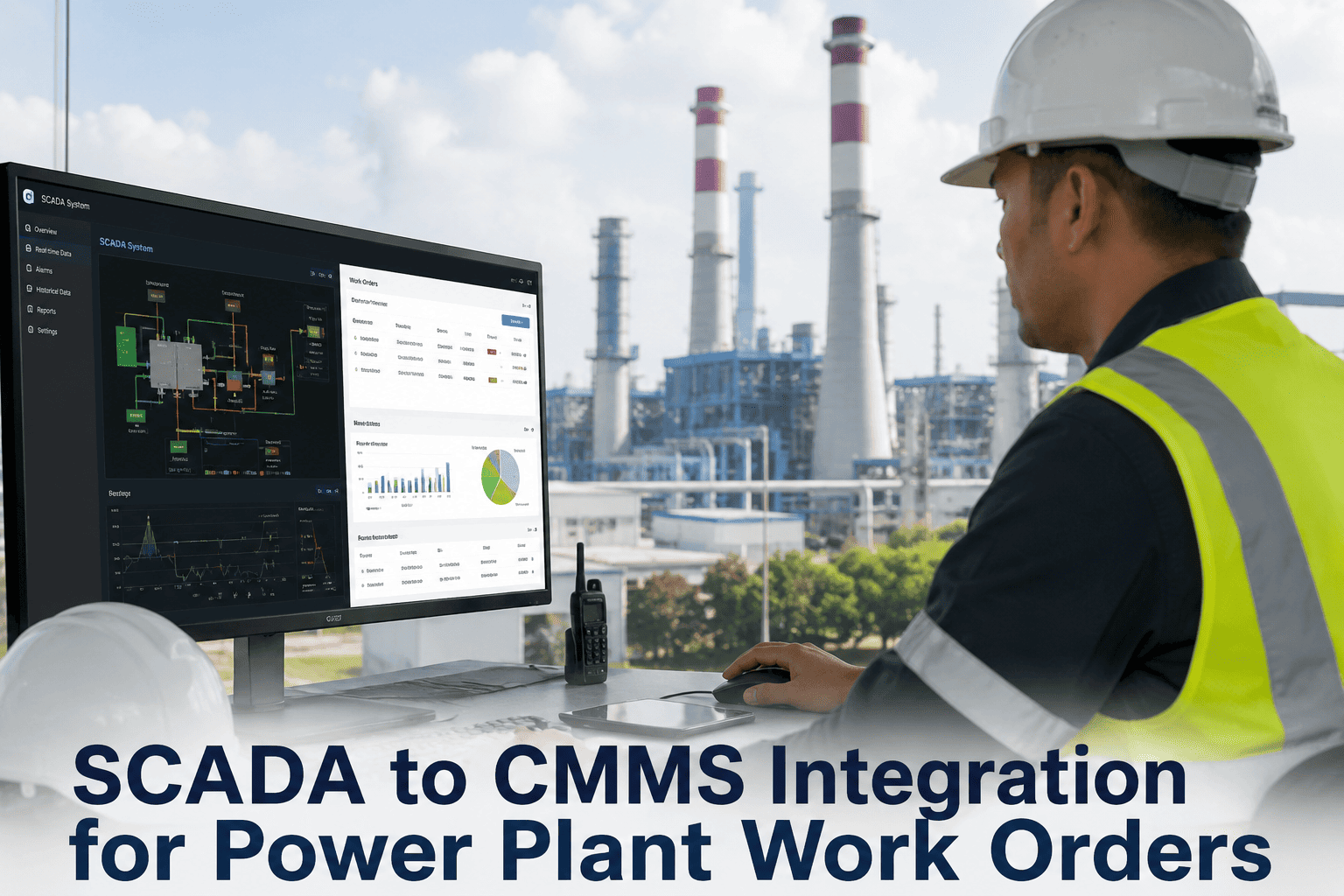
A predictive alert on a boiler feed pump only matters if it turns into a work order before the bearing fails — with the right parts, technician and permit already attached. That's the gap most power plants actually have: not detection, but the walk from inspection or alert to a scoped, assigned, tracked repair. OXMAINT AI is the maintenance management software that connects that path in one platform — inspections, defect reports and predictive alerts all become prioritized work orders, and every work order feeds back into your preventive and predictive maintenance schedule. This guide breaks down where that handoff usually breaks, what a fully-scoped work order should contain, and how OXMAINT AI runs the loop behind whatever condition-monitoring stack you already have.
Power Generation · Predictive Maintenance · Work Order Automation · 2026
AI Predictive Maintenance Work Order Automation for Power Plants
A predictive alert on a boiler feed pump only matters if it becomes a work order before the bearing fails — with the right parts, technician and permit already attached. OXMAINT AI is the maintenance management software that connects that path end to end: inspections, defect reports and predictive alerts all become prioritized work orders in one system, so preventive and predictive maintenance run on the same schedule instead of two disconnected processes.
Inspections & Predictive Alerts
→
Issues & Defects Logged
→
Work Order Created
→
PM & Predictive Schedule Updated
$2.2B → $5.6B
predictive maintenance in power generation, 2026 → 2035, 10.8% CAGR
$260K / hr
average cost of unplanned downtime at a power generation asset
70%
of predictive alerts go uninvestigated due to alert fatigue
60–70%
of PdM programs fail to show ROI within 18 months
Pain Point #7: Actionability — Why a Good Prediction Still Fails
Every plant we talk to has the sensors. Vibration monitoring on the turbine train, oil analysis on the gearbox, DGA on the step-up transformer — the detection layer is genuinely good in 2026. What breaks down is everything after the alert fires: no owner, no context, no parts, no clock. Sign up free and see every alert land as a scoped work order, not a dashboard ping.
⚠
Alert Fatigue
Flat thresholds fire on every asset the same way. Engineers see hundreds of pings a week and start ignoring the dashboard entirely — including the one that mattered.
🔍
No Asset Context
The alert says "bearing anomaly, Unit 3." It doesn't say which bearing, what the failure history is, or whether the unit is already down for an outage next week.
📦
No Parts Visibility
By the time someone checks the storeroom, the bearing, seal kit or gasket isn't in stock. A 45-day warning becomes a 5-day scramble waiting on a part.
🚫
No Escalation Path
A critical finding and a minor one land in the same inbox with the same urgency. Nothing forces the critical one up the chain when it's ignored for 48 hours.
Anatomy of an OXMAINT AI Auto-Generated Work Order
This is the difference. The moment a predictive model flags a deviation, OXMAINT AI doesn't post a notification — it builds the work order. Every field below populates automatically from asset history, inventory and your escalation rules, before a human ever opens the ticket. Book a demo to see a live alert build itself into a work order.
WO-48291 · Auto-Generated
Severity: High
01
Asset Context
Unit 2 boiler feed pump, ID BFP-204. Last 3 failure modes, hours since overhaul, and current load pulled straight from asset history.
02
Recommended Inspection
Vibration spectrum matched against the failure-mode library — outer race defect suspected. Inspection checklist attached automatically.
03
Parts & Inventory
Matching bearing kit checked against stock in real time. In stock → reserved. Out of stock → PO drafted the same hour, not the next outage window.
04
Technician Assignment
Routed to the nearest certified technician with a rotating-equipment skill tag and open capacity — not just whoever's on shift.
05
Permits & Safety
Lockout-tagout and hot-work permit templates attach based on asset class, so the crew isn't stalled waiting on paperwork on site.
06
Escalation Rule
If unacknowledged in 2 hours, it re-routes to the shift supervisor. If untouched in 8 hours on a High-severity asset, it escalates to the plant manager.
Dashboard Alert vs. OXMAINT AI Work Order
Same sensor, same anomaly, same failure mode — a completely different outcome depending on what happens in the next sixty seconds.
Alert Dashboard Alone
Sits in a queue with 40 other alerts
No indication of asset criticality or history
Technician has to check the storeroom manually
No permit, no checklist, no assigned owner
Nobody escalates it — it ages out unresolved
OXMAINT AI Work Order
Prioritized instantly against asset criticality
Full failure history & recommended inspection attached
Parts reserved or ordered the same hour
Permits & checklist ready before the technician arrives
Auto-escalates on a clock nobody can quietly ignore
A Prediction Without an Escalation Clock Is Just a Guess That Ages Well.
Set the severity tiers once. OXMAINT AI enforces them on every single alert, every shift, without a supervisor having to remember to check.
Escalation Rules — Built Into the Work Order, Not the Honor System
Watch
Early deviation, no action window pressure
Logged to the asset record. Reviewed at the next scheduled PM — no interrupt, no dispatch.
Elevated
Response required within 24 hours
Work order auto-created, technician assigned, parts checked. Escalates to supervisor if untouched by end of shift.
Critical
Response required within 2 hours
Immediate dispatch, permits pre-attached, plant manager notified in parallel. Unacknowledged after 2 hours = automatic phone/SMS escalation.
What Closing the Actionability Gap Actually Moves
Time from alert to acknowledged work order
Manual dashboard triage
~18–36 hrs
OXMAINT AI auto work order
< 5 min
Stale PdM findings, unresolved after 30 days
No CMMS loop
~40% of findings
Escalation-enforced
~6% of findings
Unplanned failures over 12 months
Reactive baseline
Baseline
Closed-loop PdM + CMMS
40–60% lower
What OXMAINT AI Gives Power Plant Reliability Teams
Auto Work Order Generation
Every predictive alert above threshold becomes a scoped, assigned work order — no operator has to remember to create it.
Asset-Specific Alert Tuning
Thresholds set per asset criticality, not a flat plant-wide number — so a critical turbine and an idle exhaust fan aren't treated the same.
Real-Time Parts Matching
Every work order checks inventory automatically and drafts a PO the moment a part is out of stock — not at the next stock-take.
Skill-Based Technician Routing
Findings route to the technician certified for that asset class, not just whoever's available on shift.
Configurable Escalation Rules
Severity tiers you set once — Watch, Elevated, Critical — enforced automatically on every alert, every shift.
Audit-Ready Work Order Trail
Alert → work order → parts → technician → close, timestamped end to end for internal reliability reviews.
"
We had vibration monitoring on every critical rotating asset for three years and our unplanned outages barely moved. The sensors were never the problem — a great prediction just sat in an inbox until someone had time to look at it. Once OXMAINT AI started turning findings straight into work orders with the parts already checked and a technician already assigned, our mean time to acknowledge dropped from over a day to minutes. The escalation rule is what actually changed behavior — nothing critical sits untouched anymore, because it stops being optional.
Reliability Manager · Combined-Cycle Power Plant
Frequently Asked Questions
What's the difference between a predictive maintenance alert and an OXMAINT AI work order?
An alert tells you something changed. An OXMAINT AI work order tells you what asset, what likely failure mode, what inspection to run, which parts are available, who's assigned, what permits are needed, and by when it must be acknowledged — automatically, the moment the alert fires.
Do we need to replace our existing predictive maintenance sensors or platform?
No. OXMAINT AI is vendor-agnostic — it connects to your existing vibration, oil analysis, thermal or DGA platform via open API and runs the work order, parts and escalation layer behind whatever detection stack you already have.
How are escalation rules configured for different asset classes?
You set severity tiers — Watch, Elevated, Critical — once per asset class or criticality group. OXMAINT AI applies the matching response-time clock and auto-escalation path to every alert on that asset from then on, with no manual re-tagging.
How fast can a power plant get this running?
Most plants go live in a few weeks — import your asset register and spares list, connect your PdM platform's alert feed via open API, and set your first escalation tiers. Alerts start generating scoped work orders from day one.
Stop Collecting Predictions. Start Closing Them.
Every alert your sensors already generate can become a scoped, owned, escalating work order — with asset context, parts and permits attached before a human even opens it. That's the loop OXMAINT AI runs.