Ai Predictive Maintenance For Power Plants Reduce Unplanned Downtime
By shreen on February 26, 2026
Every power plant operator knows the dread of an unplanned shutdown. A single turbine bearing failure at 2 AM can drain $500,000 before sunrise, with emergency contractor premiums, expedited parts shipping, and grid penalty fees compounding by the hour. Across the global energy sector, unplanned downtime costs utilities an estimated $1.4 trillion annually, representing 11% of total revenues for the world's largest companies. Yet 70% of power plants still lack real-time visibility into when critical equipment is approaching failure. The gap between reactive maintenance and intelligent prediction is where millions of dollars are either lost or saved every year. Oxmaint's AI-powered predictive maintenance platform gives power plant operators the tools to detect equipment degradation weeks before failure, automate work order generation, and convert crisis spending into controlled maintenance costs.
Power Plant Reliability Intelligence
Unplanned Downtime Costs Power Plants Over $300,000 Per Hour
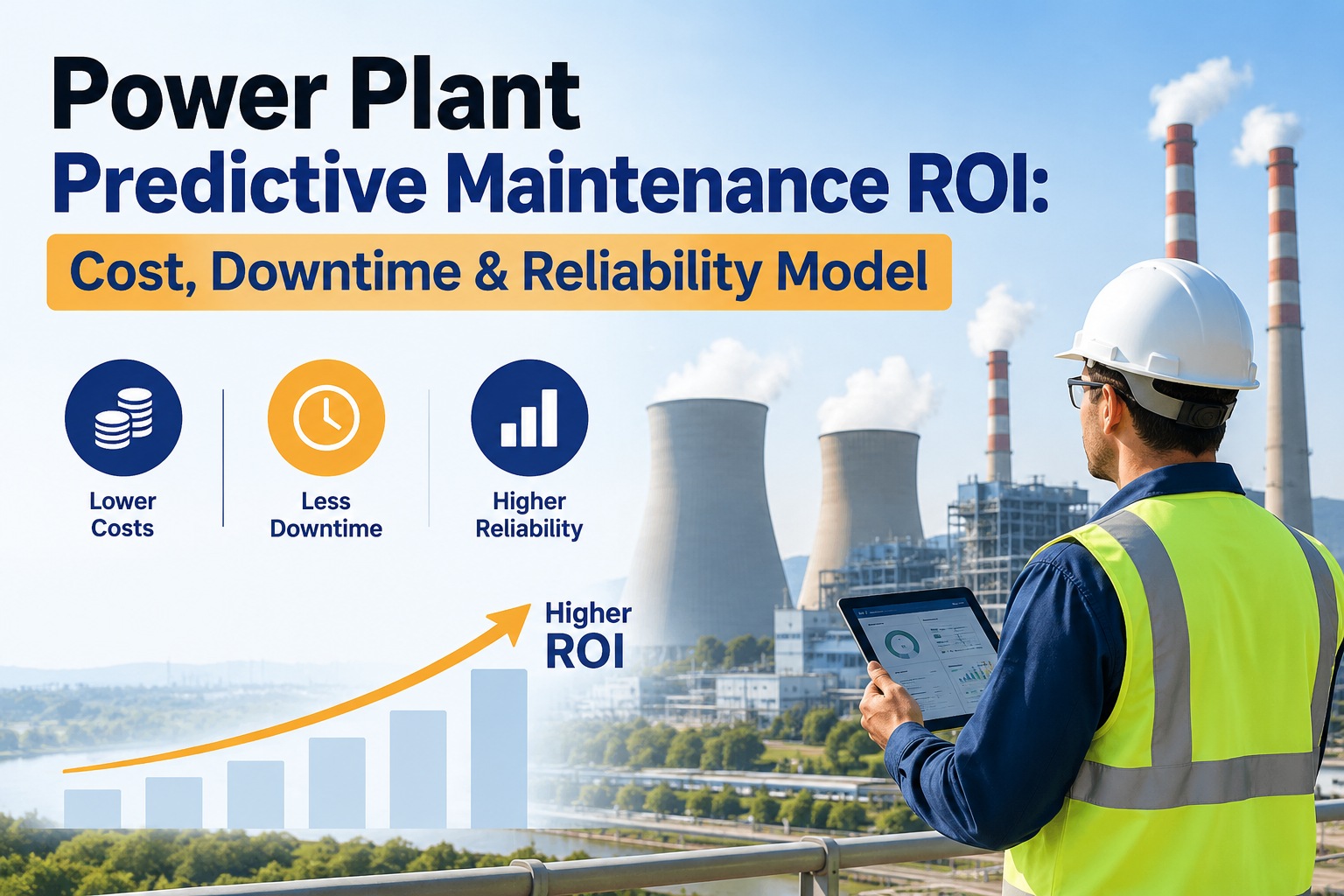
A typical 5.8-hour forced outage translates to $1.7 million in direct losses. With AI predictive maintenance, 85% of these failures become preventable weeks in advance.
$300K/hourDowntime Cost
85%predictedFailures Caught
35-50%reductionDowntime Cut
12-18monthsFull ROI
The Real Cost of Reactive Maintenance in Power Generation
Power plants running on reactive or calendar-based maintenance strategies are bleeding money through a cascade of hidden costs that extend far beyond lost megawatt-hours. Every forced outage triggers emergency repair premiums at 4-5x the cost of planned maintenance, expedited parts procurement with overnight shipping surcharges, replacement power purchases at volatile spot market prices, and regulatory penalties that can reach $1 million per incident. The math is clear: corrective maintenance after failure costs $17-18 per horsepower annually, while predictive maintenance costs just $7-13 per horsepower. For facilities with hundreds of thousands of horsepower in rotating equipment, that gap represents millions in recoverable savings. Book a demo to see how Oxmaint closes this gap for your plant.
Reactive vs. Predictive Maintenance for Power Plants
How AI-driven prediction transforms plant operations from crisis management to strategic reliability
Reactive / Calendar-Based
Equipment Failure Detection
After Breakdown Occurs
Average Repair Cost Multiplier
4-5x Emergency Premium
Monthly Unplanned Downtime
27-39 Hours Average
Annual Revenue Impact
$4M-$12M Lost Per Plant
AI Predictive / Condition-Based
Equipment Failure Detection
3-18 Months Before Failure
Average Repair Cost Multiplier
1x Planned Rate
Monthly Unplanned Downtime
9-14 Hours (50% Reduction)
Annual Revenue Impact
$2M-$8M Recovered
Average Annual Savings with Predictive Maintenance: $2.5M - $8M Per Plant
Critical Power Plant Equipment That Demands AI Monitoring
Not every piece of plant equipment justifies predictive investment. But the assets responsible for generation continuity, safety compliance, and catastrophic failure risk absolutely do. These six equipment categories account for over 90% of forced outages and emergency maintenance spending in power generation. Deploying AI monitoring on these systems alone delivers ROI that funds the entire predictive maintenance program. Plants using Oxmaint's intelligent maintenance platform prioritize these high-impact assets first, expanding coverage as the program proves value.
Six Critical Asset Categories for AI Predictive Monitoring
Gas & Steam Turbines
43%
Of all power plant equipment failures. Vibration, temperature, and bearing wear patterns predict failure 4-12 weeks ahead.
Boiler Systems
52%
Of forced outages in thermal plants from tube leaks. Corrosion, fatigue, and creep show detectable signatures months before rupture.
Generators
12%
Of forced outages from insulation degradation, bearing wear, and winding faults. Partial discharge monitoring catches failures 6-18 months early.
Transformers & Switchgear
Arc Flash
Fire and safety risk from aging equipment. Dissolved gas analysis, thermographic hot spots, and load patterns predict faults 3-18 months ahead.
Cooling Systems
8-15%
Efficiency loss from fouled condensers, cooling tower degradation, and pump cavitation. Flow and temperature trending detects drift in real time.
Balance of Plant
15%
Of forced outages from auxiliary systems: pumps, valves, compressors, and fuel handling. Vibration and current monitoring catches issues weeks ahead.
How AI Predictive Maintenance Works for Power Plants
AI predictive maintenance is not guesswork with better tools. It is a structured intelligence pipeline that converts continuous equipment performance data into failure forecasts with specific timelines, recommended actions, and cost impact projections. The system operates through four stages: continuous data ingestion from SCADA, DCS, and IoT sensors; AI-powered anomaly detection comparing real-time behavior against learned baselines; failure probability scoring with remaining useful life estimation; and automated work order generation with parts, labor, and timing recommendations. Plants implementing this pipeline through Oxmaint connect their existing monitoring systems to predictive algorithms without replacing any current infrastructure.
Four-Stage AI Predictive Maintenance Pipeline
01
Continuous Monitoring
SCADA/DCS data: temp, pressure, vibration, flow
IoT sensors: acoustics, current, thermal imaging
CMMS history: repairs, parts, failure codes
Ingestion: Every 30 Seconds
02
AI Anomaly Detection
Compare real-time vs learned equipment baselines
Detect subtle degradation invisible to operators
Cross-reference load, ambient, and fuel variables
Accuracy: 85-92%
03
Failure Forecasting
Remaining useful life estimation per asset
Risk scoring: safety, generation, cost impact
Prediction timeline: weeks to months ahead
Lead Time: 3-18 Months
04
Automated Action
Work orders auto-generated with parts and labor
Optimal timing aligned to generation schedules
Cost avoidance documented for executive reporting
Response: Weeks Ahead
Predict Failures Before They Shut Down Your Plant
Oxmaint connects to your existing SCADA, DCS, and sensor systems to detect equipment degradation patterns invisible to manual inspection, then auto-generates work orders so your team intervenes during planned windows, not during peak demand.
What AI Catches and When: Detection Windows by Equipment Type
Each critical power plant asset produces distinct degradation signatures that AI algorithms detect at different lead times. Understanding what the system monitors, what patterns indicate impending failure, and how far in advance intervention is possible helps plant managers prioritize sensor deployment and set realistic expectations for program outcomes. Schedule a demo to see these predictive models applied to your specific plant asset portfolio.
AI Predictive Detection Windows by Equipment Type
What AI monitors, what it detects, and how far ahead it predicts failure
Gas Turbines
Vibration signatures, exhaust temperature spread, compressor efficiency, bearing metal temperature trending
Dissolved gas analysis, thermographic hot spots, load tap changer operation count, oil dielectric strength
3-18 Months
Auxiliary Systems
Pump vibration, valve actuator current, compressor discharge pressure, fan bearing temperature profiles
2-8 Weeks
Overall Predictable Failure Rate
85%
The 15% of failures not predicted are typically sudden catastrophic events, manufacturing defects, or external damage that produce no degradation pattern. Every gradual wear-based failure mode shows detectable signatures when the right data is monitored.
ROI of AI Predictive Maintenance for Power Plants
The financial case for predictive maintenance in power generation is not theoretical. Every prevented forced outage avoids 4-5x cost multipliers from emergency labor, expedited parts, temporary generation procurement, and cascade damage to adjacent systems. Plants that present this ROI data to executive leadership consistently secure capital funding that reactive-mode budget requests never achieve. Here is the documented ROI breakdown for a typical 500MW thermal power plant.
Annual ROI: AI Predictive Maintenance Program
500MW thermal power plant with 200+ monitored assets
Forced Outage Avoidance
8 prevented forced outages at avg $420,000 emergency cost avoided per event
$3,360,000
Heat Rate Optimization
Fault detection eliminates 3-5% efficiency waste from degraded components and suboptimal tuning
$1,200,000
Equipment Life Extension
Optimal maintenance timing extends critical asset life 15-25%, deferring $8M in capital replacement
$960,000
Regulatory Penalty Avoidance
Prevent SAIFI/SAIDI violations and grid reliability penalties averaging $200K per incident
$600,000
Maintenance Labor Optimization
35% increase in wrench-time, technicians fix instead of diagnose, reduced overtime costs
$480,000
Total Annual Value Delivered
$6.6M
Platform investment: $300K-$500K/year including software, IoT sensors, and integration. Net ROI: $6.1M-$6.3M. Return: 12-22x in first year. Value compounds as AI models mature with additional plant-specific operational data.
Implementation: From Pilot to Plant-Wide Predictive Operations
Deploying AI predictive maintenance follows a structured path that delivers measurable value at each phase. The critical insight: start with the 15-20% of assets that cause 70% of your forced outages. Prove value fast. Expand with evidence. Sign up for Oxmaint to design a phased deployment plan for your specific plant.
Phased Implementation Roadmap
01
Month 1-2: Connect
Audit existing SCADA, DCS, and sensor data
Select top 10-15 highest-risk critical assets
Connect data feeds to Oxmaint platform
Output: Full Visibility
02
Month 3-6: Detect
AI learns asset baselines in 2-4 weeks
First fault detections and predictive alerts
Deploy IoT on highest-cost rotating equipment
Savings: $800K-$1.5M
03
Month 7-12: Prevent
Expand to all generation-critical equipment
Predictive work orders embedded in daily workflow
First executive report with documented ROI
Savings: $3M-$6M
04
Year 2+: Optimize
Full plant coverage on all monitored assets
AI models continuously improving accuracy
Capital planning driven by condition data
Return: 12-22x ROI
Stop Losing Millions to Preventable Outages
Join power plant operators saving $2.5M-$8M annually through AI-driven predictive maintenance. Your first efficiency gains are just weeks away with Oxmaint.
How much can AI predictive maintenance actually save a power plant annually?
Documented results show 35-50% reduction in unplanned downtime, translating to $2.5M-$8M in annual savings for a typical 500MW plant. A major U.S. utility deployed over 400 AI models across 67 generation units and achieved $60 million in annual savings while reducing carbon emissions by 1.6 million tons. The key drivers are avoided emergency repair premiums (4-5x planned costs), prevented grid penalties, and optimized heat rate performance. Most plants recover their entire platform investment from a single prevented major forced outage. Sign up for Oxmaint to start building your predictive maintenance program today.
Do we need to replace our existing SCADA or DCS systems to deploy AI predictive maintenance?
No. Modern predictive maintenance platforms are designed to layer on top of existing infrastructure, not replace it. Oxmaint connects to legacy SCADA and DCS systems through standard industrial protocols (OPC-UA, Modbus, DNP3) using protocol gateways. It integrates with existing CMMS and historian systems via API connections established in days, not months. For equipment with minimal instrumentation, standalone wireless IoT sensors at $100-$500 per monitoring point fill data gaps without any control system modifications. Most plants achieve initial integration within 4-8 weeks using existing hardware.
How accurate are AI failure forecasts for power plant equipment?
For fault detection such as identifying current operational problems like stuck valves, bearing degradation, or sensor drift, accuracy exceeds 90% from the first week because rules-based detection works immediately upon data connection. For predictive failure forecasting, models need 2-4 weeks to learn each asset's normal operating baseline, with accuracy improving over 3-6 months. By month 6, most plants report 85-92% prediction accuracy for major equipment failure modes. The 15% of failures that aren't predicted are typically sudden catastrophic events that produce no degradation pattern.
Which equipment should we prioritize first for AI predictive monitoring?
Start with the assets that cause the most costly forced outages: gas and steam turbines (43% of all equipment failures), boiler tube systems (52% of thermal plant forced outages), generators, and main power transformers. Deploy IoT sensors on these critical assets first, prove value within 90 days, and expand from there. This targeted approach typically costs $50K-$100K for initial sensor deployment and delivers $1M-$3M in first-year avoided failures. Book a demo to build your prioritized deployment plan with our power generation specialists.
What is the typical payback period for implementing AI predictive maintenance?
Most power plants achieve positive ROI within 6-12 months of full deployment. Industry data shows 95% of organizations implementing predictive maintenance report positive returns, with 27% achieving full payback within the first year alone. Against an annual platform investment of $300K-$500K, the typical first-year value of $3M-$6M represents a 6-20x return. Leading implementations like Duke Energy's program demonstrate 36% outage reductions across their generating fleet. Value compounds as AI models improve and coverage expands to additional plant systems.