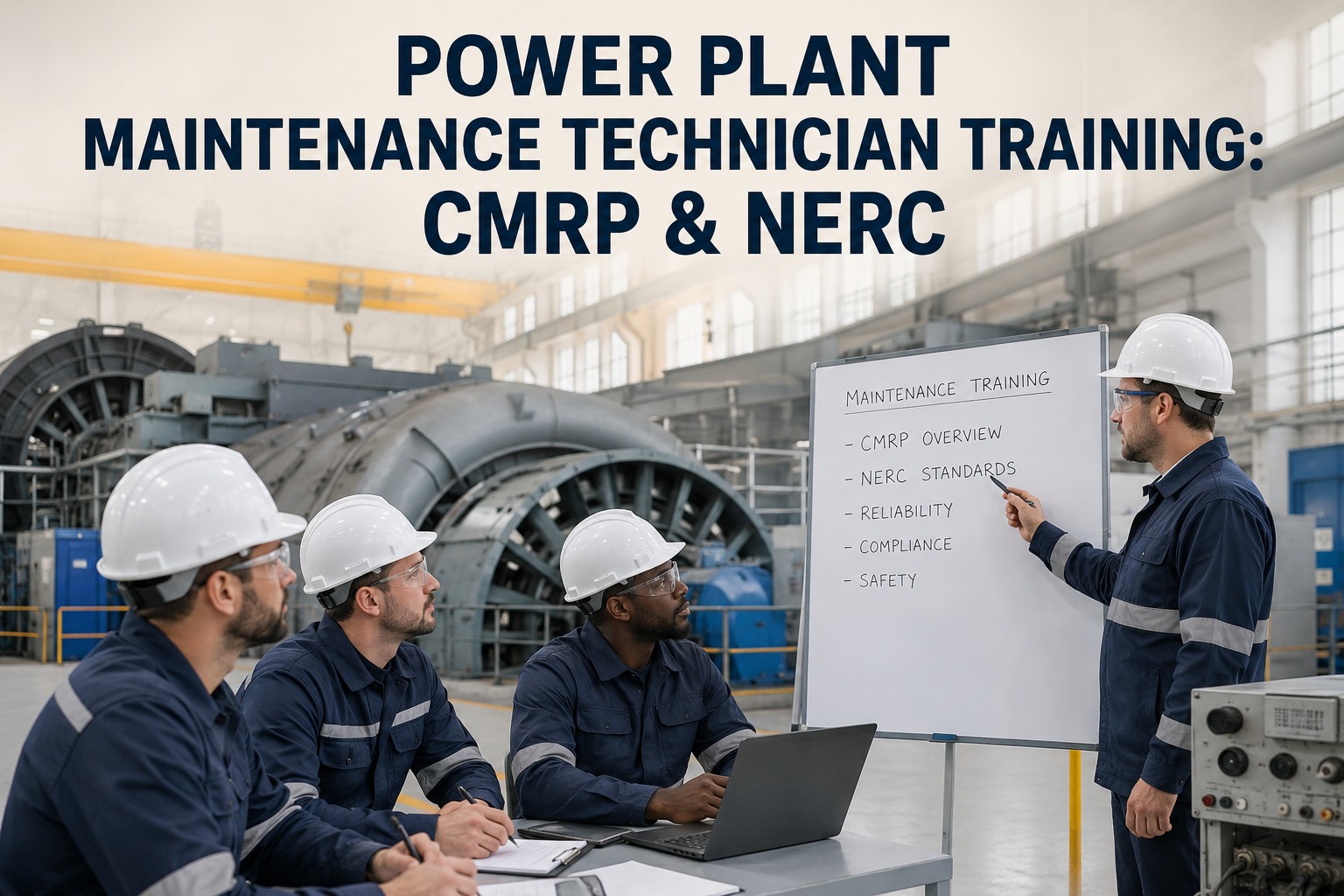
Power plant maintenance technician training has shifted from an HR checkbox to a strategic reliability lever. With nearly half of the skilled trades workforce nearing retirement and NERC auditors demanding documented evidence of competency for every maintenance task, plants can no longer afford informal, tribal-knowledge skill transfer. This page lays out a 2026-ready training roadmap spanning CMRP certification pathways, NERC compliance training, turbine specialist development, and boiler inspector qualification — and shows how OxMaint CMMS ties certification records, skill tags, and qualified-technician assignment into a single auditable system. Book a demo to see the workforce module in action.
Power Plant Maintenance Technician Training: CMRP & NERC
A structured roadmap for building, certifying, and deploying maintenance technicians across generation assets — aligned to CMRP competency standards, NERC PER-005 training requirements, OEM turbine intervals, and boiler inspector qualification pathways.
CMRP Certification as a Competency Benchmark
The Certified Maintenance & Reliability Professional (CMRP) credential, administered by SMRP, is the most widely recognized competency benchmark for reliability-focused maintenance technicians in power generation. It validates five knowledge domains that map directly to plant performance outcomes.
Business & Management
Aligning maintenance work to plant availability targets, cost control, and capital project planning. Technicians learn to justify reliability investments, not just execute wrench-turning tasks.
Manufacturing Process Reliability
Understanding how equipment degradation propagates through generation systems — from feedwater pumps to steam turbine bearings — and how maintenance decisions affect overall plant heat rate.
Equipment Reliability
Failure mode identification, FMEA participation, condition monitoring program design, and life-cycle asset management for critical generation equipment classes.
Organization & Leadership
Work order planning, crew coordination, shift handoff discipline, and the communication skills needed to mentor junior technicians through structured OJT programs.
Work Management
Preventive maintenance optimization, backlog control, scheduling compliance, and the CMMS workflow literacy that separates a technician from a reliability contributor.
NERC Compliance Training Requirements
NERC standard PER-005 requires that every person performing or actively supervising Real-Time operations be deemed competent through a documented training program. While PER-005 targets operators, maintenance work on Bulk Electric System (BES) assets triggers parallel documentation obligations under PRC-005 and TOP-003 — and auditors expect training records that tie specific competencies to specific work orders.
| NERC Standard | Training Scope | Who Must Complete | Documentation Required | Audit Cycle |
|---|---|---|---|---|
| PER-005 | System operator competency, emergency operations, restoration drills | Real-time operators; maintenance leads coordinating outages on BES assets | Training plan, completion records, simulator hours, annual refresher logs | Annual |
| PRC-005-6 | Protection system maintenance — relay, breaker, battery testing competency | Electrical maintenance technicians working on protection systems | Qualified-personnel evidence, test procedure training, calibration competency | Per maintenance interval (varies 1–6 yrs) |
| TOP-003-3 | Coordination of planned maintenance affecting transmission operations | Maintenance planners and supervisors scheduling BES outages | Notification training records, coordination procedure acknowledgment | Biennial |
| FAC-003-4 | Vegetation management and right-of-way maintenance competency | Line maintenance crews and vegetation contractors | Training on clearance distances, ANSI Z133, herbicide application | Annual |
| CIP-007-6 | Cybersecurity awareness for BES Cyber System maintenance | Technicians with physical or logical access to CIP-identified assets | Cyber awareness training, access authorization records, role-based training | Annual + on role change |
What NERC Auditors Actually Ask For
During a compliance audit, NERC will request evidence that the technician who performed a specific protection-system test or BES maintenance task was qualified at the time the work was executed. A spreadsheet of training completions is insufficient — you must demonstrate a traceable link between the individual's qualification record, the work order they completed, and the date the work was performed. This is where CMMS-integrated training records become essential.
Turbine Specialist Skill-Building Pathway
Turbine maintenance is the highest-risk, highest-consequence work in a power plant. Developing a turbine specialist requires a structured progression through inspection techniques, diagnostic technologies, and OEM-specific procedures — typically a 5–7 year journey from apprentice to lead specialist.
Foundation & Combustion Inspection
- Combustion inspection (CI) technique — fuel nozzle removal, liner scoring, transition piece fit-up per OEM standard
- Borescope navigation through turbine upper-half casing sections
- Hot-gas-path component identification and damage cataloging
- OEM tooling certification (GE, Siemens, Mitsubishi procedures)
Hot Gas Path & Vibration Diagnostics
- Hot gas path (HGP) inspection — stage 1–3 blade and vane assessment, shroud measurement
- Vibration spectrum analysis — FFT interpretation, orbit plots, phase analysis
- Bently Nevada / SKF condition monitoring system operation
- Rotor balancing fundamentals and runout measurement
Major Inspection & Advanced Diagnostics
- Major inspection (MI) — rotor removal, wheel-space inspection, diaphragm assessment
- Advanced borescope — video probe articulation, 3D blade profiling
- Bearing journal inspection and babbitt condition assessment
- Non-destructive evaluation oversight — dye penetrant, magnetic particle, ultrasonic
Lead Specialist & Outage Management
- Outage scope development and critical-path scheduling
- OEM technical directive interpretation and field implementation
- Root-cause-failure analysis leadership for forced outage events
- Mentorship of Y1–4 technicians through structured OJT modules
Boiler Inspector Training & Qualification
Boiler inspection in power generation is governed by the National Board of Boiler and Pressure Vessel Inspectors. Unlike general maintenance certifications, boiler inspector qualification is a formal licensing pathway with jurisdictional authority behind it — and recertification is non-negotiable.
Inservice Inspection Commission (NB "R" Endorsement)
The National Board commission for inservice inspection is the baseline qualification for technicians inspecting operating power boilers. Requires passing a 50-question exam and maintaining a valid commission through the jurisdiction's chief inspector.
Authorized Inspector (AI) — "A" Endorsement
For technicians overseeing ASME Code repairs and alterations on pressure-retaining boundaries. Requires employment by an Authorized Inspection Agency and completion of the National Board AI examination.
Recertification Cadence
National Board commissions expire every three years. Recertification requires 30 professional development hours, including documented attendance at the National Board Inspection Code (NBIC) training. Missed recertification voids the commission — the technician cannot legally sign inspection reports until reinstated.
Jurisdictional Variations
Some states (Ohio, Texas, California) impose additional licensing layers beyond the National Board commission. Plant training coordinators must track not just the federal/national credential but the specific state stamp for every inspector on site.
CMMS-Integrated Training Records & Skill Tagging
The gap between having trained technicians and being able to prove it during an audit is where most plants fail. A CMMS that stores certifications, training status, and skill tags alongside the work order system closes that gap — and ensures the right technician is assigned to the right job every time.
- Training records live in an HR spreadsheet, disconnected from work orders
- No way to verify at assignment time whether a technician holds the required certification
- Audit preparation takes weeks of manual cross-referencing between HR and maintenance systems
- Expired certifications go unnoticed until an auditor flags them — or a safety incident exposes them
- Skill gaps are invisible; supervisors assign based on availability, not qualification
- Every technician profile carries live certification status, expiration dates, and skill tags
- Work orders with qualification requirements auto-filter to only eligible technicians
- Audit-ready report generates in seconds — work order, technician, qualification evidence, date
- Automated alerts 60/30/0 days before any certification expires, with assigned remediation tasks
- Skill-gap dashboards show which technicians are progressing through the turbine or boiler pathway
Certification Tracking
Store CMRP, NERC PER-005, National Board commissions, OEM-specific credentials, and state licenses in a single technician profile with automated expiration alerts.
Skill Tag Assignment
Tag each technician with competency levels across equipment classes — turbine CI, HGP, MI; boiler R-stamp; relay protection; vibration analysis — and filter work orders accordingly.
Qualified-Technician Routing
Work order templates define required qualifications. OxMaint's scheduler surfaces only technicians whose tags and certifications are current, preventing misassignment.
Audit Evidence Export
One-click report ties a completed work order to the assigned technician's qualification record at the time of execution — exactly what NERC and internal auditors request.
Training Plan Linkage
Map each technician to a development pathway (apprentice → specialist → lead) and track OJT module completion, exam scores, and mentor sign-offs inside the same system.
Compliance Calendar
Visual timeline of all upcoming training due dates, recertification windows, and NERC refresher requirements across the entire maintenance workforce — no surprises.
Frequently Asked Questions
How long does it take to prepare a technician for CMRP certification?
SMRP does not mandate a minimum preparation period, but most power plant technicians need 4–6 months of structured study to cover all five knowledge domains. Technicians with 3–5 years of hands-on maintenance experience typically require less time. OxMaint's training plan module lets supervisors assign SMRP-aligned study modules and track completion against each technician's target exam date.
What NERC training records must a maintenance department maintain?
Maintenance teams working on BES assets must document training relevant to PRC-005 protection system maintenance, TOP-003 outage coordination, and CIP-007 cybersecurity awareness. Records must include the training content, completion date, instructor or provider, and the technician's demonstrated competency. NERC requires these records be retained for a minimum of five years and be producible within 72 hours of an audit request.
Can OxMaint prevent a work order from being assigned to an unqualified technician?
Yes. Work order templates in OxMaint can define required skill tags and active certifications. When a planner or supervisor opens the scheduling view, the system filters the available technician list to only those whose qualifications are current and match the work order requirements. If no qualified technician is available, the system flags the constraint and can trigger a training task.
How does OxMaint handle National Board boiler inspector recertification tracking?
Each inspector's National Board commission number, endorsement type, and expiration date are stored in their technician profile. OxMaint sends automated alerts at 90, 60, and 30 days before expiration, assigns a recertification task to ensure the 30 PDH requirement is met, and — if the commission lapses — removes the inspector's boiler inspection qualification tag so they cannot be assigned to sign inspection reports.
What does a turbine specialist training pathway look like inside OxMaint?
Supervisors build a multi-year pathway with milestones: Year 1–2 combustion inspection and borescope fundamentals, Year 3–4 hot gas path inspection and vibration analysis, Year 5–6 major inspection and advanced NDE oversight, Year 7+ outage management. Each milestone has required OJT modules, OEM course completions, and mentor sign-offs. OxMaint tracks progress and surfaces specialists-in-training for appropriate work order assignments as they advance.
Build a Workforce That's Auditable, Qualified, and Ready
Stop tracking technician certifications in spreadsheets that auditors reject and supervisors can't act on. OxMaint CMMS connects training records, skill tags, and work order assignment in one system — so every maintenance task goes to a qualified technician, and every audit is a report away.