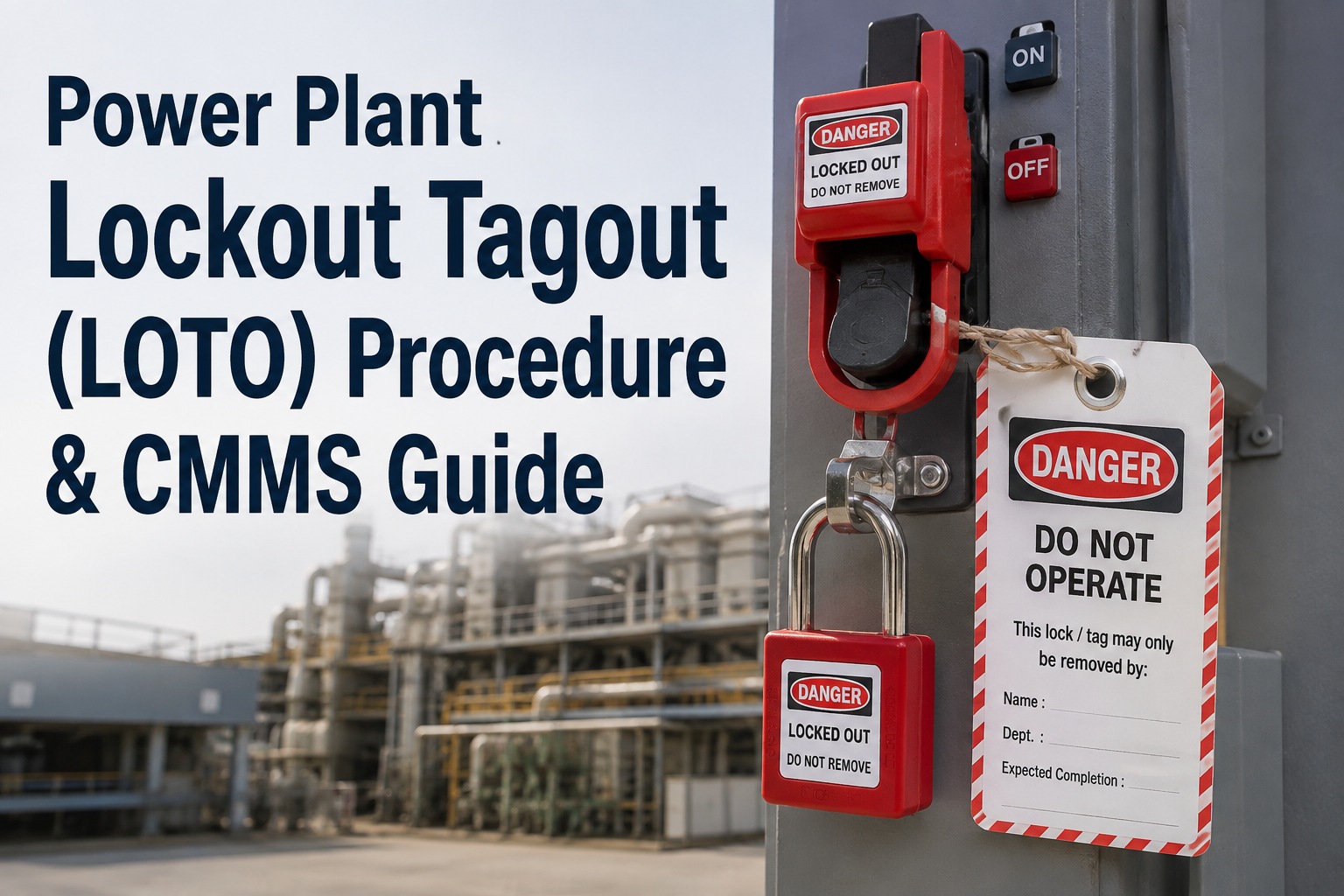
Power plant lockout tagout (LOTO) procedures are the controlled energy isolation steps that protect maintenance crews from catastrophic releases of hazardous energy during turbine overhauls, boiler inspections, and generator servicing. A single missed isolation point on a 500 MW steam turbine can cause fatal arc-flash events, weeks of unplanned downtime, and OSHA fines exceeding $15,000 per willful violation. This guide maps the complete power plant LOTO procedure — from electrical isolation and boiler lockout to turbine de-energization — and shows how modern CMMS-based digital LOTO workflows eliminate paper tag errors. See how OxMaint enforces real-time compliance by starting your Start Free Trial or booking a 30-minute demo today.
Can your current LOTO procedure survive a surprise OSHA audit on a live turbine?
Over 50,000 energy isolation incidents are reported annually across U.S. power generation. One missed lock on a boiler feed pump or generator breaker causes fatal arc flashes, weeks of forced outages, and six-figure compliance penalties. Digital LOTO powered by an AI-driven CMMS closes the gap between paper procedures and zero-harm execution.
Step-by-Step Power Plant Lockout Tagout Procedure for Turbines, Boilers & Generators
A compliant power plant LOTO procedure follows OSHA 29 CFR 1910.147 — six sequential phases that isolate every energy source before a single bolt is turned. Skipping or reordering any step accounts for roughly 80% of all LOTO-related incidents in power generation facilities.
Notify all affected employees before shutdown. Identify every energy type — electrical, hydraulic, pneumatic, thermal (steam), chemical, and gravitational. A 500 MW boiler-turbine cycle typically has 40-80 isolation points across feedwater, reheat, extraction, and cooling systems.
Follow manufacturer shutdown sequences. Ramp the turbine down per rated load curves, close boiler fuel valves, and trip the generator breaker. Never bypass interlocks — doing so masks energy states that can violently re-energize during isolation.
Open main electrical disconnects, rack out generator breakers, close steam stop valves, and block hydraulic accumulators. Physically separate the equipment from every energy source — do not rely on control-circuit interlocks or push-button stops as isolation.
Each authorized technician applies a personal padlock and durable tag at every isolation point. For boiler LOTO, install blinds or spectacle flanges on steam lines. Each tag must list the worker's name, date, and specific reason for isolation — no shared or master keys allowed.
Discharge stored energy: drain steam headers, release hydraulic pressure, ground capacitor banks, and vent compressed air. Then attempt to start the equipment using normal controls to confirm it will not operate. Measure voltage with a calibrated meter — assume nothing.
After work is complete, ensure the area is clear of tools and personnel. Each worker removes their own lock and tag — never another worker's. Re-energize in the reverse order of isolation, verify interlocks, and notify affected employees before returning the unit to service.
Turbine Lockout, Boiler LOTO & Generator LOTO: Critical Isolation Differences
Power generation assets carry distinct hazard profiles — the boiler LOTO procedure for a 600 psi steam drum is fundamentally different from the generator LOTO for a 13.8 kV bus connection. Misapplying one procedure to another asset causes 30-50% of LOTO near-misses.
| Asset / System | Primary Hazard | Isolation Points | Verification Method | Average Lockout Time |
|---|---|---|---|---|
| Steam Turbine | Residual steam, rotor spin, thermal expansion | Main stop valves, extraction non-return valves, lube oil pumps, turning gear | Steam header pressure to 0 psig, rotor at rest, bearing temp <60°C | 4-8 hours |
| Boiler & Auxiliary Systems | High-pressure steam, hot water, fuel ignition | Fuel gas/pulverizer cutoffs, feedwater valves, blowdown lines, ID/FD fans | Drum pressure 0, fuel valves double-blocked & bled, furnace purged | 6-12 hours |
| Generator & Switchgear | High-voltage arc flash, stored capacitive energy | Generator breaker racked out, field excitation breaker, neutral ground | Voltage tested at 0V phase-to-ground, capacitance discharged & grounded | 3-6 hours |
| Condensate & Feedwater | Hydraulic pressure, chemical treatment dosing | Pump suction/discharge valves, dosing pump isolation, surge tank vents | Pipe pressure 0 barg, dosing lines drained & blanked | 2-4 hours |
A 600 MW combined-cycle plant running paper LOTO on 180+ assets spent an average of 18 hours per forced outage tracking down missing isolation logs and reconciling tags across three shifts. After implementing OxMaint digital LOTO with QR-scanned lockout points, the same plant cut isolation verification time by 62%, eliminated three recurring audit findings within the first quarter, and reduced forced-outage duration from 18 hours to 7 hours — saving an estimated $340,000 per avoided outage day in replacement power costs.
How OxMaint Digital LOTO Eliminates Paper-Based Power Plant Lockout Failures
Paper lockout tags get lost, smudged, or left in lockboxes after work ends. A CMMS-based digital LOTO workflow enforces every OSHA 1910.147 step electronically — creating an immutable audit trail that reduces lockout errors by up to 90% and cuts compliance documentation time from hours to seconds.
Enforced Sequential Isolation
OxMaint forces technicians to complete and verify each LOTO step in exact sequence before the work order advances — no skipping, no working out of order. Cuts lockout procedure errors by up to 90%.
QR-Scanned Asset Verification
Each isolation point carries a QR code. Technicians scan to confirm they are at the correct valve or breaker — OxMaint cross-checks against the asset hierarchy in real time to prevent wrong-point isolation.
Real-Time Shift Handoff & Audit Trail
Every lock applied, verified, and removed is time-stamped, GPS-tagged, and tied to the technician's digital ID. Shift handoffs carry full isolation context — no lost paper tags between crews.
AI-Predicted LOTO Scheduling
OxMaint's predictive engine flags when turbine or boiler conditions will require isolation — pre-generating LOTO work orders with correct isolation points 5-14 days before failure occurs.
The Real Cost of Paper-Based LOTO vs. CMMS LOTO in Power Generation
A mid-sized 500 MW power plant running paper LOTO across 200+ assets spends an estimated $42,000-$75,000 annually on compliance documentation, audit prep, and near-miss incident overhead. CMMS-based digital LOTO recovers that cost within the first quarter of implementation.
- ✕ Manual tag reconciliation: 4-6 hours per outage
- ✕ Average 2-3 OSHA citations per audit cycle
- ✕ Tags lost, smudged, or left in lockboxes post-work
- ✕ No real-time visibility into who holds which locks
- ✕ Shift handoff gaps cause 15-20% of near-misses
- ✕ Audit prep takes 40+ labor hours per compliance cycle
- ✓ Automatic digital log: generated in real time, 0 hours
- ✓ Zero citations — full 1910.147 compliance built in
- ✓ Electronic tags cannot be lost or bypassed
- ✓ Live dashboard shows every active lockout by asset
- ✓ Shift handoff carries complete digital isolation context
- ✓ Audit-ready reports exported in under 5 minutes
Stop trusting paper tags with your crew's safety and your plant's uptime.
See how OxMaint digital LOTO enforces OSHA 1910.147 compliance on every turbine, boiler, and generator — with real-time audit trails your safety team will actually thank you for.
Power Plant LOTO & CMMS Lockout — What Teams Ask Most
A power plant LOTO procedure is the documented sequence of isolating hazardous energy sources — electrical, steam, hydraulic, pneumatic, and thermal — before maintenance begins. Only authorized employees who have completed OSHA 1910.147 training and plant-specific energy isolation certification may apply locks and tags. Each worker uses a personal padlock with a unique key; no shared or master keys are permitted under any circumstances.
CMMS-based digital LOTO replaces paper tags with enforced electronic workflows that require technicians to complete each isolation step in sequence, scan QR codes for positive asset identification, and upload verification photos before the work order progresses. This creates a tamper-proof audit trail, reduces documentation time by up to 95%, and eliminates the lost-tag and shift-handoff gaps that cause most compliance failures. You can see OxMaint's digital LOTO workflow firsthand — Book a Demo to explore it on your assets.
The top three citations are: (1) incomplete energy source identification — failing to isolate secondary or stored energy like residual steam or charged capacitors; (2) using group lockout without individual locks, where one worker's lock covers an entire crew; and (3) inadequate periodic inspections, which OSHA requires at least annually for each energy isolation procedure. Digital LOTO in a CMMS flags all three violations in real time before work begins.
A complete turbine lockout for a 500 MW unit typically takes 4-8 hours, including full steam dissipation and rotor at-rest verification. Boiler LOTO takes 6-12 hours due to the volume of high-pressure steam and the need to purge the furnace. Generator LOTO is generally faster at 3-6 hours but requires strict arc-flash PPE and voltage verification at every phase. CMMS-tracked procedures consistently cut these times by 40-60% through pre-staged isolation checklists and parallel verification workflows.
Yes. OxMaint automatically attaches the correct LOTO procedure to every preventive and corrective work order based on the asset and task type. When a turbine overhaul or boiler inspection is scheduled, the system pre-generates the isolation checklist, assigns authorized personnel, and blocks the work order from starting until all locks are verified. Start your Start Free Trial to map your plant's isolation procedures into automated workflows within days, not months.
Ready to digitize your power plant LOTO and lock in zero-harm compliance?
Join the maintenance and reliability teams using OxMaint to enforce every energy isolation step, cut audit prep to minutes, and protect their crews on every turbine, boiler, and generator.
Free 14-day trial · No credit card