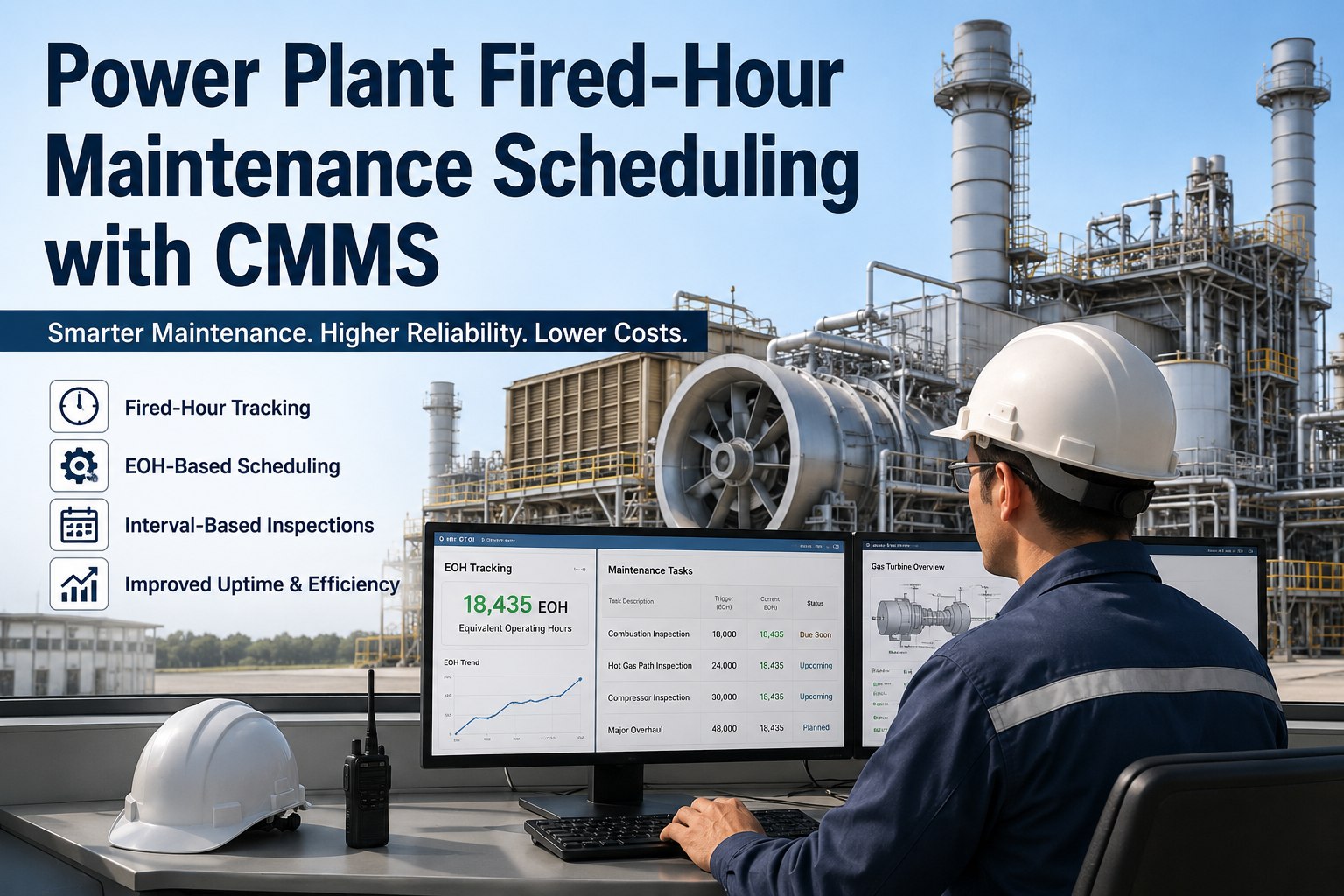
Power plant maintenance teams lose millions every year to calendar-based PM that fires too early on peakers and too late on baseload units. Fired-hour (equivalent operating hour) scheduling ties combustion inspections, HRSG tube work, and turbine overhauls to actual equipment stress — starts, trips, load cycles — instead of an arbitrary date. Start a free OxMaint trial to convert meter readings into automatic work-order triggers, or book a 30-minute demo to see EOH tracking configured for your fleet.
Power Plant Fired-Hour Maintenance Scheduling with CMMS
Replace calendar PM with fired-hour and EOH triggers. Track gas turbine equivalent operating hours, count HRSG steam cycles, and auto-generate work orders the moment a meter crosses threshold — so you stop tearing down units early and stop missing inspections late.
Why Calendar PM Fails Combustion Equipment
Calendar-based preventive maintenance assumes a unit accumulates wear at a fixed rate per month. In power generation that assumption breaks down fast. A peaking gas turbine may run 400 fired hours in a year while a baseload combined-cycle unit racks up 8,000. Scheduling a 24,000-hour combustion inspection "every 36 months" means the peaker gets torn down with 12,000 hours on it — half its useful interval — and the baseload unit blows past the threshold by 6,000 hours before anyone triggers the work order.
- Fires on a date regardless of actual runtime
- Peakers over-maintained — parts replaced at 50% life
- Baseload units under-maintained — inspections missed by thousands of hours
- No accounting for starts, trips, or load cycles
- Outage windows locked to calendar, not equipment condition
- Fires when cumulative fired hours cross OEM threshold
- Peaker teardowns aligned to actual wear — 24,000 EOH, not 36 months
- Baseload inspections triggered before threshold breach
- Starts and trips converted to equivalent hours and added to the meter
- Outage timing driven by meter data, not a wall calendar
How Fired Hours and EOH Are Calculated
Equivalent Operating Hours (EOH) is the currency of turbine maintenance scheduling. Raw fired hours — time the unit spends with flame on — form the base. But not every hour stresses the machine equally. A cold start fatigues the rotor far more than steady baseload operation, and a full-load trip dumps thermal stress that no normal operating hour reproduces. OEMs convert these events into equivalent hours and add them to the running total.
| Event | Typical Factor | Equivalent Hours Added | Why It Matters |
|---|---|---|---|
| Normal fired hour | 1.0× | 1 EOH per hour | Baseline wear at rated load |
| Hot start | ~1 EOH each | 1 EOH per event | Minimal thermal gradient — low added stress |
| Warm start | ~4 EOH each | 4 EOH per event | Rotor temperature gradient drives fatigue |
| Cold start | ~8 EOH each | 8 EOH per event | Highest start stress — full thermal shock cycle |
| Emergency trip at full load | ~1,200 EOH | 1,200 EOH per event | Sudden thermal reversal — major rotor and blade fatigue |
| Load rejection (partial trip) | ~50–200 EOH | Variable | Depends on severity and load drop percentage |
OEM Inspection Intervals by Fired Hours
Major gas turbine OEMs publish inspection intervals in fired hours, not calendar months. The table below reflects typical F-class combined-cycle thresholds. Always confirm against your specific unit's operating manual and any vendor service agreements — but the pattern holds: every interval is a meter reading, not a date.
| Inspection Type | Fired-Hour Trigger | Typical Scope | Calendar Equivalent (Baseload) | Calendar Equivalent (Peaker) |
|---|---|---|---|---|
| Combustion inspection (CI) | 24,000 EOH | Combustor cans, fuel nozzles, transition pieces, flame scanner | ~3 years | ~8–10 years |
| Hot-gas-path inspection (HGPI) | 48,000 EOH | Stage 1–2 blades, nozzles, shrouds, turbine shell internal | ~6 years | ~16–20 years |
| Major inspection (MI) | 72,000 EOH | Full rotor removal, bucket replacement, casing NDE, alignment | ~9 years | ~24+ years |
| HRSG tube inspection | Steam-cycle count + fired hours | HP evaporator, superheater, economizer NDE, catalyst check | ~4 years | ~10–12 years |
The baseload vs. peaker columns show the same fired-hour interval maps to wildly different calendar dates. A CMMS locked to calendar PM cannot reconcile this gap.
Combined-Cycle Counting: Turbine Hours + HRSG Steam Cycles
In a combined-cycle unit the gas turbine is only half the equation. The HRSG absorbs thermal stress from every startup and shutdown, and its fatigue life is driven by steam-cycle count — the number of times the HP drum transitions from cold to operating pressure and back. A unit that starts twice a day wears its HRSG faster than one that runs baseload for the same fired hours.
Gas Turbine EOH Meter
Tracks fired hours, applies start and trip factors, and accumulates equivalent operating hours against OEM combustion, HGPI, and major inspection thresholds.
HRSG Steam-Cycle Counter
Counts HP drum pressure transitions. Each cold, warm, or hot start adds to the cycle tally, driving drum and header inspection timing per ASME and OEM guidance.
Steam Turbine Hour Meter
Separate fired-hour and start counter for the steam turbine. Tracks hours since last major, casing thermal cycles, and overspeed test intervals independently.
Combined-Cycle Outage Sync
Aligns GT, HRSG, and ST inspection windows so a single planned outage captures overlapping scope — minimizing total unit downtime and startup fuel cost.
Configuring CMMS Auto-Triggers on Meter Thresholds
The mechanics of fired-hour scheduling only matter if your CMMS can act on them. OxMaint reads meter values — fired hours, start counts, trip events, steam cycles — and auto-generates work orders the instant a threshold is crossed. No planner has to remember to check a spreadsheet. No inspection gets missed because someone forgot to look at the meter.
Attach meters to each asset
Bind a fired-hour meter, a start counter, and a trip counter to every gas turbine. Bind a steam-cycle counter to each HRSG drum. Meters accept manual reads, DCS polling, or PI System tags.
Define EOH conversion rules
Set start factors (hot = 1, warm = 4, cold = 8) and trip factors per OEM documentation. OxMaint applies these multipliers automatically as events are logged, building the true EOH total.
Set threshold triggers
Configure inspection work orders to auto-generate at 24,000 / 48,000 / 72,000 EOH. Set a pre-trigger warning at 90% of threshold so planners can lock in outage windows and crew availability before the meter crosses.
Sync combined-cycle outages
Link GT, HRSG, and ST meters to a shared outage plan. When any asset approaches threshold, OxMaint flags overlapping scope so you can bundle work into a single planned outage.
Audit and reset after each inspection
After a combustion inspection or major overhaul, reset the EOH meter to zero with an audit trail. Historical readings stay archived for NERC and OEM compliance reporting.
Avoiding Premature Teardown and Missed Inspections
Tearing down at 18,000 EOH because the calendar said "3 years"
A peaking unit scheduled for a 36-month combustion inspection may have only 12,000–18,000 fired hours. The teardown replaces parts at 50–75% remaining life and burns an outage window that could have gone to a unit that actually needed it.
Missing an HGPI because raw fired hours ignored trip events
A baseload unit with two full-load trips accumulates 2,400 equivalent hours that a raw fired-hour meter never sees. The unit crosses the 48,000 EOH HGPI threshold months before the CMMS thinks it does.
Counting turbine hours but not HRSG steam cycles
A cycling unit that starts twice daily racks up steam cycles far faster than fired hours. Scheduling HRSG drum inspections off turbine EOH misses the fatigue driver entirely — drum cracks go undetected.
Manual meter reads logged weekly in a spreadsheet
A planner checks fired hours every Friday. The unit crosses 24,000 EOH on a Tuesday. The combustion inspection work order is created five days late — right in the middle of an already-scheduled run.
How OxMaint Handles Fired-Hour Scheduling
Meter-Driven Triggers
Work orders auto-generate when fired-hour, EOH, start-count, or steam-cycle meters cross configurable thresholds. No calendar guessing, no manual checks.
EOH Conversion Engine
Apply OEM-specific start and trip factors. OxMaint converts every event to equivalent hours and maintains a true wear meter alongside raw fired hours.
Combined-Cycle Outage Sync
Link GT, HRSG, and ST meters to a shared outage plan. OxMaint flags overlapping inspection windows so you bundle scope and minimize total downtime.
Pre-Threshold Warnings
Get notified at 80% and 90% of any inspection threshold. Lock in outage dates, crew, parts, and crane scheduling before the meter crosses — not after.
DCS / PI Integration
Pull fired hours, start events, and trip signals directly from your control system. No manual meter entry, no stale spreadsheet values, no missed triggers.
Audit-Ready Meter History
Every meter read, event conversion, threshold reset, and work-order trigger is timestamped and archived. Hand NERC, OEM, and insurance auditors a complete chain of evidence.
Fired-Hour Scheduling FAQ
What is the difference between fired hours and equivalent operating hours (EOH)?
Fired hours are the raw time a gas turbine spends with flame on — straightforward runtime. EOH adds equivalent hours for events that accelerate wear: cold starts add ~8 EOH each, warm starts ~4, and full-load trips can add 1,200 EOH or more. EOH is the true wear meter; fired hours alone undercount stress on cycling and frequently tripped units.
How does OxMaint know when to trigger a combustion inspection work order?
You configure a threshold — say 24,000 EOH for a combustion inspection. OxMaint continuously reads the meter (via DCS polling, PI tags, or manual entry), applies your start and trip conversion factors, and auto-generates the work order the instant cumulative EOH crosses 24,000. A pre-trigger warning fires at 90% so you can plan the outage window in advance.
Can OxMaint track HRSG steam cycles separately from turbine fired hours?
Yes. Each HRSG HP drum gets its own steam-cycle counter that logs every pressure transition. Drum and header inspection triggers fire off cycle count, not turbine EOH — which matters because a cycling unit accumulates steam fatigue far faster than fired hours would suggest. The two meters run independently and can be linked to a shared combined-cycle outage plan.
What happens to the meter after a major inspection or overhaul?
After a combustion inspection, HGPI, or major overhaul, the EOH meter is reset to zero with a full audit trail — timestamp, work order reference, and technician sign-off. Historical readings remain archived for compliance. The meter then begins accumulating toward the next threshold, and the pre-trigger warnings reset accordingly.
Can OxMaint import existing fired-hour data from our current system?
Yes. OxMaint accepts historical meter reads via CSV import or direct database migration from your legacy CMMS. You can backfill cumulative fired hours, start counts, and trip events so thresholds reflect where the unit actually is today — not a zero-based restart that would delay the next inspection.