Carbon reporting for a power plant is not the same as carbon reporting for an office building or a logistics fleet. Your boilers emit CO2, CH4, and N2O from stationary combustion. Your turbines accumulate Scope 1 emissions that must be calculated against fired hours and fuel type. Your supply chain — coal, gas, or biomass procurement — carries Scope 3 upstream emissions that regulators, investors, and CDP reviewers now scrutinize with equal attention. A generic carbon template built for a retail company will leave your GHG inventory incomplete, your GRI 305 disclosures misaligned, and your ISO 14064 verification at risk. This template is structured specifically for thermal, combined-cycle, and cogeneration power plants — covering Scope 1 direct combustion, Scope 2 auxiliary load, and Scope 3 fuel supply chain, all mapped to GHG Protocol, GRI 305, ISO 14064-1, and CDP reporting requirements. OxMaint's maintenance platform tracks the operational asset data — fuel consumption by unit, fired hours, equipment runtime — that feeds directly into accurate carbon calculations; start free or book a walkthrough to see how maintenance records become audit-ready carbon data.
Carbon Reporting Template · Power Generation · 2026
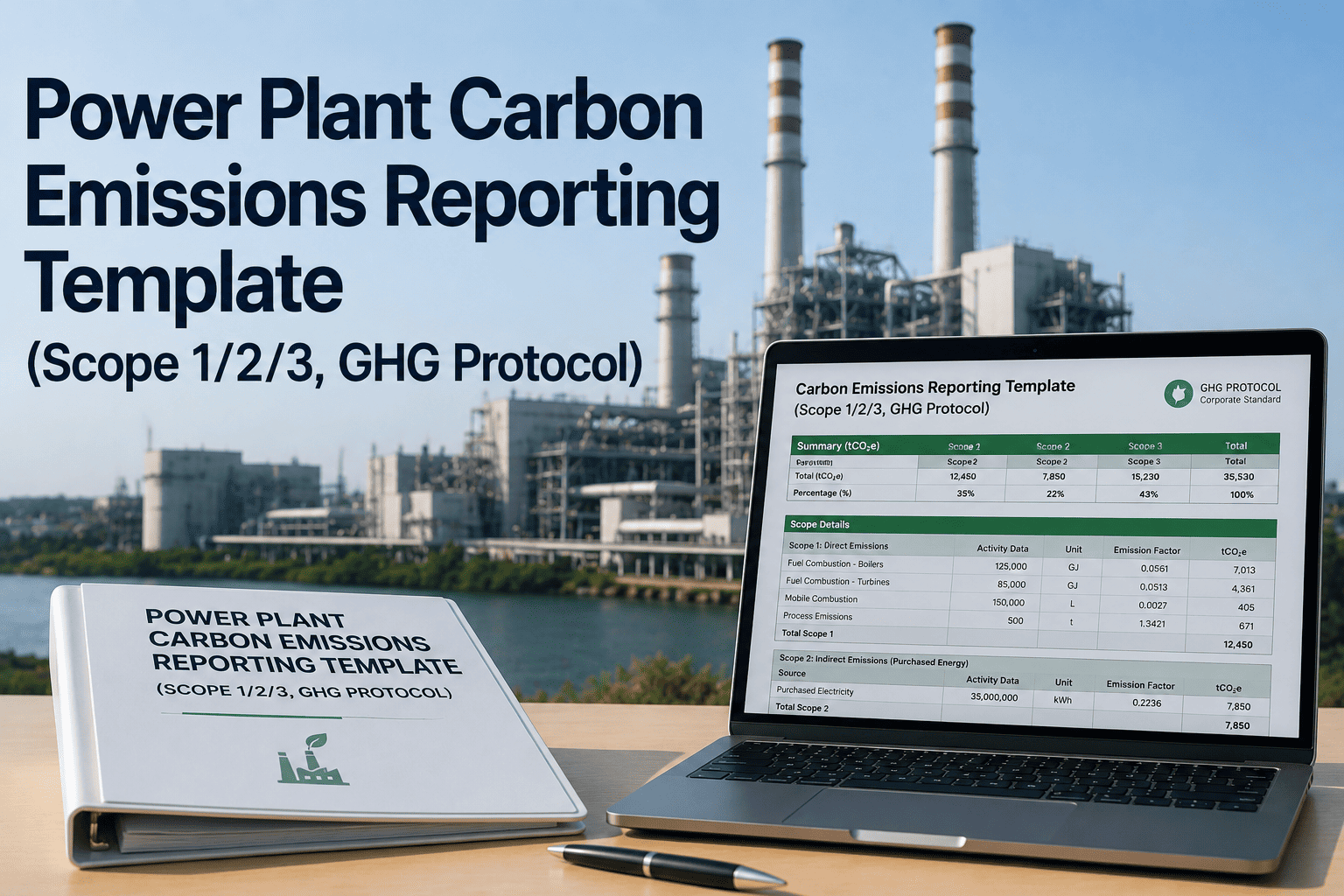
Power Plant Carbon Emissions Reporting Template
Scope 1, 2 & 3 — aligned to GHG Protocol, GRI 305, ISO 14064, and CDP. Built for boilers, turbines, and generators, not generic operations.
GHG Protocol
GRI 305
ISO 14064
CDP
IFRS S2
SCOPE 1
Direct Emissions
Emissions from sources your plant owns or controls
Boiler fuel combustion (coal, gas, oil)
Gas turbine fuel burn — CO2 + CH4 + N2O
Steam turbine auxiliary fuel use
Flaring and venting events
SF6 from generator circuit breakers
Fugitive refrigerant from cooling systems
Gases: CO2 · CH4 · N2O · SF6 · HFCs
SCOPE 2
Indirect Energy Emissions
Emissions from purchased energy consumed on-site
Auxiliary load — grid electricity purchases
Control room and admin building electricity
Purchased steam for plant startup
District cooling for control systems
Report both location-based AND market-based methods per GHG Protocol and GRI 305-2
Methods: Location-based · Market-based (RECs/PPAs)
SCOPE 3
Value Chain Emissions
Upstream and downstream indirect emissions
Cat. 1 — Fuel extraction and processing
Cat. 4 — Coal/gas transport to plant
Cat. 5 — Ash and waste disposal
Cat. 11 — Transmission line losses
Cat. 12 — End-use of sold electricity
Cat. 13 — Downstream leased assets
15 categories — power plants typically report 4 to 6
OxMaint Turns Maintenance Data Into Carbon Data
Fuel consumption logs, fired hours, and equipment runtime already live in your CMMS. OxMaint structures that data into the activity records your carbon template needs — no double-entry.
Framework Alignment — What Each Standard Requires From Your Plant
Four reporting frameworks govern power plant carbon disclosure in 2026. Each has distinct boundary, calculation, and verification requirements. Your template must satisfy all four simultaneously — or document which frameworks apply and why.
GHG Protocol
Corporate Accounting and Reporting Standard
Boundary
Operational control or equity share — choose one, apply consistently
Scope 1 Calc
Fuel consumption × IPCC emission factors per fuel type and combustion technology
Scope 2
Both location-based and market-based methods required; report both
Verification
Not mandated by standard; required by CDP and CSRD disclosure programs
GRI 305
Emissions Standard (updated via GRI 102: Climate Change 2025)
305-1
Gross Scope 1 in metric tonnes CO2e. Disclose gases, biogenic CO2 separately, and GWP source
305-2
Gross Scope 2 — location-based required; market-based required if applicable
305-3
Scope 3 categories included; methodology and base year context
305-4
GHG intensity: CO2e per MWh generated — the key power-plant-specific metric
ISO 14064
GHG Quantification and Verification
Part 1
Organization-level inventory: emission source identification, quantification, and documentation requirements
Part 3
Third-party verification: assurance level (limited or reasonable), uncertainty assessment, audit trail
Key Requirement
Activity data, emission factors, and calculations must be fully documented and reproducible
CMMS Link
Fuel consumption logs per combustion unit are ISO 14064-1 Part 1 activity data — OxMaint produces these natively
CDP
Carbon Disclosure Project — Climate Questionnaire
C6
Absolute Scope 1, 2, and 3 emissions with prior-year comparison and methodology notes
C7
Emissions breakdown by source, geography, and business division
C8
Energy consumption data — must align with Scope 1 and 2 emissions calculations
Verification
Third-party verification strongly preferred; ISO 14064-3 accepted verification standard
Scope 1 Template — Stationary Combustion Calculation
This is the highest-emission section for any thermal power plant. Every boiler, turbine, and auxiliary combustion unit requires individual fuel consumption records. The calculation formula is identical across frameworks: fuel quantity multiplied by the appropriate IPCC or EPA emission factor, converted to CO2e using current GWP values.
| Combustion Source |
Fuel Type |
Data Required |
CO2 Factor (kg/GJ) |
CH4 Factor (kg/GJ) |
N2O Factor (kg/GJ) |
| Main Boiler |
Bituminous Coal |
Tonnes burned / month |
94.6 |
0.01 |
0.0015 |
| Gas Turbine |
Natural Gas |
GJ consumed / fired hour |
56.1 |
0.001 |
0.0001 |
| Auxiliary Boiler |
Fuel Oil (No. 2) |
Litres burned / month |
74.1 |
0.003 |
0.0006 |
| Emergency Generator |
Diesel |
Hours run × fuel rate |
74.1 |
0.003 |
0.0006 |
| Flaring Events |
Natural Gas |
Volume flared (m3) |
56.1 |
0.001 |
0.0001 |
Emission factors from IPCC 2006 Guidelines, Table 2.2 and 2.3. For plant-specific factors, use CEMS measurement data where available — it produces more accurate Scope 1 figures than default factors and is preferred by CDP and ISO 14064 verifiers.
Template Section Map — Your Full Carbon Reporting Document
A complete power plant carbon report covers eight sections. The visual below shows how each section connects to the frameworks that require it and the data source that feeds it.
01
Organizational Boundary & Reporting Period
Define operational control vs equity share boundary. State the reporting year and base year. Document any boundary changes from prior periods.
GHG Protocol
GRI 305
ISO 14064-1
02
Emission Source Inventory
List every combustion unit, process source, fugitive source, and mobile source within the boundary. Assign source IDs that match your asset register in OxMaint.
ISO 14064-1
CDP C6
03
Scope 1 — Direct Combustion Emissions
Fuel consumption by unit × emission factors. Separate CO2, CH4, N2O. Report biogenic CO2 separately. Include CEMS data where available. Total in metric tonnes CO2e.
GHG Protocol
GRI 305-1
ISO 14064-1
CDP C6.1
04
Scope 1 — Fugitive Emissions
SF6 losses from generator switchgear, refrigerant leaks from cooling circuits, and methane fugitive losses from gas supply infrastructure. Often underreported — include equipment inspection records as data source.
GHG Protocol
GRI 305-1
CDP C6.1
05
Scope 2 — Purchased Electricity
Auxiliary load electricity from the grid. Report location-based (grid average factor) AND market-based (supplier-specific or residual mix). Document any RECs or PPAs that reduce market-based figure.
GHG Protocol
GRI 305-2
CDP C6.3
06
Scope 3 — Applicable Categories
Category 1 (fuel upstream), Category 4 (fuel transport), Category 5 (waste), Category 11 (transmission losses), Category 12 (end-use of sold power). Document which categories are included and materiality rationale for exclusions.
GHG Protocol
GRI 305-3
CDP C6.5
07
GHG Intensity Metrics
CO2e per MWh generated (Scope 1 intensity). CO2e per MWh including auxiliary load (Scope 1+2 intensity). These are the key power-generation KPIs required by GRI 305-4 and CDP C14. Compare to prior year and sector benchmark.
GRI 305-4
CDP C14
ISO 14064-1
08
Verification Statement & Quality Assurance
Third-party verification body, assurance level (limited or reasonable), verification standard used (ISO 14064-3 or equivalent), material misstatement threshold, and findings. Required for CDP disclosure and CSRD compliance.
ISO 14064-3
CDP C10.1a
GRI 305 Disclosure Checklist — Section by Section
GRI 305 is the most commonly referenced emissions standard for power plants making public sustainability disclosures. Use this checklist to confirm your report satisfies every required data point before submission.
305-1 Direct (Scope 1)
Gross Scope 1 in metric tonnes CO2e
Gases included (CO2, CH4, N2O, SF6)
Biogenic CO2 reported separately
Base year and recalculation context
GWP source (IPCC AR5 or AR6)
Consolidation approach used
Methodology / calculation tool cited
305-2 Indirect (Scope 2)
Location-based emissions in CO2e
Market-based emissions in CO2e
Contractual instruments used (RECs)
Grid emission factors and source
Gases included
Methodology cited
305-3 Other Indirect (Scope 3)
Categories included in calculation
Gross Scope 3 in CO2e
Gases included
Base year and recalculation context
Methodology and data sources
305-4 GHG Intensity
GHG intensity ratio (CO2e / MWh)
Scopes included in numerator
Denominator defined and justified
Gases included in calculation
Frequently Asked Questions
What is the difference between GHG Protocol and GRI 305 for power plant reporting?
GHG Protocol defines how to calculate and classify emissions — it is the accounting methodology. GRI 305 defines what to disclose publicly and in what format. Power plants typically use GHG Protocol to build the inventory and GRI 305 to structure the public report. Both reference the same emission factors and CO2e conversion methodology, so data calculated under GHG Protocol populates GRI 305 disclosures directly. Learn how
OxMaint structures operational data to feed both frameworks.
Which Scope 3 categories are mandatory for a thermal power plant to report?
No Scope 3 categories are technically mandatory under GHG Protocol, but CDP and CSRD expect material categories to be included with documented rationale for exclusions. For a thermal plant, Categories 1 (upstream fuel production), 4 (fuel transport), and 11 (transmission losses from sold electricity) are almost always material. Category 5 (ash disposal) and Category 12 (end-use of power) are material for coal plants specifically.
Book a session to map your specific Scope 3 boundary.
Does ISO 14064 verification require a third-party auditor?
ISO 14064-1 defines how to build your inventory; ISO 14064-3 governs third-party verification of it. CDP's climate questionnaire strongly recommends third-party verification and classifies responses as verified or unverified — verified scores receive higher ratings. For CSRD-covered entities, limited assurance is mandatory and reasonable assurance becomes required from 2026 onward. Your OxMaint maintenance records provide the audit-trail documentation verifiers need for Scope 1 activity data.
How does a CMMS like OxMaint help with carbon reporting data collection?
Your biggest carbon data challenge is Scope 1 activity data — fuel consumption per combustion unit, per period, with equipment IDs that match your asset register. OxMaint tracks fuel consumption by asset, records fired hours per turbine, and logs equipment inspection data that supports fugitive emission estimates. This turns your maintenance system into the primary data source for ISO 14064-compliant Scope 1 reporting, eliminating manual log compilation.
Start a free trial to see this in action.
What GWP values should a power plant use in 2026 — IPCC AR5 or AR6?
Most frameworks still reference IPCC AR5 GWP values (CH4 = 28, N2O = 265) as the default, since they remain the basis for international negotiations and many national reporting schemes. IPCC AR6 values (CH4 = 27.9, N2O = 273) are technically more current but not yet universally mandated. The safest approach in 2026 is to calculate using AR5, note the GWP source explicitly in your methodology section, and document what your figures would be under AR6 if CDP or your verifier requires the comparison.
Your Boilers and Turbines Generate the Emissions Data. OxMaint Makes It Reportable.
Maintenance records, fuel logs, and fired-hour counters — the activity data your carbon template requires — already exist in your plant operations. OxMaint structures that data into audit-ready, framework-aligned carbon reporting without manual extraction. Scope 1 reporting that takes weeks takes minutes.