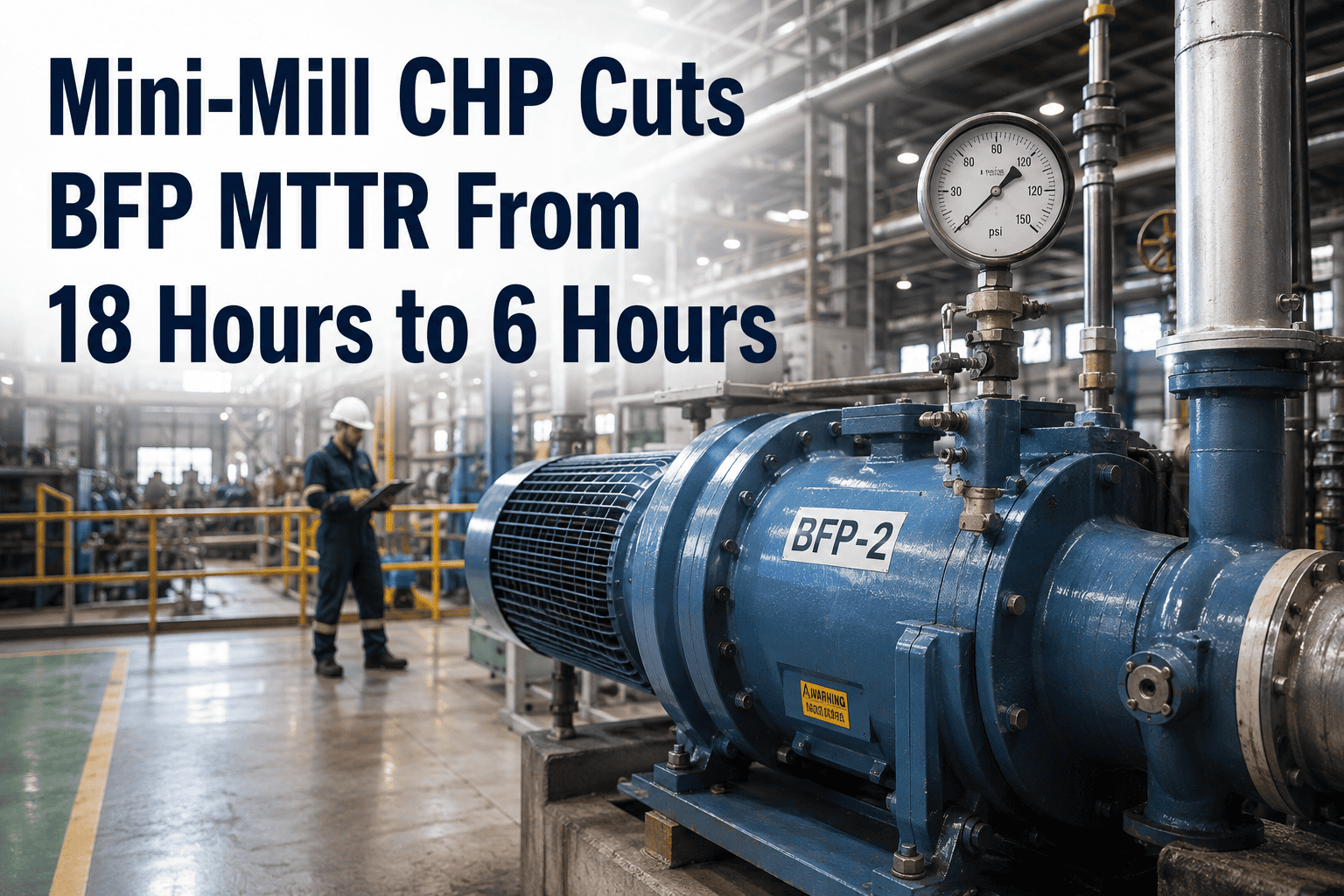
Mini-Mill CHP Cuts BFP MTTR From 18 Hours to 6 Hours

By Johnson on May 29, 2026

mini-mill-chp-cuts-bfp-mttr-18-to-6-hours

Every unplanned boiler feed pump failure at a mini-mill combined heat and power plant doesn't just stop the pump — it stops the heat, halts production, and hands your maintenance team an 18-hour scramble through disorganized parts bins and handwritten repair logs. At a steel mini-mill running continuous casting operations, a single BFP failure can cost $40,000 to $90,000 in lost production and emergency labor. This is the story of how one mini-mill CHP plant cut their BFP mean time to repair from 18 hours to 6 hours in just 9 months — using Oxmaint pre-staged spare parts and digital job instructions to transform reactive chaos into a repeatable, fast repair process. Start your free Oxmaint trial and build your own pre-staged spare parts library today.

CASE STUDY
Mini-Mill CHP Plant
Boiler Feed Pump MTTR Reduction
9-Month Transformation
A 180 MW steel mini-mill CHP plant cut boiler feed pump mean time to repair from 18 hours to 6 hours — without adding headcount. The fix wasn't more technicians. It was pre-staged spare parts, digital job instructions, and asset-linked storeroom data that eliminated the chaos every repair started with.
18 hrs
to
6 hrs
BFP Mean Time to Repair

Why BFP Failures Were Costing This Plant 3x More Than Necessary

The maintenance team at this 180 MW mini-mill CHP wasn't failing because of bad people — they were failing because of broken systems. When a boiler feed pump tripped, technicians spent the first two hours just finding the right repair manual and confirming which spare parts were in stock. Inventory was tracked on spreadsheets that hadn't been updated in months. Job instructions existed as printed PDFs stuffed in binders on a shelf no one could locate during a 2 AM emergency. The result: every BFP failure turned into a full-shift production loss.

01
No Pre-Staged Parts
Critical BFP spares were scattered across three storeroom locations with no asset-linked tracking. Average parts search time: 2.4 hours per failure event.
02
Paper Job Instructions
Repair procedures existed only in printed binders. Step sequencing errors and missing torque specs were causing rework — adding 3 to 5 hours per repair event.
03
No Failure History
Without digital repair records, the team had no data on which BFP components failed most often. Every repair started from scratch with no pattern recognition.
04
Shift Handover Gaps
Mid-repair shift changes caused step-loss and miscommunication. Technicians resuming repairs had no real-time status of what steps had been completed.

How Oxmaint Was Deployed — Phase by Phase

The plant's maintenance manager didn't attempt a full system overhaul on day one. Instead, Oxmaint was deployed in three focused phases, each targeting a specific constraint in the BFP repair process. Book a 30-minute demo to map your own phased Oxmaint deployment plan.

Phase 1
Months 1–3
Asset Registry and Parts Mapping
All BFP assets — 4 pumps across 2 CHP units — were registered in Oxmaint with full component hierarchy. Every associated spare part was linked to its asset record with bin location, quantity on hand, and reorder trigger. Storeroom was physically reorganized to match Oxmaint locations.
Result: Parts search time cut from 2.4 hours to 22 minutes

Phase 2
Months 4–6
Digital Job Instructions Build-Out
Senior technicians worked with the maintenance manager to convert paper BFP repair procedures into Oxmaint digital job instructions — with step-level checkboxes, embedded torque specs, and photo verification points. Instructions were tested against two live repair events and refined based on technician feedback.
Result: Rework incidents dropped from 4 per quarter to zero in month 6

Phase 3
Months 7–9
Pre-Staged Kits and MTTR Tracking
Based on 6 months of Oxmaint failure history, the team identified the top 3 BFP failure modes (mechanical seal, coupling, impeller wear) and built pre-staged repair kits for each — stored at the pump deck in labeled bins, with Oxmaint inventory linked. MTTR was tracked per work order and reviewed weekly.
Result: Average BFP MTTR reached 6 hours by month 9

The Numbers: Before and After Oxmaint

67%
MTTR Reduction
BFP mean time to repair dropped from 18 hours to 6 hours — a 67% improvement achieved without hiring additional maintenance staff.
0
Rework Events
Zero repair rework incidents in the final three months of the study period, down from an average of 4 per quarter pre-deployment.
22 min
Parts Retrieval
Average time to locate and stage BFP spare parts cut from 2.4 hours to 22 minutes through asset-linked storeroom organization.
$310K
Annual Savings
Estimated annual recovery in avoided production loss and overtime labor, calculated from 6 BFP failure events per year at average 12-hour reduction each.

BFP Repair Workflow: Before vs After Oxmaint

Repair Stage Before Oxmaint After Oxmaint
Failure Alert and Crew Mobilization Phone calls, manual contact list — 45 to 90 min Oxmaint work order pushed to mobile — 8 min
Parts Location and Staging Manual storeroom search across 3 locations — 2.4 hrs Asset-linked bin location in Oxmaint — 22 min
Job Instruction Access Paper binder search — often missing, 30–60 min Digital checklist on mobile, always current — instant
Active Repair Execution 6 to 8 hours with frequent step re-checks 4 to 5 hours with guided digital steps
Shift Handover During Repair Verbal briefing, step-loss risk — added 1 to 2 hrs Real-time step status in Oxmaint — zero step-loss
Post-Repair Documentation Paper form, often incomplete or lost Auto-captured in Oxmaint work order history
Total MTTR (Average) 18 hours 6 hours

"Before Oxmaint, a BFP failure meant my best technician spending the first three hours just trying to get organized. Now the work order hits their phone with the parts kit location and the repair checklist loaded. We repaired a mechanical seal failure in 5 hours and 40 minutes last month. That would have been a full-shift loss eighteen months ago."


Maintenance Manager 180 MW Mini-Mill CHP Plant, Combined Casting and Rolling Operations
Your BFP Failures Don't Have to Cost 18 Hours. They Can Cost 6.
Oxmaint pre-staged spare parts, digital job instructions, and asset-linked storeroom management — deployed in under 90 days at your CHP plant.

What Maintenance Teams Ask Before Deploying Oxmaint at a CHP Plant

How long does it take to build the pre-staged spare parts library in Oxmaint for BFP assets?
For a typical CHP plant with 2 to 4 boiler feed pumps, the full asset registry and parts mapping process takes 3 to 4 weeks including physical storeroom reorganization. Oxmaint's asset import tools can intake existing parts lists from Excel or ERP exports, significantly reducing manual entry time. Start your free trial and use the guided asset setup wizard to begin.
Can Oxmaint digital job instructions handle BFP repairs that vary by failure mode?
Yes. Oxmaint supports multiple job instruction templates per asset, so your team can have separate repair checklists for mechanical seal failures, coupling replacements, and impeller wear — each with its own step sequence, torque specs, and parts list. The correct template is linked to the work order based on the fault type selected at the time of job creation. Book a demo to see how fault-type job routing works in Oxmaint.
Does Oxmaint track MTTR automatically or does someone have to calculate it manually?
Oxmaint captures work order open and close timestamps automatically, calculating MTTR per asset and per failure type without manual calculation. MTTR trends are visible in the reporting dashboard and can be exported for monthly maintenance review meetings. No manual spreadsheet required.
What happens to Oxmaint data if a technician loses mobile connectivity during a repair?
Oxmaint's mobile app supports offline mode — technicians can complete job instruction checklists and record parts usage without connectivity. Data syncs automatically when the device reconnects. This is especially important in CHP plant environments where the pump deck or boiler room may have limited signal coverage.
How does Oxmaint help with shift handover during a multi-hour BFP repair?
Each Oxmaint work order shows real-time step completion status, technician notes, and parts consumed — visible to any authorized user on desktop or mobile. The incoming shift technician opens the work order and sees exactly which steps are done, what's pending, and any notes from the outgoing crew. No verbal briefing gaps. See the Oxmaint shift handover workflow in your free trial.
18-Hour BFP Repairs Are a Process Problem. Oxmaint Is the Fix.
Pre-staged parts, digital job instructions, automatic MTTR tracking, and shift-handover visibility — built for CHP maintenance teams that can't afford another 18-hour stoppage.

Share This Story, Choose Your Platform!