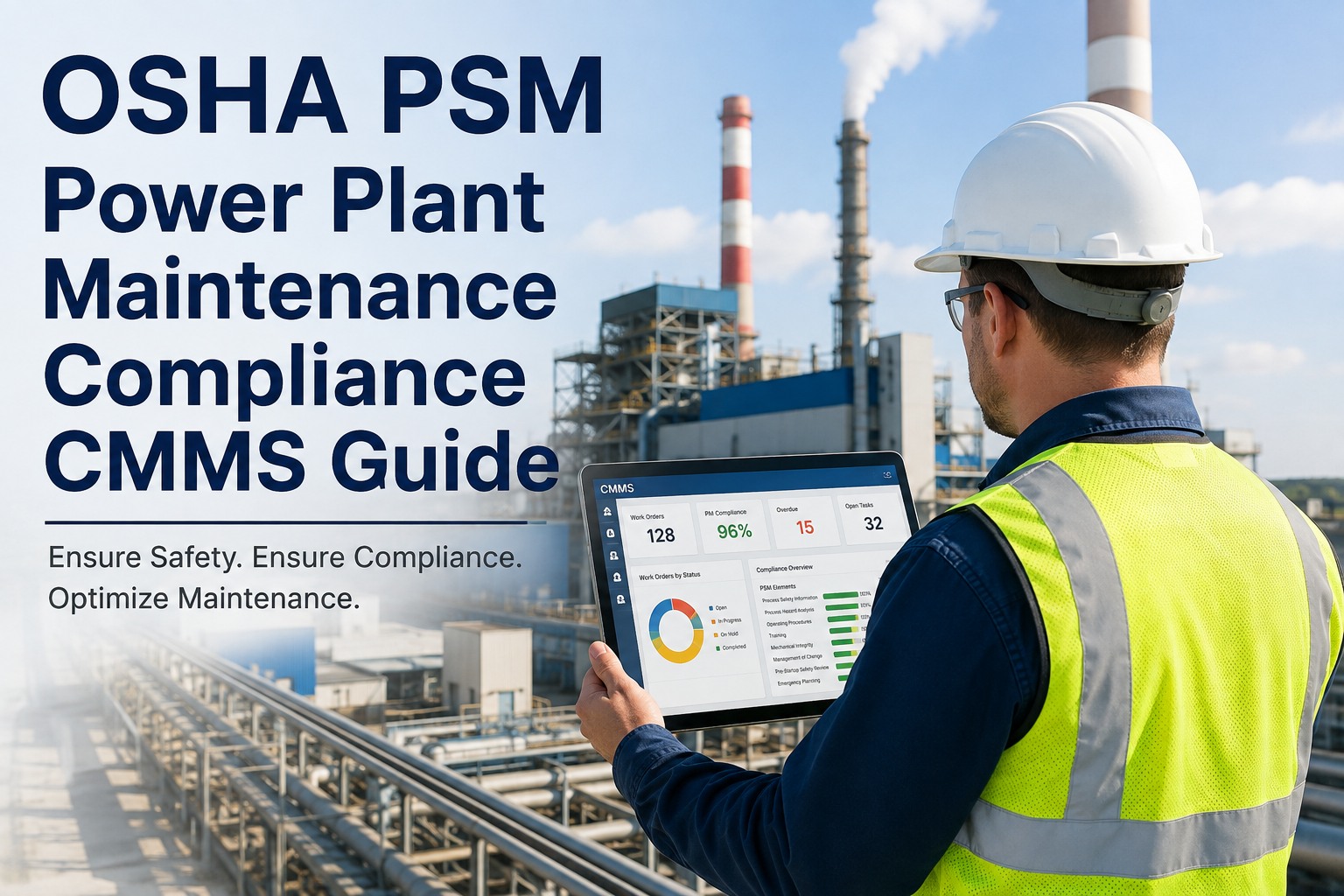
OSHA Process Safety Management (PSM) compliance for power plants hinges on a rigorous mechanical integrity program, documented PHA reviews, and instantly retrievable PSM inspection records. A single missing preventive maintenance record during an OSHA audit can trigger willful violations exceeding $156,000 per instance, making digitized maintenance tracking a financial imperative for power generation facilities. By implementing a CMMS built for PSM compliance, maintenance and reliability teams eliminate paper-based blind spots, enforce inspection intervals, and maintain an audit-ready chain of custody for every critical asset. See how OxMaint streamlines your PSM program when you Start Free Trial today.
OSHA PSM Power Plant Compliance
Is your power plant one missing inspection record away from a seven-figure OSHA violation?
Process Safety Management (29 CFR 1910.119) requires power plants to maintain meticulous mechanical integrity documentation, PHA records, and equipment histories. When audits happen, reactive maintenance and spreadsheets are not enough to prove compliance.
PSM Compliance Framework
The 14 elements of OSHA PSM every power plant must document
OSHA 1910.119 mandates 14 interlocking management elements. Power plants that fail to connect asset maintenance data to these elements face systemic compliance gaps during regulatory audits.
Employee Participation
Document worker involvement in PSM development; CMMS access logs provide auditable proof of team engagement across maintenance workflows.
Process Safety Information
Equipment specifications, safe operating limits, and materials of construction must be tied to individual assets in a central EAM database.
Process Hazard Analysis (PHA)
PHA findings demand corrective work orders. Tracking recommendations to completion in a CMMS closes the loop and proves hazard mitigation.
Operating Procedures
Certified procedures must be accessible. Integrating them into mobile work orders ensures technicians follow exact PSM-compliant protocols.
Training & Certification
Maintenance staff require documented initial and refresher training. CMMS profiles log certifications and restrict work order assignment to qualified personnel.
Mechanical Integrity (MI)
The core PSM maintenance element. Requires scheduled inspections, thickness monitoring, and deficiency tracking for all pressure vessels and piping.
Management of Change (MOC)
Equipment replacements and procedural changes require formal MOC review. CMMS triggers ensure no asset modification bypasses documentation.
Incident Investigation
Root-cause analysis findings must link to corrective preventive maintenance. Digital work order histories provide the data trail investigators need.
Mechanical Integrity PSM
PSM inspection records checklist for power generation assets
A compliant mechanical integrity program requires specific, time-stamped documentation. Use this checklist to evaluate if your current maintenance tracking meets OSHA PSM inspection record standards.
Pressure Vessels & Boilers
- API 510 internal and external inspection dates logged
- Ultrasonic thickness measurement (UTM) trending reports
- Relief device sizing and inspection certificates
- Corrosion rate calculations and remaining life estimates
Piping & Valves
- API 570 inspection intervals scheduled and completed
- Circuitization drawings linked to asset records
- Injection point and deadleg monitoring logs
- Emergency isolation valve functional test records
Rotating Equipment
- Vibration analysis baselines and route schedules
- Lubrication analysis and oil change histories
- Alignment and thermal growth check documentation
- Bearing temperature trend logs and alarm setpoints
Electrical & I&C
- Switchgear and transformer IR thermography reports
- Protective relay calibration and test intervals
- UPS battery load test and replacement dates
- Grounding system continuity verification records
CMMS vs Spreadsheets
Spreadsheet PSM tracking vs CMMS-based PSM compliance
Over 60% of power plants still rely on fragmented spreadsheets for mechanical integrity tracking. The gap between static spreadsheets and an active CMMS during an OSHA audit is the difference between a clean pass and a multi-million dollar penalty.
| PSM Requirement | Static Spreadsheets | OxMaint CMMS |
|---|---|---|
| Inspection Scheduling | Manual date entry; high risk of missed intervals | Automated PM triggers based on API 510/570 intervals |
| Audit Retrieval Speed | Days to locate paper records and cross-reference files | Instant asset history reports in under 30 seconds |
| Deficiency Tracking | No automated alerts for overdue corrective actions | Real-time escalation for unresolved mechanical deficiencies |
| PHA Recommendation Closure | Manual tracking; open items easily lost in transitions | Closed-loop work order verification linked to PHA findings |
| Mobile Field Documentation | Transcription from paper to spreadsheet causes data loss | Technicians enter UTM data and photos directly at the asset |
Process Safety CMMS
How OxMaint powers your PSM program for power plants
OxMaint translates OSHA PSM requirements into automated maintenance workflows. By centralizing asset data, inspection schedules, and deficiency management, reliability teams maintain continuous compliance without administrative overhead.
Automated Mechanical Integrity Scheduling
Configure API 510, 570, and 653 inspection intervals directly to critical assets. OxMaint auto-generates work orders 30 days prior, ensuring no PSM-required inspection interval lapses and triggering supervisor escalations for overdue tasks.
Instant Audit-Ready Documentation
Generate comprehensive PSM inspection records, including technician signatures, measurement data, and condition photos, in a single click. Auditors receive a traceable, time-stamped chain of custody for every asset without waiting days for manual compilation.
Predictive Failure Analytics
AI-driven vibration and thermal analysis predict bearing and gearbox failures up to 4 weeks in advance, preventing catastrophic asset failures that trigger OSHA incident investigations and forced plant outages.
PHA & MOC Closed-Loop Tracking
Link Process Hazard Analysis recommendations directly to corrective work orders. Management of Change requests automatically route to engineering review, ensuring no equipment modification bypasses PSM compliance protocols.
A 500 MW natural gas power plant utilizing 1,200 critical assets transitioned from spreadsheet tracking to OxMaint to prepare for an OSHA PSM audit. Within 3 months, they identified 47 overdue thickness inspections that had been masked by manual scheduling errors. By closing these gaps via automated CMMS scheduling, they achieved a zero-finding audit result and reduced their mechanical integrity administrative burden by 35 hours per month, saving approximately $42,000 annually in compliance management overhead.
PSM Guide Power
The cost of non-compliance in power generation
Failing to maintain PSM mechanical integrity records impacts more than regulatory fines. The compounding costs of forced outages, insurance premiums, and reputational damage make reactive maintenance an existential financial risk.
See OxMaint on your critical assets
Book a 30-minute demo to discover how OxMaint maps OSHA PSM requirements to automated maintenance workflows, ensuring your power plant is audit-ready every day of the year.
Frequently Asked Questions
OSHA PSM power plant compliance questions answered
What is OSHA PSM compliance for power plants?
OSHA PSM compliance for power plants involves adhering to the Process Safety Management standard (29 CFR 1910.119), which governs the management of highly hazardous chemicals used in power generation. It requires facilities to implement 14 elements including process hazard analysis, mechanical integrity programs, and comprehensive documentation. A CMMS ensures these documentation requirements are continuously met without manual overhead.
How does a CMMS help with mechanical integrity PSM requirements?
A CMMS centralizes mechanical integrity by automatically generating, scheduling, and tracking preventive maintenance work orders for pressure vessels, piping, and rotating equipment. It ensures inspection intervals meet API standards and retains time-stamped, photo-documented records. To see how OxMaint enforces these schedules, Start Free Trial and map your first asset today.
How long must power plants retain PSM inspection records?
OSHA requires PSM inspection records to be retained for the life of the equipment, plus additional documentation like PHA reports kept for at least five years. Digital CMMS records satisfy these retention requirements indefinitely without physical storage degradation, making historical retrieval instant during audits.
What triggers an OSHA PSM audit at a power generation facility?
OSHA PSM audits are triggered by reported chemical releases, catastrophic equipment failures, employee complaints, or as part of the Program Quality Verification (PQA) cycle requiring compliance audits every three years. Maintaining continuous, audit-ready CMMS documentation ensures your plant passes these inspections without scrambling for paperwork.
Can OxMaint integrate with existing power plant maintenance systems?
Yes, OxMaint integrates seamlessly with existing ERP, SCADA, and plant data historian systems via open APIs. This allows you to layer PSM compliance automation over your current infrastructure without ripping out legacy investments. Schedule a tailored integration walkthrough by booking a demo at calendly.com/oxmaintapp/30min.
Make your next OSHA audit the easiest one yet
Join the power generation reliability teams using OxMaint to automate mechanical integrity scheduling, digitize PSM inspection records, and eliminate compliance blind spots forever.
Free 14-day trial · No credit card