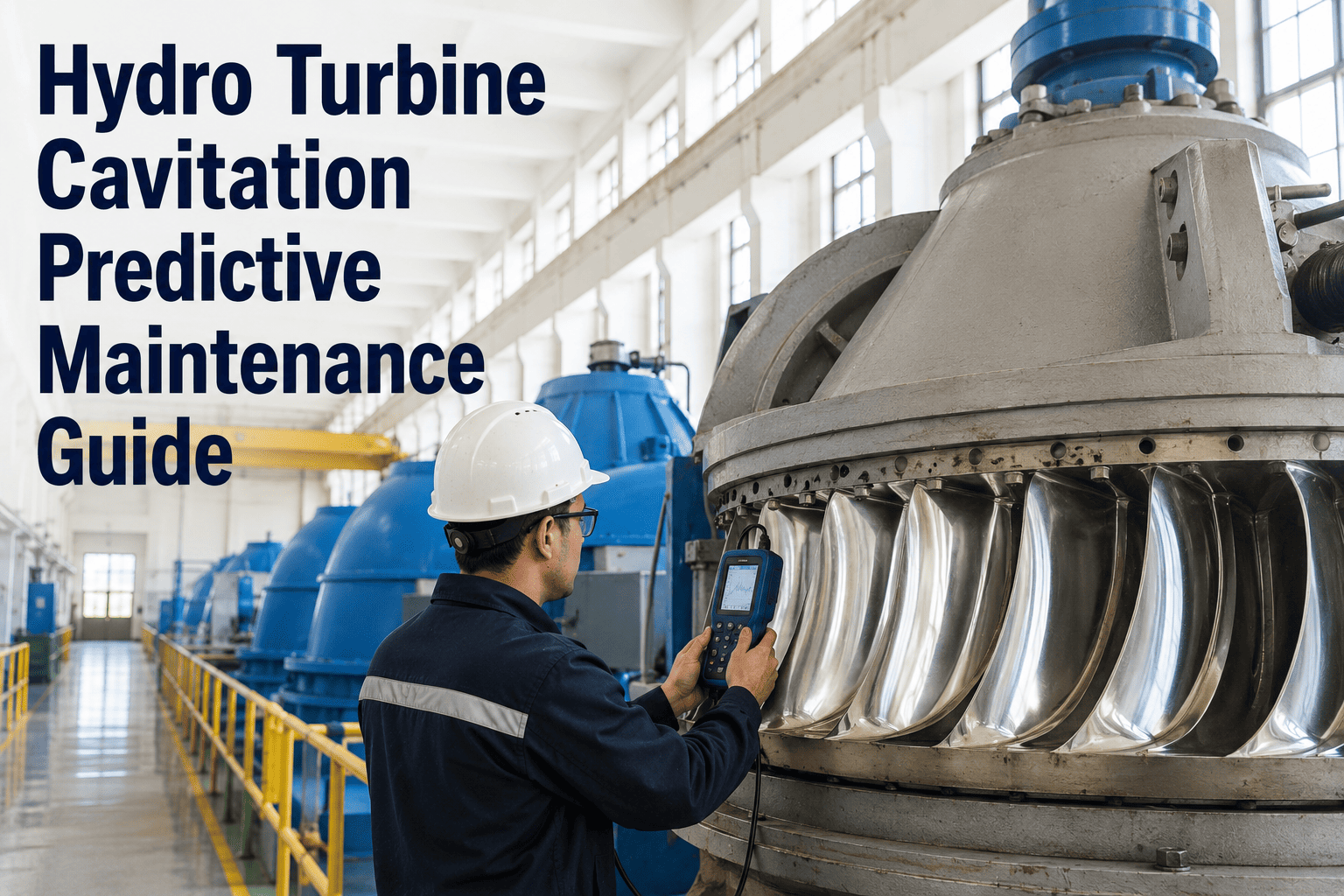
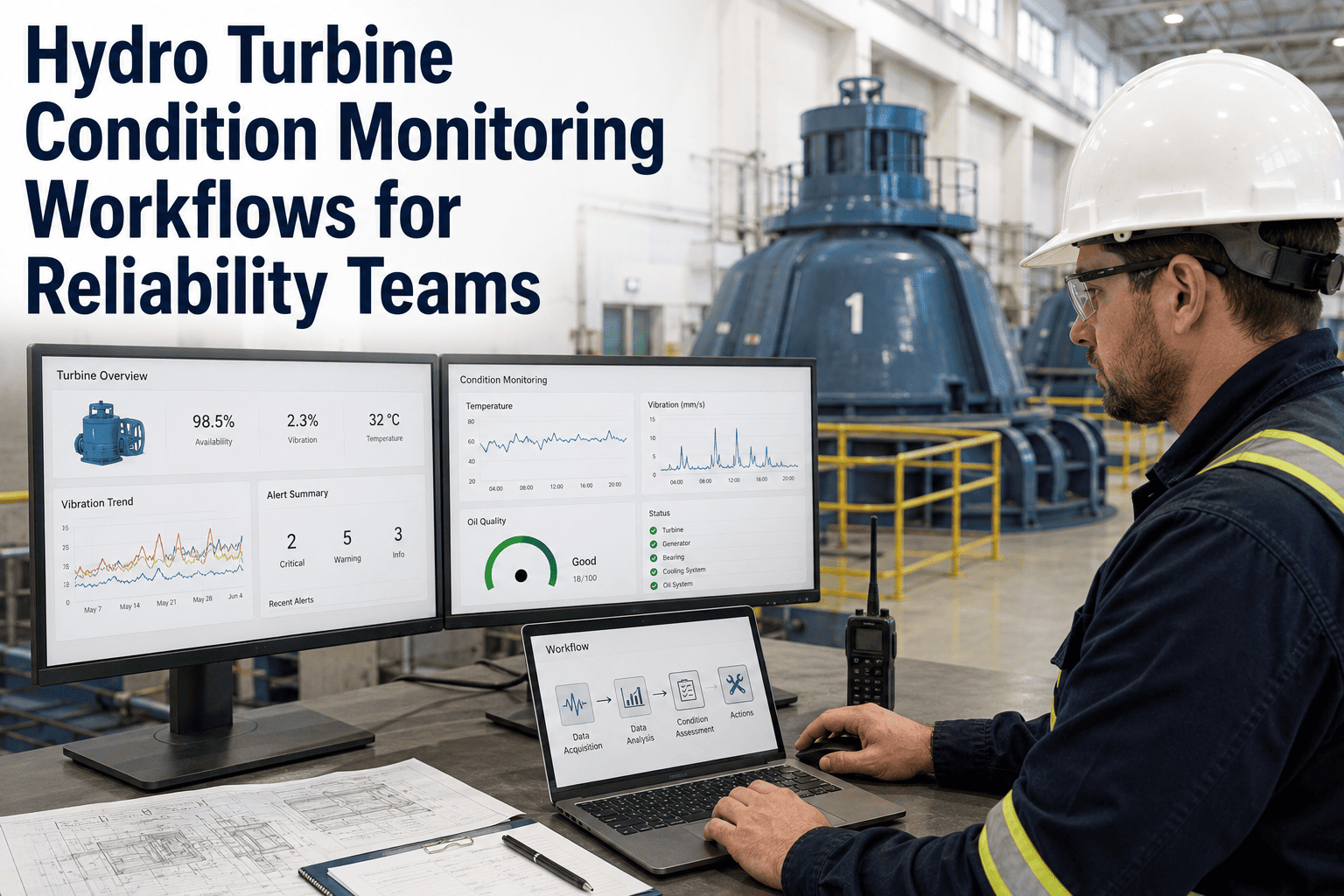
Cavitation is the leading cause of unplanned downtime and runner blade failure in hydropower turbines — and it rarely announces itself before the damage is already deep. Vapor bubbles forming and collapsing under extreme pressure erode blade surfaces, reduce hydraulic efficiency by up to 4%, and can trigger structural failures that cost over $200,000 in lost generation and emergency repairs per incident. The facilities that catch cavitation early are not running more inspections — they are running smarter ones, with predictive maintenance systems that flag acoustic anomalies and efficiency drops before the first visible pit forms. Start free on OxMaint to set up cavitation condition tracking on your turbine assets, or book a demo to see how predictive workflows are configured for hydro fleets.
PREDICTIVE MAINTENANCE · HYDRO MAINTENANCE
Hydro Turbine Cavitation Predictive Maintenance Guide
From early acoustic signals to runner replacement — a field guide to catching cavitation before it becomes a structural event.
4%
Typical hydraulic efficiency loss from advanced cavitation erosion
$200K+
Estimated cost of a single unplanned outage caused by runner blade failure
28,000€/hr
Reported downtime cost at a 295 MW pumped-storage facility (2025 market rates)
THE SCIENCE BEHIND THE DAMAGE
What Cavitation Actually Does to Your Runner
Cavitation begins the moment local water pressure drops below vapor pressure — high velocities and off-design operating angles are the usual triggers. The resulting vapor bubbles collapse violently against blade surfaces, generating localized pressure spikes and temperatures as high as 2,000 K. The cumulative effect is not immediately visible but relentlessly progressive.
Stage 1
Inception
Acoustic emission sensors detect high-frequency noise from bubble formation. Vibration baseline shows a subtle broadband increase. No visible surface damage — but the erosion clock has started.
Signal: Acoustic anomaly · Efficiency baseline shift
Stage 2
Surface Pitting
Runner low-pressure blade faces show visible pitting. Vibration amplitude has measurably increased. Efficiency loss of 1–2% is detectable in generation output curves.
Signal: Pitting depth log · Vibration trend flag
Stage 3
Crack Propagation
Pitting deepens under cyclic hydraulic stress. Cracks propagate along blade profiles. Efficiency has dropped 3–4% and bearing wear is accelerating from elevated vibration loads.
Signal: NDT crack length · Bearing temperature rise
Stage 4
Structural Failure
Blade perforation or fracture occurs. Forced outage is immediate. Emergency sourcing, transport, and weld repair can take weeks — at spot market prices and emergency labor rates.
Signal: Forced trip · Emergency work order
Track Cavitation Stages Before They Escalate
OxMaint maps acoustic, vibration, and efficiency signals to a single asset health score — so your team sees the stage transition, not just the failure.
SENSOR TO WORK ORDER
Predictive Monitoring Signals That Matter
| Monitoring Signal |
What It Detects |
Cavitation Stage |
OxMaint Action Triggered |
| Acoustic Emission (AE) |
High-frequency bubble collapse noise |
Early |
Anomaly flag + watch alert |
| Vibration Spectrum |
Broadband increase, sub-synchronous components |
Early–Mid |
Trend alert + inspection work order |
| Efficiency Curve Drift |
Generation output vs. expected at flow rate |
Mid |
Performance deviation report |
| Bearing Temperature |
Elevated wear from vibration-induced loading |
Mid–Late |
Escalated work order priority |
| NDT / Visual Pitting Log |
Surface damage depth measurement |
Late |
Repair scope + long-lead part flag |
| Draft Tube Pressure Pulsation |
Vortex rope formation at part-load |
Mid |
Operating regime alert to control room |
RISK FACTORS
Operating Conditions That Accelerate Cavitation
01
Off-Design Operation
Running Francis or Kaplan units significantly above or below the design flow point increases angle of attack on runner blades, creating localized low-pressure zones where cavitation nucleates. Grid frequency regulation demands are pushing more units into these ranges.
02
Sediment-Laden Water
Himalayan and high-gradient river systems see sediment concentrations that compound cavitation erosion — silt particles abrade blade surfaces already weakened by bubble collapse, accelerating pitting rates by a factor of two or more compared to clean-water installations.
03
Tailwater Fluctuation
Variable downstream water levels alter the net positive suction head available to the turbine. When tailwater drops unexpectedly, the cavitation sigma margin narrows, and units not equipped with automatic derate logic begin eroding faster than inspection cycles can catch.
04
Aging Runner Profiles
Surface finish degrades with every operating cycle. As blade profiles deviate from the original hydraulic geometry through erosion and weld repair, the cavitation performance envelope shrinks — a unit that operated cleanly at commissioning may cavitate at the same flow point 15 years later.
EXPERT REVIEW
Dr. Priya Nandakumar
Senior Reliability Engineer — Hydropower Asset Management, 18 Years
The problem with cavitation is that it feels manageable right up to the point where it is not. A team doing quarterly visual inspections will miss the stage-one-to-stage-two transition entirely, because that transition happens in the sensor data, not on the runner surface. The plants that have meaningfully reduced their cavitation-related outage rate are the ones treating acoustic and vibration signals as first-class maintenance data — not as background noise to be reviewed once a year. Once you start trending those signals against your efficiency curve in a single view, the story becomes very clear very fast.
FREQUENTLY ASKED
Cavitation Predictive Maintenance — Common Questions
How early can predictive maintenance detect cavitation before visible damage appears?
Acoustic emission monitoring and vibration spectrum analysis can detect cavitation inception before any surface pitting is visible — typically days to weeks ahead of measurable efficiency loss. OxMaint logs these signals as anomaly flags on the asset record, creating a trend history that lets your team track whether the signal is stable, worsening, or linked to a specific operating regime.
Start free to configure acoustic anomaly tracking on your turbine assets.
Which turbine types are most vulnerable to cavitation damage?
Francis turbines are the most widely affected because their fixed runner geometry means cavitation risk rises sharply at part-load and overload conditions. Kaplan turbines can adapt blade angle to reduce cavitation exposure, but their runner hub seals and blade mechanisms become failure points. Pelton turbines are relatively immune to classic runner cavitation but face bucket erosion in high-sediment conditions. The monitoring approach differs by type, and OxMaint supports separate condition templates per turbine class.
Book a demo to map your fleet.
How does OxMaint connect sensor data to a maintenance work order?
When a monitored signal — acoustic level, vibration amplitude, or efficiency deviation — crosses a configured threshold, OxMaint automatically generates a work order with the signal trend attached. The work order includes the asset record, the breach detail, and the recommended inspection scope. Planners do not need to review raw sensor dashboards to act; the system surfaces the decision when the data says to.
Sign up free to set your first threshold.
Can cavitation monitoring reduce the frequency of scheduled runner inspections?
Yes. Plants using continuous condition monitoring and trending shift from fixed-interval runner inspections — typically annual or biennial — to condition-triggered inspections based on actual signal behavior. This means inspections happen when the data says the runner needs attention, not on a calendar. Teams typically reduce total inspection events while catching more real degradation events earlier.
Book a demo to see how the interval logic is set up.
What does OxMaint do when a cavitation event points to a long-lead spare requirement?
When a cavitation stage assessment indicates that runner replacement or major weld repair is likely within the asset's health trajectory, OxMaint flags any long-lead components associated with that asset — runner bowls, stay ring seals, or draft tube liners — and prompts procurement to begin sourcing. This bridges the gap between condition monitoring and supply chain planning, which is where most facilities lose months of lead time.
Start free to link spares to your asset records.
OXMAINT · PREDICTIVE MAINTENANCE
Stop Treating Cavitation as a Visual Inspection Problem
OxMaint connects acoustic, vibration, and efficiency signals to condition-based work orders — so your team catches cavitation at Stage 1, not Stage 4.