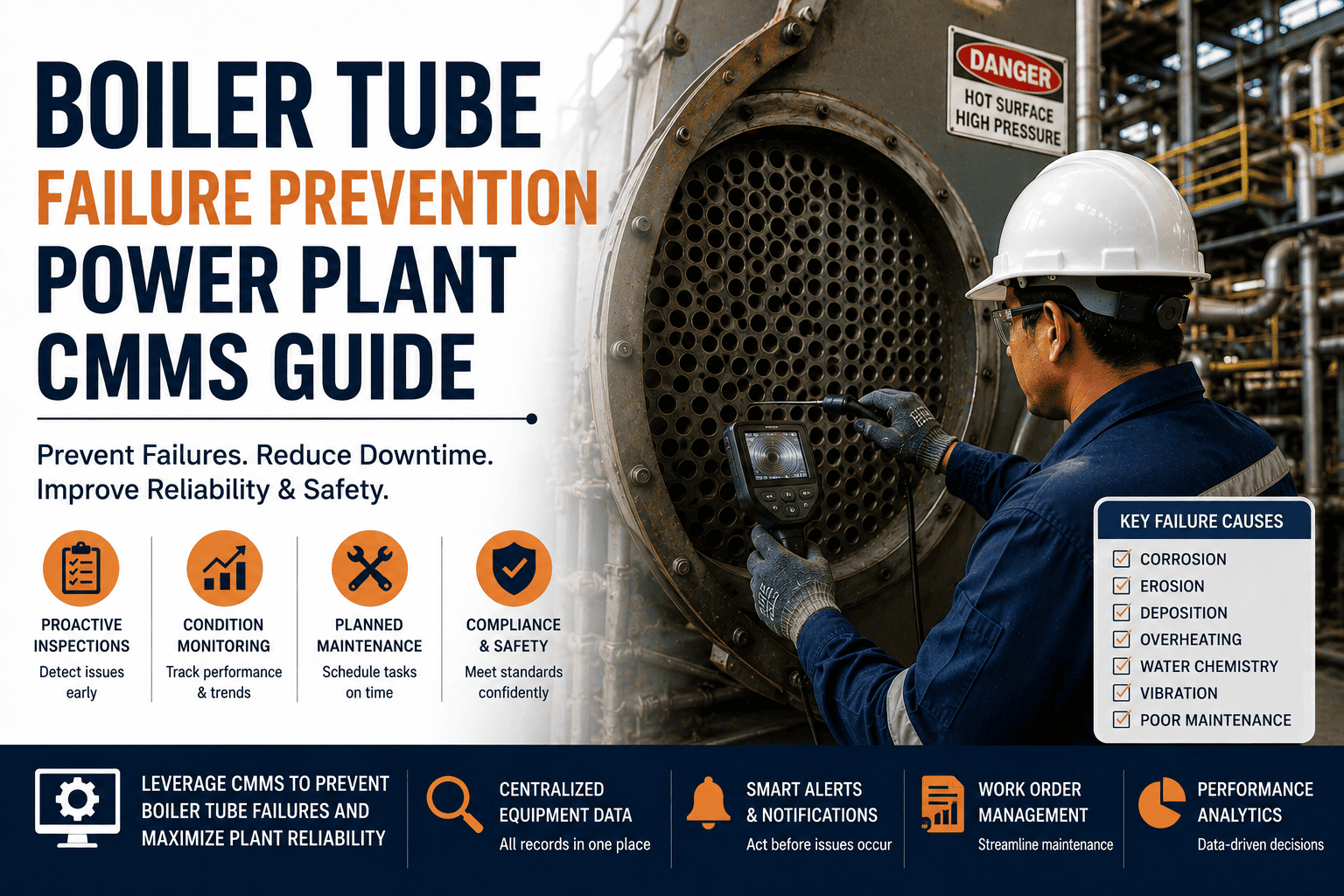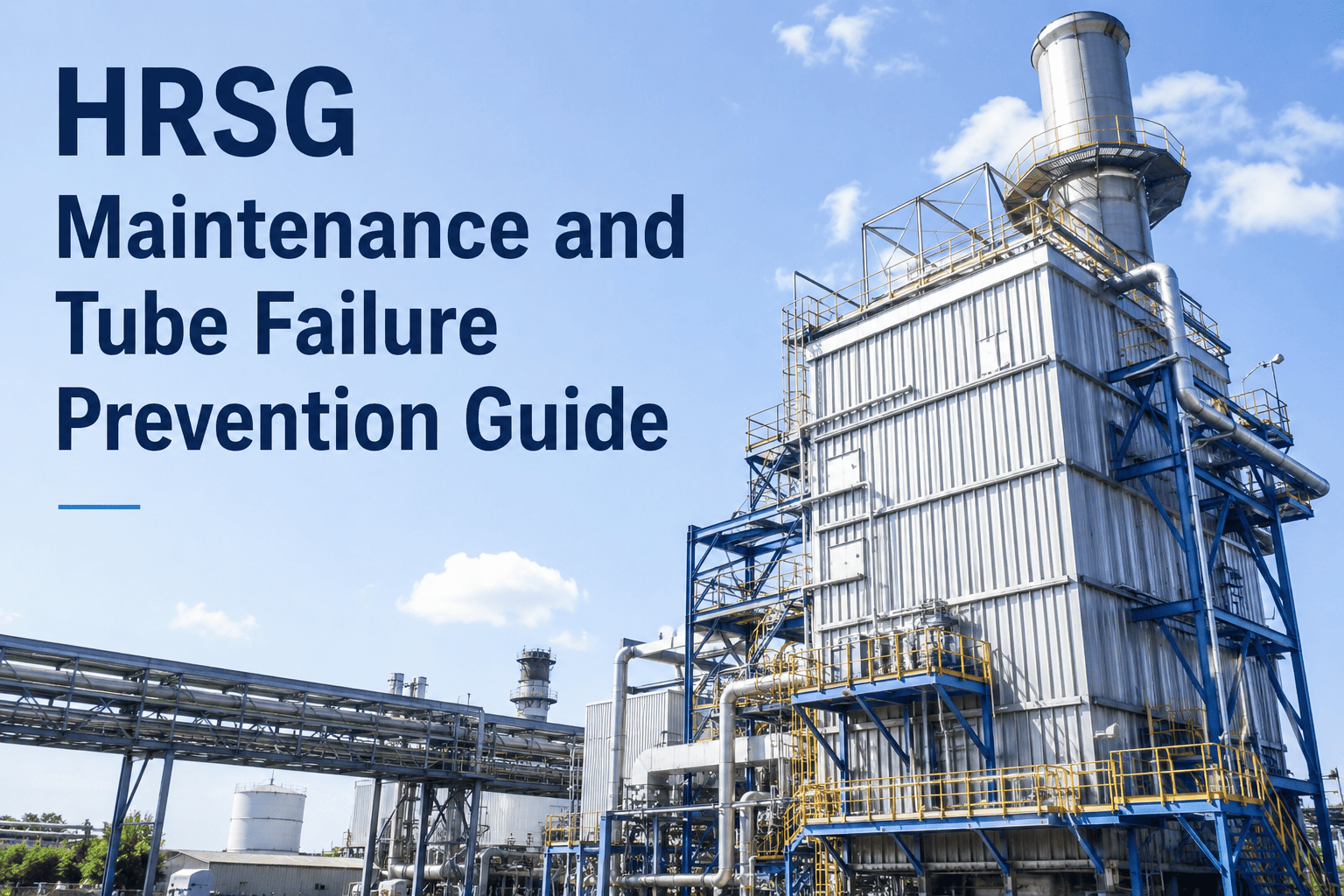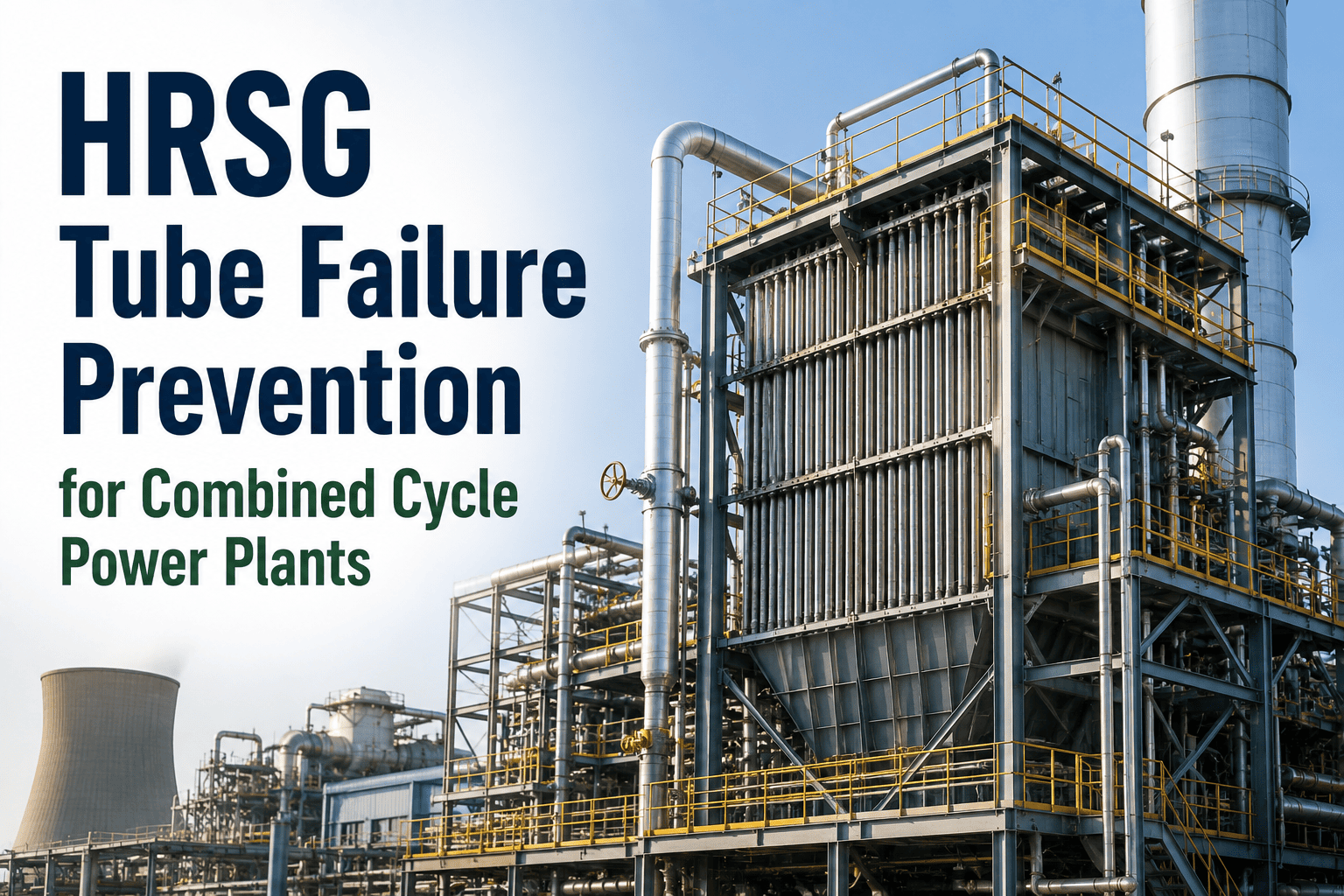
HRSG tube failure prevention is the single most critical reliability challenge facing combined cycle power plants today, with unplanned tube leaks causing forced outages that cost $500,000 to $2 million per incident in lost generation revenue alone. Flow accelerated corrosion, thermal cycling fatigue, and steam chemistry deviations account for over 70% of these failures — yet most are predictable and preventable with disciplined inspection programs, chemistry control, and a robust CMMS that tracks every tube segment, repair history, and inspection interval. Whether you manage a single-shaft or multi-shaft CCGT facility, implementing a structured HRSG tube failure prevention program can cut unplanned downtime by 30–50% and extend creep-life-critical component reliability well beyond original design life. OxMaint's AI-powered CMMS and EAM platform centralizes your HRSG maintenance, automates preventive schedules and predicts failure modes before they force an outage — you can Start Free Trial or book a personalized demo to see it on your assets.
40% of combined cycle forced outages trace back to HRSG tube failures.
A single tube leak can take a 500 MW block offline for 3–7 days. Our AI-powered CMMS tracks every tube segment, inspection interval, and chemistry threshold — so your team prevents failures before they cost you a megawatt.
What causes HRSG tube failures in combined cycle plants?
Industry data from EPRI and NERC GADS shows that roughly 40% of unplanned HRSG outages stem from just four tube-degradation mechanisms. Understanding which one dominates your unit is the first step in HRSG tube failure prevention.
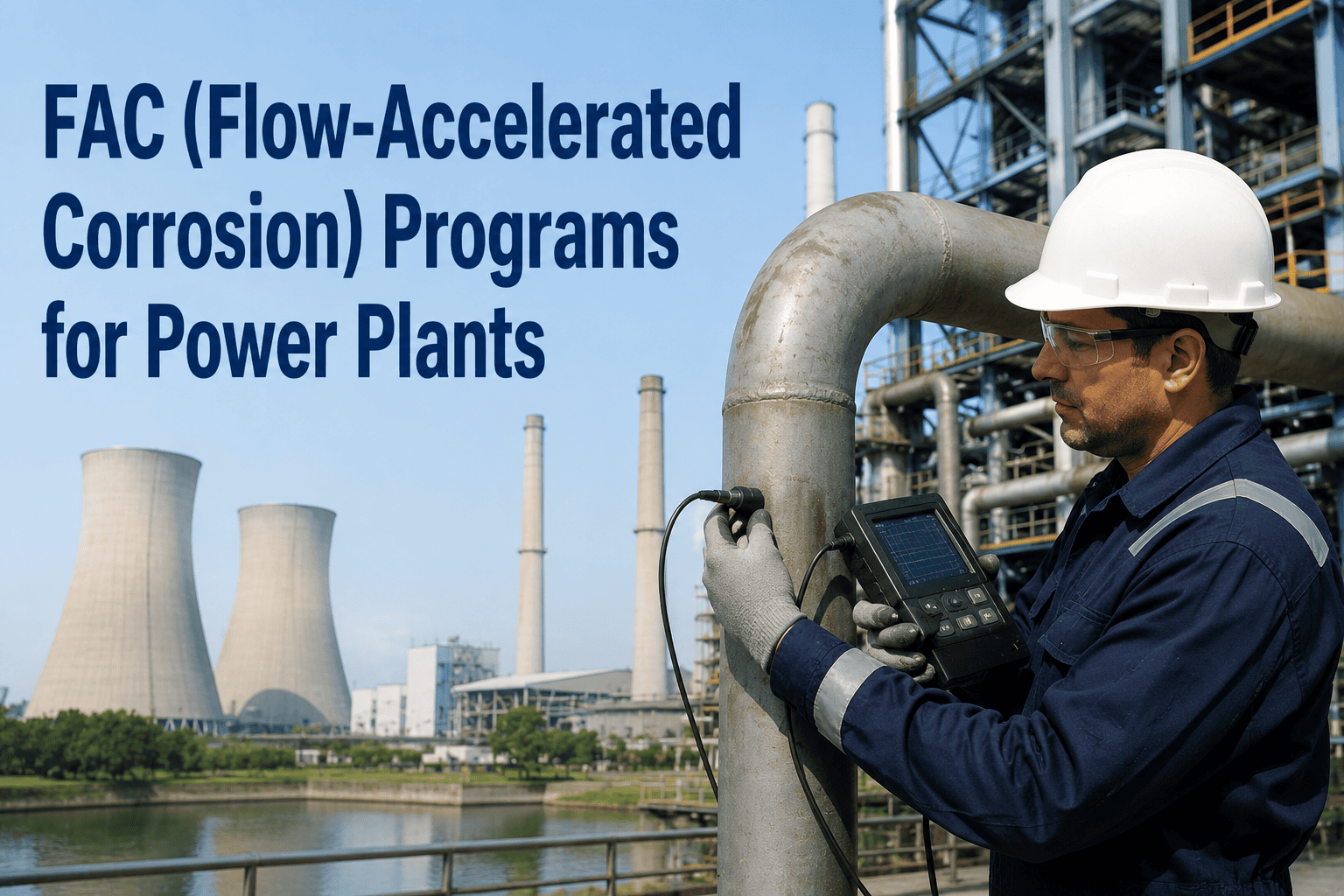
Single-phase and two-phase FAC thin carbon steel elbows and T-joints in LP evaporator and economizer circuits — the leading HRSG tube failure mechanism.
Cycling duty, fast-start ramps, and drain-line deficiencies drive header and tube-to-header fatigue cracks, especially in HP superheater outlet headers.
Duct firing and gas-side fouling elevate tube-metal temperatures above design, accelerating creep in HP superheater and reheater circuits.
Chloride ingress, caustic carryover, and oxygen excursions cause pitting and stress-corrosion cracking in stainless steel and alloy tubing.
How to build an HRSG tube failure prevention program
A defensible HRSG tube program combines risk-based inspection, chemistry control, cycling management, and a CMMS that enforces every task on schedule. Here is the proven five-phase roadmap.
Build a complete asset register of HP, IP, and LP circuits — economizer, evaporator, superheater, reheater — with design material, operating temperature, and flow velocity. Rank each circuit by FAC susceptibility (ASME PRA-1), creep exposure, and cyclic duty history. Plants that complete this baseline within 90 days typically identify 15–25 high-risk tube segments they were not inspecting at all.
Assign inspection techniques — UT thickness mapping, phased-array weld inspection, borescope, replica microstructure — to each ranked circuit. High-risk FAC locations need 12–18 month intervals; moderate-risk 24–36 months. Upload every inspection result to your CMMS so wall-thickness trends are visible across outages, not buried in a spreadsheet.
Enforce IAPWS TGD3-10 action levels for sodium, silica, chloride, sulfate, cation conductivity, and pH in real time. Integrate chemistry data feeds into your CMMS so every excursion auto-generates a work order for sampling, diagnosis, and correction. A 500 MW combined cycle plant that auto-tracks chemistry action levels typically reduces chemistry-related tube damage events by 60–80% within two years.
Limit startup ramp rates to manufacturer-recommended thermal-stress curves (typically 5–8 °C/min for HP headers), and verify drain-valve operation every cold start. Faulty drain systems cause water quenching and thermal shock that crack tube-to-header welds. Schedule drain-valve stroking and thermocouple calibration as preventive tasks in your CMMS — not as afterthoughts during startup.
Every tube weld repair, clamp, and replacement must be logged with location, material, welder ID, and root-cause code. Feed inspection trends and repair history into OxMaint's predictive analytics to forecast which tube segment will fail next — enabling planned weld overlays or replacements during scheduled outages instead of forced ones.
HRSG tube inspection checklist for outage planning
Use this tiered checklist to scope every combustion-turbine outage. Each item maps to a preventive or predictive work order template inside OxMaint, so nothing falls through the cracks.
- UT thickness at all single-phase elbows and T-joints in LP economizer and evaporator
- Two-phase FAC screening at evaporator inlet headers and riser tubes
- Verify minimum wall thickness against ASME B31.1 code calculations
- Flag any location below 87.5% nominal wall for replacement or weld overlay
- Compare trends to prior outage — flag accelerated thinning rates immediately
- Dye-penetrant or magnetic-particle inspect all HP superheater outlet header stub-to-tube welds
- Phased-array UT on header-to-nozzle circumferential welds with high cyclic duty hours
- Inspect attemperator spray water piping for thermal-quench cracking
- Verify drain-line freedom — flow-test every HP and RH drain valve during startup
- Review startup ramp-rate logs for thermal-exceedance events since last outage
- Replica microstructure examination on HP superheater and reheater outlet headers
- Borescope internal tube surfaces for oxide scale exfoliation and blockage
- Review gas-side fouling and soot-blower effectiveness on finned-tube bundles
- Assess creep damage per NEI/EPRI guidelines — plan header replacement before 100,000 hours
- Validate tube-metal thermocouple readings against design limits for duct-fired operation
- Borescope stainless steel tubing for chloride pitting and stress-corrosion cracking
- Review 12-month chemistry log for cation conductivity and sodium excursions
- Inspect condenser tube leaks and polish demineralizer performance trends
- Verify deaerator and feedwater oxygen scavenger dosing consistency
- Audit all sampling-line conditioning for representative, contamination-free readings
Flow accelerated corrosion: the thinning-rate equation
FAC is the dominant HRSG tube failure mechanism. Use this simplified form of the Berge-Beaufils thinning model to estimate remaining life at each susceptible location — then track it in your CMMS.
A 2×1 combined cycle plant with 8,000 annual operating hours inspects a 4-inch LP economizer elbow. Current UT reading: 3.8 mm wall. Design minimum per B31.1: 3.0 mm. Calculated thinning rate from prior outage trends: 0.35 mm/year. Remaining life = (3.8 − 3.0) ÷ 0.35 = 2.3 years. OxMaint flags this elbow as "Replace within 18 months" in the next planned outage — preventing a forced outage that would have cost an estimated $850,000 in lost generation.
HRSG tube failure prevention with OxMaint CMMS
OxMaint turns your HRSG tube program from a spreadsheet-and-sticky-note scramble into an AI-powered, audit-ready system of record. Here is how four core capabilities map directly to HRSG failure prevention.
Upload thickness readings from any NDE vendor. OxMaint auto-trends wall loss per location, calculates remaining life against B31.1 minimums, and surfaces replacement recommendations 12+ months before failure — cutting unplanned HRSG downtime by 30–50%.
Auto-generate preventive work orders for every HRSG tube inspection, drain-valve stroking, and soot-blower task based on operating hours, starts, or calendar intervals. Never miss a high-risk circuit again — no spreadsheet, no memory-based scheduling.
Connect your chemistry analyzers. Every IAPWS action-level excursion auto-creates a work order for diagnosis and corrective action — reducing chemistry-related tube damage events by up to 80% and creating a full audit trail for regulators.
Track every tube segment, header, and spare part — with material grade, welder ID, and install date. Know exactly which replacement tube sections and weld overlays you have in stock and which circuits have repair history, so outage scope is precise and parts are ready.
The cost of HRSG tube failures vs. prevention
A single forced HRSG outage at a 500 MW combined cycle block typically costs $500K–$2M in lost generation margin, emergency labor, and restart fuel. Compare that to the annual cost of a structured prevention program — the payback is measured in a single avoided outage.
| Cost Category | Reactive (No Program) | With OxMaint Prevention | Annual Savings |
|---|---|---|---|
| Forced outage lost generation (3–7 days @ $80–120/MWh margin) | $500K – $2M per event | 1 event every 4–5 yrs (vs. every 1–2 yrs) | $250K – $750K |
| Emergency repair labor & welding (premium time) | $80K – $150K per event | Planned outage scope, standard rates | $40K – $80K |
| Restart fuel & cycling damage (per cold restart) | $50K – $120K | Fewer forced cold restarts | $25K – $60K |
| Chemistry-related tube damage repairs | $100K – $300K/yr | 60–80% reduction with auto-action-level monitoring | $60K – $200K |
| Insurance premium & NERC compliance penalties | Higher risk profile | Documented, audit-ready program | $20K – $50K |
| Estimated Total Annual Savings (per 500 MW block) | $395K – $1.14M | ||
A 2×1 combined cycle plant operating 7,500 hours/year was experiencing one to two HRSG tube leaks annually, costing an average of $920,000 per forced outage. After implementing an OxMaint-driven prevention program — risk-based UT inspections, automated chemistry monitoring, and predictive remaining-life tracking — the plant went 38 months without a single HRSG forced outage. The CMMS subscription cost was recovered within the first 60 days of avoided downtime.
Stop managing HRSG tubes in spreadsheets.
See how OxMaint's AI-powered CMMS predicts tube failures, automates inspections, and keeps your combined cycle block online. Book a 30-minute demo on your assets today.
HRSG tube failure prevention: your questions answered
Ready to prevent your next HRSG tube failure?
Join the combined cycle plants using OxMaint to predict failures, automate inspections, and keep their blocks online. Start your free trial or book a personalized demo — see OxMaint on your HRSG assets in 30 minutes.
Free 14-day trial · No credit card