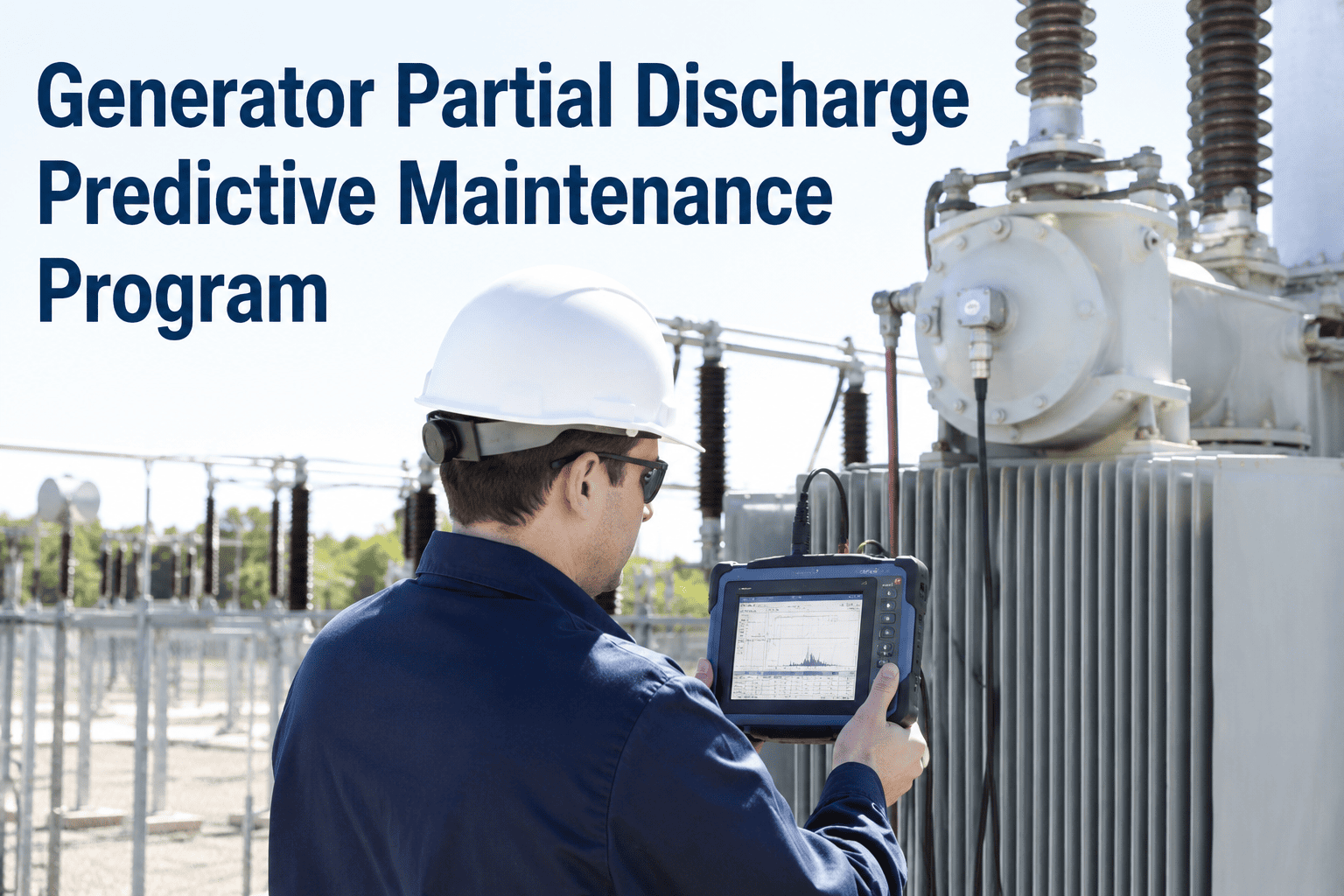
Generator Partial Discharge Predictive Maintenance Program

By Johnson on June 18, 2026

generator-partial-discharge-predictive-maintenance-program

Generator winding insulation failure is the most expensive single-component failure in power generation — and partial discharge activity builds for months before any conventional meter detects it. Research confirms that approximately 37% of disruptive generator faults originate in stator winding problems, with insulation degradation — driven largely by partial discharge — responsible for around 40% of those failures. The critical challenge is that partial discharge is invisible to standard monitoring instruments until winding damage is already advanced and repair costs are escalating. A structured partial discharge predictive maintenance program, connected to a CMMS that automates inspection scheduling and work order response, is the only practical way to manage this risk across an operating fleet. OxMaint's predictive maintenance module integrates PD monitoring data with automated work order workflows — turning PD trend readings into scheduled maintenance actions with zero manual steps in between. If your generators are still on calendar-based inspection cycles, book a 30-minute demo to see how a PD program connected to OxMaint changes the risk equation.

Generator Reliability · Predictive Maintenance · OxMaint

Generator Partial Discharge Predictive Maintenance Program

A complete framework for detecting, trending, and acting on partial discharge data — so winding insulation failures are caught months before the forced outage, not days after.

37%
of disruptive generator faults caused by stator winding problems (IEEE)
8–16 wk
Lead time for generator replacement parts after catastrophic failure
60–90 days
Advance warning typical from PD trending before insulation failure
Understanding PD

What Partial Discharge Is and Why It Matters

Partial discharge is not a failure — it is the early warning signal that a failure is developing. Understanding what it is and what produces it is the foundation of any effective PD monitoring program.

01
Definition
Partial discharge (PD) is an electrical breakdown occurring in a small portion of the insulation system — typically in voids, cracks, or at conductor interfaces — without bridging the full insulation gap. It produces high-frequency current pulses measurable with capacitive couplers or electromagnetic sensors.
02
What Causes It
Thermal cycling that creates micro-cracks in the insulation, delamination from vibration, moisture ingress, contamination (oil, dust, carbonaceous deposits), and age-related insulation degradation all create void spaces where PD initiates and progressively worsens.
03
Why It Escalates
Each PD event chemically degrades the surrounding insulation material, enlarging the void and increasing discharge intensity. This self-reinforcing process accelerates over months — which is why early detection via trending is far more valuable than single-point measurements.
04
Why It Goes Undetected
PD activity is invisible to standard metering, temperature monitors, and vibration sensors. Only dedicated PD measurement equipment — or infrared scanning for surface discharge — detects it. Without a PD program, insulation condition is unknown until failure or offline testing.
Program Structure

The 4-Phase Generator PD Monitoring Program

Phase Activity Measurement Method OxMaint Integration Frequency
1 — Baseline Establish initial PD fingerprint per winding phase and location Online capacitive coupler or offline hi-pot PD mapping Baseline values stored in OxMaint asset record as comparison reference Once at program start
2 — Trending Track Qmax, NQN, and phase-resolved PD patterns over time Online continuous or periodic offline measurement OxMaint ingests readings, plots trends, flags rate-of-change acceleration Quarterly (offline) or continuous
3 — Alert Response Investigate winding segments showing trend acceleration or threshold breach Localized PD mapping, thermal imaging, visual inspection Auto-generated work order with inspection scope and technician assignment On trigger
4 — Intervention Planning Schedule resin injection, slot wedge tightening, or rewinding based on severity Condition assessment + PD severity classification OxMaint links intervention work order to outage planning window with parts pre-ordering Per assessment outcome
OxMaint Generator PD Program

See How OxMaint Connects PD Data to Maintenance Actions

Book a 30-minute demo and we will walk through PD trend ingestion, alert generation, automatic work order creation, and outage planning integration — using a real generator asset configuration.

Severity Classification

PD Severity Levels and Maintenance Response Matrix

Level 1 — Low
Qmax: <100 mV
PD activity present but within acceptable limits for machine age and design class. No immediate action.
OxMaint response: Continue trending at current interval. No work order generated.
Level 2 — Elevated
Qmax: 100–500 mV
Trend acceleration or threshold entry. Winding inspection recommended at next planned outage.
OxMaint response: Watch-level alert. Work order created for next outage window scope.
Level 3 — High
Qmax: 500 mV–2 V
Significant degradation indicated. Consider load reduction, accelerated inspection interval, and outage advancement.
OxMaint response: Urgent work order. Planning flag for outage advancement. Engineering review triggered.
Level 4 — Critical
Qmax: >2 V
Imminent insulation failure risk. Immediate controlled shutdown assessment required.
OxMaint response: Emergency work order. Multi-channel escalation. Shutdown decision documentation.
Expert Review

What Generator Reliability Engineers Recommend


The single most common failure mode I encounter in power plant generator programmes is not a lack of PD measurement — it is the absence of a systematic response process once the data comes in. Plants measure PD on schedule, the consultant submits a report, and the report sits in someone's inbox for six months. By the time the recommendation reaches a work order, the window to intervene before the next outage has passed. What changes the outcome is connecting the PD measurement directly to your CMMS so that a trend breach triggers a work order automatically, with the correct inspection scope and assigned technician, on the same day the measurement is taken. That is the difference between a PD monitoring program and a PD predictive maintenance program. Generator rewinding is a $500,000 to $2 million repair depending on unit size. Every plant that eliminates even one emergency rewinding per decade has funded its predictive maintenance program many times over.

Senior Generator Reliability Consultant
20 years in high voltage generator diagnostics, stator winding rehabilitation, and PD monitoring program development at gas, steam, and hydro generating stations
FAQs

Frequently Asked Questions

What PD monitoring hardware does OxMaint integrate with?
OxMaint integrates with all major generator PD measurement platforms including IRIS Power TGA-B and TGA-R, Qualitrol Intellinova, Doble M4100, and Siemens partial discharge monitoring systems via API or CSV import. Periodic offline measurements submitted by third-party testing contractors can also be manually entered or bulk-imported into the OxMaint asset record for trend tracking. Historical PD test results from any prior system can be imported to establish a retrospective trend baseline. Confirm hardware compatibility for your generator fleet in a 30-minute demo.
How does OxMaint determine when a PD trend warrants a work order versus continued monitoring?
OxMaint evaluates both absolute PD magnitude (Qmax levels) and rate-of-change — how fast the readings are rising over the past 90 days. A steady high reading may warrant continued monitoring, while a sharp acceleration from a lower baseline is often more concerning and triggers an earlier alert. Threshold levels are configurable by asset class, machine voltage rating, and insulation system type, so the alert criteria align with the specific generator design rather than generic industry averages. Configure your generator's PD alert thresholds in a free trial environment.
Can OxMaint support a PD program across a multi-unit generating fleet?
Yes — OxMaint's fleet-level generator dashboard displays PD severity status, trend direction, and open maintenance actions for every unit in your asset register simultaneously. This allows reliability engineers managing multiple units across one or more sites to identify which generators require attention at a single view, rather than reviewing individual test reports for each machine. Trend comparison across similar units also helps identify fleet-wide insulation degradation patterns. See the multi-unit PD dashboard in a live demo.
How does OxMaint help document PD program findings for insurance and regulatory purposes?
OxMaint maintains a complete, timestamped record of every PD measurement, alert generated, work order created, and maintenance action taken for each generator in the asset register. This audit chain is exportable by date range, unit, or severity level — producing a documented maintenance history that satisfies insurer inspection requirements and supports regulatory compliance review for nuclear and other regulated generation facilities. Review OxMaint's audit export format in a free trial.
What generator maintenance actions does OxMaint support beyond PD — including hydrogen-cooled unit requirements?
OxMaint supports the full generator maintenance scope: stator temperature RTD monitoring, hydrogen purity and pressure tracking (purity above 97% threshold alerts), seal oil differential pressure, exciter output trending, cooler fouling detection, and rotor retaining ring inspection scheduling. All parameters are tracked in the same asset record as PD data, giving the maintenance team a single composite view of generator health across all monitored inputs. See the complete generator monitoring scope in a live demo.
Generator PD Program · OxMaint · Predictive Maintenance

Catch Insulation Failures Before They Become Forced Outages

OxMaint connects your generator partial discharge monitoring data to a complete predictive maintenance workflow — from PD trend alert to closed work order — so every developing insulation fault becomes a planned intervention rather than an emergency rewinding.
Share This Story, Choose Your Platform!