Partial discharge is the earliest detectable indicator of stator winding insulation breakdown — and it is active in your generators right now, whether or not anyone is measuring it. Stator winding insulation problems account for approximately 40% of all generator forced outages, and the insulation defects that cause those outages almost always announce themselves months in advance through measurable PD activity. The IEEE 423 Gold Book reports that roughly half of all generators experience a forced outage within a year of their last scheduled maintenance — because periodic outage inspections give only a snapshot of insulation condition, while PD is a continuous process that evolves between outages. OxMaint gives maintenance teams the structure to track PD readings as a condition trend, correlate them with temperature and vibration data, and make outage scope decisions based on evidence — not just calendar intervals. Start tracking your generator PD readings in OxMaint free and build the insulation condition record that prevents your next unplanned outage.
Blog · Generator Reliability · Predictive Maintenance
Generator Partial Discharge: The Insulation Warning Your Maintenance Programme Cannot Afford to Ignore
PD activity tells you your generator insulation is failing — months before it fails. OxMaint tracks PD trends alongside temperature and vibration data to give your team the evidence it needs to plan repairs at the right outage, not the next emergency shutdown.
40%
of forced outages traced to stator winding insulation failure
~50%
of generators experience a forced outage within a year of last maintenance (IEEE 423)
$480K+
typical stator emergency rewind cost — preventable with PD trend tracking
Months
advance warning available from continuous PD trend monitoring
What Partial Discharge Actually Is
Understanding the Signal Before You Can Track It
Partial discharge refers to localized electrical discharges that occur within or on the surface of stator winding insulation — discharges that bridge part of the insulation but do not fully span the conductor gap. They occur when localized electrical field stress exceeds the dielectric breakdown strength of a defect or void in the insulation system. Every PD event is both a symptom and an accelerant: the discharge itself erodes the insulation at the discharge site, enlarging the defect and increasing future PD activity. Left untracked, this vicious cycle culminates in complete insulation breakdown.
01
Internal Void PD
Manufacturing voids, thermal cycling delamination, or aging-induced microcracking in the insulation bulk
High — internal PD is not visible and progresses invisibly until insulation failure
02
Slot Discharge
Loss of contact between the coil surface and the slot wall — typically from vibration loosening the slot fill
Medium — associated with end winding vibration; trackable through combined PD and vibration monitoring
03
End Winding Surface PD
Contamination, moisture, or semi-conducting grading layer damage at the coil end winding region
Medium-High — detectable visually during outage but only with surface access and UV inspection
04
Delamination PD
Insulation layer separation from thermal and mechanical cycling — creates air gaps that initiate PD activity
Very High — delamination progresses rapidly under load cycling and is the most common precursor to catastrophic winding failure
The Tracking Workflow
How OxMaint Structures Partial Discharge Maintenance Tracking
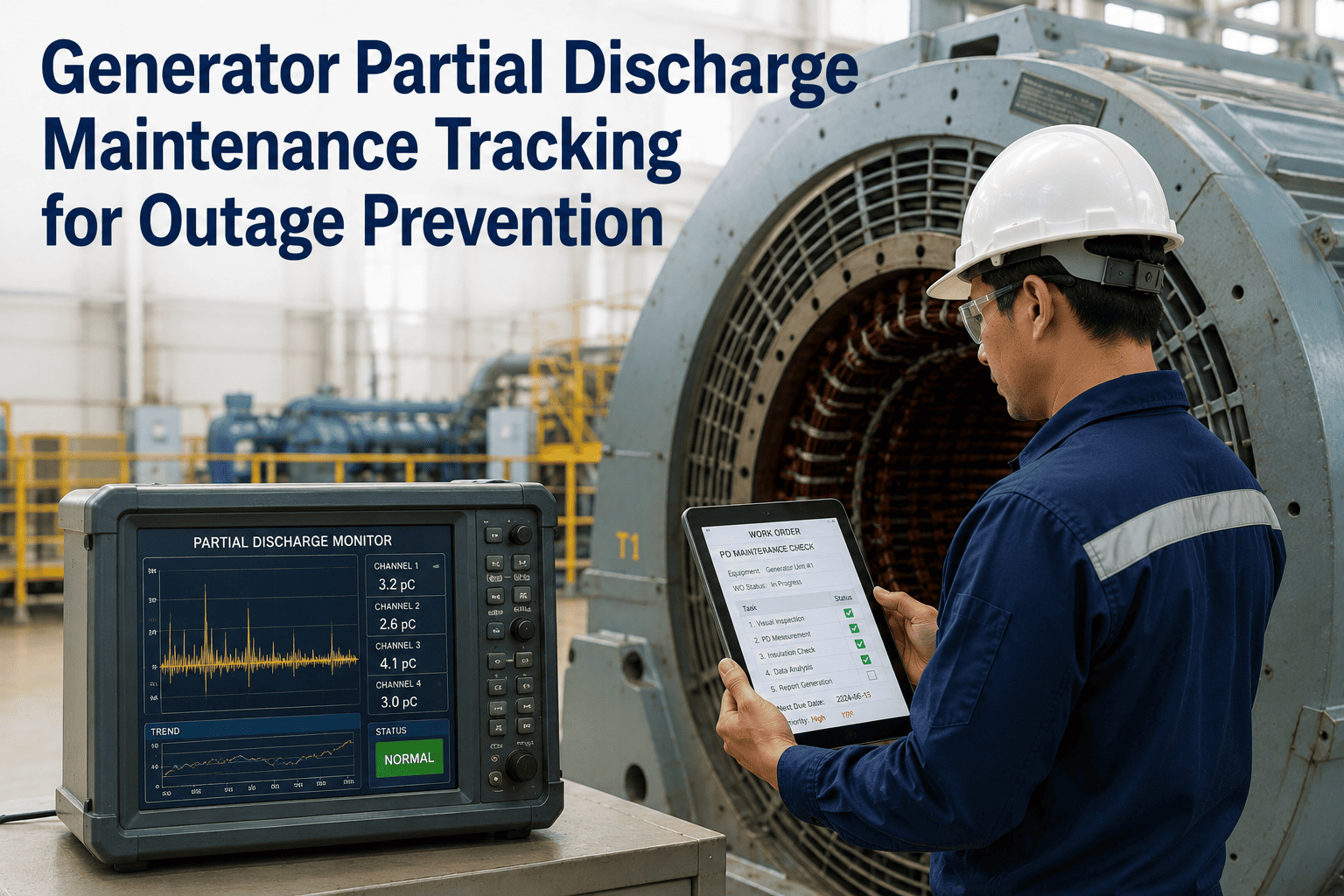
PD monitoring hardware produces data — OxMaint provides the maintenance workflow that turns that data into decisions. Whether you have continuous online PD monitoring or conduct periodic offline tests during outages, OxMaint structures the same tracking workflow around your measurement cadence.
Online PD Monitoring
1
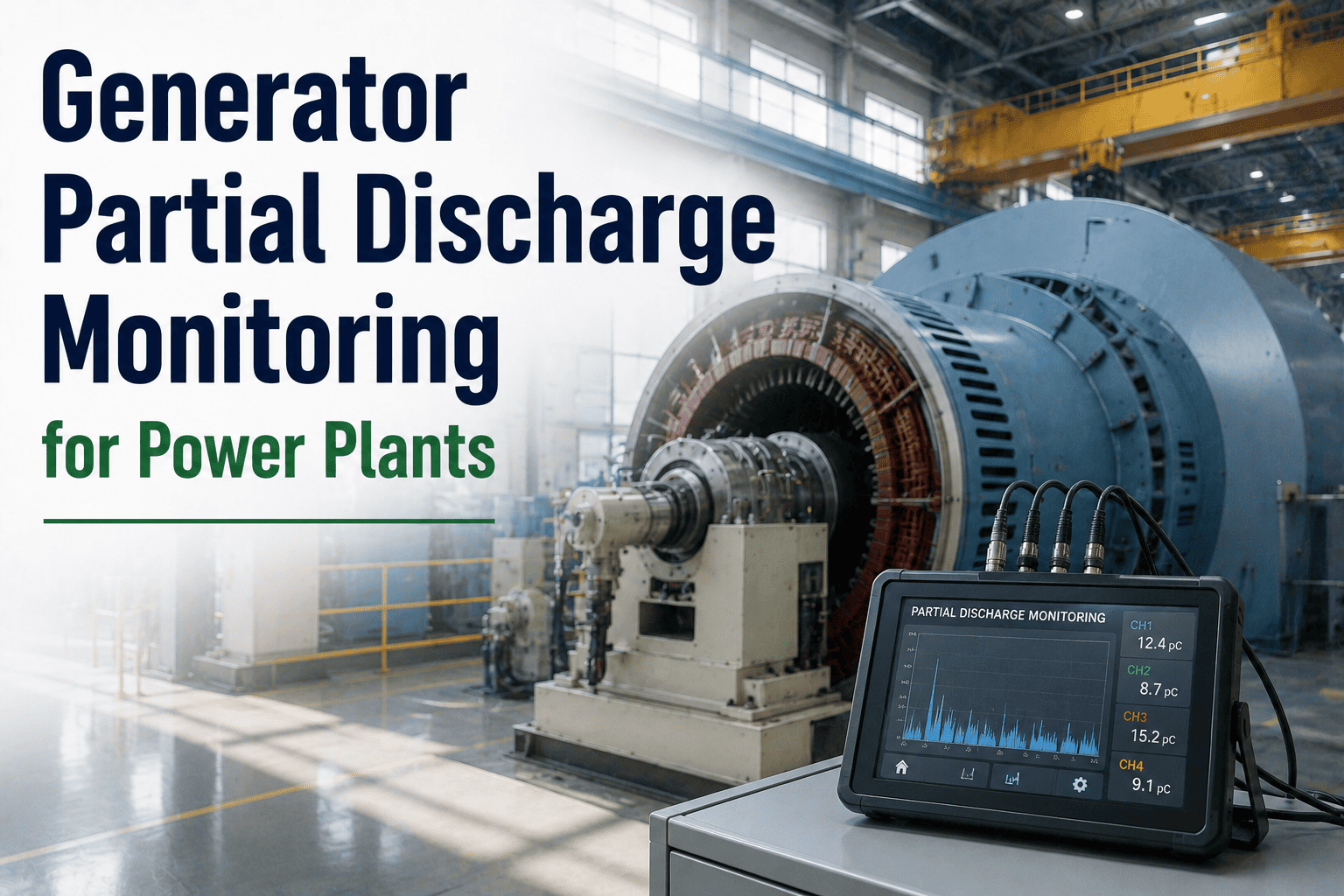
Coupling capacitor sensors installed on generator terminals stream PD pulse data to OxMaint through the IoT gateway continuously
2
OxMaint correlates PD magnitude and pulse rate against load, temperature, and operating hours — building a normalized trend per phase
3
Threshold breach on any phase auto-generates a prioritized work order assigned to the maintenance engineer with trend data, load context, and recommended investigation action attached
4
Findings logged, outage window recommended in OxMaint based on deterioration rate — evidence-based scope justified before the outage is planned
Periodic Offline Testing
1
Offline PD test results (pC magnitude, NQN, peak values per phase) entered into OxMaint during each outage inspection against the generator asset record
2
OxMaint trends test results across successive outages — calculating rate of change and flagging upward trends that exceed IEEE 1434 deterioration guidelines
3
PM schedule auto-advances inspection interval when deterioration rate accelerates — preventing the situation where a fast-moving condition is measured only at fixed calendar intervals
4
Full historical PD test record — with load conditions at time of each test — exports as an audit trail for insurance purposes, OEM consultation, or insulation life assessment
Multi-Signal Correlation
Why PD Tracking Alone Is Not Enough — and What OxMaint Combines It With
PD signals from one component can travel through the electrical circuit and appear as noise in sensors monitoring adjacent components — causing false alarms or masking real deterioration. Siemens Energy and GE's monitoring guidance both emphasize that isolated PD monitoring leads to misdiagnosed alarms. OxMaint tracks PD alongside complementary signals to give maintenance teams the full insulation condition picture.
| Signal |
What It Detects |
Relationship to PD |
OxMaint Tracking |
| Partial Discharge (PD) |
Insulation void activity and degradation |
Primary insulation health indicator |
Per-phase trend with load normalization |
| Stator Slot RTDs |
Hot spots from insulation conductivity loss |
Confirms PD is associated with thermal degradation |
Channel-level trend vs. insulation class limit |
| End Winding Vibration |
Slot fill looseness and winding movement |
Explains slot discharge PD source — vibration causes surface PD |
Continuous accelerometer trend with maintenance trigger |
| Insulation Resistance (IR/PI) |
Overall insulation condition and moisture ingress |
Validates PD reading by confirming bulk insulation state |
Outage test logging with trend vs. IEEE C50 limits |
| Rotor Flux / Air Gap |
Rotor winding inter-turn shorts |
Distinguishes rotor faults from stator PD contributions |
Linked asset record with separate threshold configuration |
A generator running at 91°C stator temperature with elevated PD is months from an emergency rewind — not years
OxMaint monitors both signals in the same asset record and alerts your team before the deterioration rate makes outage scheduling impossible. Book a demo to see combined PD and temperature trending on real generator data.
FAQ
Partial Discharge Maintenance Tracking Questions
Can OxMaint track partial discharge without continuous online monitoring hardware installed?
Yes. OxMaint fully supports offline PD test data entry — results from portable PD testing during outages are logged against the generator asset and trended across successive tests. Most plants begin with periodic offline tracking and layer in continuous monitoring as budget allows.
Start entering your outage PD records today free.
How does OxMaint handle PD readings from multiple generators on the same plant?
Each generator is a separate asset record in OxMaint — with its own PD trend history, threshold configuration, and maintenance work order queue. The fleet dashboard shows all generators in a single reliability view, with deteriorating units highlighted for priority review. Comparing PD trends across similar units helps calibrate what constitutes a significant deviation.
See the fleet dashboard in a live demo.
What PD measurement standard does OxMaint use for threshold configuration?
OxMaint's generator PD templates reference IEEE 1434 (Guide for Measurement of Partial Discharges in AC Electric Machinery) for trending guidance and IEC 60270 / IEC 60034-27-2 for measurement definitions. Thresholds are configurable by the maintenance engineer based on machine type, insulation system, and manufacturer guidance — the platform does not enforce a single standard but supports documentation of the chosen reference.
How does OxMaint help justify outage scope changes based on PD trend data?
OxMaint generates a PD trend report that shows measurement history, rate of change, associated temperature and vibration data, and work order investigation findings — all linked to the generator asset. This combined record provides the evidence base for engineering review of whether the next outage scope should include a winding inspection or rewind scope, replacing the guesswork of interval-based outage planning.
Build your PD evidence record starting free.
Can OxMaint integrate with existing GE, Siemens, or Iris Power PD monitoring systems?
OxMaint integrates with third-party monitoring systems through its IoT gateway and API. Alarm outputs and trend data from GE's GHM system, Siemens' GenAdvisor, Iris Power equipment, and other monitoring platforms can feed OxMaint work order triggers while maintaining the full maintenance workflow, inspection history, and audit trail in one system.
Partial discharge doesn't announce itself. Build the tracking workflow that does.
OxMaint turns periodic PD test results and continuous online monitoring data into a structured maintenance record — so your next outage scope is driven by insulation condition evidence, not calendar assumptions.