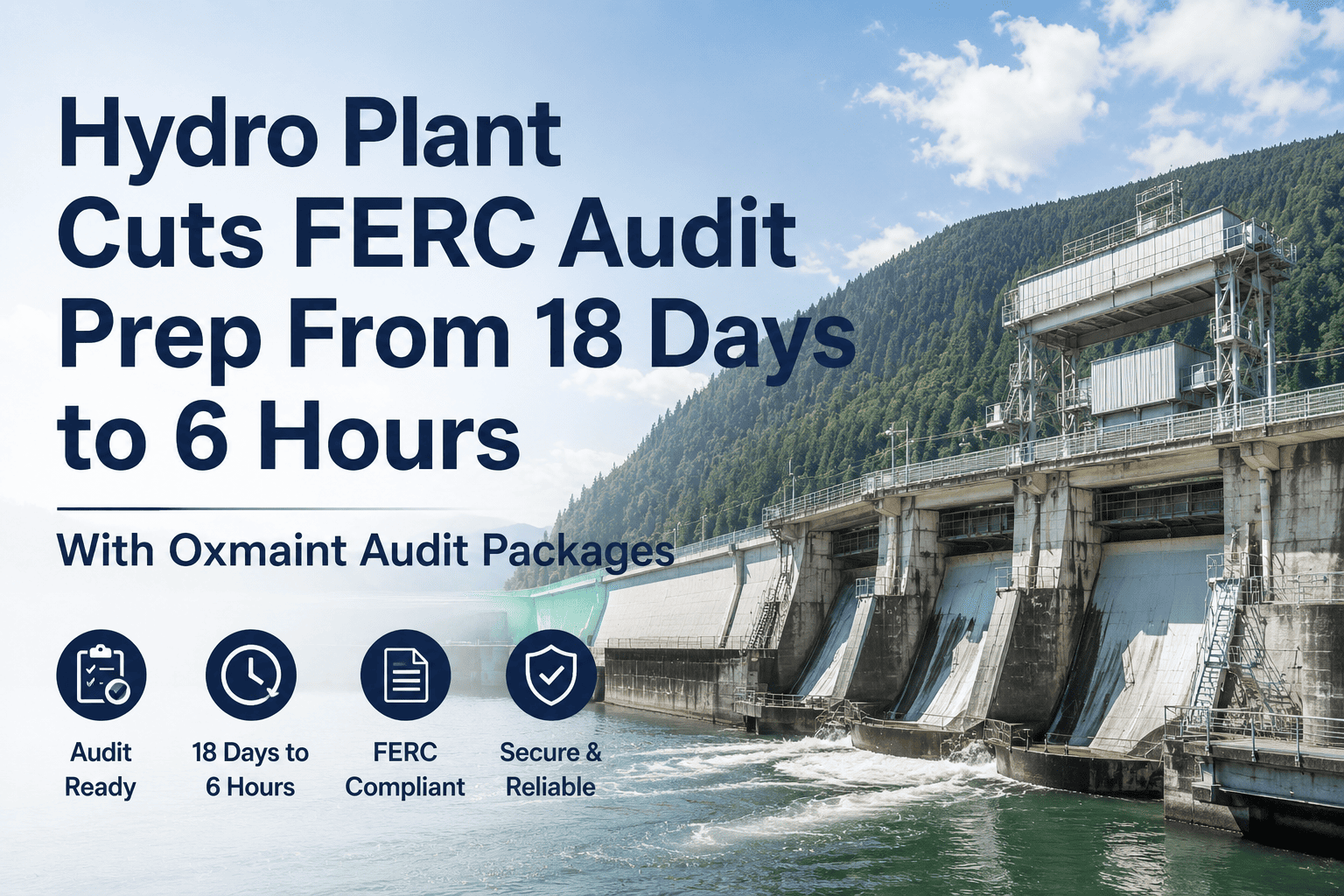
FERC Part 12 independent consultants and licensed project owners operate under a clear obligation: every dam inspection must produce documented findings on seepage, cracking, deformation, spillway operability, and instrumentation readings — organized, attributable, and retained in a format that satisfies both the Independent Consultant and the FERC regional engineer reviewing the report. Facilities that discover documentation gaps do so at the worst possible moment — during the Part 12D inspection cycle or after an unusual event triggers an unscheduled review. If your dam safety records are split across paper logs, PDF reports, and project-specific shared drives with no central retrieval path, the gap is already a liability. Start your OxMaint free trial and put every dam inspection record in one auditable, retrievable system.
FERC Part 12 · Dam Safety · Independent Consultant Inspection
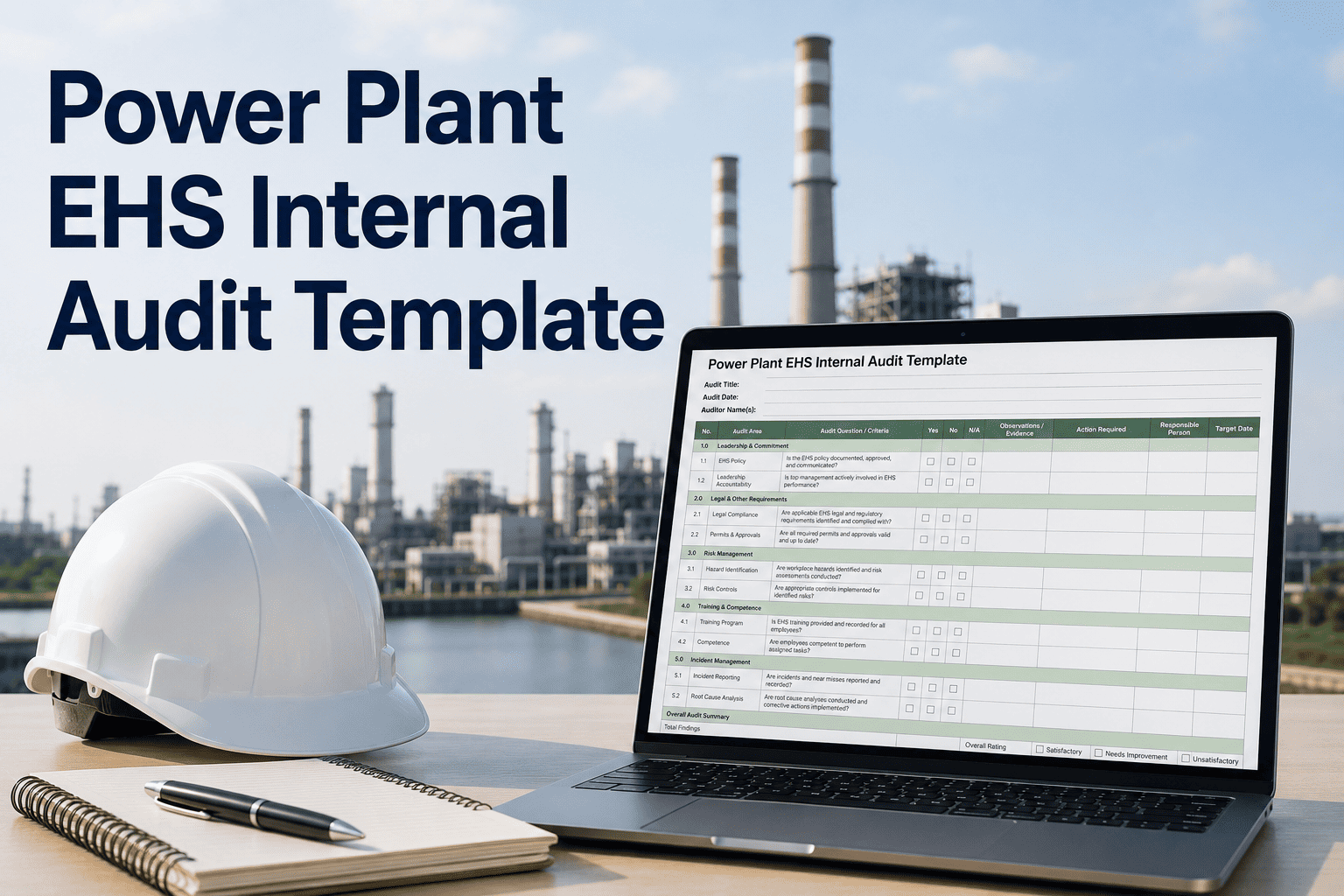
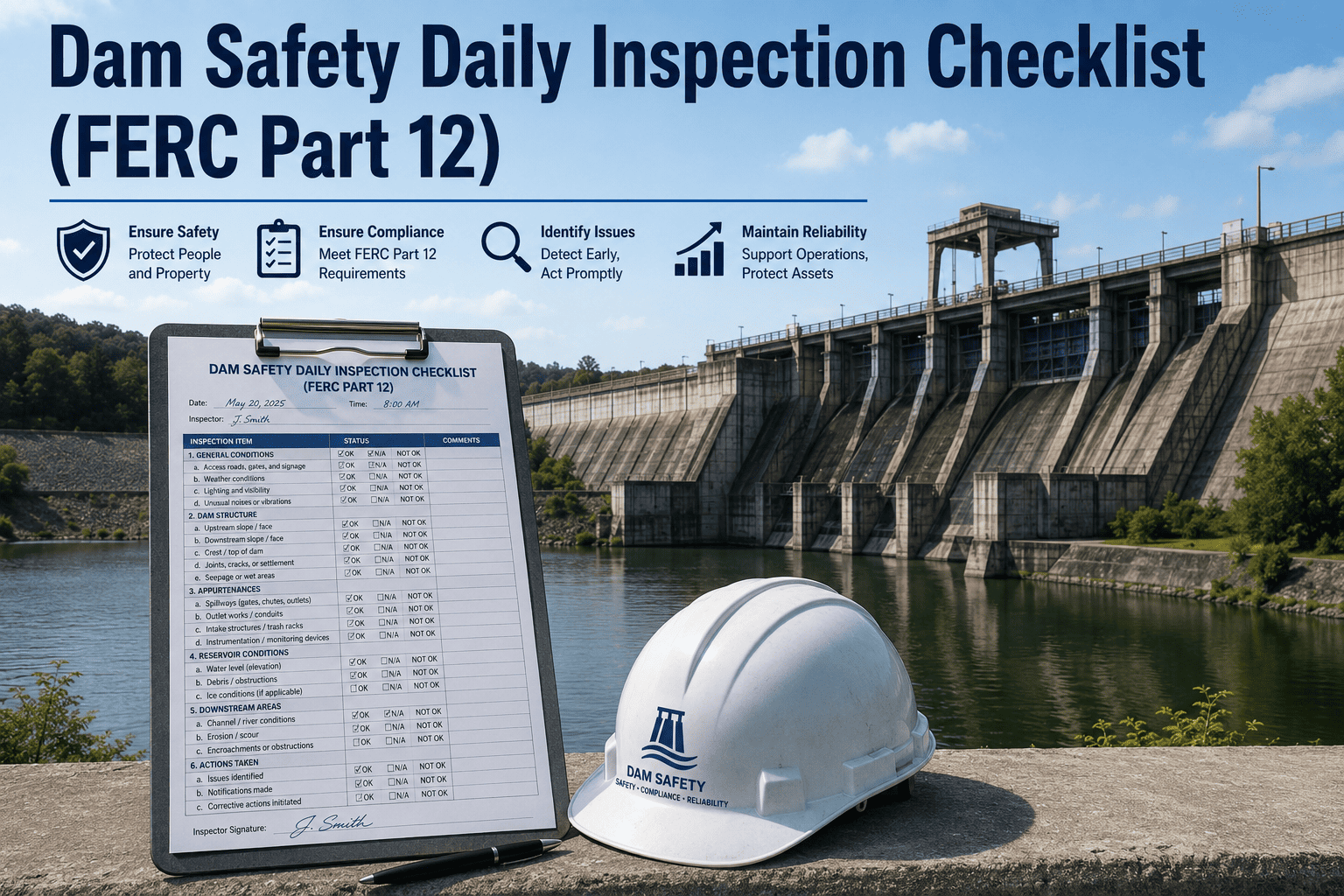
Free FERC Part 12 Dam Inspection Template — Seepage, Crack Measurement, Spillway, and Sign-Off Records
A field-ready inspection template covering every observation category required under FERC Part 12D — seepage measurement, crack mapping, spillway gate operability, embankment deformation, and instrumentation readings. Download the template, then see how OxMaint turns every completed inspection into a permanent, retrievable compliance record.
Dam Inspection Status — Project Overview
Spillway Gates
Operational
Embankment — Upstream Face
Monitor — Seepage
Instrumentation — Piezometers
Within Range
Downstream Toe — Drain Outlets
Action Required
Crest Survey — Reference Points
Within Tolerance
The Regulatory Context
What FERC Part 12 Actually Requires — And Where Inspection Programs Fall Short
Part 12D
Independent Consultant Inspection
Every FERC-licensed hydropower project must undergo an independent consultant inspection every 5 years under Part 12D. The IC reviews the physical condition of all project works — dam, spillway, powerhouse, water conveyance — and submits a formal report to FERC covering findings, safety evaluations, and recommended actions. Every observation in that report must be traceable to documented field inspection records.
Frequency: Every 5 years
Annual
Owner-Conducted Inspections
In the years between Part 12D IC inspections, the project owner is responsible for conducting annual inspections of all project works and retaining documented findings. FERC regional engineers review these records during compliance monitoring visits. Gaps in annual inspection records weaken the evidentiary foundation of the Part 12D cycle and may trigger closer FERC scrutiny of the project's safety program.
Frequency: Annual minimum
Event-Driven
Unusual Event Inspections
Floods, earthquakes, significant seepage changes, and other unusual events require prompt documented inspections regardless of the annual or 5-year cycle. FERC expects a written inspection record within days of a triggering event — including observations on all potentially affected project works, comparison to pre-event baseline readings, and a determination of whether escalated monitoring or remediation is warranted.
Frequency: Within days of trigger event
Template Structure
FERC Part 12 Dam Inspection Template — Six Observation Zones, Every Required Data Point
The template is organized by inspection zone matching the physical structure of a typical embankment dam project. Each zone includes the specific observation fields, measurement units, baseline comparison columns, and sign-off requirements that FERC Part 12 inspection reports reference.
05
Instrumentation Readings
06
Sign-Off and Follow-Up
Seepage Measurement Fields
Weir ID / monitoring point location
Text
Flow rate — current reading (gallons per minute or liters per second)
Numeric
Baseline / previous reading for comparison
Numeric
Change from baseline — percentage and direction
Calculated
Water clarity — clear / turbid / discolored
Select
Seepage location description and photo reference
Text + Photo
Action required — monitor / investigate / remediate
Select
Crack Mapping Fields
Crack ID and structure location (crest / upstream / downstream / abutment)
Text
Crack orientation — longitudinal / transverse / diagonal
Select
Width — current measurement (mm)
Numeric
Width — previous measurement and date
Numeric
Length — current and previous comparison
Numeric
Depth estimate and investigation method
Text
Photo references and crack map sketch attachment
Attachment
Spillway Inspection Fields
Spillway type — ungated / gated / fuse plug
Select
Gate operability test — date, result, operator
Date + Text
Chute and stilling basin condition — erosion, cracking, joint condition
Text
Trash rack condition and debris accumulation level
Select + Text
Bridge and access structure condition
Text
Energy dissipator condition and scour observation
Text
Overall rating — satisfactory / needs attention / unsatisfactory
Select
Embankment and Crest Survey Fields
Crest survey benchmark ID and elevation reading
Numeric
Settlement — comparison to baseline and previous reading
Numeric
Upstream slope condition — erosion, rutting, wave damage
Text
Downstream slope condition — sloughing, boils, saturation evidence
Text
Riprap condition and coverage adequacy
Select + Text
Vegetation — acceptable / encroachment noted / trees on slope
Select
Abutment contact condition — left / right bank observations
Text
Instrumentation Reading Fields
Piezometer ID and installation depth
Text
Current water level reading and date
Numeric
Reading vs. action level — within / approaching / exceeded
Select
Settlement monument readings — current vs. baseline
Numeric
Inclinometer readings — if applicable, comparison to installation baseline
Numeric
Instrument condition — functioning / requires maintenance / failed
Select
Reading trend — stable / gradual change / rapid change
Select
Sign-Off and Follow-Up Fields
Inspector name, title, and qualifications
Text
Inspection date, start time, and end time
Date + Time
Reservoir level at time of inspection
Numeric
Weather conditions during inspection
Text
Overall safety rating — no concerns / monitor / immediate action
Select
Follow-up actions required — description, responsible party, due date
Text + Date
Supervisor review sign-off and date
Signature + Date
OxMaint · FERC Part 12 · Dam Safety Records · Audit-Ready
Every Dam Inspection Record Should Be Retrievable in 60 Seconds. OxMaint Makes That Possible.
OxMaint centralizes all dam inspection records, seepage trends, crack measurement histories, and follow-up actions — linked to assets, timestamped, and exportable on demand. See the dam safety workflow in 30 minutes.
Why Trending Matters in Dam Safety
A Single Inspection Record Is Evidence. A Series of Records Is Early Warning.
Seepage Rate Trending
A 218% increase over 3 years — invisible without systematic annual records. Detected early, it is a monitoring decision. Detected at the Part 12D inspection, it becomes a finding requiring explanation.
Crack Width Trending — Downstream Toe
Stable crack growth — measurable but not accelerating. This conclusion is only defensible to FERC when four annual measurements exist with consistent methodology and dated sign-off. Without records, there is no stable trend — only uncertainty.
Paper vs. CMMS
Dam Inspection Record-Keeping — Before and After a Dedicated System
| Inspection Area |
Paper and PDF Records |
With OxMaint |
| Seepage Trend Analysis |
Manual extraction from annual reports — cross-referencing paper files across multiple inspection cycles to identify a trend takes hours and relies on consistent field recording formats across different inspectors |
All seepage readings stored per monitoring point — trend view shows every annual reading in sequence, automatically flagging deviation from baseline without manual comparison |
| Crack Measurement History |
Crack dimensions recorded on paper field sheets or PDF templates — comparison to previous year requires locating the matching prior-year form and reading across two documents |
Each crack record linked to its measurement history — current and previous readings displayed together with change calculation, enabling immediate progression assessment in the field |
| Follow-Up Action Tracking |
Action items noted in inspection narrative but not formally tracked — at the next inspection, there is no automated way to confirm whether previous items were resolved or remain open |
Every follow-up action generates a work order with a responsible party and due date — open actions remain visible until formally closed with evidence of completion |
| Part 12D Preparation |
Independent Consultant requests annual inspection records — team spends days locating, organizing, and copying paper and digital files spanning the previous 5-year inspection cycle |
Filter by project, date range, and inspection type — complete 5-year record package with all observation data and sign-offs exported in minutes for IC review |
| Unusual Event Response |
Post-flood inspection form filled in field — comparison to pre-event readings requires locating the most recent prior inspection form before the field team can characterize change |
Pre-event baseline readings available in OxMaint from any device — field team compares current observations to last recorded values in real time, documenting change on the same platform |
OxMaint · FERC Part 12 · Dam Safety · Free to Start
Your Next Part 12D Independent Consultant Visit Should Not Be a Records Scramble.
OxMaint stores every annual dam inspection record, seepage measurement, crack history, and follow-up action in one centralized, retrievable system. Five years of documented inspection history — organized, attributable, and ready for your IC in minutes. No IT project. No implementation delay.
Frequently Asked Questions
FERC Part 12 Dam Inspection Template — Common Questions
What inspection zones does the FERC Part 12 template cover?
The template covers six zones: seepage measurement (weir readings, clarity, location), crack mapping (width, length, orientation, progression), spillway inspection (gate operability, chute, trash rack), embankment survey (crest settlement, slope conditions, riprap, vegetation), instrumentation readings (piezometers, settlement monuments, inclinometers), and sign-off with follow-up action fields.
Set up your dam inspection workflow in OxMaint free.
How does OxMaint support the 5-year Part 12D Independent Consultant inspection cycle?
OxMaint retains every annual inspection record linked to the project and inspection zone. When a Part 12D IC review approaches, filtering by project and date range produces the complete 5-year inspection history — all observation data, seepage readings, crack measurements, and follow-up closures — in a single exportable package without manual document gathering.
See the record export workflow in a live demo.
Can OxMaint track seepage and crack measurement trends over multiple inspection cycles?
Yes. OxMaint stores each measurement against the monitoring point or crack record, enabling trend views that show progression across annual inspection cycles. Seepage rate changes and crack width growth are visible without manual cross-referencing of historical reports — giving engineering staff the data foundation to characterize condition trends for FERC submission.
Does the template apply to concrete gravity dams as well as embankment dams?
The template zones are structured around embankment dam inspection requirements but most fields apply directly to concrete gravity, arch, and buttress dams as well. Crack mapping, spillway inspection, instrumentation readings, and sign-off zones are universal. The embankment-specific fields (riprap, slope conditions) can be adapted to concrete surface condition observations for non-embankment structures.
Start free and configure your specific dam type in OxMaint.