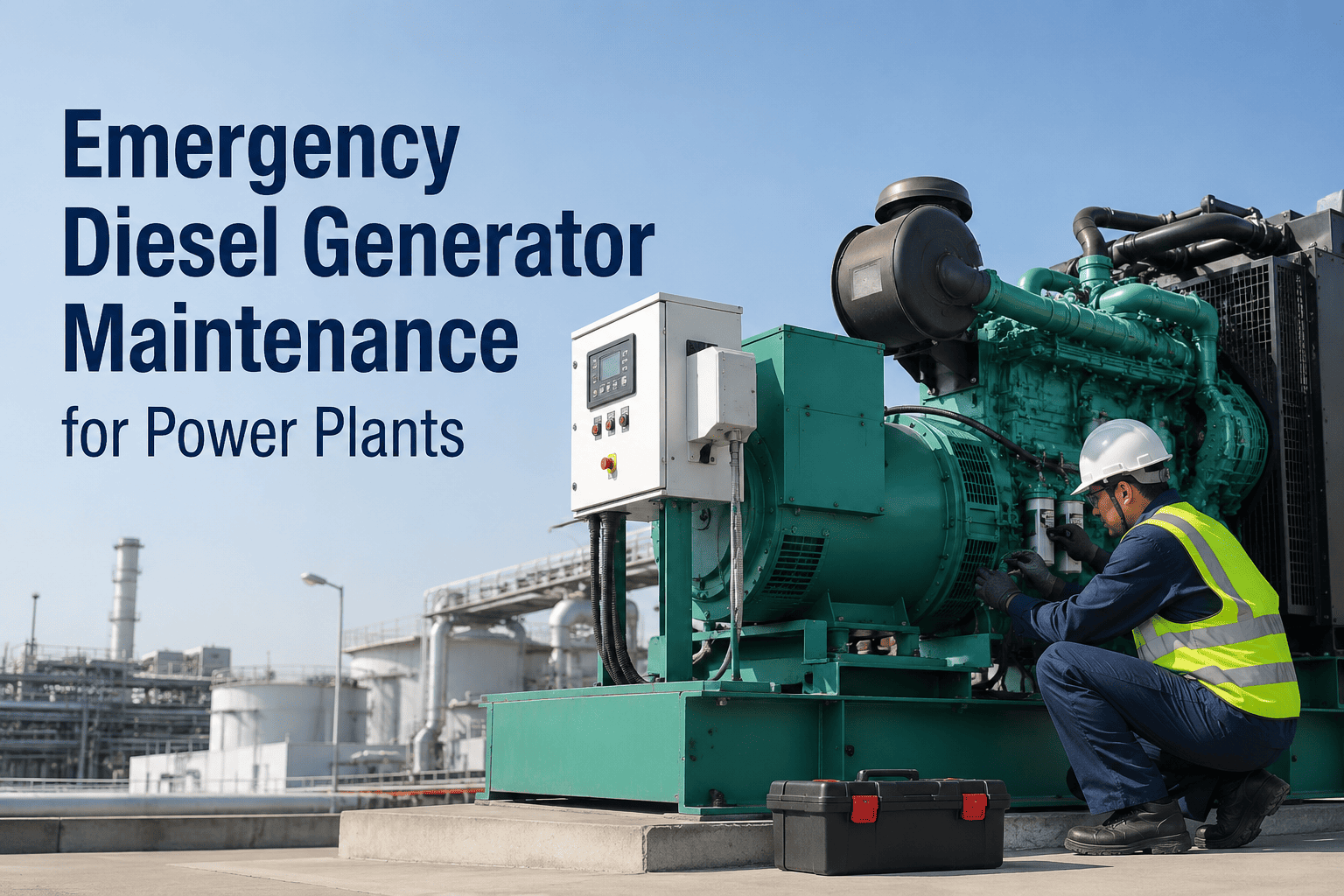
An emergency diesel generator that starts in a test but fails to hold load under real fault conditions is not a backup — it is a false sense of security. In thermal power plants, the EDG is the last line of defence for safety-critical systems: emergency cooling pumps, fire protection, control room power, and blackout recovery. A missed battery load test, degraded fuel quality, or an unchecked cooling system can render the EDG non-functional at the exact moment the plant needs it most. This checklist gives your electrical, mechanical, and safety teams a complete inspection framework covering battery condition, fuel management, load bank testing, cooling, alarms, and emergency readiness — structured so every check is traceable in your OxMaint compliance and preventive maintenance platform with a timestamped record available for regulatory review on demand.
Emergency Diesel Generator Maintenance Checklist for Power Plants
A complete EDG maintenance framework covering battery health, fuel quality, load bank testing, cooling system, engine alarms, and emergency readiness — for plants where the generator must start within 10 seconds and hold full load without hesitation.
Battery System & Starting Circuit
The battery is the only energy source between a de-energized plant and an EDG that starts. A battery that reads 24V on a voltmeter but cannot deliver 800–1200 A of cranking current for 30 seconds is not a working starting system — it is a discharged cell waiting to fail at the worst possible moment.
Fuel System & Quality Management
Diesel fuel stored for standby generator use degrades within 6–12 months. Water contamination, microbial growth, and oxidation products create injector-blocking sludge that causes the engine to start, run for 30 seconds, and then stall at exactly the moment it is needed for emergency load pickup.
Load Bank Testing & Generator Output
A diesel generator that has never been run at full load is not a tested generator — it is an untested assumption. Carbon buildup in lightly-loaded engines, governor hunting under step-load changes, and AVR instability only appear when the machine is actually stressed. Load bank testing is non-negotiable.
Regulators don't accept "we tested it last year." OxMaint timestamps every EDG test, captures load and voltage readings, and generates audit-ready reports that prove your emergency generator is ready — not just scheduled for a check.
Engine Cooling & Lubrication System
A diesel engine that trips on high coolant temperature 45 seconds into an emergency start has not failed mechanically — it has failed because no one verified the coolant heater was working, the radiator was clean, or the oil level was correct. Prevention takes 10 minutes; the consequence takes hours.
Alarms, Protection & Control Systems
An EDG with a bypassed low-oil-pressure trip or a silenced high-temperature alarm is not a protected machine — it is a machine that will run itself to destruction in the event of an actual fault. Every protection system must be tested independently and every alarm must trip the correct response.
Emergency Readiness & Compliance Records
Emergency readiness is not a state of mind — it is a documented condition. Regulatory inspectors, insurance auditors, and internal safety reviews all require evidence that the EDG has been tested, protected, and maintained according to a defined schedule. Missing records are treated the same as missing maintenance.
Five Metrics That Prove Your EDG Is Emergency-Ready
| Metric | How to Measure | Target | Frequency |
|---|---|---|---|
| Start Reliability | Successful starts / Total start attempts | 100% | Monthly |
| Load Acceptance | Time to rated voltage at 100% load step | Below 10 seconds | Quarterly |
| EDG Availability | Auto-ready hours / Total hours | Above 99% | Monthly |
| Battery Capacity | Discharge test: actual Ah vs rated Ah | Above 80% rated | Quarterly |
| PM Completion Rate | Completed PMs / Scheduled PMs | 100% | Weekly |
Frequently Asked Questions
How often must a power plant EDG be tested under load?
Monthly no-load test starts are a minimum standard; load bank testing at 50–100% rated capacity should be conducted quarterly. For safety-critical applications under AERB or CEA guidelines, an annual endurance run at full rated load for a minimum of 2 hours is required, with documented results. OxMaint auto-schedules all test intervals and generates the compliance evidence package.
What causes a diesel generator to fail to start in an emergency?
The three most common causes are a discharged or degraded battery that cannot deliver cranking current, contaminated or gelled fuel blocking the injectors, and a failed start relay or solenoid that prevents the signal from reaching the engine. All three are completely preventable with a structured weekly and monthly inspection regime. See how OxMaint prevents EDG start failures.
How long can diesel fuel be stored before it needs quality testing?
Diesel stored in a sealed, clean tank with inhibitor additives can remain usable for 6–12 months. Beyond 12 months, microbial growth and oxidation products create sludge that blocks filters and injectors. A fuel quality certificate from a certified laboratory is required before using stored fuel older than 12 months in a critical application.
What records do regulators require for EDG compliance in Indian power plants?
CEA and AERB inspectors typically require the last 12 months of test run logs, battery load test certificates, fuel quality records, protection relay test certificates, and the maintenance work order history. Records must be retained for a minimum of 5 years. OxMaint generates audit-ready EDG compliance packages on demand.
Why is engine pre-heating critical for EDG emergency readiness?
A cold diesel engine starting at ambient temperature (especially below 25°C) takes 60–90 seconds to reach operating oil pressure and combustion stability. Pre-heating the jacket water to 35–45°C via an immersion heater ensures the engine accepts full load within the required 10-second window and prevents thermal shock to liner and bearing surfaces during emergency loading.
Every Test Logged. Every Battery Trended. Every Emergency Covered.
OxMaint converts this checklist into scheduled mobile inspection rounds with test data capture, battery trend charts, and one-click compliance reports — so the next regulatory audit is a formality, not a scramble.