In March 2024, a 500 MW combined-cycle gas turbine plant in the southeastern United States was operating at 89% availability — 4 percentage points below the regional fleet average and 7 points below best-in-class CCGT facilities. Unplanned outages from gas turbine hot gas path degradation, HRSG tube failures, and steam turbine blade erosion were costing the facility $4.2M annually in lost generation revenue plus emergency maintenance expenses. The plant's existing CMMS tracked work orders and PM schedules but provided no predictive insight into component degradation — technicians discovered failures reactively through alarms or performance drops rather than proactively through condition monitoring. By May 2025, fourteen months after deploying OxMaint's predictive maintenance platform with gas turbine, HRSG, and steam turbine analytics, the facility reached 96% availability with zero unplanned GT outages, 78% reduction in HRSG forced outage hours, and 92% reduction in steam turbine emergency maintenance events. This case study documents the deployment methodology, predictive analytics implementation, and financial impact of transitioning from reactive to predictive maintenance in a large combined-cycle facility.
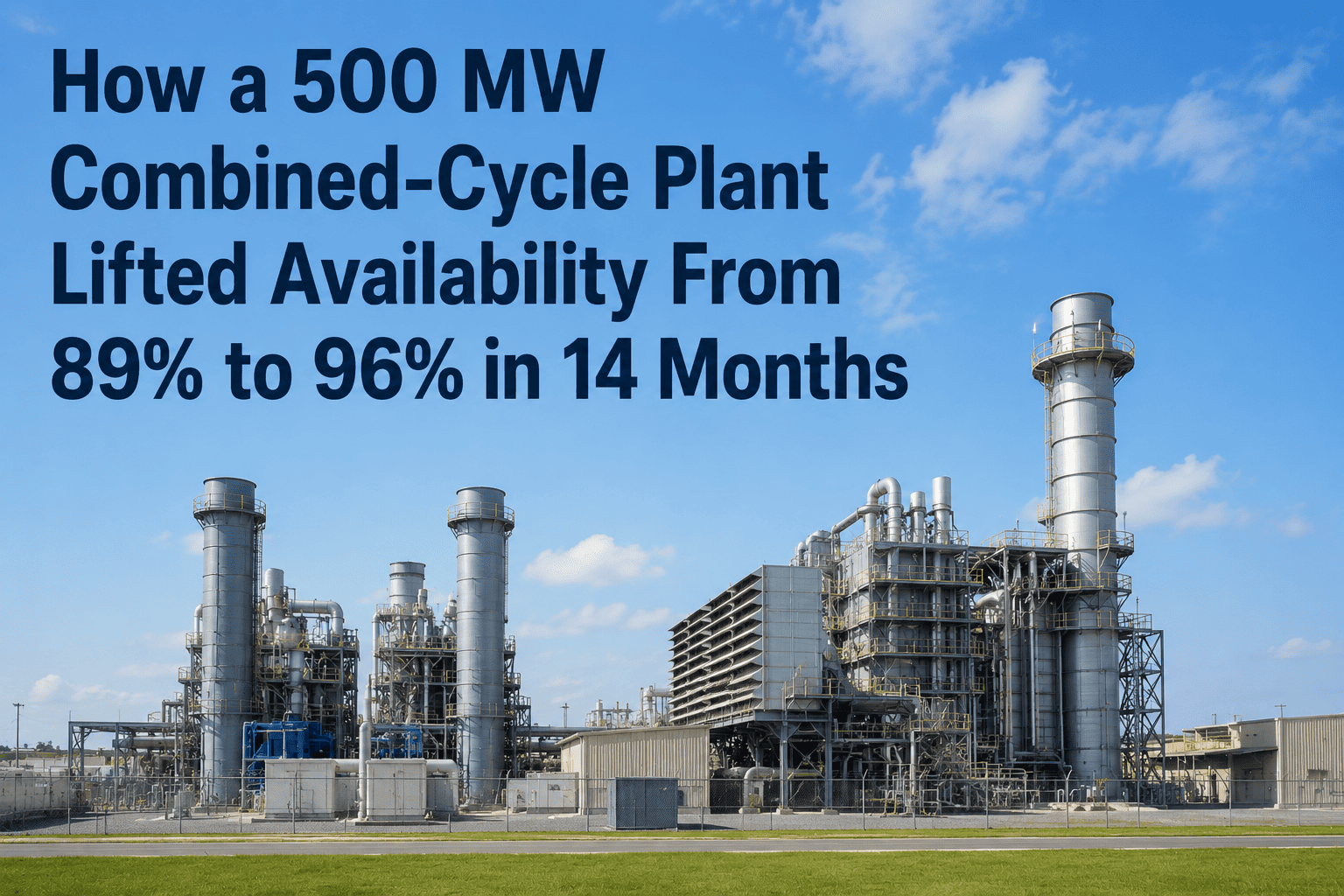
How a 500 MW Combined-Cycle Plant Lifted Availability From 89% to 96% in 14 Months
Detailed case study on deploying predictive maintenance at a 2x1 CCGT facility — documenting gas turbine hot gas path analytics, HRSG tube failure prediction, steam turbine blade monitoring, and the operational changes that eliminated $4.2M in annual unplanned outage costs.
Facility Profile and Baseline Challenges
The facility is a 2x1 combined-cycle configuration with two Frame 7FA gas turbines, two triple-pressure HRSGs with reheat, and one steam turbine generator. Commissioned in 2006, the plant operates in intermediate duty cycle with 180-220 starts per year and 5,500-6,200 operating hours annually. The baseline availability of 89% in March 2024 resulted from three primary failure modes: gas turbine hot gas path component degradation requiring unplanned outages every 8-10 months, HRSG superheater and reheater tube failures from flow-accelerated corrosion and thermal fatigue, and steam turbine blade erosion from moisture carryover and solid particle ingestion. The existing maintenance strategy relied on OEM-recommended inspection intervals and time-based PM — technicians had no condition monitoring data indicating when components were approaching failure thresholds.
Deployment Methodology — April to August 2024
OxMaint deployment occurred in three phases over five months. Phase 1 (April-May 2024) connected the platform to existing plant DCS and condition monitoring systems — gas turbine vibration sensors, HRSG tube temperature arrays, steam turbine bearing RTDs, and performance monitoring databases. Phase 2 (June-July 2024) established baseline condition signatures for each major component and configured predictive alert thresholds based on OEM failure mode data and the plant's historical maintenance records. Phase 3 (August 2024) activated automated work order generation and integrated predictive alerts into the daily operations and maintenance workflow. The entire deployment required no new sensors or hardware — OxMaint ingested data from existing plant instrumentation through standard OPC-UA and Modbus protocols.
Gas Turbine Predictive Analytics — Hot Gas Path Component Monitoring
Gas turbine hot gas path degradation was the primary contributor to unplanned outages in the baseline period — combustion liner cracking, transition piece wear, and first-stage turbine blade coating spallation typically forced unscheduled outages every 8-10 months when performance degradation exceeded dispatch limits or when combustion dynamics reached trip thresholds. OxMaint's gas turbine analytics module monitored exhaust temperature spread across turbine sections, combustion dynamics frequency content, and compressor discharge pressure trends to predict hot gas path component degradation 30-45 days before forced outage conditions developed. Between September 2024 and May 2025, the system generated 6 predictive alerts for GT hot gas path issues — all 6 were addressed during scheduled outage windows with zero resulting forced outages.
HRSG Predictive Analytics — Tube Failure Prevention
HRSG tube failures from flow-accelerated corrosion, thermal fatigue, and erosion-corrosion accounted for 34% of forced outage hours in the baseline period. Superheater and reheater tubes operating at 540-565°C are particularly vulnerable to creep damage and oxide scale exfoliation — failures typically manifest as pinhole leaks or ruptures that force immediate unit shutdown. OxMaint's HRSG monitoring module tracked tube metal temperature deviations, steam temperature distributions, and attemperator spray patterns to identify tubes experiencing abnormal thermal stress or flow distribution issues. The system flagged 4 tubes for inspection during planned outages — ultrasonic testing confirmed wall thickness below minimum thresholds in 3 of the 4 flagged tubes, all replaced before failure occurred.
Achieve Similar Results in Your CCGT Facility
OxMaint's predictive maintenance platform for combined-cycle plants provides gas turbine hot gas path analytics, HRSG tube monitoring, and steam turbine blade degradation tracking in a single system. Deploy in 4-5 months with no new sensors required — connects to existing plant DCS and condition monitoring systems.
Steam Turbine Predictive Analytics — Blade Erosion and Bearing Monitoring
Steam turbine maintenance in the baseline period was reactive — blade erosion from moisture carryover and solid particle ingestion was discovered during scheduled inspections or after efficiency degradation became operationally significant. OxMaint's steam turbine module tracked stage efficiency trends, bearing vibration signatures, and thrust bearing position to predict blade erosion progression and bearing degradation before operational impacts occurred. The system correctly predicted low-pressure turbine blade erosion requiring refurbishment 8 weeks before the scheduled inspection interval — allowing the facility to coordinate blade repair with a concurrent generator stator inspection rather than scheduling a separate outage.
Financial Impact and ROI Analysis
The 7 percentage point availability improvement from 89% to 96% generated $4.2M in annual value through avoided forced outage costs and increased generation revenue. This breaks down to $2.6M in avoided unplanned outage costs (emergency maintenance labor, expedited parts procurement, and extended outage durations) plus $1.6M in incremental generation revenue from the 613 additional operating hours at average $55/MWh margin. OxMaint platform costs totaled $240K over 14 months including deployment, training, and subscription — delivering a 17.5x first-year ROI before accounting for ongoing years of benefit.
Operational Changes and Cultural Adoption
The transition from reactive to predictive maintenance required operational process changes beyond the technology deployment. Daily operations meetings began including a predictive alert review — plant manager, operations supervisor, and maintenance planner evaluated each active alert for scheduling priority and resource requirements. Maintenance planning shifted from fixed calendar-based PM to condition-based scheduling — the fall 2024 major inspection was extended by 4 days to address 3 predictive alerts that would have otherwise required mid-cycle forced outages. Technician training focused on interpreting alert severity levels and understanding the component degradation mechanisms that each alert type indicated.
Frequently Asked Questions
Deploy Predictive Maintenance in Your Combined-Cycle Facility
OxMaint's CCGT predictive maintenance platform monitors gas turbine hot gas path components, HRSG tube arrays, and steam turbine blades to predict failures 30-45 days in advance. No new sensors required — connects to existing plant DCS and condition monitoring systems. Deploy in 4-5 months with training and support included. Free tier available to start deployment planning.