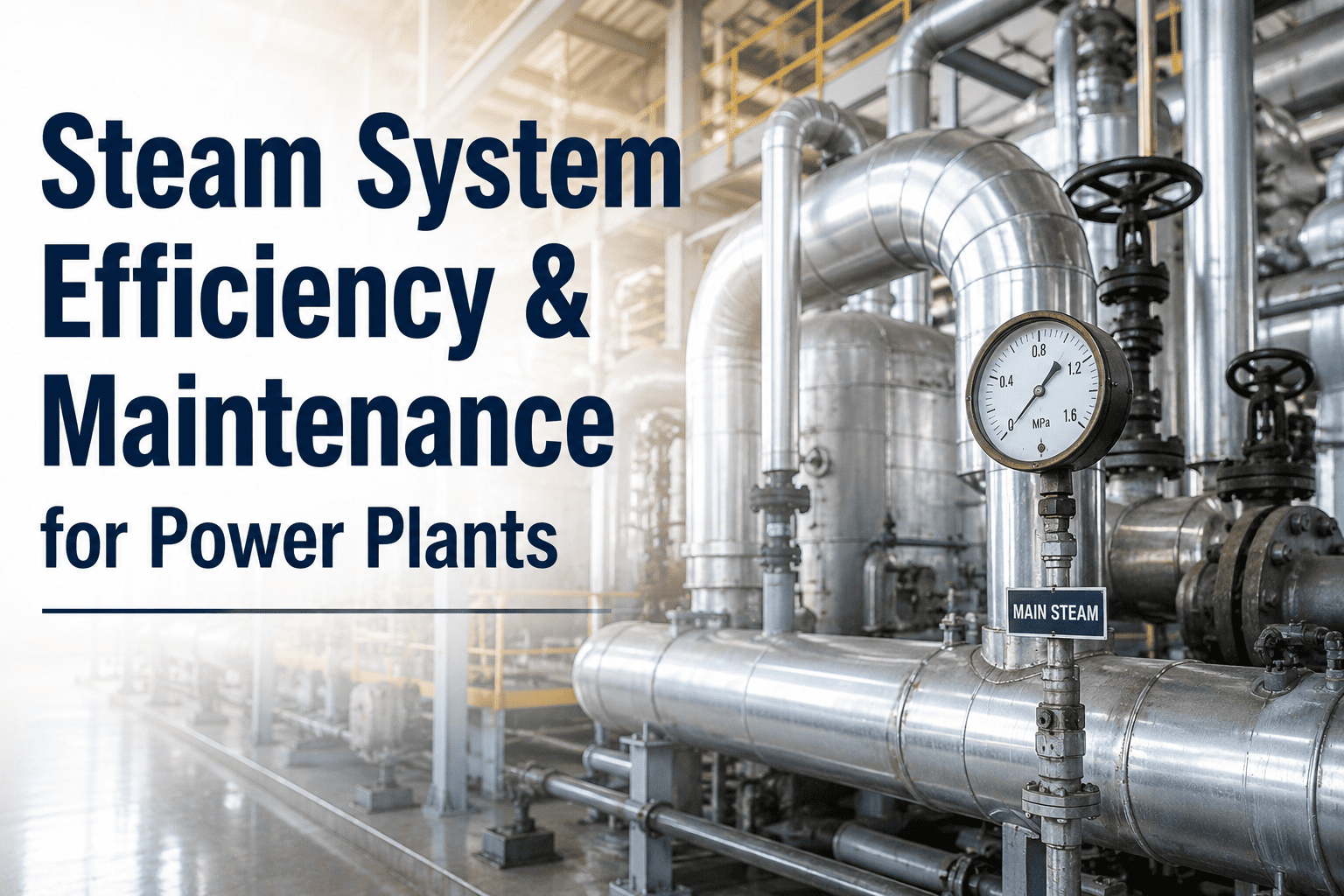
Electrical loss reduction through maintenance in power plants can recover 1.5–3% of total generated output—translating to millions in annual revenue for mid-sized facilities. Losses in transformers, busbars, power factor correction equipment, and cable connections accumulate silently through thermal degradation, loose contacts, and insulation breakdown. A CMMS-driven electrical maintenance efficiency program targets these loss points systematically, combining thermographic surveys, dissolved gas analysis, and scheduled contact tightening. Start your Start Free Trial to see how OxMaint's work-order automation and predictive analytics capture these losses before they hit your bottom line.
Stop losing megawatts through poor electrical maintenance
Power plants lose 2–4% of gross generation to preventable electrical losses—bad contacts, degraded transformers, and uncorrected power factor. OxMaint's AI-powered CMMS schedules the exact maintenance tasks that recover that energy, automatically.
Four sources of electrical loss in power plants—and their maintenance fix
A 500 MW plant operating at 60% capacity factor generates ~2.6 TWh annually. Even a 1% electrical loss reduction recovers 26 GWh—worth roughly $1.3M at $50/MWh. These four loss categories account for over 90% of preventable electrical waste.
No-load (core) and load (copper) losses rise as insulation ages, oil degrades, and cooling pathways block. DGA, oil filtration, and OLTC maintenance can recover 0.3–0.6% efficiency.
Loose busbar joints, corroded cable lugs, and degraded breaker contacts create thermal hotspots. A single 0.5 mΩ resistance rise on a 3 kA busbar wastes ~4 kW continuously—per joint.
Uncorrected power factor below 0.95 triggers utility penalties and increases I²R losses. Capacitor bank maintenance and automatic PF controller calibration typically pay back in under 6 months.
Degraded cable insulation, undersized conductors, and worn motor bearings increase resistance and heat. Thermographic inspection and bearing vibration analysis catch these losses early.
How transformer maintenance reduces core and copper losses
Transformers are the single largest contributor to electrical losses in a power plant. A 50 MVA unit with 0.6% total losses wastes ~300 kW continuously—about $130K/year at $50/MWh. Targeted maintenance recovers a meaningful slice of that.
| Maintenance task | Loss type addressed | Frequency | Efficiency recovery |
|---|---|---|---|
| Dissolved gas analysis (DGA) | Core & insulation degradation | Quarterly | 0.05–0.12% |
| Oil filtration & moisture removal | Dielectric loss, cooling efficiency | Annual | 0.08–0.15% |
| OLTC inspection & contact cleaning | Contact resistance in tap changer | 6–12 months | 0.03–0.08% |
| Radiator & cooling fan cleaning | Thermal load loss | Semi-annual | 0.05–0.10% |
| Bushing inspection & PD testing | Dielectric leakage | Annual | 0.02–0.06% |
A 180-asset plant recovering $42K/year in electrical losses
Power factor maintenance: the fastest-payback electrical fix
Power factor below 0.95 increases current draw for the same real power, multiplying I²R losses across every cable, transformer, and busbar. Capacitor bank degradation—swollen cans, blown fuses, detuned reactor faults—silently erodes PF correction capacity.
Capacitor bank health audit
Schedule quarterly capacitance measurement, visual swelling checks, and fuse continuity testing. A 10% capacitance drop in one step can pull plant PF from 0.96 to 0.92—triggering penalties.
Automatic PF controller calibration
Relay-based PF controllers drift over time. Annual CT calibration, setpoint verification, and step-sequence testing ensure the controller engages the right capacitor steps at the right time.
Harmonic & resonance survey
Detuned reactors and harmonic filters degrade. Annual THD measurement prevents resonance events that destroy capacitors and inflate losses. Target THD below 5% per IEEE 519.
Busbar maintenance checklist: stop the thermal leakage
Every bolted busbar joint, cable lug, and breaker contact is a resistance point. As contacts loosen from thermal cycling and vibration, resistance rises and heat compounds. A single hot joint at 90°C wastes 5–10× more energy than the same joint at 40°C.
- Scan all busbar joints, breaker terminals, and cable connections under 40%+ load
- Flag any joint exceeding 15°C above ambient or showing delta >10°C vs. similar joints
- Generate auto-work-order in OxMaint for every hotspot flagged
- Micro-ohmmeter measurement across breaker poles and busbar joints
- Compare to baseline—flag any joint >50 µΩ or 20% above original
- Clean, re-torque to manufacturer spec, re-test, and log in CMMS
- Annual torque verification on all bolted connections per NETA MTS-2019
- Replace corroded hardware, apply anti-oxidant compound on aluminum joints
- Track torque values over time in OxMaint asset history to spot drift trends
CMMS electrical loss reduction with OxMaint's AI-powered platform
OxMaint transforms electrical loss reduction from a reactive scramble into a data-driven PM program. Every thermographic scan, DGA result, and contact-resistance reading feeds predictive models that trigger work orders before losses compound.
Predictive thermographic work orders
Upload IR scan reports and OxMaint auto-generates priority work orders for every hotspot—assigned to the right technician with parts, torque specs, and safety procedures attached. Cut hotspot response time from 2 weeks to 48 hours.
Transformer DGA trending & alerts
Log every DGA sample against asset history. OxMaint's AI detects Rogers/Duval triangle shifts and predicts insulation failure 3–6 months ahead—scheduling oil filtration or replacement before efficiency collapses.
Automated power factor PM scheduling
Quarterly capacitor bank audits, PF controller calibrations, and harmonic surveys run on auto-generated PM cycles. OxMaint tracks PF readings over time and flags trending decay so you act before penalties hit.
Loss-recovery analytics dashboard
Track recovered kWh, avoided penalty costs, and loss-rate trends across every asset in one dashboard. Quantify ROI by asset class and justify maintenance spend with hard numbers—no more defending budgets with anecdotes.
See how OxMaint recovers megawatts on your assets
Book a 30-minute demo and we'll map your plant's top 5 electrical loss sources—and show you the CMMS workflows that recover them.
Electrical loss reduction in power plants — your questions answered
What are the main causes of electrical losses in a power plant?
The primary causes are transformer core and copper losses (0.8–1.5% of generation), resistive losses at busbar joints and breaker contacts (0.2–0.5%), uncorrected power factor penalties (0.3–1.0%), and cable/motor degradation (0.4–0.8%). Most are preventable through scheduled thermography, DGA, contact tightening, and capacitor bank maintenance managed in a CMMS.
How much can electrical loss reduction through maintenance save a power plant?
A structured maintenance program targeting transformer efficiency, busbar contacts, and power factor typically recovers 0.5–1.5% of gross generation. For a 500 MW plant at 60% capacity factor, that's 13–39 GWh/year—worth $650K–$2M annually at $50/MWh. Most plants see payback on CMMS investment within 3–6 months. Ready to quantify your savings? Book a Demo and we'll run the numbers on your assets.
How does a CMMS reduce electrical losses?
A CMMS like OxMaint schedules preventive maintenance tasks at the right interval—thermographic surveys, DGA sampling, busbar torque checks, capacitor bank audits—so no loss-generating degradation goes unaddressed. It also trends measurement data over time, auto-generates work orders from inspection findings, and provides analytics that quantify recovered energy. This replaces spreadsheet-based tracking where tasks slip and losses compound silently.
How often should transformer maintenance be performed for loss reduction?
DGA sampling should occur quarterly for critical transformers; oil quality testing and filtration annually; OLTC inspection every 6–12 months; radiator and cooling system cleaning semi-annually; bushing PD testing annually. OxMaint's PM engine auto-schedules these based on asset criticality, operating hours, and manufacturer specs—ensuring nothing drifts past its interval.
What power factor should a power plant maintain, and how?
Most utilities require PF above 0.95 to avoid penalties. Maintain it by scheduling quarterly capacitor bank health audits (capacitance measurement, fuse checks, visual inspection), annual PF controller calibration, and annual harmonic surveys per IEEE 519. A CMMS ensures these tasks recur on schedule and flags PF reading decay between cycles. Start your free trial at https://app.oxmaint.ai to automate PF maintenance today.
Recover 1–3% of your generation output starting now
Join power plants using OxMaint to turn electrical maintenance from a cost center into a megawatt recovery engine. AI-powered work orders, predictive analytics, and loss-tracking dashboards—live in days, not months.
Free 14-day trial · No credit card